






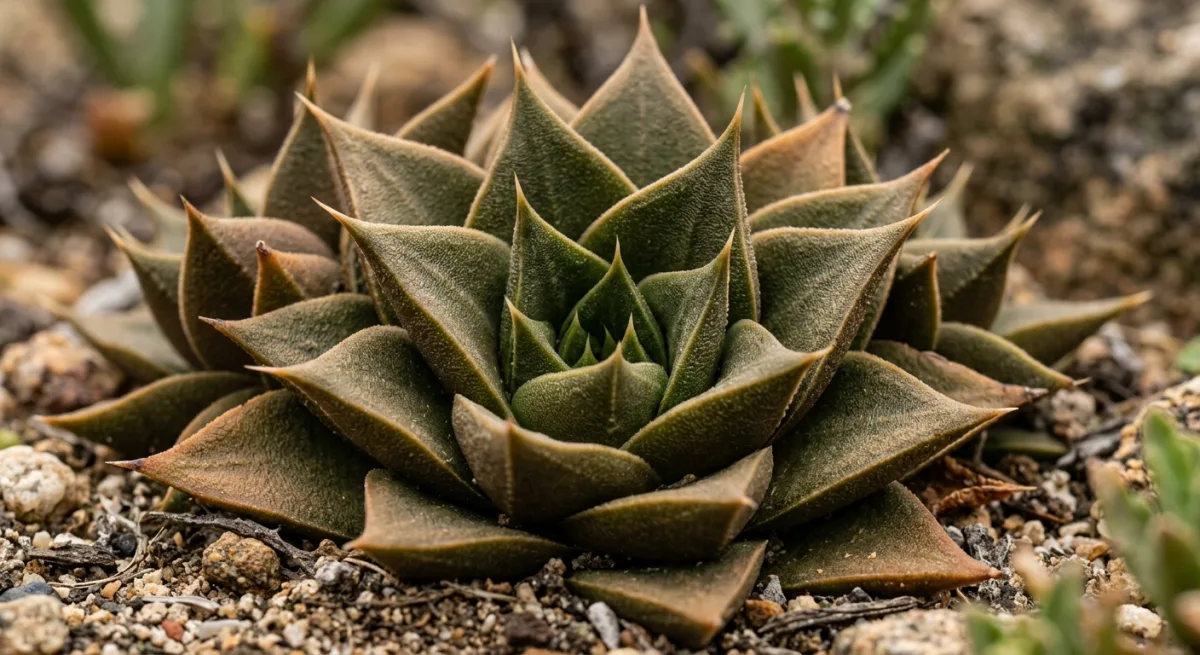
Tucked away in the Klein Karoo of South Africa, where a scorching sun bakes limestone ridges and weathered shale pavements, stand miniature living towers that seem sculpted by a master geometer. Astroloba herrei, frequently called the Spiral Tower Succulent, is one of the most dignified, noble, and elusive jewels of the Asphodelaceae family. A close cousin to Haworthia and Haworthiopsis, this extraordinary succulent stacks its leaves in an impeccably ordered five-ranked spiral (pentastichous arrangement), ascending toward the southern sky like an ancient, miniature fortress.
When growers first encounter this species, they are often awestruck by its rigid, almost porcelain-like foliage and strict architectural discipline. Yet cultivating Astroloba herrei in an indoor collection or greenhouse is far more than an aesthetic exercise; it demands an appreciation of physiological adaptations honed over millions of years. Frequent watering is never an expression of plant love—it merely deprives roots of oxygen and suffocates them. Once you master this core philosophy with Astroloba herrei, your reverence for nature's geometric response to extreme drought will grow exponentially.
1. Botanical Identity and Morphological Characteristics
Astroloba herrei honors Hans Herre, the legendary curator of the Stellenbosch University Botanical Garden and pioneering explorer of South African flora. The species is a caulescent (stem-forming) succulent that grows vertically and, over many years, produces basal offsets to form compact, sculptural colonies. In its wild habitat, vertical stems range between 15 and 25 cm in height, while stem diameter stays neatly between 4 and 6 cm thanks to its densely packed, clasping leaves.
The plant's most mesmerizing morphological feature is its phyllotaxy. Leaves spiral around the central axis to form five distinct vertical columns. Each leaf is deltoid-triangular, exceedingly succulent, firming to a rigid texture toward the tip, and terminating in a sharp, prominent apiculus (pointed tip). The leaf epidermal surface is matte, displaying shades from deep olive green to glaucous bluish-green. Under intense, unfiltered sunlight, these hues give way to protective bronze, mahogany, and purplish stress pigments (anthocyanins). The abaxial (under) surface carries pronounced keels and occasional microscopic raised tubercles. Its water-storing parenchyma tissue is dense and compact, allowing the plant to sustain its cellular metabolism through months of blistering rainlessness purely on internal reserves.
In its native range, blooming typically occurs in late summer or autumn. From the stem apex emerges an unbranched, slender inflorescence (a simple raceme) bearing small, tubular, cream-white to greenish flowers with slight radial asymmetry. Rich in nectar, these blooms are pollinated in nature by solitary bees and specialized flies.
2. Light Requirements and Indoor Positioning
Astroloba herrei thrives on abundant light, yet its relationship with blazing midday UV radiation is nuanced. In the wild, it often shelters beneath low karroid shrubs (Karoo fynbos) or wedges into north- and east-facing rocky fissures. When grown indoors, on a balcony, or in a greenhouse, it prefers bright direct light during the early morning or late afternoon, paired with bright, dappled protection or a sheer curtain during peak summer hours (11:00 AM to 4:00 PM).
In low-light settings, the plant quickly loses its prized architecture. This phenomenon, known as etiolation, causes internodal spacing to stretch, distorts the crisp spiral symmetry, turns the foliage a weak pale green, and leaves the stem limp and vulnerable. An east- or west-facing windowsill provides exceptional conditions indoors. If placing it near a south-facing window, set it back 30 to 50 cm to prevent heat scorch (irreversible bleached or corky brown lesions). During dark winter months, supplementing with full-spectrum LED grow lights for 10 to 12 hours daily keeps the geometric columns tight and sturdy.
3. Watering Discipline: The 'Soak and Dry' Protocol
Untimely and excessive watering remains the primary reason collectors lose Astroloba specimens. Like many arid xerophytes, these plants utilize Crassulacean Acid Metabolism (CAM) respiration. To prevent catastrophic water loss, they seal their stomata tightly during daylight hours, opening them only under the cool cover of night to absorb carbon dioxide. Constant root zone moisture denies root cells oxygen, causing cellular asphyxiation and opening the door to devastating anaerobic soil-borne fungi such as Fusarium and Rhizoctonia.
The fundamental rule of cultivation is simple: Never apply water until the potting substrate has dried through its entire depth. When you do water, soak the pot thoroughly until water flows freely through the drainage holes (the soak method). Empty the drip saucer within 10 minutes; never let the pot sit in pooled moisture. Before the next irrigation, verify that the substrate has dried completely down to the bottom tier (the dry method). Check deep moisture by inserting a wooden skewer or by gauging the weight of the pot by hand.
Aligning with seasonal rhythms is equally essential. Astroloba herrei undergoes active vegetative growth during the milder transitions of spring and autumn. During extreme midsummer heat (exceeding 32°C / 90°F) and the chill of winter (below 10°C / 50°F), the plant enters semi-dormancy. During these resting phases, scale back watering to a light substrate drenching once every month or two, purely to keep fine root hairs from desiccation.
4. Ideal Soil Formulation and Pot Selection
The root system of Astroloba herrei consists of thick, fleshy, fragile storage roots. These specialized subterranean organs crave ambient oxygen, porosity, and instantaneous drainage far more than rich organic matter. Peat-heavy or standard bagged potting soils are hazardous for this species; they retain water like a sponge and inevitably rot root tissues.
Your potting mix should contain at least 75% to 80% inorganic, porous mineral aggregates by volume. Aim for a graded particle size between 2 and 5 mm. Pumice offers pore structure and holds air; porous volcanic lava rock provides trace minerals and mechanical ballast; zeolite binds excess mineral salts while buffering the rhizosphere within an optimal neutral to mildly alkaline zone (pH 6.5–7.5).
| Substrate Component | Ratio (%) | Botanical Function & Benefit |
|---|---|---|
| Horticultural Pumice (2–4 mm) | 40% | Provides continuous micro-channels for root gas exchange and sharp drainage |
| Crushed Lava Rock (Red/Black 3 mm) | 25% | Delivers essential trace elements, structural weight, and stability |
| Clinoptilolite Zeolite (2–4 mm) | 15% | High cation-exchange capacity, nutrient buffer, and pathogen suppression |
| Coarse Quartz Grit / River Sand | 10% | Prevents substrate compaction and provides anchorage for roots |
| Coir / Decomposed Leaf Mold | 10% | Minimal organic baseline to support beneficial mycorrhizal fungal activity |
Container choice plays a defining role in plant longevity. Unfinished, porous terracotta pots reign supreme, allowing excess moisture to evaporate evenly through the clay walls. Plastic and glazed ceramic vessels trap moisture inside, demanding heightened vigilance with watering intervals. Additionally, because Astroloba herrei develops deep, anchor-like taproot structures, choose tall, narrow succulent pots over shallow pans to accommodate vertical root expansion.
5. Step-by-Step Propagation Techniques
Propagating Astroloba herrei requires genuine patience. Its cellular division rate is markedly slower than that of common echeverias or crassulas. The two proven botanical propagation avenues are separating basal offsets and taking stem tip cuttings (beheading). While single leaf propagation is theoretically possible in some Asphodelaceae, detached Astroloba leaves lacking substantial stem meristem tissue have a survival and shoot-generation rate below 5%; it is not recommended.
Method 1: Basal Offset Division
- Timing: Perform divisions at the onset of active growth in early spring.
- Separation: Unpot the parent plant gently. Brush loose substrate away to expose the junction where offsets connect to the main stem. Select a pup that is at least 4 to 5 cm tall and has begun initiating its own independent root system. Sever it cleanly at the connection point using a sterilized scalpel.
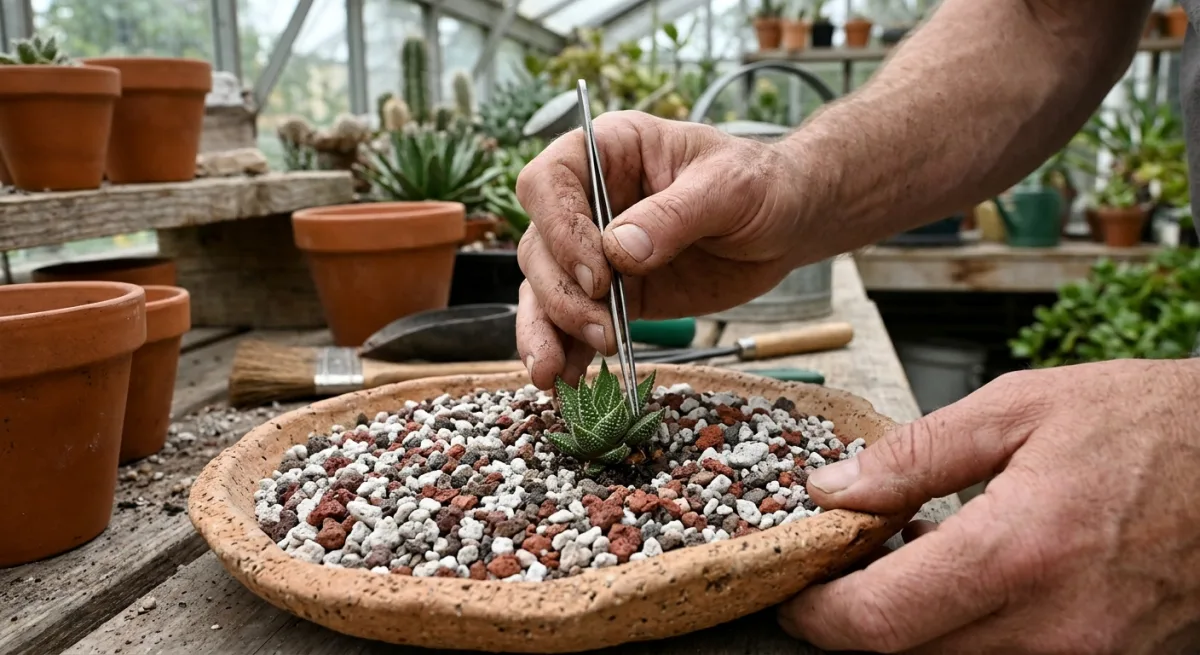
- Callusing: Dust the exposed cut surface with sulfur powder or activated charcoal. Do not pot the offset immediately. Place it in a shaded, warm, dry area with good ventilation for 4 to 7 days until a protective, pale, corky callus seals the wound.
- Potting: Plant the callused pup into the dry mineral mix detailed above. Withhold all water for the first 7 to 10 days to let microscopic root tears heal. Afterward, begin light bottom-watering to stimulate exploratory root growth.
Method 2: Apical Stem Cuttings (Beheading)
If an older specimen has lost its lower foliage, become leggy, or suffered localized base damage, taking a top cutting rejuvenates the plant. Using a sterile, razor-sharp blade, sever the healthy top rosette, retaining at least 5 to 6 cm of foliage-bearing stem. If the rooted base is left in its pot, its dormant nodes will sprout several new offsets over the coming months. Allow the severed crown cutting to callus in dry shade for one full week, then seat it atop a dry bed of pumice and zeolite. Within 4 to 6 weeks, adventitious root tips will emerge into the gravel bed.
6. Common Pests, Diseases, and Treatments
Thanks to a dense, cuticular wax layer, Astroloba herrei resists pests better than thin-leaved succulents. Nevertheless, indoor and greenhouse environments present specific vulnerabilities:
- Mealybugs (Pseudococcidae): The most persistent pest of this species. They tuck themselves deep into the crevices of the tight spiral foliage and around the basal stem line, secreting cottony protective wax. For minor issues, eliminate them individually using a fine brush dipped in 70% isopropyl alcohol. For extensive infestations, apply neem oil emulsions or a systemic insecticide formulated with acetamiprid.
- Root Mealybugs (Rhizoecus spp.): These subterranean pests attack root surfaces, forming powdery white deposits and disrupting water transport. If a plant shows dehydration despite regular watering, unpot and inspect the root ball. Wash away all soil, immerse roots briefly in an insecticidal or alcohol solution, let dry, and repot into fresh mineral substrate.
- Basal Stem & Root Rot (Fusarium oxysporum / Pythium spp.): Triggered by prolonged soil saturation coupled with low temperatures. Symptoms include a black, soft stem base and leaves that detach at the slightest brush. Unpot immediately, excise all blackened tissue back to clean, healthy green vascular bundles with a sterile blade, and re-root the remaining crown as an apical cutting.
7. Seasonal Care Calendar & Expert Horticultural Tips
Replicating the seasonal rhythm of the semi-arid Karoo plateau unlocks steady, healthy growth. Here is your year-round care framework:
- Spring (March – May): Vegetative growth resumes. Increase watering frequency as the substrate dries out completely. In mid-spring, apply a balanced, low-nitrogen, high-potassium liquid fertilizer (such as NPK 5-10-15) diluted to one-quarter strength. This is the optimal window for repotting and offset division.
- Summer (June – August): During periods of sustained high heat, the plant slows down and enters semi-dormancy. Space out waterings and suspend all fertilization. Air circulation is paramount—keep the plant away from stagnant, humid heat pockets, using gentle fans or open window breezes where possible.
- Autumn (September – November): The second peak growth window arrives. Flower spikes often emerge during this phase. Water thoroughly whenever the substrate dries completely. A final application of dilute potassium-rich feed prepares the plant for winter rest.
- Winter (December – February): Full dormancy. Maintain cool conditions around 8°C to 12°C (46°F–54°F) to support a restful winter pause. Withhold water almost completely, offering only a small sip if the spiral foliage shows deep shrinkage wrinkles. Protect strictly from freezing temperatures; anything below 0°C (32°F) can cause fatal cell wall collapse.


Reader Reviews & Comments 3 Reviews
Julian Vance
Claire Thornton
Marcus Sterling
Leave a Review & Rating
Share your plant care tips, experiences, or questions with our succulent community.