






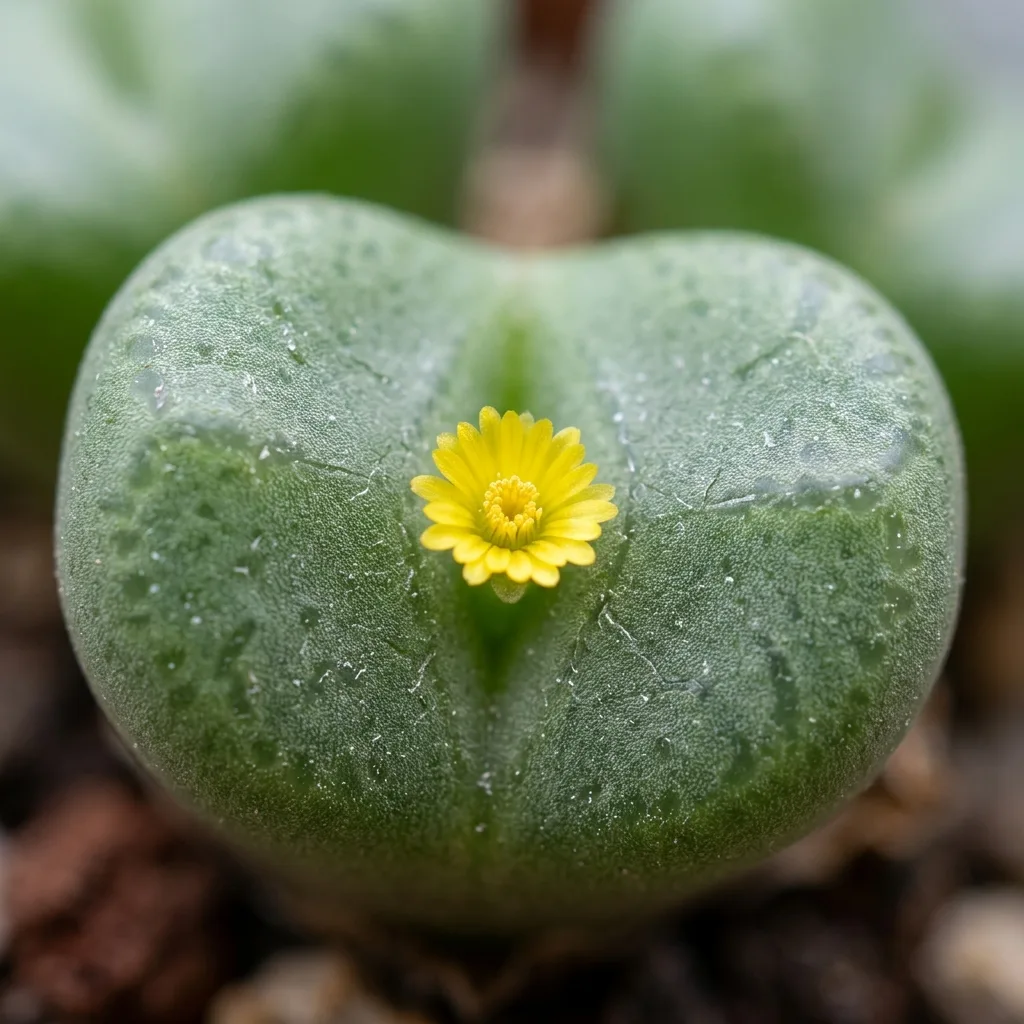
Across the fog-swept, arid plains of the Succulent Karoo and Namaqualand in South Africa and southern Namibia, nature hides tiny, almost invisible living sculptures nestled among white quartz pebbles: the genus Conophytum. Frequently confused with Lithops by casual succulent enthusiasts, these extraordinary organisms represent one of botanical evolution's ultimate masterpieces in water conservation. Resembling diminutive buttons or cleft pebbles, their bodies are actually composed of a single pair of fleshy, fully fused leaves. To endure the blistering desert sun and merciless droughts, these leaves have minimized their surface area to the absolute extreme, drawing their volume-to-surface ratio close to a perfect geometric sphere.
Cultivating Conophytum on a bright windowsill or in a greenhouse is not a standard routine of watering an ordinary potted houseplant; it is an intimate front-row seat to one of the plant kingdom's most captivating metamorphoses. Throughout the scorching summer months, your plant will desiccate into what appears to be a lifeless, paper-dry husk. Yet, with the first crisp breeze of early autumn, plump, jade-green leaves and jewel-toned, silky blossoms rupture through that protective membrane. This rhythm is not accidental—it is governed at the cellular level by an impeccably calibrated biochemical clock.
The most fatal pitfall for growers is panicking at the sight of these dried summer husks and attempting a rescue watering. Remember: excessive watering is never an expression of love; it deprives the root system of vital oxygen and suffocates the plant from below. In the miniature world of Conophytum, patient restraint is just as vital a nutrient as a perfectly porous mineral substrate. Let us explore the internal anatomy of these delicate living stones and establish a scientifically grounded cultivation protocol designed to keep them thriving for generations.
1. Botanical Biology and Physiological Foundations
The genus Conophytum belongs to the family Aizoaceae (commonly known as ice plants or mesembs) and consists of obligate winter-growing xerophytic succulents. Their survival strategy hinges on a phenology inverted relative to standard northern hemisphere flora. In their indigenous habitats, winters are cool, misty, and accompanied by sporadic showers, while summers present scorching temperatures and absolute, rainless drought. This intense evolutionary pressure equipped Conophytum with two primary cellular adaptations: Crassulacean Acid Metabolism (CAM) and Cellular Resorption with Protective Sheathing (Tunic Formation).
To prevent transpirational water loss during dry daytime hours, Conophytum keeps its stomata sealed tight. Under the cover of night, it opens its microscopic pores to assimilate carbon dioxide, sequestering it as malic acid within its vacuoles before completing photosynthesis during the day using stored solar energy. However, the most striking physiological event occurs in late spring. As ambient temperatures climb and photoperiods lengthen, the plant initiates a controlled internal resorption: it retrieves stored water and mobile nutrients from the outer leaf pair, channeling them into the developing embryonic leaves within. The depleted outer leaves gradually desiccate, forming a paper-thin, parchment-like sheath (tunic). This desiccated husk acts as an insulative shield against ultraviolet radiation and thermal shock; together with the epicuticular wax (farina) dusting the epidermis, it provides the plant with its own biologically synthesized sunscreen.
Beneath the soil line, Conophytum exhibits a remarkably shallow, fibrous root network rather than a taproot. Designed to instantly absorb condensation from ocean fogs and morning dew, these fine xylem vessels are exceptionally vulnerable to hypoxia. When soil remains waterlogged, the absence of pore space invites rapid colonization by anaerobic fungi and oomycetes, particularly Fusarium and Pythium species. Consequently, high macro-porosity and rapid gas diffusion throughout the root zone are the definitive prerequisites for long-term survival.
2. Diagnostic Signals and Cellular Needs
Interpreting the subtle morphological cues of Conophytum bridges the gap between vibrant longevity and catastrophic rot. Here is how to decipher your plant's cellular SOS signals:
- Turgor Loss and Lateral Wrinkles (Healthy Thirst): During the active vegetative season (autumn through early winter), vertical striations along the lateral walls of the fused leaves signal that internal cellular vacuoles are depleted. This is a healthy, natural indicator that an irrigation cycle is required.
- Summer Desiccation (Normal Estivation): From May to June, as outer leaves turn pale straw-yellow, turn papery, and shrink inward, do not fear decline—this is the onset of dormancy. As long as you can detect a firm, plump core beneath the papery skin, the plant is behaving completely normally.
- Translucency and Gel-Like Softening (Root & Stem Rot): If the base of the leaf body turns glassy, yellowish-brown, or takes on a watery, gelatinous consistency, root hypoxia has ruptured cell membranes, allowing opportunistic pathogens to liquefy the parenchymal tissues. This is a life-threatening emergency requiring prompt intervention.
- Etiolation (Light Starvation / Elongation): When bodies that should remain flattened, button-like domes begin stretching into elongated cylinders, the plant is desperately seeking light. This cellular stretching dilutes chloroplast density, thins the defensive cuticle, and leaves the plant structurally compromised and vulnerable to pests.
3. Step-by-Step Cultivation Protocol
Follow this precise step-by-step protocol to root, manage the sheathing phase, and expand your Conophytum into multi-headed heirloom clusters:
- Container Selection and Drainage Setup: Due to their shallow, fibrous root systems, opt for shallow terracotta pots approximately 6–8 cm (2.5–3 inches) deep with ample drainage holes. Line the base of the pot with a 1 cm layer of coarse, dust-free pumice to prevent drainage holes from clogging.
- Substrate Formulation: Organic content should strictly remain at or below 15% by volume. The optimal blend consists of: 2 parts horticultural pumice (2–4 mm), 2 parts porous lava rock (1–3 mm), 1 part zeolite, and only 1 part sieved, low-tannin coconut coir or screened mineral succulent soil. Avoid fine sand, as it compacts into a concrete-like matrix and suffocates delicate root hairs.
- The Awakening Soak (Early Autumn): In early autumn, when night temperatures reliably fall into the 12–15°C (54–59°F) range, gently mist the dry husks in the evening to break root dormancy. Follow up with a thorough bottom-watering 4 to 5 days later. Water should percolate instantly through the mineral matrix; within days, the softened papery sheaths will burst, revealing vibrant green leaf heads.
- Light Exposure: During the active winter cycle (October through March), position plants on a south- or west-facing sill where they can absorb at least 4 to 6 hours of direct, unfiltered sunshine. Insufficient light degrades their compact growth habit and aborts flower bud initiation.
- Transitioning into Estivation (Late Spring): Starting in mid-April, as leaves lose their gloss and wrinkle near the base, double the interval between waterings. By May, when the leaves visibly yellow into papery sheaths, CEASE WATERING ENTIRELY. Move the pots to a well-ventilated, bright position shielded from harsh midday sun.
4. Essential Specifications, Equipment, and Parameters
Cultivating Conophytum successfully demands millimeter-level precision regarding substrate particle size and seasonal atmospheric conditions. The following reference chart details the optimal parameters for a stable cultivation environment:
| Component / Parameter | Standard Value / Target Metric | Physiological & Cellular Function |
|---|---|---|
| Inorganic Mineral Base | 80% – 85% (Pumice, Zeolite, Crushed Lava) | Maintains macro-porosity and oxygen diffusion; eliminates moisture stagnancy. |
| Organic Fraction | 15% Maximum (Sieved Coconut Coir) | Retains minimal moisture while providing anchor sites for fine root hairs. |
| Granulometry (Grain Size) | 1 mm – 4 mm, dust-screened | Prevents compaction around the root collar, fostering rapid gas exchange. |
| Container Material & Depth | Unground, unglazed terracotta (6–8 cm) | Permits lateral moisture evaporation through clay walls, keeping root zones cool. |
| Summer Dormancy Temp | 24°C – 32°C (75°F – 90°F) with strong air movement | Slows metabolic rate to survival levels; safeguards internal water reserves. |
| Active Growth Temp | Day: 18°C – 22°C (64°F – 72°F) / Night: 10°C – 14°C (50°F – 57°F) | The thermal diurnal drop stimulates CAM malic acid cycling and bud initiation. |
| Fertilization Regimen | Once annually (October) at 1/4 strength, low nitrogen | Excess nitrogen weakens epidermal cells and ruptures leaves; trace minerals suffice. |
5. Five Common Cultivation Mistakes and Recovery Protocols
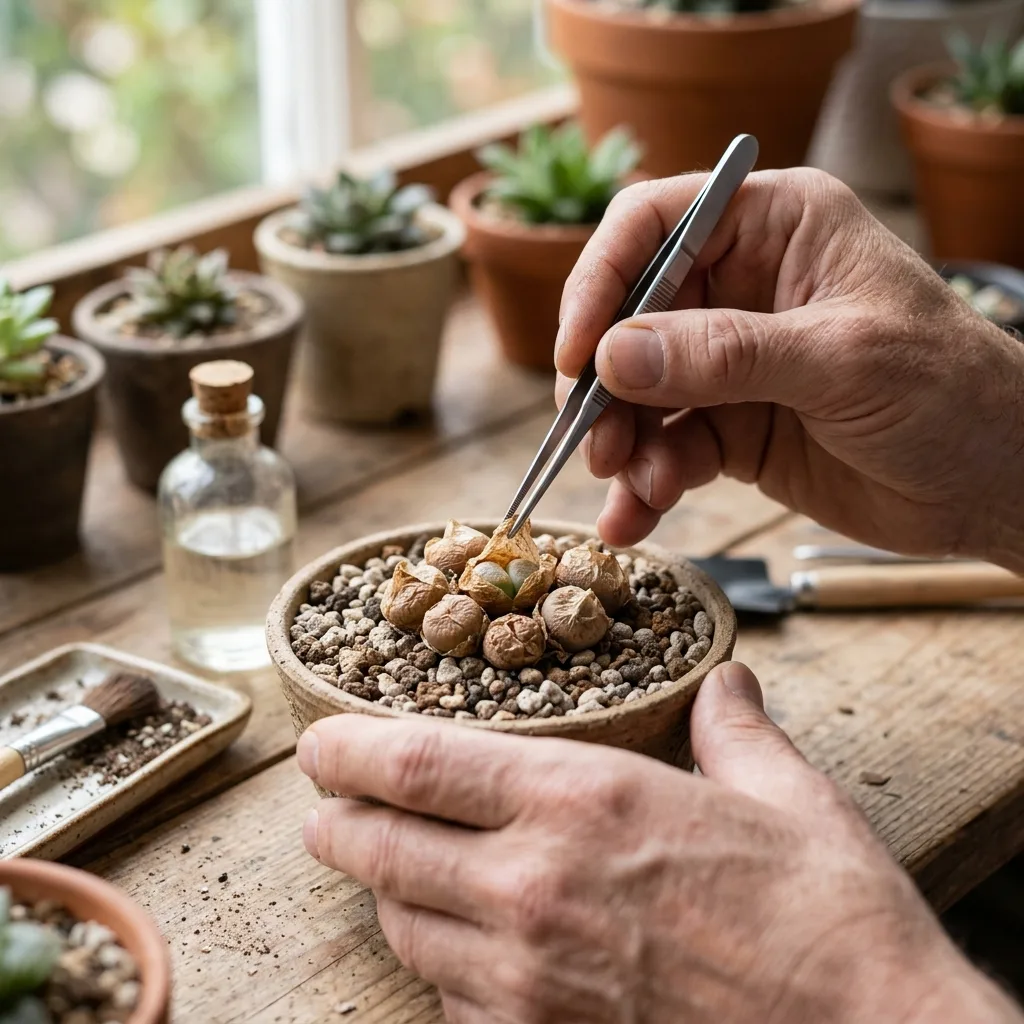
- Mistake 1: Peeling the Desiccated Sheath for Aesthetics. Stripping away the dry brown husk damages the fragile epidermal layers of the juvenile body beneath and leaves it instantly vulnerable to sunburn. Recovery: Immediately move the plant into bright shade. Lightly dust exposed tissue with sulfur powder to prevent fungal entry, allowing the damaged cells to callous naturally.
- Mistake 2: Rescue Watering in Midsummer. Mistaking the summer tunic for a dying, desiccated plant and soaking the pot in July heat will cook the inactive root hairs and trigger total liquefaction. Recovery: If accidentally saturated, unpot the plant immediately. Dry the bare roots on paper towels in a shaded, well-ventilated space for 48 hours, replant into completely dry mineral mix, and withhold moisture until autumn.
- Mistake 3: Planting in Rich Commercial Peat Soils. Peat-heavy potting mixes stay damp for weeks and harden upon drying, strangling fine feeder roots. Recovery: Submerge the root ball in lukewarm water to gently rinse away all peat residue. Let the bare roots dry for 24 hours in the shade, then repot into an 85% inorganic substrate.
- Mistake 4: Overwintering in Warm, Dim Rooms Near Radiators. Keeping Conophytum in dark rooms with elevated temperatures forces weak, stretched growth (etiolation). Recovery: Transition the plant to a cooler (approx. 12–15°C / 54–59°F), brightly illuminated window. While stretched tissue cannot shrink, new leaves emerging in the next cycle will return to their naturally compressed, button-like habit.
- Mistake 5: Over-Fertilization (Nitrogen Rupture). Applying conventional, nitrogen-heavy houseplant fertilizers causes rapid vacuolar swelling, splitting the leaf epidermis longitudinally. Recovery: Cease feeding immediately. Keep the fissures completely dry to encourage a clean scar, which will be shed naturally during the following spring's sheathing process.
6. Seasonal Calendar and Long-Term Results
When aligned with their evolutionary clock, Conophytum specimens can thrive for decades, dividing each year from solitary buttons into dense, mounding cushions. Use this seasonal calendar as your operational compass:
- Autumn (September – November): Awakening, Growth, and Blooming. Water resumes. Bodies plump up and produce jewel-like, silk-textured flowers in vibrant yellow, white, orange, or magenta. Water deeply every 10 to 14 days, only when the substrate has thoroughly dried out.
- Winter (December – February): Vegetative Development. CAM photosynthesis runs at peak efficiency. Maximize direct sunlight and maintain cool night temperatures. Taper irrigation to once every 3 to 4 weeks, watering strictly on sunny mornings.
- Spring (March – May): Translocation and Resorption. Outer leaves lose their turgidity and wrinkle. Cease watering progressively throughout April. The inner leaf pair resorbs all moisture and nutrients from the outer shell. Keep dry!
- Summer (June – August): Deep Estivation (Summer Sleep). Fully dormant beneath paper sheaths. Zero root watering. Maintain in a breezy, bright-shade location. A very light ambient misting on cool summer nights once a month is acceptable to simulate desert fog, but do not saturate the soil.
By respecting this biological cadence, you will witness each individual head split into two every cycle. One head becomes two, two become four, four become eight, eventually forming a mesmerizing heirloom cluster that serves as a living centerpiece in your succulent collection.


Reader Reviews & Comments 4 Reviews
Eleanor Vance
Clara Higgins
Julian Thorne
Marcus Sterling
Leave a Review & Rating
Share your plant care tips, experiences, or questions with our succulent community.