






Across the hyper-arid, mesmerizing expanses of South Africa’s Namaqualand and the Great Karoo plateaus, nestled among sun-scorched quartz pebbles, lies a botanical marvel so discreet that at first glance it mimics an inert fragment of bedrock. Known to science as Cheiridopsis denticulata, and commonly referred to among hobbyists as the Carpet Weed Succulent or Toothed Carpet Mesemb, this remarkable organism stands as a living testament to evolutionary ingenuity under extreme duress. Every specimen of Cheiridopsis welcomed into our living spaces brings along millions of years of ecological memory—the rhythm of cool winter rains and the searing stillness of summer dormancy. My dear fellow plant enthusiasts, nurturing this diminutive desert treasure in our homes or on our balconies goes far beyond standard potted plant care; it requires us to listen attentively and align ourselves with its unique, ancient biological cadence.
1. Botanical Identity and Morphology: Nature's Toothed Armor
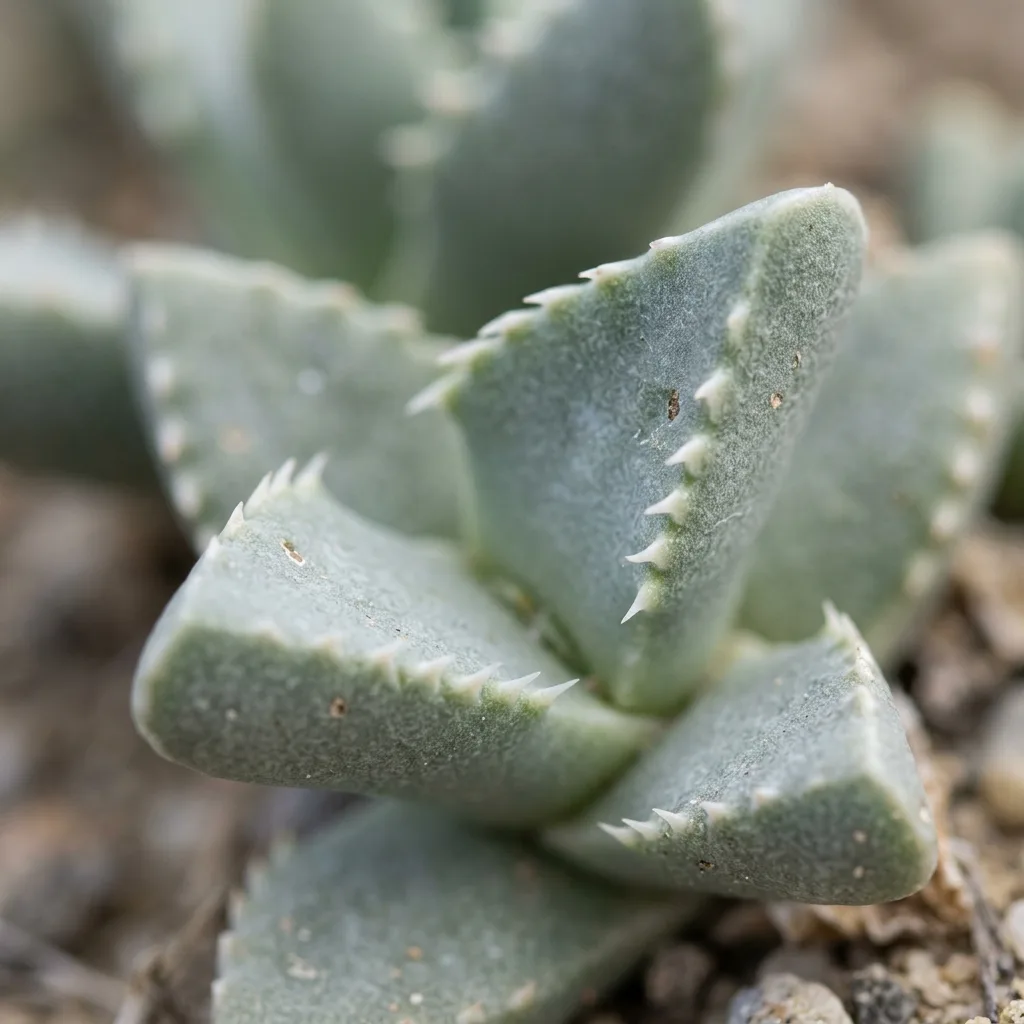
As a distinguished representative of the family Aizoaceae (the mesembs), Cheiridopsis denticulata is an acaulescent (stemless) or extremely short-stemmed, clump-forming dwarf succulent. Its specific epithet, denticulata, originates from Latin, translating directly to 'finely toothed'—an explicit morphological tribute to the cartilaginous, minuscule denticles elegantly lining the leaf margins and keel. The generic designation Cheiridopsis is derived from the Greek cheiris (sleeve or glove), highlighting the genus's signature adaptation: throughout its summer dormancy, the emergent leaf pairs remain protected within the desiccated, papery sheath (tunic or sleeve) of the prior season's exhausted leaves.
Morphologically, the plant consists of opposite pairs of fleshy leaves fused at their base, displaying a chalky, glaucous blue-green or muted lead-gray tone. The leaf epidermis is endowed with microscopic translucent idioblasts (windows) and an epicuticular wax layer that filters the intense ultraviolet radiation of the Karoo while channeling light safely into the deep photosynthetic parenchyma. In late winter, daisy-like blossoms spanning 4 to 6 cm—often completely eclipsing the rosette itself—erupt from the center of these compact leaves. The petals present a captivating spectrum ranging from pristine ivory and creamy white to brilliant canary yellow, occasionally flushing with delicate salmon-pink overtones, offering collectors an unforgettable botanical spectacle.
2. Growth Rhythm and Photoperiodic Demands: An Inverted Life Cycle
The most pervasive error committed by growers in the Northern Hemisphere is treating Cheiridopsis denticulata as a conventional summer-growing succulent like an Echeveria or Sedum. This species is indigenous to the winter-rainfall regions of western South Africa. Consequently, its phenology is inverted: it stirs into active growth in autumn as night temperatures drop, flourishes and blooms throughout the winter, and prepares for its summer sleep (aestivation) toward late spring.
Its lighting requirements are uncompromising:
- Light Intensity: Requires at least 5 to 6 hours of direct, unfiltered sunlight each day. Unobstructed south- or southwest-facing window sills are optimal for indoor cultivation.
- Insufficient Light (Etiolation): Under substandard illumination, its dense, compact architecture unravels rapidly. The leaves elongate, dilute into a pale grass-green, and lose their diagnostic cartilaginous teeth. An etiolated specimen experiences a drastic collapse in systemic resistance against opportunistic fungal pathogens.
- Summer Protection: During its dormant phase in summer, shield the plant from harsh midday sun. Relocate it to a bright location with filtered light and generous, continuous ambient air movement.
3. Substrate Architecture and Container Selection: Replicating Desert Hardpans
Rich, moisture-retentive organic matter is the foremost adversary of Cheiridopsis. In its native habitat, it anchors into quartz gravels, decomposing granite, and low-clay mineral deposits. The root system features a substantial primary taproot supported by fine, fragile fibrous roots that can succumb to anoxic rot within hours if subjected to soggy soil.
The mineral-dominated substrate formula that has yielded absolute success in my nursery over the years is structured as follows:
- 40% Horticultural Pumice (2–4 mm grain size)
- 25% Crushed Volcanic Scoria / Lava Rock (Red or Black) - for micro-porosity and aeration
- 15% Zeolite or Coarse Quartz Grit - for cation exchange and structural integrity
- 20% Sifted low-humus cactus soil or sterilized leaf mould (strictly avoid uncomposted peat or fibrous coco coir)
For container choice, unglazed terracotta pots fitted with ample drainage apertures are indispensable. Plastic and fully glazed ceramic containers restrict gas exchange across the root zone and trap residual dampness. Because of the developing taproot, avoid excessively shallow display trays; ensure the container provides at least 8 to 10 cm of depth to allow healthy vertical root descent.
4. Irrigation Strategy: The Seasonal Paradigm and the 'Stacking' Hazard
Irrigation is where true horticultural mastery reveals itself. When watering Cheiridopsis, one must abandon the calendar and read the plant’s structural morphology. Adhere strictly to this seasonal regimen:
| Season | Physiological State | Irrigation Protocol |
|---|---|---|
| Autumn (Sept – Nov) | Awakening & Active Vegetative Growth | Soak thoroughly only after the substrate has been bone dry for 2–3 days. |
| Winter (Dec – Feb) | Anthesis (Blooming) & Leaf Absorption | Moderate watering. Avoid complete desiccation while buds are expanding and flowers open. |
| Spring (Mar – May) | Tunic Formation & Retraction | Taper off water progressively. Allow outer leaves to shrivel and dry into papery sleeves. |
| Summer (Jun – Aug) | Complete Dormancy (Aestivation) | Virtually dry. A meager drizzle on a cool evening once a month preserves fine root hairs without breaking dormancy. |
The 'Stacking' Phenomenon: If a Cheiridopsis denticulata maintains more than two pairs of turgid, fleshy leaves simultaneously, it is experiencing chronic over-watering. In balanced metabolic conditions, the plant absorbs the moisture and nutrient reserves of the aging outer leaves to construct the emergent inner set. Forcing water onto a specimen whose outer leaves have not dried down into a parchment sheath induces abnormal leaf accumulation (stacking). This causes hydrostatic tension, cellular rupture, and fatal bacterial or fungal decay.

5. Temperature, Ventilation, and Relative Humidity Parameters
Originating from continental desert regimes, this plant thrives on pronounced diurnal temperature fluctuations. A steep drop in night temperature is essential for species utilizing Crassulacean Acid Metabolism (CAM), allowing stomata to open after sunset to fix carbon dioxide with minimal transpiration loss.
- Temperature: Optimum winter daytime temperatures range between 15°C and 20°C, cooling to 8°C–12°C at night. It can withstand brief, dry frosts between -2°C and 0°C; however, for reliable cultivation, keep ambient temperatures above 5°C.
- Air Circulation: Stagnant air is lethal to Cheiridopsis. Providing continuous, gentle air circulation indoors using a small oscillating fan or cracked window lowers the incidence of mealybugs and damp rot by upwards of 80%.
- Humidity: Prefers low relative humidity (30%–50%). Closed terrariums, poorly ventilated humid greenhouses, and bathrooms will cause rapid decline.
6. Propagation Techniques: Seed Sowing and Clump Division
Propagating Cheiridopsis denticulata is a gratifying exercise requiring patience, hygiene, and precise seasonal timing.
Generative Propagation via Seed
The seeds are minute and dust-like. Sowing is best undertaken in early autumn (September to October). Scatter the seeds evenly across the surface of a sterilized, purely mineral seed-starting mix composed of fine pumice and washed river sand; do not cover them. Maintain ambient moisture using a clear cover in bright, indirect light at 15°C–18°C. Germination typically commences in 7 to 14 days. Once cotyledons appear, gradually increase ventilation to deter damping-off fungi.
Vegetative Propagation via Division
Over several seasons, plants develop multiple growing crowns, forming a dense, ground-hugging cushion. During routine repotting in early autumn, mature clumps can be carefully separated using a flame-sterilized scalpel, ensuring each division retains a portion of root tissue and at least one intact growing apex. Dust cut surfaces with sulfur powder or ground cinnamon, allow them to callus in the shade for 3 to 4 days, and pot into the dry mineral mix detailed above. Wait at least seven to ten days before initiating the first watering.
7. Common Pathologies, Pests, and Physiological Disorders
While evolutionarily hardened against natural extremes, greenhouse and domestic settings can introduce specific challenges:
- Root Mealybugs (Rhizoecus spp.): These pests reveal themselves through powdery white, waxy deposits distributed through the root system. Unpot the plant completely, wash the root ball free of old soil, treat with an appropriate systemic drench, and repot in fresh, sterile mineral aggregate.
- Basal Stem & Root Rot (Fusarium / Phytophthora): Triggered by excessive moisture coupled with low substrate aeration. If the stem base softens into a dark, translucent mush, saving the specimen is challenging; salvage any healthy, firm leaf tissue immediately as prospective cuttings.
- Epidermal Fissures: Sudden, excessive water intake after prolonged dry spells creates hydrostatic overpressure, causing the leaves to split longitudinally. While the resulting scars are permanent, the plant will survive if watering is dialed back immediately.
Ultimately, my friends, caring for Cheiridopsis denticulata is a lesson in patience and botanical harmony. When we abandon rigid human schedules and harmonize with its ancestral winter rhythm, this desert sentinel will reward your devotion with stunning, silky blossoms—a breathtaking message sent straight from the South African wilderness.


Reader Reviews & Comments 3 Reviews
Julian Vance
Marcus Sterling
Clara Higgins
Leave a Review & Rating
Share your plant care tips, experiences, or questions with our succulent community.