






As the most resilient inhabitants of arid valleys, rugged rock faces, and vast desert ecosystems, succulents have spent millions of years perfecting the art of survival. Their evolutionary genius for sequestering water within specialized parenchyma tissues and fleshy foliage makes them far more than drought-defying natural marvels; the moment they cross our thresholds, they fundamentally enrich the biological equilibrium of our living spaces. Bringing nature's ancient adaptive legacy into our living rooms, home offices, and bedrooms erects an invisible, protective shield against the chronic stress and chemical pollutants of modern urban life.
While many enthusiasts adopt succulents simply for their architectural silhouettes and low-maintenance reputation, these plants are in truth bioactive organisms that filter indoor air, regulate ambient relative humidity, and cultivate deep cognitive calm. Operating through Crassulacean Acid Metabolism (CAM) photosynthesis and capturing airborne volatile organic compounds (VOCs), they actively bolster physical health and mental clarity while greening your home. Let us delve into the botanical science behind 7 tangible health benefits of cultivating indoor succulents, alongside the foundational horticultural protocols designed to maximize their physiological vitality.
1. Botanical Identity and Morphological Adaptations
The term 'succulent' does not designate a single plant family; rather, it is a functional morphological classification spanning over 60 distinct botanical families, including Crassulaceae, Asphodelaceae, Euphorbiaceae, and Cactaceae. Plants belonging to these lineages have evolved specialized water-storing tissues in their leaves, stems, or roots. To minimize evapotranspiration under desiccating conditions, their epidermis is reinforced with a thickened cuticle layer and often blanketed by a delicate, microscopic epicuticular wax coating known as 'farina'.
Their specialized CAM physiology makes them uniquely advantageous for indoor environmental health. Rather than opening their stomata during the heat of the day, CAM plants preserve internal moisture by keeping their pores tightly sealed until dusk, during which time they capture ambient carbon dioxide and convert it into malic acid stored within cellular vacuoles. Species like Sansevieria trifasciata (Snake Plant / Mother-in-Law's Tongue), Aloe barbadensis (Aloe Vera), and Crassula ovata (Jade Plant) possess remarkable phytochemical profiles and substantial leaf surface areas that turn them into stellar, round-the-clock indoor air purifiers.
2. 7 Health Benefits of Keeping Succulents Indoors
At the intersection of plant biology and human physiology, succulents transform everyday interiors into restorative, micro-greenhouse sanctuaries by delivering multifaceted health benefits:
- 1. Nocturnal Oxygen Production (Inverted CAM Pathway): Unlike standard C3 house plants that respire and release carbon dioxide during the night, CAM succulents consume CO2 and release pure oxygen in total darkness. Keeping them on a bedroom nightstand supports deeper sleep cycles and optimizes blood oxygen saturation throughout the night.
- 2. Elimination of Airborne Toxins (VOCs): Landmark investigations, including NASA's Clean Air Study, demonstrate that Dracaena trifasciata (Sansevieria) and Aloe vera translocate hazardous volatile organic compounds—such as benzene, formaldehyde, and trichloroethylene emitted by paints, adhesives, and synthetic carpets—down to their root zones, where symbiotic rhizosphere microorganisms neutralize them.
- 3. Natural Evaporative Humidification: Through gentle transpiration, succulents release microscopic water vapor back into the ambient indoor air. This natural humidifying effect prevents indoor humidity from plummeting during the winter heating season, mitigating dry throat irritation, spasmodic coughing, and dermal dehydration.
- 4. Cortisol Reduction and Mental Restoration: Supported by the biophilia hypothesis, visual and physical interaction with living fractal botanicals downregulates sympathetic nervous system arousal. Studies show a measurable decrease in salivary cortisol levels and stabilization of resting heart rates in rooms adorned with healthy succulents.
- 5. Enhanced Focus and Cognitive Performance: Keeping an architectural succulent such as a Haworthia or an Echeveria on your desk mitigates directed-attention fatigue, enhancing working memory retention and cognitive focus by up to 15%.
- 6. Immune Support via Soil Microbiome Exposure: The living root zone of potted succulents hosts beneficial soil microflora, including friendly non-pathogenic bacteria such as Mycobacterium vaccae. Inhaling these organic micro-aerosols stimulates natural serotonin release in the human brain, gently bolstering systemic immunological resilience.
- 7. On-Demand Topical First-Aid: Medicinally recognized succulents like Aloe barbadensis store an abundance of glucomannans, acemannan, and vital micronutrients within their parenchymal gel. Freshly harvested gel acts as a soothing, regenerative topical balm for minor domestic thermal burns, insect bites, and minor abrasions.

3. Light Requirements and Strategic Indoor Placement
The ability of succulents to maintain active gas exchange and drive cellular air filtration is directly governed by photon availability. When kept in dim corners, succulents inevitably suffer from etiolation—stretching out unnaturally with weak, pale stems as they reach for light—which significantly diminishes their metabolic efficiency and air-cleansing capacity.
To optimize their therapeutic output, position bedroom specimens on east-facing windowsills that receive soft, invigorating morning sun, or along southwest-facing sills that offer generous, filtered bright light. For home offices and desk arrangements with indirect lighting, low-light-tolerant genera like Haworthiopsis and Zamioculcas maintain excellent metabolic vigor without succumbing to light deprivation.
4. Watering Discipline: The 'Soak and Dry' Protocol
The most pervasive mistake in domestic succulent care is providing small, frequent sips of water. Frequent shallow watering does not express affection; it deprives the root system of vital oxygen, creating an anaerobic environment that invites pathogenic root rot. Succulents thrive on an authentic drought simulation known as the 'Soak and Dry' method.
Never irrigate your plants until at least 80% of the substrate depth has turned completely bone-dry. When it is time to water, drench the pot thoroughly until moisture drains freely from the base holes, and discard any residual water that collects in the saucer within 15 minutes. Once rehydrated, the xylem tissues rapidly draw moisture into leaf vacuoles, restoring cell turgor and initiating vigorous metabolic cycles.
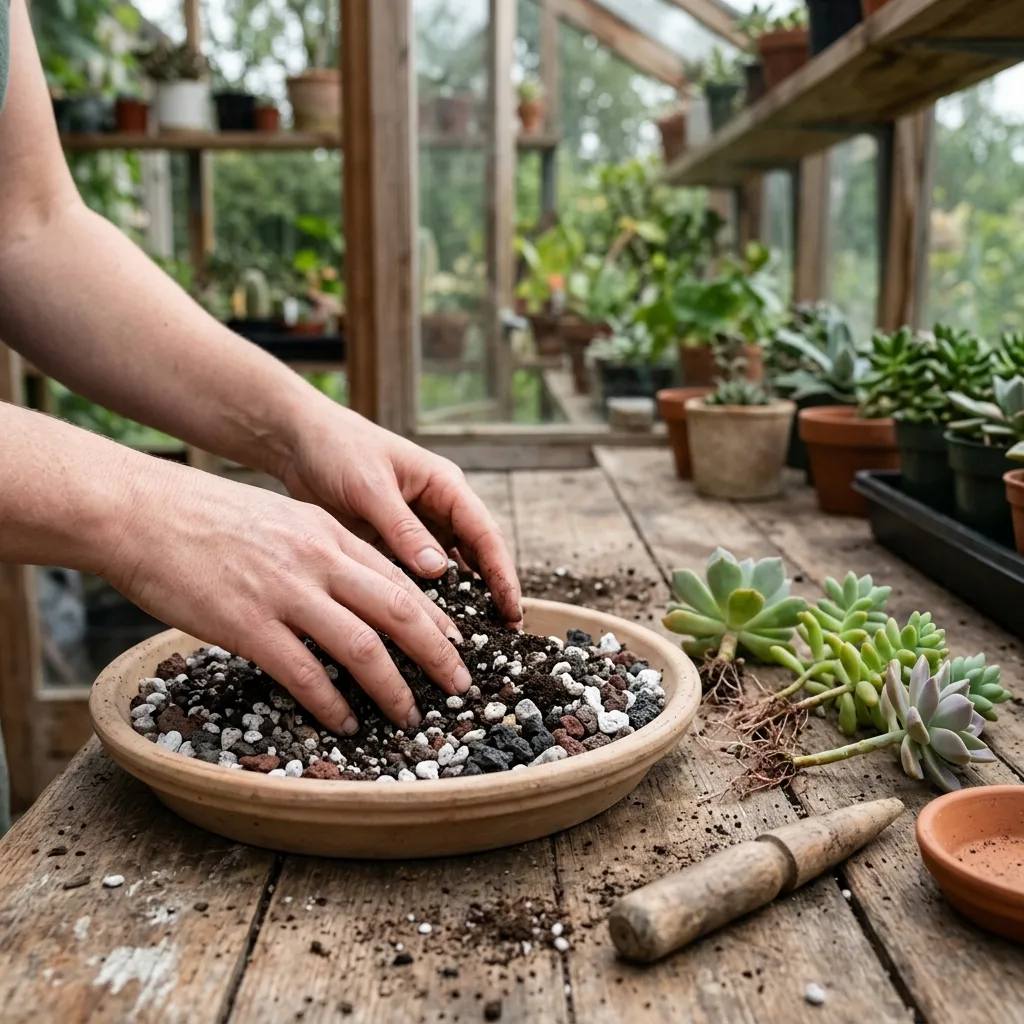
5. Formulating the Ideal Substrate and Pot Selection
Succulent root systems are exquisitely sensitive to prolonged moisture retention. If water remains suspended within the capillary pores of heavy garden soil or dense peat, fine root hairs suffocate and decay within days. A gritty, mineral-dominated, quick-draining substrate is absolutely essential.
| Substrate Component | Ratio (%) | Functional Botanical Benefit |
|---|---|---|
| Pumice (3-6 mm particle size) | 40% | Provides superior rhizosphere aeration and retains air within microscopic pores. |
| Crushed Lava Rock / Zeolite | 25% | Supplies trace minerals, creates macroscopic drainage channels, and binds excess salts. |
| Coarse Horticultural Sand / Perlite | 15% | Prevents substrate compaction and crusting, allowing lateral root expansion. |
| Sterile Horticultural Peat / Sifted Leaf Compost | 20% | Delivers a modest baseline of organic nutrients and safe, short-term moisture retention. |
Regarding containers, unglazed terracotta pots remain distinctly superior to glazed ceramic or plastic pots due to their microporous walls, which permit evaporative moisture release through the container sides. Using decorative planters without functional drainage holes is an almost certain death sentence for succulent root architecture.
6. Step-by-Step Propagation Techniques
Multiplying your succulent collection to expand your home's air-purifying power is an enjoyable, reliable botanical process when carried out systematically:
- Healthy Leaf Selection: Select a plump, mature leaf from the lowest tier of the stem. Gently grasp and wiggle it side to side until it detaches cleanly without leaving any meristematic tissue behind on the stem.
- Callus Formation: Rest the detached leaf in a well-ventilated, dry location out of direct sunlight for 3 to 5 days. This allows the severed tissue to develop a dry, protective scar (callus) that blocks fungal pathogens.
- Placement on Dry Substrate: Lay the callused leaf flat upon a tray filled with dry, gritty succulent soil. Withhold water completely until roots appear; moisture prior to root emergence risks rot.
- Root Hydration and Rosette Formation: Once delicate, pinkish-red adventitious roots and a tiny pup rosette emerge, mist the root zone lightly every 3 to 4 days, encouraging roots to seek deeper moisture in the soil.
7. Seasonal Care Rhythms and Troubleshooting Common Pitfalls
Spring and Summer: This is the prime vegetative growth window. Offer your succulents ample morning sunlight, apply a balanced, potassium-focused cactus fertilizer diluted to half-strength once per month, and water promptly as the soil dries completely.
Autumn and Winter: Most varieties shift into metabolic rest (dormancy). Space your watering routines out to every 3 to 4 weeks, halt fertilization entirely, and shift containers a few inches back from cold glass panes to prevent cold draft damage.
The most frequent pest infestation involves mealybugs (Pseudococcidae), which appear as cottony white clusters nestled deep in leaf axils—often triggered by stagnant air and overwatering. Address early infestations immediately by spot-treating with a cotton swab dipped in 70% isopropyl alcohol; treat broader populations with an emulsion of cold-pressed horticultural neem oil.


Reader Reviews & Comments 4 Reviews
Eleanor Vance
Marcus Bennett
Julian Hayes
Chloe Davies
Leave a Review & Rating
Share your plant care tips, experiences, or questions with our succulent community.