






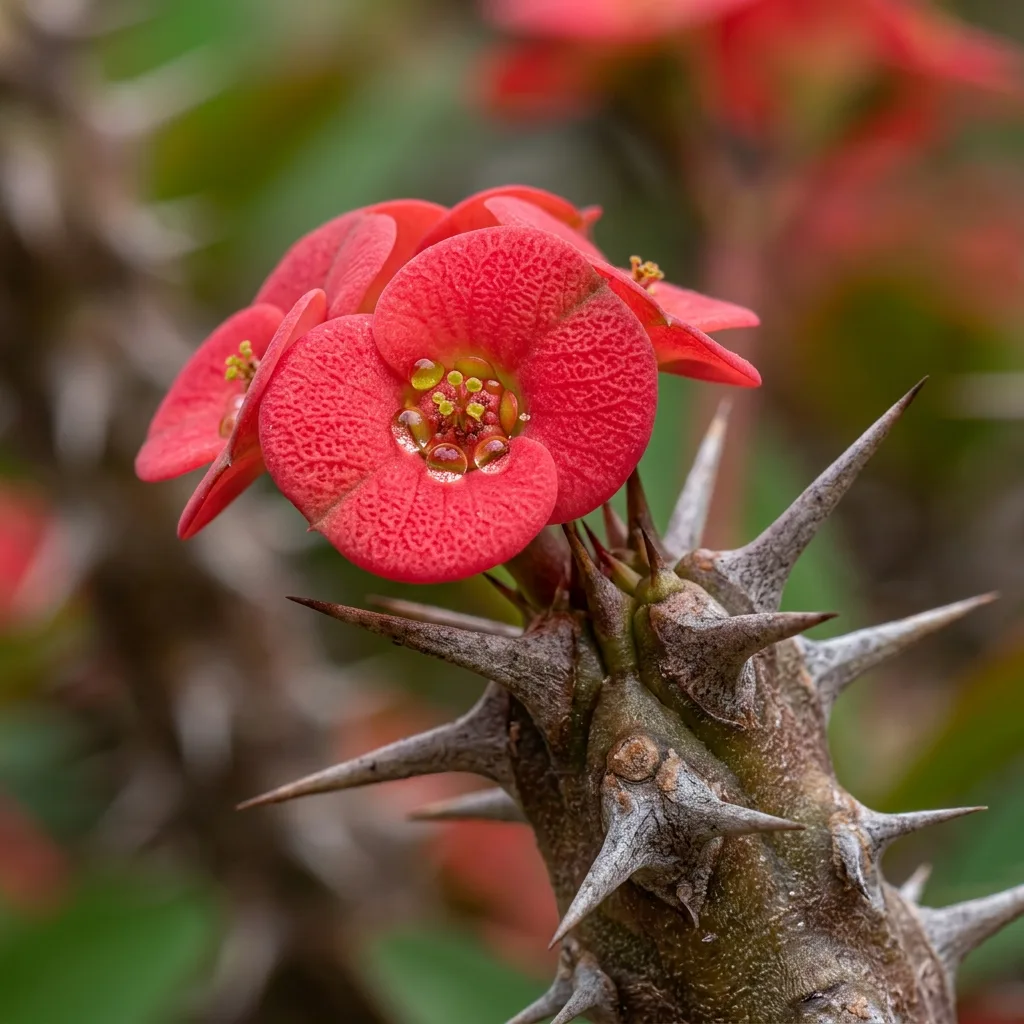
Hailing from the granite outcrops and arid scrublands of Madagascar directly into our living rooms, the Crown of Thorns (Euphorbia milii) stands as one of the most resilient and visually rewarding shrubby succulents in the botanical kingdom. While its succulent stems armored with sharp spines might initially resemble a formidable defensive fortress, the velvety, vibrant scarlet, coral, or ivory blossoms emerging above this prickly armor present a masterclass in natural contrast and understated elegance. What most houseplant enthusiasts casually admire as 'flowers' are, in precise botanical reality, specialized modified leaves known as bracts (or cyathophylls) that lovingly frame the minute true flowers nestled within.
All too often in home environments, we encounter Crown of Thorns specimens that produce nothing but lush green foliage and bare thorns, persistently refusing to set a single bud. Awaking that dormant tropical blooming genetics within your plant is never a matter of luck; it relies entirely on accurately replicating the subtle photoperiodic and hydric stress cycles of its ancestral ecosystem. Viewed through the lens of a botanist, when adequate photon flux, balanced cellular moisture, and calibrated mineral nutrition align, inducing a persistent bloom cycle on your Euphorbia becomes inevitable.
In this master horticultural guide, we will unpack the physiological dynamics of Euphorbia milii while systematically exploring the science behind the '5 secrets to making Crown of Thorns bloom'—providing actionable, step-by-step solutions to elevate your specimen into an enduring floral showpiece.
1. Botanical Identity and Morphological Traits
As a distinguished member of the spurge family (Euphorbiaceae), Euphorbia milii is frequently conflated with true desert cacti (Cactaceae), yet it belongs to an entirely separate evolutionary lineage shaped by convergent evolution. Lacking the specialized cushion-like areoles unique to cacti, its menacing thorns are actually sharp stipular spines emerging directly from the epidermal layer along the ribbed stems. In the arid Malagasy climate, these spines serve dual purposes: they deter grazing herbivores and actively capture condensing morning fogs, channeling lifesaving dew droplets directly toward the root collar.
The reproductive anatomy of this plant centers around a highly specialized pseudanthium called a 'cyathium'. The central, nectar-secreting true floral organs—both male staminate flowers and a solitary female pistillate flower—are minuscule and easily overlooked by the naked eye. The true visual spectacle comes from the pair of opposing, brightly pigmented bracts enclosing each cyathium. Furthermore, circulating throughout the plant's vascular bundles is a milky white latex sap laden with complex diterpene esters. This viscous exudate acts as an immediate antiseptic seal against physical trauma, yet it is caustic and dermally irritating, warranting careful handling and gloved care during pruning and propagation.
2. Lighting Requirements and Interior Positioning
The Crown of Thorns is unequivocally not a shade-tolerant houseplant; it requires an intense photon bombardment to run its photosynthetic machinery at full throttle. When deprived of sufficient light, the plant quickly undergoes etiolation: internodes stretch out, leaves turn pale, and, most decisively, the hormonal synthesis required for floral induction (florigen pathway) grinds to an absolute halt.
When positioning your plant indoors, give it pride of place right beside south- or west-facing windows that receive at least 4 to 6 hours of direct, unfiltered solar radiation each day. While a gentle sheer curtain may be prudent during the most blistering midday heatwaves of midsummer to prevent the glass from acting as a magnifying lens, direct morning and late-afternoon sun exposure without barriers is vital for synthesizing the anthocyanin pigments that impart such dazzling, saturated hues to the bracts.
3. Watering Discipline: The 'Soak and Dry' Method
Thanks to its semi-woody, succulent stems packed with water-storing parenchyma tissue, Euphorbia milii exhibits phenomenal drought tolerance. Watering a succulent excessively on a rigid calendar schedule is not a gesture of love—it deprives the root system of vital oxygen and invites opportunistic fungal pathogens to rot the rhizosphere. The definitive watering approach here is the golden horticultural standard: the 'soak and dry' method.
Prior to irrigating, always verify that at least the top two-thirds of the substrate profile—and during the cold winter dormancy, the entirety of the soil—has dried out completely. Insert your finger or a clean wooden skewer deep into the root zone; if the wood emerges completely dry and devoid of clinging soil particles, it is safe to water. At that point, hydrate generously until water flows freely from the drainage holes, and be sure to empty any runoff trapped in the saucer within 15 minutes to keep the root tips from suffocating.
4. Ideal Potting Substrate and Container Selection
The fine feeder roots of Crown of Thorns perish in dense, compacted, moisture-retentive garden soils or heavy peat formulations. For root cells to respire efficiently, the potting matrix must exhibit high macroporosity, structural stability, and razor-sharp drainage. Regarding container materials, unglazed terracotta is undeniably superior; its porous clay walls allow gas exchange and enable excess moisture to evaporate laterally through the pot itself.
| Substrate Component | Ratio (%) | Horticultural Function and Root Dynamics |
|---|---|---|
| Coarse Pumice (3-6 mm) | 35% | Creates vital macropores, aerating roots and preventing compaction. |
| Lava Rock / Zeolite | 25% | Prevents root rot, improves structure, and slowly leaches trace minerals. |
| High-Grade Blonde Peat / Coco Coir | 25% | Supplies essential organic base and provides a slightly acidic pH balance. |
| Coarse River Sand / Coarse Perlite | 15% | Accelerates downward gravitational drainage and prevents soil clumping. |
5. The 5 Vital Secrets to Inducing Continuous Blooms
Here are the 5 botanically grounded secrets that will break bud dormancy and transform your Crown of Thorns into an uninterrupted floral centerpiece:
- Secret 1: Exceeding the Photonic Threshold (Phototropic Triggering): A Crown of Thorns can survive in modest light, but it will steadfastly refuse to flower. A minimum of 4 hours of intense direct sunlight is mandatory to trigger cyathium morphogenesis. During low-light winter months, push the pot directly against your brightest window pane or provide full-spectrum horticultural grow lights.
- Secret 2: Low-Nitrogen, High-Phosphorus and Potassium Nutrition: Formulations loaded with nitrogen stimulate rampant, watery green foliage and soft thorn growth at the expense of blossoms. To steer internal resources toward flowering, feed your plant every 3 weeks through spring and summer with a water-soluble fertilizer formulated at an NPK ratio around 10-30-20 or a specialized succulent blend at half-strength.
- Secret 3: Strategic Hydric Cycling (Controlled Drought Stress): Keeping a Euphorbia uniformly wet keeps it trapped in a vegetative growth loop. Allowing the potting mix to dry down thoroughly between waterings mimics the Malagasy dry season, gently triggering the plant's natural survival instinct to reproduce through a lavish burst of bracts.
- Secret 4: Day-to-Night Thermal Fluctuations: In its native habitats, baking daytime sun gives way to cool, breezy night mountain air. Replicating this 6-8°C diurnal differential inside your home (e.g., 22-26°C / 72-78°F during the day dropping to 15-18°C / 59-64°F at night) provides a profound physiological cue that shatters floral dormancy.
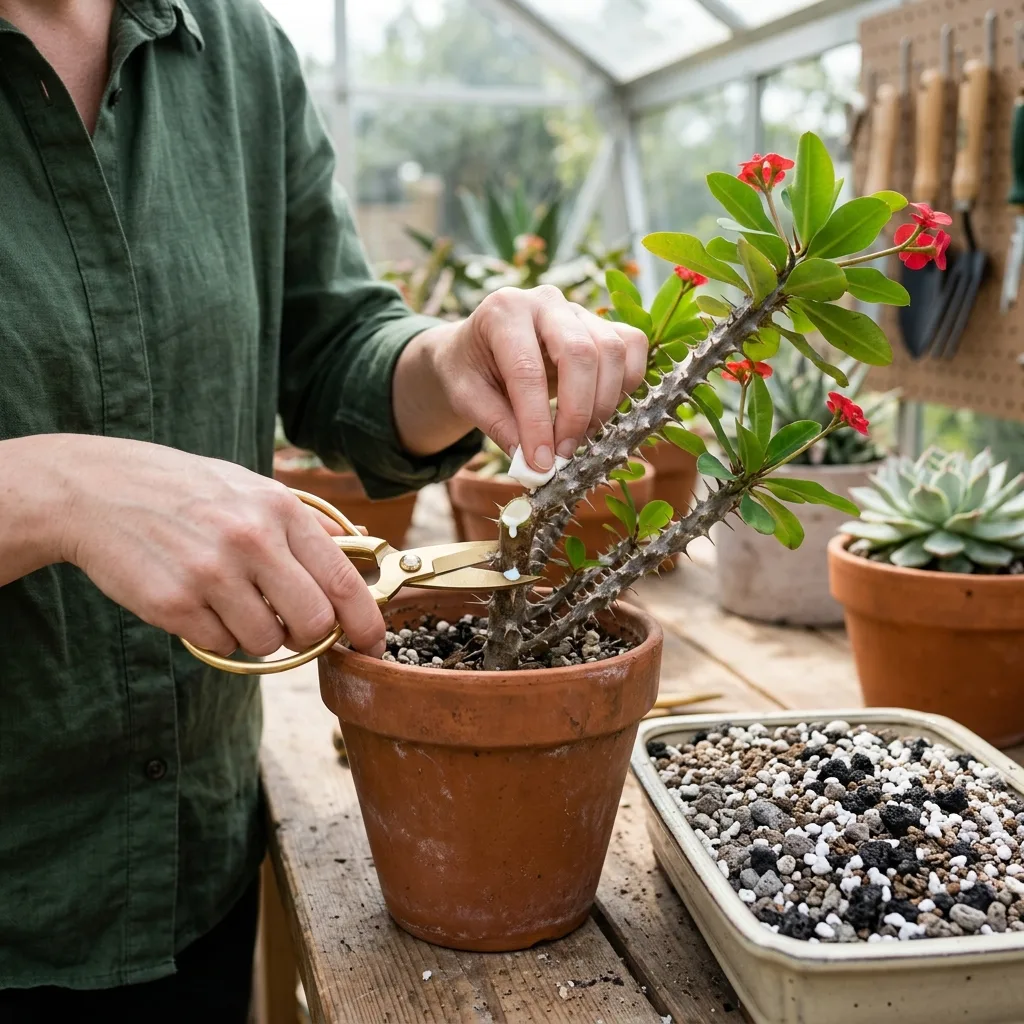
- Secret 5: Selective Pinching and Rejuvenation Pruning: Crown of Thorns sets its finest inflorescences on the tips of fresh, vigorous lateral shoots. By shortening overgrown, bare, or woody older branches in early spring with sterile pruning shears, you break apical dominance and encourage an explosion of multiple bloom-bearing secondary shoots below the cuts.
6. Step-by-Step Propagation Protocol
Stem cuttings represent the most reliable, genetically identical, and rapid method for propagating Euphorbia milii. The ideal window to take cuttings is during late spring or early summer when vascular activity is peak.
- Using sterilized, razor-sharp bypass pruners, snip a robust terminal shoot measuring roughly 10-12 cm (4-5 inches) in length.
- To halt the immediate flow of caustic milky latex, quickly dip the severed base into a vessel of cold water or gently dab it with an absorbent paper towel. (Wear protective nitrile gloves to prevent skin irritation).
- Never insert a freshly cut stem directly into moist soil! Place the cutting in a dry, shaded, and well-ventilated spot for 3 to 5 days until a firm, protective suberized callus forms over the wound.
- Insert the callused cutting approximately 3 cm deep into our mineral-rich, slightly moistened succulent soil blend.
- Shield the cutting from direct scorching sun for the initial 10 days, maintaining subtle ambient humidity by lightly misting the surface soil only. Adventitious roots will establish firmly within 3 to 4 weeks.
7. Common Pests, Diseases, and Clinical Remedies
Mealybugs (Pseudococcidae): These pervasive pests lodge themselves in the nooks between thorns and leaf axils, masquerading as white, cottony masses. Treat by dabbing individuals directly with cotton swabs dipped in 70% isopropyl alcohol, followed by a thorough foliage wash with cold-pressed neem oil or insecticidal potassium soap.
Root and Stem Rot (Fusarium and Phytophthora spp.): The catastrophic byproduct of overwatering coupled with dense, suffocating soil. Symptoms include a softened, discolored stem base accompanied by sudden leaf drop. Unpot the plant immediately, amputate all darkened, necrotic roots down to clean tissue, dust the wounds with sulfur powder or cinnamon, and replant into fresh, bone-dry mineral media.
Abrupt Leaf Abscission: Cold drafts, ambient temperatures plummeting below 12°C (54°F), or severely prolonged dehydration can cause the plant to drop its leaves en masse as a protective response. Correcting ambient conditions will prompt dormant axillary buds to flush fresh leaves within several weeks.
8. Seasonal Care Calendar and Professional Checklist
Spring (Awakening and Formative Pruning): As ambient temperatures climb and light lengthens, step up watering frequency progressively. Refresh root-bound pots and worn soil if necessary. Perform pruning cuts to establish branching structure and initiate high-phosphorus feeding.
Summer (Vigorous Growth and Floral Display): Move plants to a sunny patio or warm, sun-drenched window. Water deeply whenever the substrate dries out completely. Keep in mind that summer breezes and warm air evaporate soil moisture substantially faster.
Autumn (Hardening Off): Taper off fertilizing routines as daylight wanes, ceasing all supplemental feeding by late October. Relocate outdoor specimens indoors well before nighttime temperatures drop below 12°C (54°F).
Winter (Rest and Light Maximization): Position your Euphorbia in the absolute brightest, sunniest window in your house. Extend the intervals between waterings, only giving moisture when the soil profile is entirely dry. Keep the plant away from dry, hot forced-air vents or cold window drafts.


Reader Reviews & Comments 4 Reviews
Julian Hayes
Eleanor Vance
Clara Higgins
Marcus Sterling
Leave a Review & Rating
Share your plant care tips, experiences, or questions with our succulent community.