






When you envision the towering silhouettes of monumental cacti rising like majestic pillars against the crimson horizons of the Sonoran Desert, you are beholding nature's most breathtaking architectural triumph over extreme aridity. Surviving for millions of years under an unforgiving sun without squandering a single drop of moisture, these colossal botanical formations are far more than wild wilderness monuments—they are living sculptures that we can successfully cultivate in our homes and conservatories. Bringing the timeless resilience of the desert into our living spaces demands a profound reverence for cellular hydraulics and the unhurried cadence of botanical time.
The cactus family (Cactaceae) evolved to endure the most severe drought regimes on Earth by transforming succulent stems into accordion-like reservoirs designed for dynamic expansion. In nature, these botanical titans routinely achieve masses exceeding several tons and reach soaring heights of 15 to 20 meters. Yet, within indoor microclimates or greenhouse collections, provided their root zones receive the precise mineral and geochemical balance, they will faithfully stand beside us for decades. Rearing a giant cactus into enduring architectural magnificence is never an overnight achievement; it is an exquisite, patient dialogue between raw light, specialized soil chemistry, and mindful stewardship.
1. Taxonomic Identity, Areole Architecture, and Spine Morphology
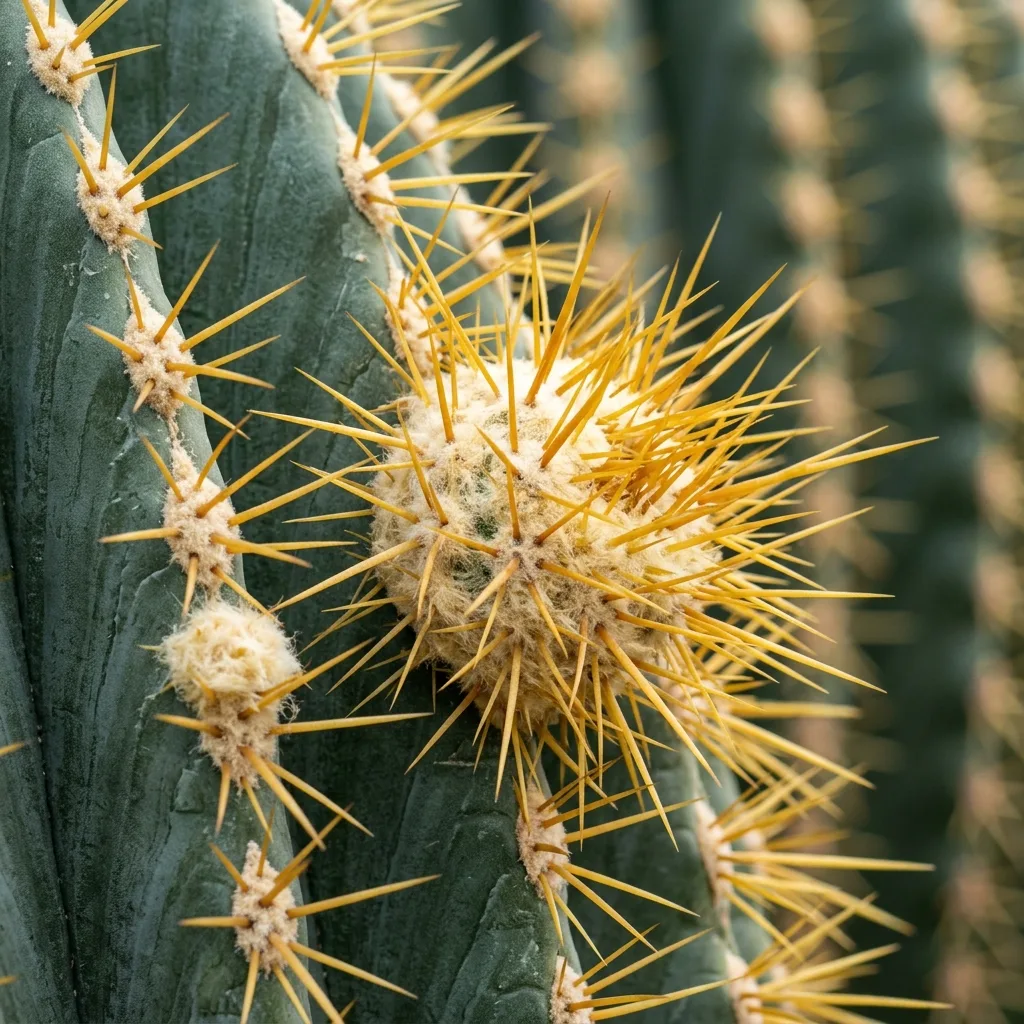
The world's largest cactus species belong predominantly to the columnar (Cereeae) and spherical (Cacteae) tribes of the family Cactaceae. The definitive anatomical hallmark of these desert titans is the areole—a highly specialized, condensed spur shoot completely unique to cacti. Far from serving purely as mechanical deterrents against grazing herbivores, the rigid, lignified spines arising from these areoles function as microscopic water harvesting structures. During misty desert dawns, atmospheric humidity condenses along these spines and drips directly to the shallow root zone below, while dense clusters cast intricate shade patterns that shelter the photosynthetic epidermal tissues beneath.
Here are 10 of the most iconic giant cactus species celebrated in botanical science:
- 1. Carnegiea gigantea (Saguaro): The quintessential emblem of the Sonoran Desert, reaching up to 15 meters in height and storing tons of water within its pleated, accordion-like ribs that expand dynamically following seasonal cloudbursts.
- 2. Pachycereus pringlei (Cardón / Elephant Cactus): The heaviest cactus species known to science, capable of weighing up to 25 metric tons and attaining heights of 19 meters, supported by heavily lignified basal trunks.
- 3. Echinocactus platyacanthus (Giant Barrel Cactus): A massive globular specimen reaching up to 2.5 meters in height and 1.5 meters in diameter, distinguished by broad ribs and formidable brown central spines.
- 4. Cereus peruvianus / repandus (Peruvian Apple Cactus): A vigorous columnar species with distinctive glaucous blue-green epidermis, easily adapting to indoor culture and capable of reaching ceiling height with ease.
- 5. Pachycereus marginatus (Mexican Fence Post Cactus): An architectural marvel defined by pristine white margins along its areoles, perfectly uniform geometric ribs, and an upright columnar habit extending 4 to 5 meters.
- 6. Trichocereus terscheckii (Cardón Grande): A massive, multi-branched cold-hardy giant native to northwestern Argentina, bearing thick golden spines and immense structural resilience.
- 7. Stenocereus thurberi (Organ Pipe Cactus): Known for forming expansive colonies of upright, densely ribbed stems emerging from a single base, reaching impressive heights of up to 8 meters.
- 8. Neobuxbaumia polylopha: A breathtaking botanical wonder showcasing dozens of closely spaced, delicate ribs lined with fine golden spines, rising as an unbroken solitary column up to 10 to 12 meters.
- 9. Ferocactus diguetii (Santa Catalina Giant Barrel): The undisputed giant among barrel cacti, occasionally attaining heights of 4 meters on Gulf of California islands, crowned by curved, formidable spines.
- 10. Espostoa lanata (Peruvian Old Man Cactus): A striking Andean colossus reaching up to 7 meters in habitat, concealing fierce internal spines beneath a dense, protective mantle of silky white epidermal wool.
2. Irradiance Dynamics, Photoperiod, and Atmospheric Circulation
The photosynthetic machinery of giant cacti relies upon Crassulacean Acid Metabolism (CAM), a specialized biological adaptation requiring high photon flux densities to convert stored malic acid into energetic carbohydrates during the day. When ambient irradiance drops below threshold levels, the apical meristem begins to narrow and stretch upward in a pale, conical shape. This irreversible morphological distortion is known as etiolation. To maintain robust girth and healthy spine production, your giant cacti demand a minimum of 6 to 8 hours of unfiltered direct sunlight daily.
Equally critical to their cellular vitality is active air circulation. Stagnant, humid microclimates inside modern living spaces cause ambient moisture to settle within the areoles and spine crevices, providing an ideal vector for fungal spore germination. Indoor air must remain dynamic and regularly replenished, replicating the arid breezes of their native plateaus so nocturnal gas exchange can occur through open stomata without elevated humidity risks.
3. Hydration Cycles and the Vital Winter Dormancy Regime
Because mature specimens possess massive reservoirs of water within their cellular parenchyma, watering frequency is entirely subordinate to watering methodology. The golden rule is absolute: the entire substrate column must dry out completely—from the soil surface all the way down to the drainage holes—between applications. During the vigorous spring and summer growth cycles, hydrate thoroughly until water flushes freely from the base, but never allow the pot to sit in residual drainage runoff.
A rigorous winter dormancy phase is the cornerstone of long-term cactus longevity. From early November through early March, place the cactus in a cool, bright zone maintained between 8 and 12°C (46–54°F), and cease watering entirely. Applying water during winter in a heated interior encourages unseasonable, weak apical growth under dim light, which inevitably invites fatal pathogen collapse.
4. High-Mineral Substrate Chemistry and Vessel Mechanics
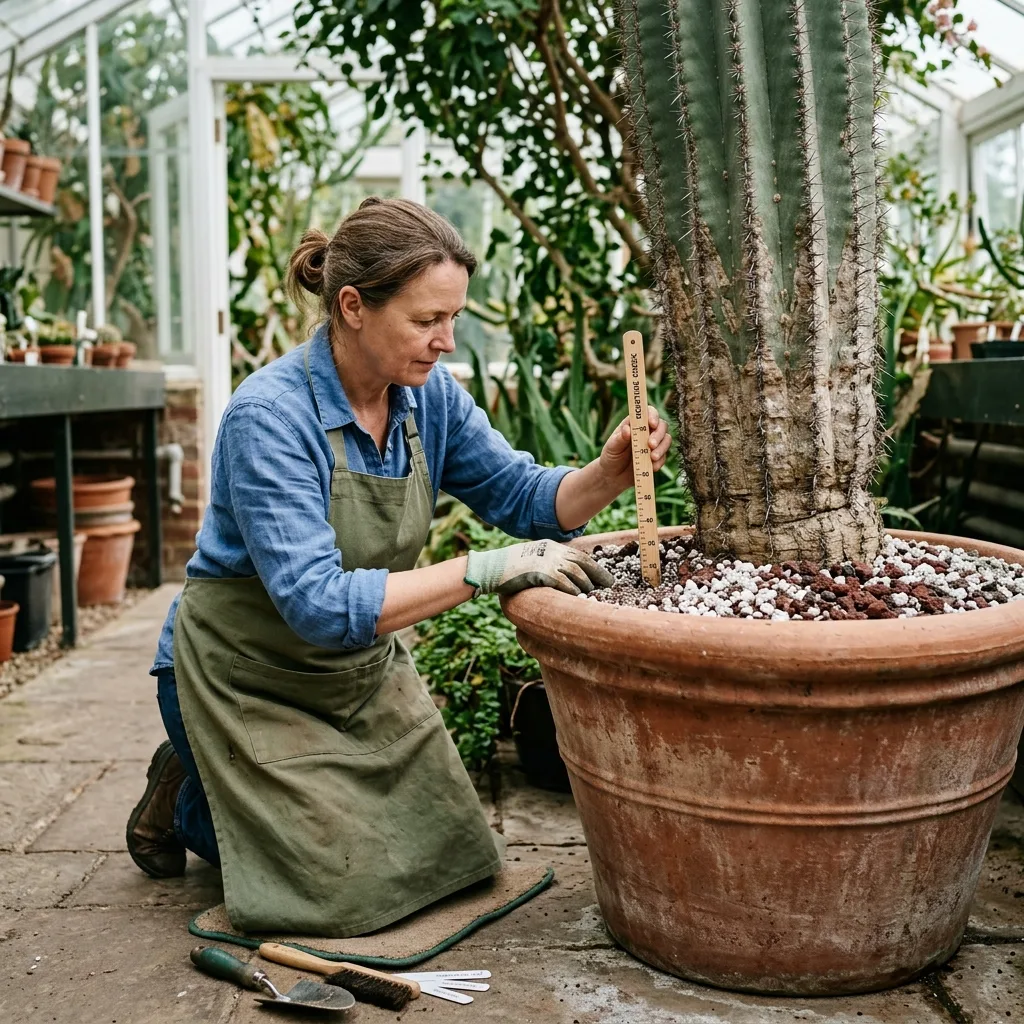
The sensitive root architectures of giant cacti rapidly suffocate and deteriorate in standard commercial potting mixes saturated with peat moss. Cactus roots require high porosity, rapid oxygen diffusion, and instantaneous drainage, which can only be achieved with an aggregate-dominated, volcanic mineral blend. Furthermore, selecting the proper container is vital: top-heavy columnar and massive barrel cacti require heavy, unglazed terracotta or solid concrete pots to anchor their center of gravity and promote gas exchange across the pot walls.
| Substrate Component | Ratio (%) | Botanical Functionality |
|---|---|---|
| Pumice Stone (3–6 mm) | 40% | Maximum root aeration, capillary balance, and structural drainage. |
| Crushed Lava Rock / Zeolite | 25% | Micronutrient retention, cation exchange capacity, and mineral stability. |
| Coarse Quartz River Sand | 15% | Prevents substrate compaction and provides heavy mechanical stability. |
| Screened Organic Leaf Compost | 20% | Gradual, low-level delivery of organic nitrogen and essential humic acids. |
5. Flowering Induction and Targeted Nutritional Protocols
Securing blooms on specimen-sized cacti requires both environmental discipline and exceptional patience. In nature, species like Carnegiea gigantea frequently require 30 to 50 years to achieve reproductive maturity. However, architectural indoor species such as Trichocereus and Cereus can produce massive, nocturnal, fragrance-rich flowers within 4 to 6 years of establishment. The indispensable biological trigger for bud formation is a cold, completely arid winter dormancy period.
Nutritional supplementation should be reserved exclusively for the active growth window (May through August), applied at half-strength once per month. Select a specialized fertilizer featuring a low-nitrogen, high-phosphorus, and high-potassium ratio (such as N-P-K 5-10-15). Excessive nitrogen forces hyper-rapid water absorption, swelling thin cellular walls until the epidermis splits and exposes vulnerable tissues to opportunistic rot.
6. Propagation Techniques, Stem Cuttings, and Grafting
Giant cacti can be multiplied through seed culture or vegetatively via terminal stem cuttings. When taking an apical cutting from a columnar specimen, use a sterile, surgical-grade blade to produce a clean, uniform cut. Dust the exposed wound with elemental sulfur powder or powdered horticultural cinnamon, then position the cutting upright in a shaded, well-ventilated space for 2 to 4 weeks to develop a tough, vulcanized callus. Attempting to plant an uncallused cactus cutting into moist substrate will lead to immediate fungal rot rather than root emergence.
Grafting, on the other hand, is a valuable horticultural technique used to accelerate the development of slow-growing globular giants (such as juvenile barrel species). By fusing the scion onto vigorous, disease-resistant rootstocks like Trichocereus spachianus or Hylocereus undatus, growth rates can be accelerated threefold during early developmental stages.
7. Defending Against Fungal Pathogens and Internal Decay
The most devastating adversaries of specimen cacti are virulent soil-borne pathogens, specifically Fusarium oxysporum and Phytophthora cactorum. If you detect localized stem softening, unnatural darkening, or orange-red discolored halos at the base of the areoles, immediate surgical intervention is required. Using a sterilized scalpel, excise every trace of discolored, translucent tissue until only healthy, pristine green and white vascular tissues remain. Treat the surgical site thoroughly with a copper-based botanical fungicide or colloidal sulfur, and keep the plant in dry, well-ventilated isolation to heal.


Reader Reviews & Comments 3 Reviews
Clara Davenport
Julian Vance
Marcus Sterling
Leave a Review & Rating
Share your plant care tips, experiences, or questions with our succulent community.