






Picture the sun-scorched, wind-whipped quartzite gravel outcrops of Minas Gerais, Brazil—a dramatic, untamed landscape where daytime solar radiation bakes the stone, and cooling nocturnal mists sweep across the plateaus. Concealed within this harsh microclimate thrives one of the rarest, most extraordinary cacti on Earth: the Night-Blooming Discocactus (Discocactus horstii). Revered among specialist succulent and cactus collectors as a veritable 'holy grail,' this miniature desert jewel defies time with its flattened, subterranean disc-like habit and the snow-white, woolly cephalium it crowns itself with at sexual maturity. Cultivating it in your personal collection is less like tending an ordinary houseplant and far more like sustaining the delicate pulse of a living geological gem.
With its mesmerizing geometric ribbing and pure white, trumpet-shaped nocturnal blossoms that saturate the midnight air with a heady, jasmine-sweet fragrance, Discocactus horstii captivates all who behold it. Yet nurturing this species demands deep horticultural attentiveness and physiological understanding. The most catastrophic mistake novice growers make is treating this tropical Brazilian gem like a common North American desert cactus—withholding moisture in freezing conditions or smothering its fragile root system in dense, peat-laden commercial potting soils. Horstii belongs to a warm, tropical climate regime with deeply distinct hydrological rhythms.
As you advance in your botanical journey, you realize that true plant guardianship does not mean showering affection through heedless watering cans; it means systematically reconstructing the porous, stony, mineral-rich bed in which its ancestors evolved over millions of years. Let us walk through the exact botanical parameters required to cultivate this breathtaking specimen in radiant, long-lived health on your windowsill or greenhouse bench.
1. Taxonomic Identity, Areole Architecture, and Spine Morphology
The genus Discocactus occupies an evolutionary niche within the subfamily Cactoideae, closely allied with the tribe Trichocereeae. Among its peers, Discocactus horstii is both the smallest and the most morphologically specialized taxon. In natural rock cracks, its stem remains geophytic—semi-subterranean and distinctly globose to flattened-globose (discoid)—rarely exceeding 5 to 7 centimeters in diameter. The epidermis displays a sophisticated matte dark green tone, often shifting toward warm bronze or deep plum-purple under intense, unfiltered light.
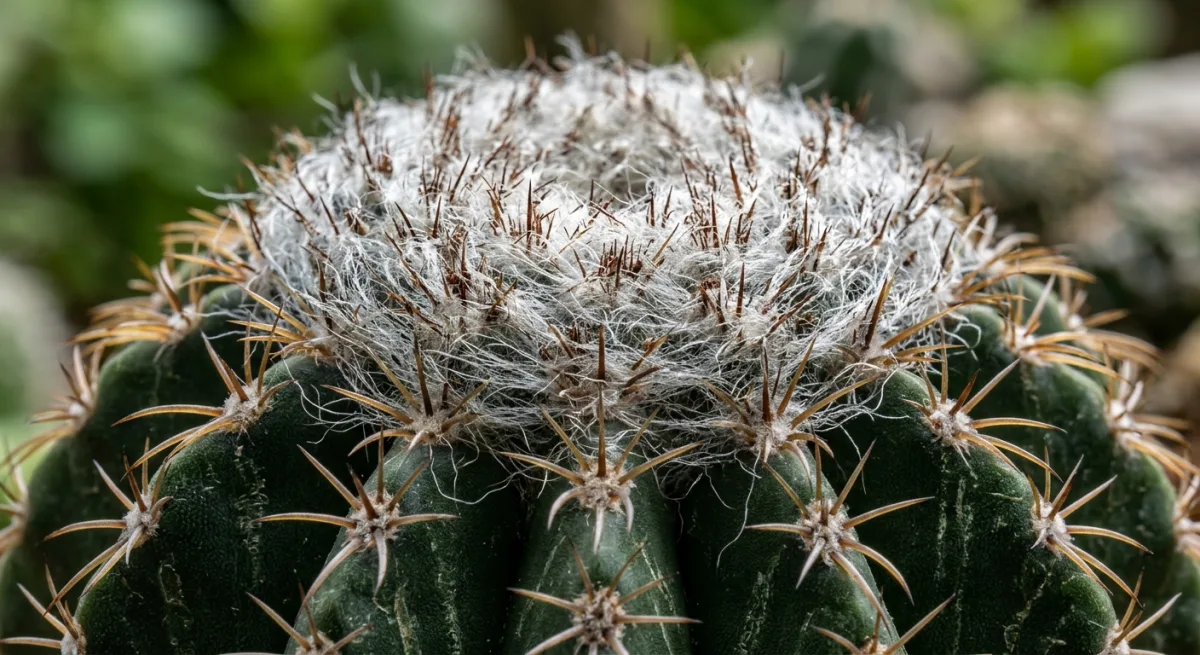
The rib morphology exhibits captivating mathematical precision, presenting between 12 and 22 low, sharply notched, tuberculate ribs. Areoles sit tightly packed along these ribs, giving rise to its signature spine structure: the pectinately arranged radial spines curve closely backward against the stem body like delicate claws. Creamy tan when young, these spines mature into a weathered grayish-white. Far from being dangerously aggressive, these soft spines function primarily as microclimatic windbreakers and radiation baffles, reducing boundary-layer moisture loss across the epidermis.
The most profound ontogenetic shift occurs once the plant attains adulthood (typically around 4 to 6 cm in stem diameter). The apical meristem terminates purely vegetative expansion and transitions into producing a specialized terminal reproductive structure known as a cephalium. Dense with silky white wool and bristly brownish setae, the cephalium becomes the permanent floral platform. Once initiated, the green vegetative body ceases to expand; henceforth, all photosynthetic assimilate is channeled into this apical crown for flowering and seed set.
2. Light Intensity, Solar Acclimation, and Aeration Standards
Tucked between glistening quartz pebbles and fractured metamorphic stone at ground level in habitat, Discocactus horstii relishes abundant, high-intensity, yet slightly filtered light. Exposing unacclimated plants to raw summer midday sun—particularly behind non-ventilated greenhouse glass where convective heat accumulates—will scorch the delicate epidermal cell walls and lead to irreversible solar bleaching or necrotic scars.
For indoor culture, an unshaded south- or west-facing window provides optimal photon flux; however, during the peak heat of summer mid-afternoon, a sheer linen curtain should diffuse the harshest rays. If cultivating under artificial grow lights, an energy-efficient, full-spectrum LED array delivering roughly 18,000 to 25,000 lux (350–500 µmol/m²/s PPFD) for a 12- to 14-hour photoperiod will effortlessly preserve the plant's tight, compact habit and encourage prolific cephalium development.
Ventilation is the absolute life insurance policy for this species. In the wild, night winds keep moisture from pooling dangerously on the epidermis. Stagnant, humid, unventilated air in enclosed corners is an open invitation to rot. Ensure gentle, continuous air movement around the bench using a dedicated oscillating fan.
3. Hydration Cycles and the Vital Winter Warmth Protocol
When watering Discocactus horstii, conventional desert cactus maxims must be unlearned. While Sonoran or Chihuahuan desert species (such as Echinocactus or Ferocactus) easily endure bone-dry cold dipping to 0°C or below, this tropical Brazilian native possesses zero frost hardiness and will collapse if subjected to cold, wet conditions.
Spring and Summer (Active Growth): Water thoroughly using the time-tested 'soak-and-dry' approach. Allow the gritty substrate to dry out nearly completely before drenching the root zone until water runs freely from the drainage holes. Always use tepid, mineral-soft water—ideally collected rainwater or reverse-osmosis water with chlorine and heavy bicarbonates removed. Highly alkaline tap water deposits lime salts that swiftly clog fragile root hairs and prevent nutrient uptake.
Winter Inactivity Protocol: During the winter months, ambient temperatures must never fall below 12°C (54°F). The safe, ideal overwintering bracket is between 14°C and 16°C (57–61°F). If wintered in a warmed living space (around 18–20°C), offer a modest bottom-splash of lukewarm water every 4 to 6 weeks. This minimal sip prevents the fine feeder rootlets from withering completely (root dieback) without saturating the potting zone. Cold, sodden soil is an immediate death sentence for this species.
4. High-Porosity Mineral Substrates and Pot Selection
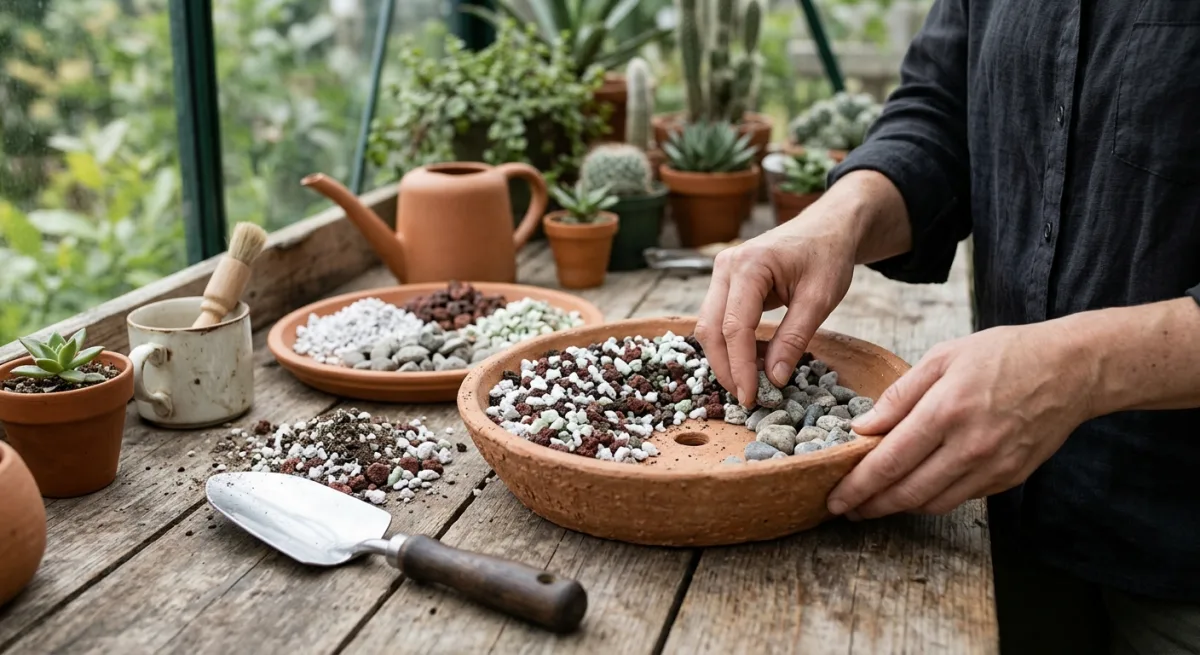
Planting a lithophytic cactus that naturally inhabits pure quartzite detritus into heavy, organic peat-based potting soil is horticultural malpractice. The root system of Discocactus horstii does not tolerate persistent capillary moisture; it demands an open, macroporous structure that drains instantly while allowing atmospheric oxygen to bathe the root plane. Your potting medium should contain at least 80% to 85% inorganic mineral aggregates.
Container choice is equally pivotal. Unglazed, porous terracotta pots permit lateral moisture evaporation through their ceramic walls, making them infinitely safer than non-breathable plastic pots. Furthermore, Discocactus horstii produces a broad, laterally spreading root network rather than a massive, deep taproot. Choose shallow, wide earthenware bowls or pans over deep, cylindrical containers.
| Substrate Component | Ratio (%) | Botanical Function & Horticultural Benefit |
|---|---|---|
| Pumice (2–4 mm graded) | 35% | Creates an open macroporous structure, facilitates root aeration without floating. |
| Crushed Lava Rock (Scoria) | 25% | Provides physical anchorage and slowly releases trace minerals and iron. |
| Zeolite (Clinoptilolite) | 15% | Enhances cation-exchange capacity (CEC), buffers pH, and absorbs impurities. |
| Coarse Quartz Grit or Perlite | 10% | Maintains stable drainage micro-channels for delicate root branching. |
| Fine-Sifted Quality Leaf Compost / Peat | 15% | Supplies minimal organic carbon buffering and mild acidity for natural uptake. |
A foundational 2-centimeter layer of clean, coarse lava rock at the base of the pot ensures immaculate drainage. After potting, blanket the surface with a 1-centimeter top-dressing of pure quartz pebbles or pumice to lift the vulnerable root collar away from damp compost—the simplest, most elegant safeguard against basal stem rot.
5. Inducing Nocturnal Blossoms and Nutritional Support
Witnessing a Discocactus horstii bloom is one of the true spectacles of the botanical world. As dusk approaches, slender flower buds surge outward from within the woolly depths of the cephalium. By nightfall, the pristine white, multi-petaled, funnel-form blossoms unfurl completely, reaching up to 7 cm in length and releasing an intoxicating, sweet perfume reminiscent of jasmine and gardenias. By dawn, this fleeting floral drama draws to a close, and the flower gently collapses. In habitat, this rapid nocturnal cycle evolved specifically to attract nocturnal hawk moths and bats.
To reliably stimulate flowering:
- Apply a low-nitrogen, high-phosphorus, high-potassium soluble cactus fertilizer (e.g., NPK 4-10-12) diluted to one-quarter strength every third watering from late spring through mid-summer.
- Provide a mild, unforced winter rest period within the 14–16°C window to stimulate the hormonal switch for floral bud initiation.
- Mature specimens with fully developed cephalia require steady, cautious nutritional support; generating these lavish blooms consumes substantial cellular phosphorus and potassium reserves.
6. Propagation: Seeds vs. Grafting Considerations
Discocactus horstii is an intrinsically solitary cactus that virtually never produces offsets (pups). As a result, propagation follows two paths: seed germination or vegetative grafting.
Seed Propagation: Viable seeds obtained via cross-pollination between two genetically distinct clones must be surface-sown on a sterile, mineral-rich bed. Maintain temperatures between 25°C and 28°C under high humidity. Germination generally occurs within 7 to 14 days. However, own-root seedlings remain exceptionally delicate and prone to damping-off for their first two seasons; reaching the size of a marble can take 3 to 4 years of attentive care.
Grafting: Many mature specimens encountered in the trade are grafted onto vigorous rootstocks such as Trichocereus, Hylocereus, or Echinopsis. Grafting bypasses the species' notoriously sensitive root system, accelerates vegetative development by four to five times, and brings about cephalium formation years earlier. When caring for a grafted Horstii, tailor your watering frequency and winter thresholds to the cultural needs of the underlying rootstock.
7. Disease Management, Fungal Defense, and Pest Control
The foremost physiological threats to this species are basal stem rot and root decay caused by opportunist fungal pathogens such as Fusarium oxysporum and Phytophthora. Sudden epidermal softening, dulling of the cuticle, or dark water-soaked discoloration around the base indicates vascular compromise.
Emergency Rescue Protocol: If collar rot is detected, immediately unpot the cactus and dissect all diseased, blackened tissue using a flame-sterilized scalpel until clean, white vascular rings are reached. Dust the wound with sulfur powder or ground cinnamon, and allow it to callous in a warm, dry, shaded location for 10 to 14 days. Because re-rooting an unrooted, adult Discocactus is notoriously difficult, the most reliable rescue method is emergency top-grafting onto a robust columnar rootstock such as Myrtillocactus geometrizans.
Regarding insect pests, mealybugs (Pseudococcidae) frequently seek refuge within the dense, protective fleece of the cephalium. Inspect this apical wool regularly under a magnifying glass. Treat localized infestations immediately using a cotton swab dipped in 70% isopropyl alcohol, or apply a systemic soil drench of horticultural neem oil during warm active growth.


Reader Reviews & Comments 4 Reviews
Marcus Thorne
Julian Vance
Eleanor Brooks
Clara Sterling
Leave a Review & Rating
Share your plant care tips, experiences, or questions with our succulent community.