






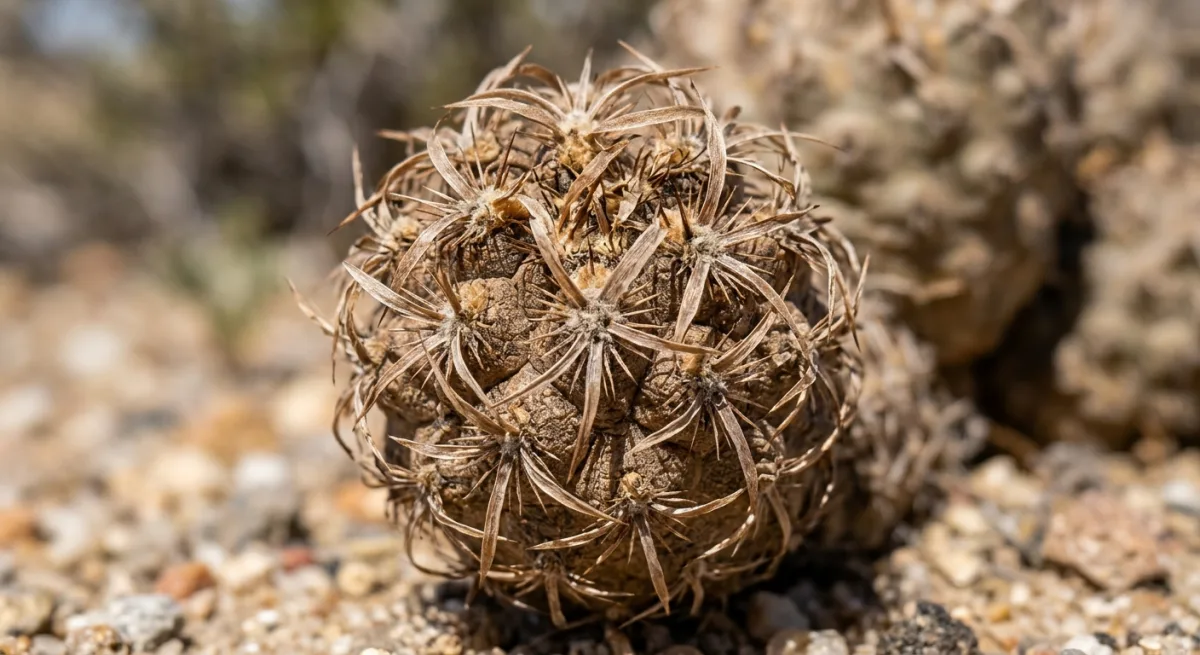
High in the windswept, gravelly desert plateaus along the eastern slopes of the Argentine Andes lies a subtle marvel of evolutionary architecture. Resembling weathered pine or spruce cones scattered across a stony plain, featuring cartilaginous, flexible papery spines and an upright, segmented silhouette, Tephrocactus articulatus ssp. diadematus stands as one of the most mesmerizing geometric curiosities in the succulent kingdom. Commonly known among enthusiasts as the Pine Cone Cactus or Spruce Cone Cholla, this extraordinary specimen brings the rugged, timeless grace of a living geological sculpture directly into your sunniest interior spaces.
Many growers encounter this Andean treasure and feel hesitant, unnerved by how easily its jointed segments dislodge or puzzled by its parchment-textured central spines. Far from a physical flaw, this fragile articulation is a brilliant survival mechanism honed over millennia to endure crushing droughts and browsing native fauna. Settle in with a warm cup of coffee as we wander through the greenhouse together, exploring the precise physiological requirements, soil chemistry, and propagating secrets needed to help your Pine Cone Cactus flourish across decades.
1. Taxonomic Identity, Areole Architecture, and Spine Morphology
Positioned taxonomically within the family Cactaceae and the subfamily Opuntioideae, Tephrocactus articulatus boasts remarkable morphological variability. The subspecies diadematus is distinguished by its distinctly conical, pine-cone-shaped stem segments crowned with prominent, sword-like apical spines that ascend like an ornate tiara—fittingly inspired by the Latin diadema, meaning crown.
The plant's body consists of subglobose to cylindrical segments joined by remarkably narrow, brittle constrictions or joints. Each segment is cloaked in a matte, ash-green to pewter-gray epidermis designed to deflect intense solar radiation. Its areoles house a dual-tiered defense system: First, prominent, flattened, paper- or straw-like central spines that are soft and flexible to the touch, serving as physical sunshades that minimize evaporative surface cooling. Second, concealed beneath these papery shields lie clusters of insidious, microscopic barbed bristles known as glochids. While the central spines buffer searing UV radiation and conserve cellular moisture, the glochids act as a microscopic deterrent against desert herbivores.
2. Light Intensity, UV Dynamics, and Atmospheric Ventilation
Adapted to high-altitude Andean deserts bathed in unimpeded solar energy, Tephrocactus evolved under fierce ultraviolet radiation. Cultivating this species indoors demands substantial, unfiltered light to sustain its dense, spherical, cone-like architecture. Provide at least 5 to 6 hours of direct, unfiltered sunlight daily, ideally sourced from unobstructed south- or southwest-facing exposures.
Deprived of adequate light, the plant rapidly undergoes etiolation. The robust, spherical segments stretch into pale, spindle-shaped, and structurally fragile stems that permanently compromise the specimen's aesthetic and vascular integrity. Open terraces, unshaded window sills, and well-aerated glasshouse benches provide an ideal microclimate. Crucially, still and stagnant indoor air invites opportunistic fungal spore germination. Consistent, buoyant air circulation is just as vital to the metabolic health of this cactus as direct sunlight.
3. Irrigation Dynamics and the Critical Winter Dormancy Regime
Tephrocactus articulatus ssp. diadematus operates via Crassulacean Acid Metabolism (CAM), a water-conserving photosynthetic pathway where stomata open exclusively during cool night hours to capture carbon dioxide, remaining tightly sealed throughout blistering days to lock in moisture. Consequently, habitual, frequent watering is not an act of devotion—it suffocates the subterranean root hairs, depriving them of essential oxygen.
From mid-spring through early autumn, apply the time-tested 'soak-and-dry' method. Drench the container thoroughly until water flows freely from the drainage holes, then refrain from watering entirely until the substrate has dried out bone-dry to the very bottom of the pot. As autumn draws to a close and ambient temperatures decline toward 12–15°C (54–59°F), systematically taper off irrigation to ease the plant into its seasonal dormancy.
4. Highly Mineral Substrate Formulation and Container Architecture
The root system of the Pine Cone Cactus is its most vulnerable organ. Composed of fine, fibrous roots distributed through the upper soil profile, it quickly suffocates in moisture-retentive, peat-heavy potting mixes. To replicate the mineral scree, volcanic deposits, and limestone gravel of the Andean plateaus, your potting medium should comprise 75–80% porous, inorganic aggregates.
The following substrate formulation balances structural aeration, swift drainage, and optimal cation-exchange capacity for Tephrocactus:
| Substrate Component | Volumetric Ratio (%) | Botanical & Structural Function |
|---|---|---|
| Pumice (3–6 mm) | 35% | Anchors the top-heavy segments, creates macro-air pockets, and guarantees rapid drainage. |
| Lava Rock / Scoria (2–4 mm) | 20% | Supplies trace iron and magnesium minerals while preventing soil compaction. |
| Clinoptilolite Zeolite | 15% | Enhances cation-exchange capacity; absorbs excess moisture and buffers fertilizer salts. |
| Coarse Quartz Sand / Perlite | 10% | Promotes effortless lateral penetration of delicate capillary feeder roots. |
| Sifted Coir or Mature Compost | 20% | Provides minimal organic matter and trace nutrient retention (never use raw peat). |
Regarding container selection, unglazed terracotta pots are without equal. The natural microporosity of fired clay permits water vapor to escape laterally through the pot walls, ensuring uniform, three-dimensional drying of the root ball. Non-porous plastic or glazed containers trap lingering moisture, exponentially magnifying the danger of subterranean rot.
5. Induction of Flowering and Strategic Nutrient Supplementation
Flowers on Tephrocactus are relatively rare in domestic cultivation, yet they create an astonishing visual contrast when they emerge. Delicate, tissue-paper-textured petals in hues of satiny cream-white to pale translucent yellow flare open around a dense cluster of brilliant golden-yellow stamens. Triggering these floral buds relies on two inseparable physiological triggers: a chilly, bone-dry winter rest followed by an abrupt elevation in light intensity and temperature in spring.
Exposing the cactus to cold (5–10°C / 41–50°F) without a drop of water throughout winter promotes endogenous stress hormones (such as abscisic acid). As spring warmth awakens the plant, the first deep irrigation shifts hormonal balance toward reproductive bud initiation. Throughout the active growing season (May through July), supply a low-nitrogen, high-potassium-phosphorus liquid fertilizer (such as an NPK 5-10-15 formulation) diluted to one-quarter strength once monthly.
6. Propagation: Segment Partitioning and Grafting Protocols
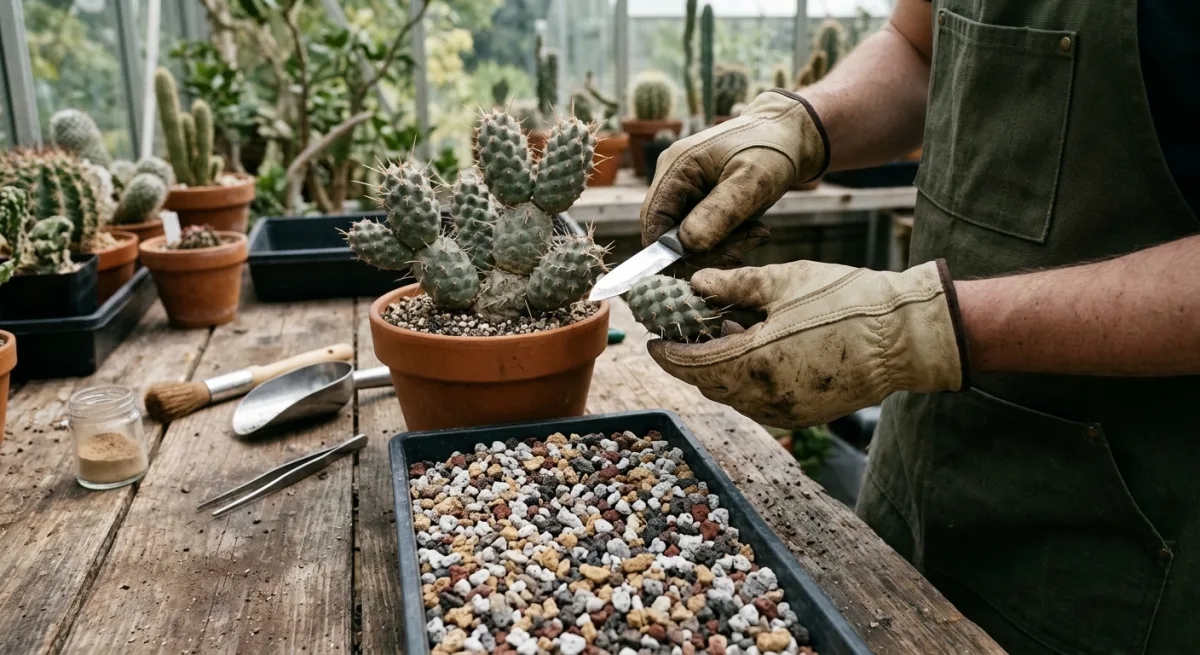
Multiplying your Pine Cone Cactus is remarkably straightforward thanks to its segmented habit. Surgical scalpels are rarely required; the natural cleavage zones separate cleanly when handled properly:
- Harvesting Segments: Grasp a fully mature, firm terminal segment using thick leather gauntlets or silicone-tipped tongs. Gently twist the segment sideways until it detaches at the joint with a distinct, clean snap.
- Callus Formation: Never insert a freshly severed segment directly into damp soil. Place it in a dry, warm, and shaded location with ample airflow for 5 to 7 days. Allow the small detachment wound to desiccate completely, forming a dense, whitish-gray suberized callus.
- Rooting Substrate: Seat the callused segment upright, burying the base no more than 1–1.5 cm deep in a completely dry bed of fine pumice, grit, and zeolite. Withhold all water for the first two weeks.
- Moisture Stimulation: After fourteen days, lightly mist the substrate surface around the base to encourage adventitious root emergence. Vibrant pink-tipped rootlets will anchor the cutting within 4 to 6 weeks.
For growers wishing to accelerate slow growth rates or salvage a prized clone suffering from basal stem damage, cleft or flat grafting onto vigorous rootstocks such as Opuntia ficus-indica or Cylindropuntia provides an exceptional, highly compatible lifeline.
7. Mitigating Pathogenic Rots and Pest Management
The primary hazard confronting the genus Tephrocactus is fungal infection stemming from overwatering and poor ventilation. Soil-borne pathogens such as Fusarium oxysporum and Phytophthora can breach the root zone, reducing structural stem tissues to a dark, gelatinous decay within hours. Immediate intervention is required the moment a segment displays localized softening, uncharacteristic yellowing, or a waterlogged appearance.
Unpot the specimen without delay. Wash away all remaining substrate, and excise all diseased, discolored root and stem tissue using an alcohol-sterilized blade until only pristine, healthy green tissue remains. Dust the clean margins generously with powdered sulfur or activated charcoal to inhibit secondary infections. Additionally, keep a watchful eye for mealybugs nestled in the deep crevices between segments and beneath areolar spines. Eradicate these cottony pests using a cotton swab saturated with 70% isopropyl alcohol, or deploy a targeted systemic insecticide if an infestation establishes a foothold.


Reader Reviews & Comments 4 Reviews
Julian Vance
Clara Higgins
Eleanor Brooks
Marcus Sterling
Leave a Review & Rating
Share your plant care tips, experiences, or questions with our succulent community.