






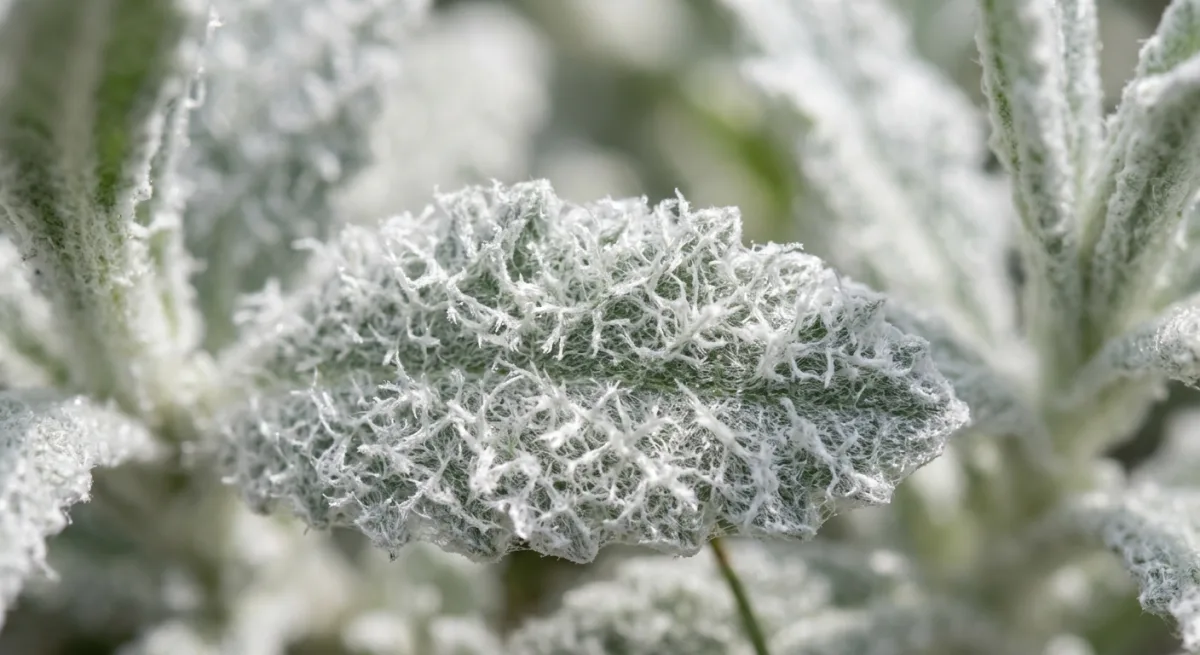
Look across the wind-swept, calcareous crags of Andalusia's Sierra Nevada, and you will spot Lavandula lanata rising from limestone clefts like luminous, silver-white clouds. Commonly celebrated as Woolly Lavender, the thick, velvety felt blanketing its foliage is not mere ornament; it is a sophisticated evolutionary shield composed of branched dendritic trichomes designed to deflect punishing alpine ultraviolet radiation and mitigate desiccation from bone-dry mountain gales. Yet, when transitioned into domestic collections, humid patios, or living rooms, this majestic protective coat can swiftly turn into a fatal moisture trap. As every experienced grower of succulents and xerophytic subshrubs eventually discovers: the plant world's most resilient drought champions are inevitably the first to perish from two shallow inches of standing water in a pot saucer.
The dense trichome mat on Woolly Lavender foliage captures ambient droplets from rainfall or overhead misters like a sponge, establishing a sustained, microscopic humid chamber right against the epidermis. This microclimate provides an ideal incubation ground for aggressive Mediterranean and soil-borne fungal pathogens, notably Phytophthora nicotianae and Botrytis cinerea (gray mold). When you water this species from above, the moisture lingering on the foliage does not refresh the plant—it serves as an open invitation for fungal hyphae to dissolve cellular membranes. If you have observed its silver foliage turning murky brown, the base of the central crown softening, or the upper tips paradoxically wilting despite wet substrate, the vascular xylem vessels within the root collar have become severely compromised.
1. Early Diagnostic Symptoms and Microscopic / Visual Clues
Successfully rehabilitating an ailing Lavandula lanata specimen hinges on catching the earliest physiological warning signals during the critical 72-hour window before total root system collapse occurs. In this xerophytic shrub, decay moves insidiously from the basal crown upward:
- Dulling of the Silvery Luminescence: A thriving Woolly Lavender exhibits a brilliant, almost metallic silver-white sheen under direct sun. When root pressure drops and fungal hyphae compromise water transport, the structural turgor of the trichomes deflates, shifting the plant's reflective hue from striking platinum to a dull, slate-gray, and eventually a sickly, muddy yellow.
- Basal Foliage Necrosis and Gelatinous Collapse: If the velvet leaves at the lowest nodes touching the potting medium soften, turn dark sepia, and develop a limp, water-soaked texture, this is an unequivocal symptom of Botrytis or advancing crown rot.
- Paradoxical Wilting (Vascular Xylem Occlusion): The growing tips droop limply while the potting mix remains visibly saturated. Plant owners often mistake this for thirst and add more water. In reality, the vascular xylem bundles are congested with fungal mycelia and tyloses, preventing even a single molecule of water from ascending to the upper canopy.
- Sub-Epidermal Necrotic Collar at the Stem Base: The crown tissue loses its fibrous firmness. Scraping the bark gently with a fingernail reveals a brown, soft necrotic ring rather than vibrant, chlorophyll-rich green cambium tissue.
- Sloughing Root Cortex and Anaerobic Odor: When the root ball is gently extracted, healthy ivory-colored feeder roots are nowhere to be found. Instead, the root cortex slips off between your fingers like a decaying fibrous sheath, leaving behind fragile central stele threads accompanied by a distinct, sour odor of anaerobic decay.
2. Root Causes and Environmental Triggers
The biological decline of Lavandula lanata is almost invariably triggered by substrate mismatches. Its native Andalusian limestone habitats feature scree and cliff faces with less than 1% organic matter, a alkaline pH buffer between 7.5 and 8.5, and completely unobstructed, gravity-driven drainage.
When this species is potted into standard peat-dominated succulent mixes or rich commercial garden potting soils, the micro-capillary pores retain water for extended periods, driving the dissolved oxygen content within the rhizosphere to zero (severe hypoxia). Deprived of oxygen, root cells undergo anaerobic fermentation, producing ethanol and lactic acid. This metabolic distress signal acts as a potent biochemical beacon, attracting mobile flagellated zoospores of Phytophthora directly to the root caps. Compounding this error is overhead watering. Every droplet caught within the branched trichome thicket remains suspended for hours. In enclosed spaces, display windows, or sheltered patios lacking brisk air movement, this persistent moisture layer allows airborne spores to germinate and breach the epidermal cuticle directly.
3. Natural and Organic Management Protocols
If the pathogen invasion is detected in its earliest stages, deploying biological barriers and natural antifungal interventions can revitalize the plant's endogenous systemic resistance before resorting to harsh synthetic treatments:
- Trichoderma harzianum Biological Inoculation: At the first hint of root stress, inoculating the rhizosphere with beneficial mycorrhizae and Trichoderma harzianum strains creates competitive exclusion. These beneficial fungi rapidly colonize root surfaces, outcompeting destructive oomycetes for space and vital nutrients while releasing chitinolytic enzymes that degrade pathogen cell walls.
- Pure Ceylon Cinnamon and Elemental Sulfur Barrier: After carefully excising necrotic root segments or rotted lower leaves, dusting the exposed wound sites with pharmaceutical-grade elemental sulfur or pure Ceylon cinnamon powder encourages rapid suberization and callous formation, sealing tissue against opportunistic secondary invaders.
- Field Horsetail (Equisetum arvense) Decoction: Rich in bioavailable amorphous silica, an organic horsetail tea strengthens epidermal cell walls when taken up systemically, creating a physical barrier that resists fungal penetration. Always apply this preparation strictly as a root drench; never spray it over the felted foliage.
- Targeted Dynamic Airflow Therapy: In humid weather, position an oscillating miniature fan near your lavender. Maintaining a gentle, continuous air current disrupts the boundary layer microclimate nestled between the dense trichomes, rapidly drying surface humidity and halting spore germination cycles.
4. Chemical and Systemic Fungicide Application Protocol
When necrotic lesions encircle the lower crown and soft rot ascends into the woody stems, biological treatments alone cannot halt the vascular collapse. Immediate systemic intervention is required to arrest internal fungal development. The chemical protocol detailed below relies on true amphimobile (two-way xylem/phloem mobile) active ingredients:
| Active Ingredient | Target Pathogen | Dosage (Per 1 Liter Water) | Application Protocol |
|---|---|---|---|
| Fosetyl-Aluminium (80%) | Phytophthora & Pythium (Root Rot) | 2.5 grams | Apply twice as a root drench, spaced 14 days apart |
| Fludioxonil + Cyprodinil | Botrytis cinerea (Gray Mold) | 0.8 grams | Target directly to the crown base; repeat after 10 days |
| Propamocarb Hydrochloride | Oomycete Root Pathogens | 1.5 ml | Single emergency root drench during substrate repotting |
5. Quarantine and Disinfection Protocol
Upon verifying active disease, prompt sanitary actions prevent cross-contamination across your Mediterranean collection and succulent displays:
- Surgical Debridement: Carefully excise all discolored, blackened, or structurally collapsed foliage and lateral branches using razor-sharp bypass pruners. Make your cuts at least 1 to 2 cm into entirely healthy, firm green tissue.
- Thermal or Chemical Tool Sterilization: Submerge your pruning shears in 70% isopropyl alcohol for 30 seconds or flame-sterilize the cutting edges between every single cut. Transferring fungal inoculants from infected vascular bundles to pristine stems will rapidly accelerate crown loss.
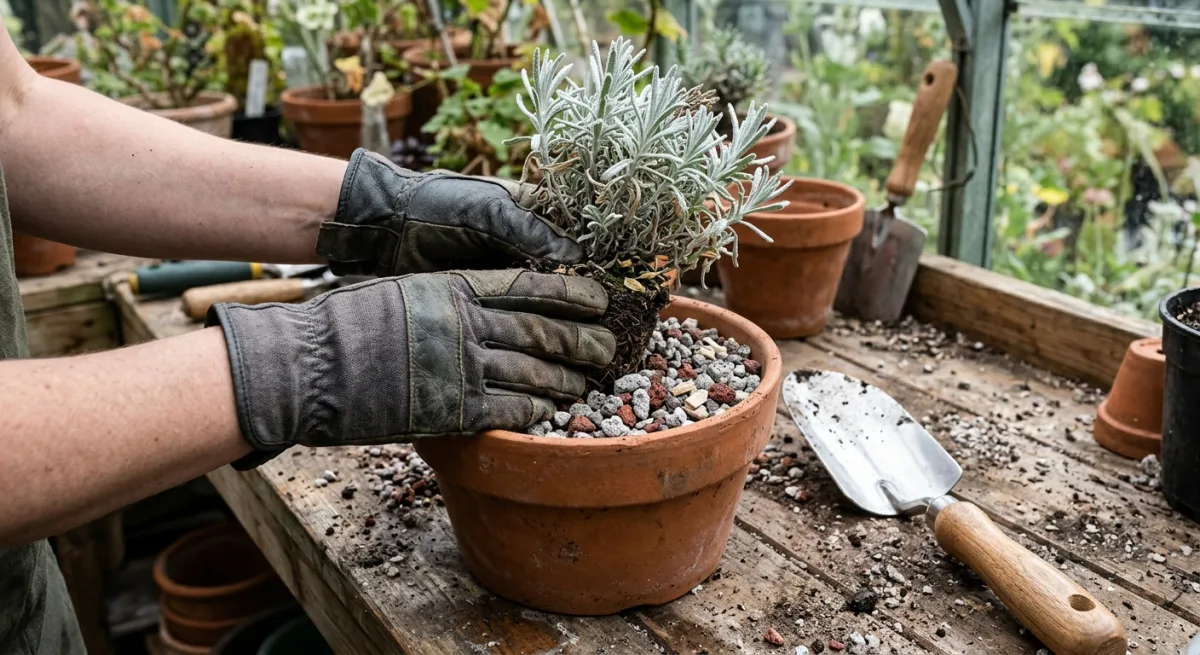
- Substrate Disposal and Container Disinfection: Discard old, diseased potting mix into municipal waste bags—never add it to garden compost. If the plant was housed in plastic, discard the pot entirely. For valued unglazed terracotta, scrub away mineral deposits and soak the pot in a 1:9 household bleach-to-water solution for two hours, followed by thorough air-drying under direct sunlight.
6. Plant Rehabilitation and Long-Term Recovery Care
A post-operative Lavandula lanata recovering from surgical root trimming and systemic fungicidal drenches is in critical physiological shock. The primary horticultural goal is re-establishing immediate rhizosphere aeration and mirroring its native Andalusian alpine conditions.
The Ultimate Scree Substrate Recipe: Woolly Lavender cannot survive long-term in standard peat-based potting soils. Provide an open, coarse, mineral-dominant medium:
- 40% Horticultural Pumice (3–6 mm particle grading)
- 20% Crushed Lava Rock (pozzolana) or Zeolite
- 15% Coarse River Grit or Washed Crushed Limestone (supplying vital calcium carbonate and maintaining a pH around 7.5–8.0)
- 25% Low-organic loam or unfertilized, fibrous blonde peat
Pot Selection: Choose unglazed, high-porosity terracotta containers equipped with ample drainage holes. Unglazed clay allows lateral evaporative transpiration through its walls, keeping the core substrate cool and oxygen-rich.
Post-Recovery Watering Discipline: During rehabilitation, withhold irrigation until the potting mix has dried completely to the base of the container. Water exclusively via controlled bottom-soaking or along the perimeter rim, ensuring moisture never contacts the silver crown. Position the plant where it receives 6 to 8 hours of uninterrupted, direct sunlight daily, paired with vigorous, constant ambient airflow.


Reader Reviews & Comments 4 Reviews
Julian Vance
Liam Henderson
Catherine Sterling
Beatrice Campbell
Leave a Review & Rating
Share your plant care tips, experiences, or questions with our succulent community.