






Peer into the steep, sun-baked river gorges and jagged limestone cliffs of South Africa's Eastern Cape, and you will encounter an astonishing botanical silhouette draping several feet down rocky fissures: Huernia pendula. Unlike most of its upright, clumping carrion flower relatives, this remarkable species embraces gravity in an elegant cascade, making it one of the most prized hanging treasures among succulent connoisseurs. Known colloquially as the trailing Huernia or weeping Huernia, this botanical wonder brings wild, sculptural elegance into our living spaces through succulent tissues evolved to endure blistering winds and fierce gorge sunshine.
While typical houseplants strain vertically toward the ceiling, Huernia pendula billows gracefully over the rim of the pot like a living cliffside tapestry. When its deep crimson-to-black miniature bell flowers emerge from the lower stem nodes, you cannot help but marvel at nature's architectural and chemical brilliance. In this comprehensive guide, we examine the distinctive life cycle of trailing Huernia and explain how to differentiate between natural pendulous growth and weakness-induced stem collapse.
1. Botanical Identity and Morphological Characteristics
Huernia pendula is a succulent, trailing perennial belonging to the dogbane family, Apocynaceae, and the milkweed subfamily, Asclepiadoideae. Its specific Latin epithet, 'pendula', translates directly as 'hanging down' or 'pendant'. In its native habitat within the Kei and Bashee river valleys, the plant thrives as an obligate lithophyte, anchoring into narrow cliff fissures and spilling down vertical rock faces anywhere from 3 to 5 feet (1 to 1.5 meters) in length.
Its stem morphology instantly sets it apart from traditional Huernias. While most species in the genus display thick, prominently toothed (tuberculate) stems, Huernia pendula produces slender, cylindrical stems with 4 to 5 muted angles and a relatively smooth surface. Juvenile shoots initially grow upright, but once they reach approximately 6 to 8 inches (15–20 cm), their sheer weight and lithophytic genetics cause them to arch gracefully downward. Under diffuse shade, the stems maintain a rich emerald green, but when exposed to filtered sunshine, photoprotective anthocyanin pigments turn them an alluring bronze, dusky purple, or russet hue.
The blossoms represent the species' crowning glory. Emerging from late spring through mid-autumn, the solitary flowers measure roughly 0.8 inches (2 cm) across, forming a five-lobed, cup- or bell-shaped corolla. The interior face of the petals is coated in a velvety, deep mahogany-maroon sheen. Unlike giant Stapelia species that emit potent odors, trailing Huernia releases only a subtle, faint scent, just enough to attract its primary pollinators—tiny flies—without overpowering indoor living quarters.
2. Light Requirements and Indoor Positioning
Accustomed to cliff faces partially shaded by sparse xerophytic shrubs, trailing Huernia thrives in bright, ambient light shielded from intense midday sun. Indoors, east- or west-facing windowsills are prime real estate. The gentle warmth of morning light or late afternoon sun fuels cellular photosynthesis and enhances the plant's gorgeous bronze pigmentation without overwhelming its chloroplasts.
If placing your specimen near an unobstructed south-facing window, always filter the sunlight through a sheer linen curtain during the peak summer months. Excessive, unacclimated UV radiation breaks down chlorophyll, resulting in bleached white or pale yellow sunburn scars that permanently damage stem tissue. Conversely, insufficient light triggers etiolation: stems stretch thinly, lose their plump cellular density, turn a sickly pale green, and hang limp and fragile.

3. Watering Discipline: The 'Soak and Dry' Method
Like other stem succulents operating under Crassulacean Acid Metabolism (CAM), Huernias store copious water within specialized parenchyma tissues. This adaptation grants them formidable drought resilience, yet makes them acutely susceptible to overwatering—the single greatest cause of specimen loss. Frequent, shallow watering is not an act of love; it deprives the root zone of oxygen and suffocates hair-thin feeder roots.
The cornerstone of successful cultivation is the strict 'Soak and Dry' protocol. Never water based on a calendar; wait until the entire root ball, from the top layer to the deepest bottom corner of the pot, is completely dry. You can verify moisture levels by inserting a wooden skewer to the base of the container. If it emerges bone-dry and free of damp particles, the plant is ready for hydration.
When watering, drench the substrate thoroughly until water cascades freely through the drainage holes, rinsing away accumulated mineral salts. Always empty the catch tray immediately afterward; standing water is fatal. During winter, when the plant enters semi-dormancy, decrease watering intervals drastically. Allow the stems to wrinkle slightly, offering only a modest splash once or twice a month to prevent root dieback.
4. Ideal Soil Mix and Pot Selection
Because Huernia pendula is adapted to bare rock crevasses, its roots demand perpetual aeration and instant drainage. Standard peat-based potting soils act like waterlogged sponges, cutting off subterranean oxygen and fostering anaerobic pathogen outbreaks. A successful substrate must contain at least 60% to 70% coarse, porous inorganic mineral particles.
| Substrate Component | Ratio (%) | Botanical & Mechanical Function |
|---|---|---|
| Horticultural Pumice (3–5 mm) | 35% | Highly porous; resists compaction while supplying perpetual root-zone oxygen. |
| Crushed Lava Rock / Zeolite | 25% | Anchors the root system, buffers excess mineral salts, and keeps drainage channels clear. |
| Coarse River Sand / Quartz Grit | 10% | Prevents structural settling and ensures uniform water distribution across the root ball. |
| Organic Cactus Substrate (Coco Coir & Sifted Bark) | 30% | Provides essential micro-nutrients, moisture buffering, and root hold. |
Pot selection should honor the trailing habit of this lithophyte. Unglazed terracotta is the gold standard; its micro-porous walls allow soil moisture to evaporate evenly from all sides, preventing wet pockets. Hanging terracotta planters or elevated ceramic pedestals let the stems drape effortlessly, protecting fragile nodes from mechanical friction and promoting 360-degree airflow.
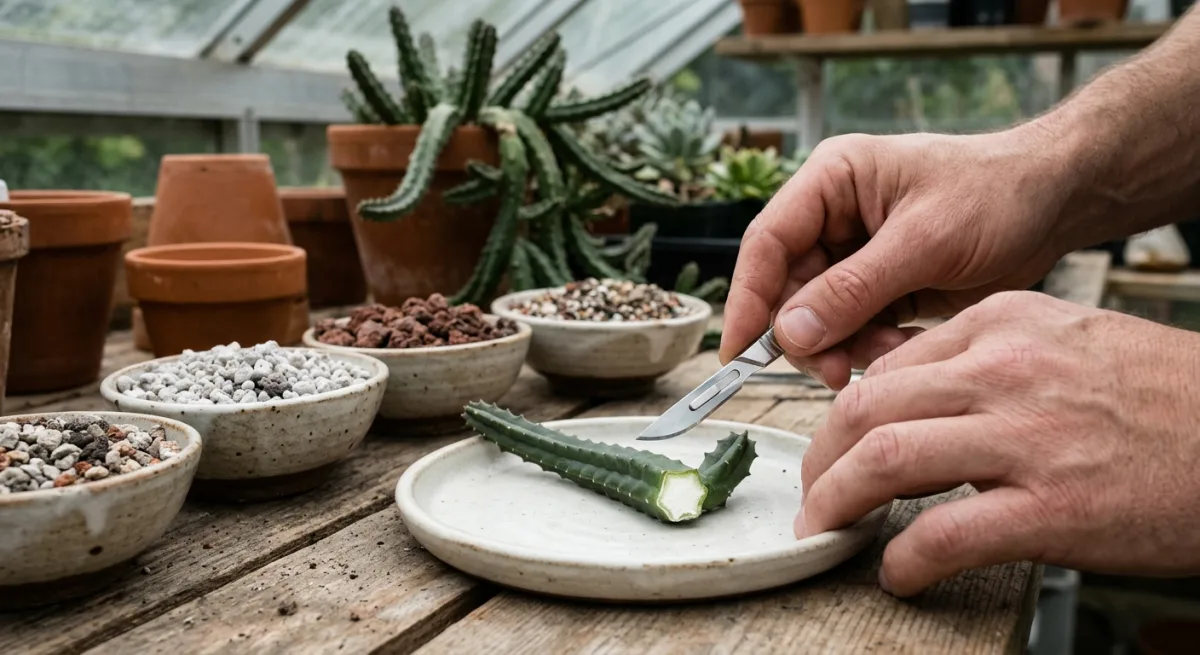
5. Step-by-Step Propagation Techniques
Propagating trailing Huernia via stem cuttings is exceptionally rewarding, boasting a near-perfect success rate when executed during the active growing season. Spring and early summer are prime times, as surging auxin hormone levels accelerate root primordia emergence.
- Select Healthy Cuttings: Identify plump, firm, disease-free stem segments at least 3 to 4 inches (8–10 cm) in length.
- Perform a Clean Cut: Using a razor blade or craft knife sterilized with isopropyl alcohol, sever the cutting at a natural joint. Avoid blunt pruning shears, which crush the succulent vascular bundles.
- Callus Formation (Crucial Step): Do not plant the cutting immediately! Place it in a dry, shaded, well-ventilated spot for 4 to 7 days. Allow a firm, chalky-white, dry callus to form over the wound to block fungal spores.
- Dry Planting: Insert the callused end 1 inch (2–3 cm) deep into completely dry, gritty mineral mix. If needed, support the stem with a small wooden skewer or gravel top-dressing.
- Initial Moisture Discipline: Keep the substrate dry for the first 5 to 7 days. Afterward, begin misting or lightly dribbling water around the stem base. Vigorous roots generally establish within 3 to 4 weeks, at which point standard watering can resume.
6. Common Pests, Diseases, and Treatments
Issues with trailing Huernia almost always stem from cultural stress or environmental imbalances:
- Mealybugs (Pseudococcidae): These sap-sucking pests congregate in cottony white clusters along stem nodes and tucked against the inner pot rim. Remedy: Dab them directly with a cotton swab dipped in 70% isopropyl alcohol. For extensive infestations, apply cold-pressed neem oil or a systemic horticultural insecticide.
- Stem and Root Rot (Fusarium & Phytophthora): Fungal pathogens fueled by soggy soil cause stems to turn mushy, translucent, and black from the roots upward. Remedy: Unpot the plant immediately. Cut away all diseased tissue with a sterile blade until only pristine, healthy green tissue remains. Dust wounds with sulfur powder or ground cinnamon, dry thoroughly, and re-root.
- Etiolation and Drooping: Weak light causes stems to stretch, pale, and sag lifelessly. Gradually transition the plant into a location with brighter, filtered sunlight over a two-week period.
7. Seasonal Care Calendar and Expert Tips
Spring (Waking Phase): Stems visibly plump and resume apical growth. Resume deep watering as the potting mix dries out. Apply a diluted, low-nitrogen, high-potassium cactus fertilizer once a month.
Summer (Peak Growth & Bloom): The active flowering window. Exotic dark bell blossoms open sequentially. Monitor soil dryness more closely during heatwaves, but prioritize maximum ventilation over excessive moisture.
Autumn (Wind-Down): Flower production tapers off. Reduce watering frequency and cease fertilization entirely. If grown outdoors, bring the plant inside before nighttime temperatures dip below 50°F (10°C).
Winter (Resting Period): Keep your trailing Huernia in a cool, bright room maintained at 50–59°F (10–15°C). Keep watering to an absolute minimum to safeguard dormant roots from cold, wet rot.


Reader Reviews & Comments 3 Reviews
Julian Miller
Eleanor Brooks
Claire Harrington
Leave a Review & Rating
Share your plant care tips, experiences, or questions with our succulent community.