






Tucked away along the stony shale ridges and calcareous outcrops of South Africa’s semi-arid Little Karoo, Stapelia erectiflora—affectionately recognized by collectors as the miniature velvet starfish flower or upright carrion flower—is an exquisite botanical treasure. Unlike its massive, dramatically scented relative Stapelia gigantea, erectiflora takes its name from its slender, upright-standing stems and delightfully miniature, velvet-textured bell-like blooms. Adapted to thrive beneath the dappled canopy of companion 'nurse bushes' in its native habitat, this modest succulent brings the quiet resilience of wild desert flora straight to your windowsill.
Belonging to the Stapeliinae tribe within the dogbane family (Apocynaceae), this miniature stem succulent is neither a true cactus nor a conventional broad-leaved houseplant. Having evolved to sacrifice true leaves to prevent transpirational water loss in blistering heat, its four-angled stems direct photosynthetic activity straight through cortical tissues. Cultivating this delicate gem in modern living spaces begins with appreciating this remarkable evolutionary architecture.
1. Botanical Profile & Morphological Nuances
Morphologically, Stapelia erectiflora forms dense, cushion-like clusters branching out from low-lying basal stems. Slender upright branches typically reach 10 to 15 cm in height and measure roughly 1 cm across, showing off four pronounced longitudinal ribs. Along the margins of these ribs sit tiny denticles or tubercles—the evolutionary remnants of ancient ancestral leaves. The epidermis is veiled in a dense coat of microscopic puberulent hairs, giving the stems a velvety, matte, muted greyish-green finish. When kissed by intense direct sunlight, the plant synthesizes protective anthocyanin pigments, blushing into dusty hues of purple, bronze, and crimson.
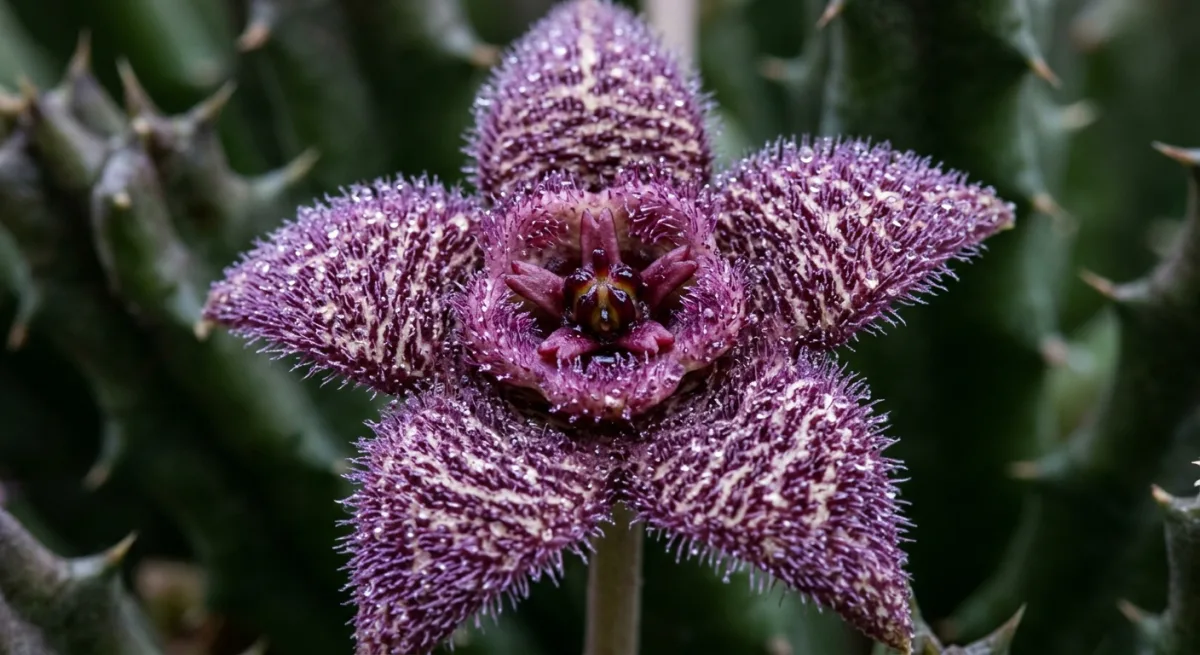
The true marvel, however, unfolds during the blooming period. From late summer into mid-autumn, delicate pedicels emerge near the base of the stems to bear outward-nodding, bell-shaped star flowers whose petal lobes reflex elegantly backward. The interior corolla is densely lined with vibrant violet-to-burgundy trichomes (delicate, multicellular hair-like structures). In nature, these hairs trap morning fog droplets and entice micro-pollinators into the intricate central corona.
2. Light Requirements & Optimal Indoor Positioning
In wild scrublands, Stapelia erectiflora establishes itself beneath low shrubs that soften harsh solar radiation. This ecological niche directly informs how light must be managed in the home. Harsh, unfiltered midday sunlight through glass panes can scorch the epidermal tissue, resulting in chlorosis and permanent scarring. The sweet spot is gentle direct sunlight in the early morning via an east-facing exposure, or bright, dappled light near a south- or west-facing window buffered by sheer curtains.
Conversely, chronically low light causes stems to stretch, pale, and lose structural firmness—a physiological decline known as etiolation. To promote tight, compact stem growth and stimulate floral bud initiation, provide at least 4 to 5 hours of bright, filtered sunlight daily. During winter dormancy, move the pot to a bright yet noticeably cool windowsill to honor its natural resting period.
3. Watering Protocol: Mastering the 'Soak and Dry' Rhythm
The single most destructive mistake in succulent care is sticking to an inflexible calendar schedule (such as watering 'every Monday'). Regular shallow drenching does not demonstrate care; it starves roots of oxygen and triggers swift fungal decline. Stapelia erectiflora relies on Crassulacean Acid Metabolism (CAM) to process carbon dioxide by night, and its delicate fibrous root system requires rapid dry-down cycles with abundant aeration.
Before introducing water, confirm that the potting substrate has dried thoroughly to the base of the pot. Insert a slender wooden skewer down to the bottom; if it emerges completely dry and clean, the root zone is ready. Apply water generously until it runs freely from the drainage holes, employing the classic 'soak and dry' technique, and discard every drop of run-off collected in the saucer immediately. From late autumn through late winter, when the plant rests, suspend watering almost completely. Provide only a light, cautious splash once a month if the stems begin to wrinkle excessively.
4. Ideal Substrate Formulation & Potting Dynamics
Preventing root rot hinges on using an open, heavily inorganic mineral substrate that drains rapidly while preserving internal pore space. Standard peat mixes or regular garden soil are dangerous for this species. The following balanced formula has been refined through years of cultivation in specialist collections:
| Component | Proportion (%) | Botanical Function & Soil Benefit |
|---|---|---|
| Pumice (3–5 mm grain) | 35% | Creates porous aeration chambers and prevents root compaction |
| Lava Grit (Scoria) / Zeolite | 25% | Provides mineral weight, buffers pH, and adsorbs excess salts |
| Coarse Quartz Sand / Grit | 15% | Accelerates swift moisture runoff and prevents clumping |
| Quality Low-Peat Succulent Blend / Coco Coir | 20% | Retains trace micronutrients and just enough baseline moisture |
| Crushed Horticultural Charcoal | 5% | Supplies natural antifungal protection and binds impurities |
Pair this mineral mix with an unglazed terracotta pot. The porous clay allows moisture to evaporate laterally through the pot walls, cooling the roots and preventing standing water pockets. Because Stapeliad roots remain relatively shallow, shallow succulent pans or half-pots with multiple drainage apertures are far superior to deep, standard planters.
5. Step-by-Step Propagation Techniques
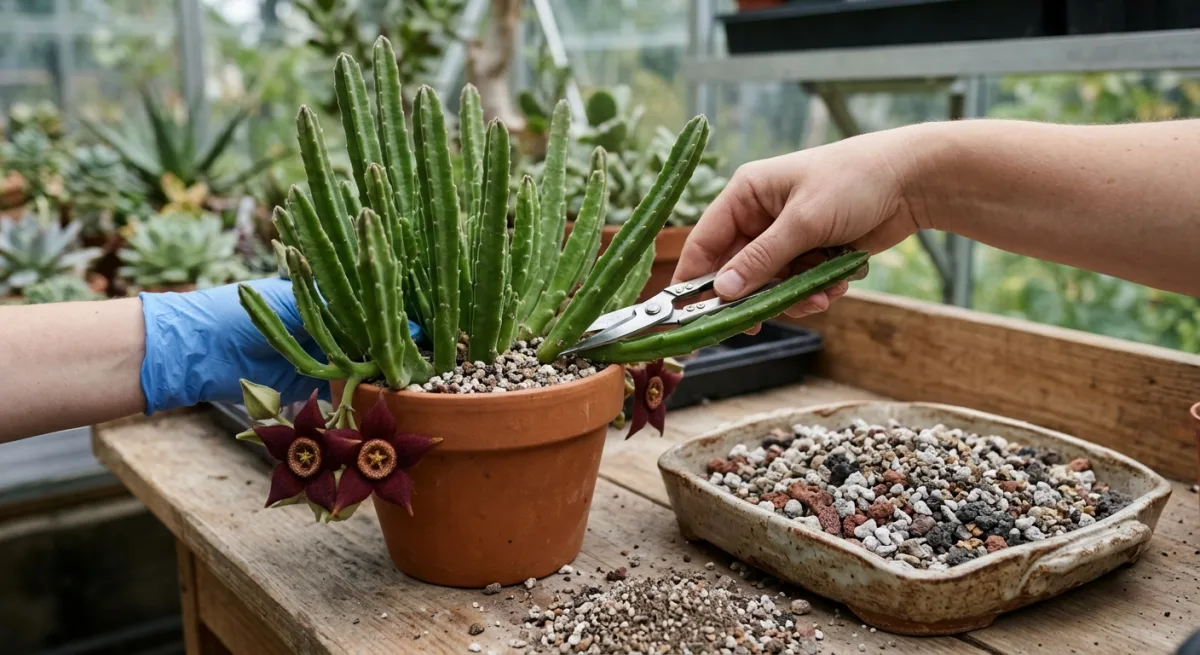
Multiplying Stapelia erectiflora is straightforward and exceptionally rewarding. The plant readily produces healthy offsets from its base, which make ideal cuttings:
- Select Mature Stems: In spring or early summer, select a firm, mature side shoot roughly 5 to 7 cm long emerging near the crown.
- Make a Clean Detachment: Using a sterilized, razor-sharp blade, sever the cutting at the narrow joint where it connects to the primary stem.
- Callus Formation: Never plant freshly cut succulent stems directly into damp soil! Rest the cutting in a dry, shaded, well-ventilated spot for 4 to 7 days until the cut end forms a dry, firm, whitish callus. This barrier stops pathogenic fungi from invading the tissue.
- Dry Potting: Insert the callused stem upright into dry mineral substrate, roughly 1 to 2 cm deep. Use coarse pumice chunks to brace the cutting securely.
- Initial Moisture Timing: Withhold water completely for the first 7 to 10 days. By the second week, mist the surface substrate lightly to coax new feeder roots out. Cuttings typically establish healthy roots within 3 to 4 weeks.
6. Common Pests, Diseases, and Integrated Treatments
The primary adversary of the Stapeliad collector is the mealybug (Pseudococcidae). These persistent sap-feeders settle into the recessed furrows between stem ribs or cluster invisibly around the root collar, weaving protective waxy cotton webs and draining vital plant juices until growth stalls.
For minor surface infestations, dab individual pests away using a cotton swab dipped in 70% isopropyl alcohol. If subterranean root mealybugs appear, remove the plant from its container, wash all old soil away with tepid water, trim damaged roots, let dry, and apply a systemic drench such as neem or horticultural insecticide. To guard against soil fungi, occasional preventative waterings infused with organic cinnamon extract or copper-based treatments provide an effective protective buffer.
7. Seasonal Rhythm & Cultivation Calendar
Spring (Waking Phase): As temperatures climb above 18°C (64°F), reintroduce water steadily. Apply a balanced, low-nitrogen cactus fertilizer diluted to quarter-strength once early in the growing season.
Summer (Active Vegetative Growth): Protect the stems from scorching afternoon sun with dappled shade. During severe heatwaves exceeding 35°C (95°F), the plant may pause active growth; ease back on watering accordingly. A pronounced day-to-night temperature swing of 10–12°C helps trigger flower buds.
Autumn (Peak Flowering): Blooms open in succession throughout early to mid-autumn. Maintain consistent, moderate soil drying intervals and avoid shifting or rotating the pot once swollen buds appear to prevent bud drop.
Winter (Dormancy): Overwinter your plant in a cool, bright spot between 8°C and 12°C (46–54°F). Keep substrate almost bone dry. Protect rigorously against freezing temperatures, as exposure below 5°C (41°F) causes irreversible cellular damage.


Reader Reviews & Comments 3 Reviews
Marcus Thornton
Chloe Bennett
Eleanor Vance
Leave a Review & Rating
Share your plant care tips, experiences, or questions with our succulent community.