






When nature's sacred geometry breaks free from the flat confines of traditional pots, we are treated to some of the botanical realm's most magnificent sculptural displays: living mixed succulent balls (also celebrated among garden designers as succulent kissing balls or topiary spheres). Uniting resilient xerophytic species from the rugged cliffs of South Africa to the sun-bleached plateaus of Mexico across a full 360-degree orb, these living installations represent an exquisite harmony of biological adaptation and visual wonder. While plant lovers often admire them with a mixture of reverence and maintenance anxiety, understanding their physiological mechanics turns these living spheres into long-lasting biological jewels that retain their balanced symmetry year after year.
Unlike specimens nestled in conventional containers, a mixed succulent sphere operates as a suspended micro-ecosystem exposed to gravity, omnidirectional light gradients, and specialized moisture dynamics. The silvery, powdery coating adorning many of their leaves—known botanically as epicuticular wax or farina—serves as the plant's endogenous mineral sunscreen and water-repellent shield. When handling, planting, or grooming these spheres, preserving this protective wax against abrasive fingerprints is your first crucial step in safeguarding cellular health. Let us dive deep into the botanical architecture, root-zone hydraulics, and step-by-step care protocols required to keep your living succulent spheres thriving in peak vitality.
1. Botanical Identity and Morphological Characteristics
In taxonomic horticulture, a mixed succulent sphere does not signify an individual plant species; rather, it denotes an intentional polyculture composed of compact, non-competitive members of the Crassulaceae family displaying matched drought tolerances and growth tempos. The living structural backbone of these arrangements typically relies on Sempervivum (Hens and Chicks), miniature Echeveria cultivars (notably E. elegans and E. minima), clumping Sedum varieties (such as Sedum album and Sedum rubrotinctum or Jelly Beans), complemented by trailing accents like Senecio rowleyanus (String of Pearls).
These plants utilize Crassulacean Acid Metabolism (CAM) photosynthesis, a physiological survival marvel wherein stomata open exclusively at night to capture carbon dioxide. This minimizes transpiration under scorching daylight conditions while accumulating nocturnal malic acid pools for diurnal sugar synthesis. Within the confines of a suspended spherical matrix, their root systems (rhizosphere) cannot penetrate deeply in a vertical plane; instead, they develop an intricate horizontal fibrous weave that grips tightly into the porous, moss-lined core. Although leaf water-storage parenchyma varies between thick-leaved rosettes and pendant beads, all chosen species share an extraordinary capacity to hold mucilaginous cellular reserves that endure extended dry spells without collapsing.
2. Light Requirements and Domestic Positioning
The primary physiological challenge of managing a spherical succulent arrangement indoors is asymmetrical photon capture. A succulent orb placed passively on a sunny window ledge collects light on only one hemisphere; the shaded underside and rear face promptly succumb to etiolation—an unnatural elongation of stems paired with pallid, weakened tissue as cells stretch frantically toward light. To maintain tight rosette morphology and rich coloration, the arrangement demands at least 5 to 6 hours of bright, filtered sunlight or high-intensity grow lights every single day.
If you suspend your succulent ball from a ceiling hook or bracket, choose a position directly adjacent to an unshaded south- or west-facing window. For orbs displayed atop decorative pedestals or shallow ring stands, adopt a strict rotational routine: turn the sphere ninety degrees (a quarter-turn) every 3 to 4 days. This systematic rotation guarantees uniform ultraviolet exposure across every rosette, stimulating anthocyanin and carotenoid protective pigments that reward you with balanced, blushing tones of crimson, amethyst, and coral across the entire surface.

3. Irrigation Discipline: The 'Submerge-and-Dry' Protocol
Frequent, shallow watering is never a sign of good botanical care; with succulents, it suffocates the root hairs and invites fungal collapse. Standard top-down watering with a can fails completely on a spherical form: water simply runs over the outer contours, failing to penetrate the dense internal core while becoming dangerously trapped inside the central hearts of upward-facing rosettes.
The indispensable gold standard for spherical succulent arrangements is the Submersion (Bottom Soaking) Method. Wait until the entire orb feels feather-light in your hands and the succulent leaves show the subtlest loss of turgor pressure (slight give when gently pressed). Fill a deep basin or bucket with room-temperature, dechlorinated water and submerge the entire sphere gently. Keep it underwater for roughly 10 to 15 minutes, allowing the fibrous core to fully rehydrate until air bubbles cease rising to the surface. Next, lift the sphere out and suspend it over a drainage grid for at least 30 minutes to permit all gravitational water to drain away completely. Never set a dripping-wet sphere directly into an enclosed decorative bowl or poorly ventilated corner.
4. Substrate Architecture and Spherical Construction
Standard bagged potting soil is wholly unsuitable for crafting a living succulent ball; it leaches out through wire gaps, compacts over time, and retains far too much moisture, suffocating root tissue. The structural core must be engineered around long-fiber sphagnum moss and coco coir interwoven with high-porosity volcanic aggregates, securely bound within a galvanized wire armature or wrapped with rot-resistant biological cordage.
The higher the structural aeration inside the core, the more freely root xylem tissues can respire, creating an inhospitable zone for anaerobic root-rotting pathogens. The following table outlines the ideal substrate formulation for engineering and maintaining a long-lived succulent sphere:
| Substrate Component | Ratio by Volume (%) | Botanical Function & Structural Benefit |
|---|---|---|
| Long-Fiber Sphagnum / Coco Coir | 35% | Creates the cohesive structural core while providing mild, buffered moisture retention |
| Fine Horticultural Pumice (2–4 mm) | 30% | Guarantees permanent macropores, preventing compaction and maximizing root oxygenation |
| Calcined Clay or Horticultural Zeolite | 20% | Dramatically increases Cation Exchange Capacity (CEC) and moderates nutrient release |
| Aged Crushed Bark / Coarse Perlite | 15% | Provides an airy organic landing bed that allows delicate emerging rootlets to anchor securely |
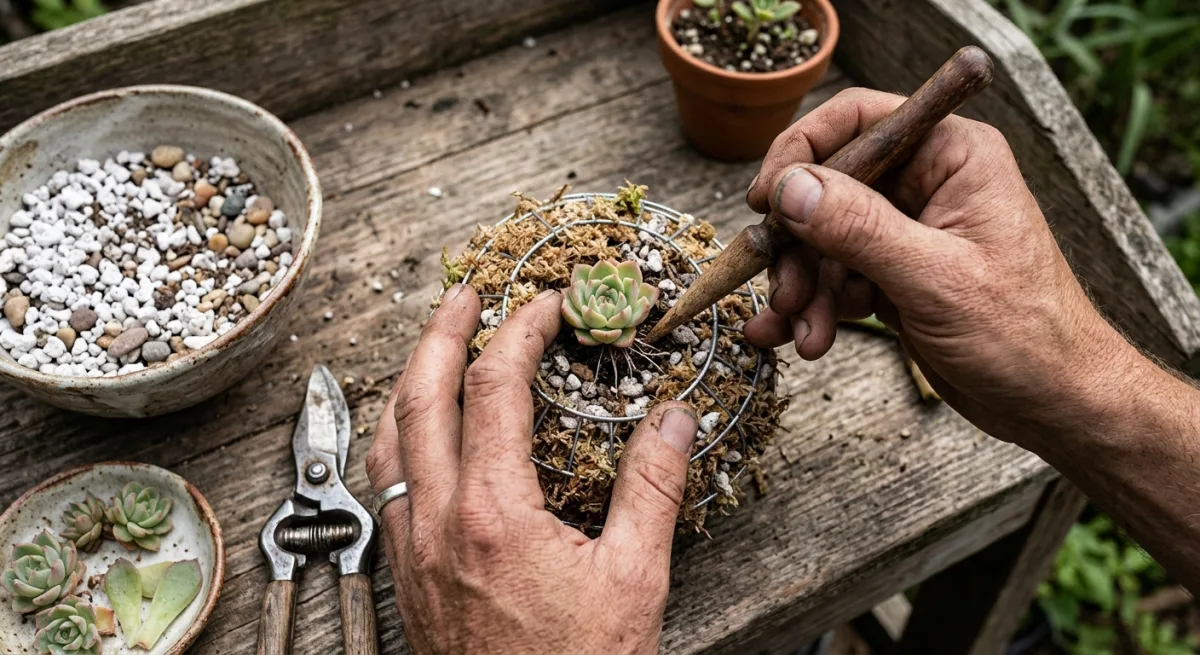
5. Step-by-Step Propagation and Rejuvenation
Over time, a flourishing succulent ball naturally evolves: rosettes push out stolons, trailing stems lengthen, and older specimens require artistic pruning. To rejuvenate thinning spots or craft a brand-new living orb from scratch, rely on terminal stem cuttings and lateral offset separation:
- Harvesting Healthy Offsets: Identify robust offshoots (pups) produced around the margins of mature Sempervivum or Echeveria rosettes. Using a surgical scalpel or razor-sharp pruning snips disinfected with isopropyl alcohol, sever the stolon cleanly as close to the parent core as possible.
- Callus Formation: Never plant freshly cut succulent offsets into damp medium immediately. Place the cuttings on a dry, shaded tray with good airflow for 2 to 4 days. This allows the severed vascular bundle to form a firm suberized scar tissue (callus) that shields the cutting against soil-borne pathogens.
- Insertion into the Matrix: Use a chopstick or pencil to open a small pilot hole through the moss barrier into the aerated core. Gently insert the callused stem into the opening. If the cutting feels loose, anchor it temporarily using a U-shaped piece of florist wire or hair pin until root hairs lock into the fibers.
- Post-Planting Acclimation: Refrain from giving the entire ball a full soaking for the first 7 to 10 days post-insertion. Instead, lightly spritz the surface around the new cuttings to stimulate adventitious root development. Once the new roots have anchored securely into the core, resume normal submersion soaking.
6. Common Pests, Pathologies, and Botanical Treatments
Due to the dense, clustered nature of a mixed succulent ball, mealybugs (Pseudococcidae) represent the most frequent insect pest. These sap-sucking pests hide deep within the secluded leaf axils, concealing themselves beneath white, cottony secretions. At the first sign of an infestation, dab individual clusters directly with a cotton swab soaked in 70% isopropyl alcohol to dissolve their protective wax coating on contact. For broader outbreaks, spray the sphere thoroughly at dusk with cold-pressed neem oil or a potassium fatty-acid horticultural soap solution.
On the pathological front, root and crown rot caused by Fusarium or Phytophthora fungi is the primary killer. If individual leaves turn translucent, mushy, or take on a water-soaked yellowish cast before dropping, that sector is suffering from excess moisture. Carefully extract the rotting specimen with curved botanical tweezers, scrape away any decaying matter, dust the exposed void with elemental sulfur powder or ground organic cinnamon (a natural antifungal), and withhold all water from the sphere for at least two full weeks to let the rhizosphere recuperate.
7. Seasonal Horticultural Calendar & Expert Maintenance
- Spring: The period of active hormonal awakening and vigorous cellular division. Relocate the sphere to embrace gentle morning sunlight. Once a month, enrich your submersion water with a quarter-strength, low-nitrogen balanced succulent fertilizer.
- Summer: Under extreme summer heat (above 32°C / 90°F), CAM plants may enter semi-dormancy to conserve internal fluids. Protect the sphere from scorching midday sun. Schedule watering sessions strictly by monitoring the dry weight of the orb rather than relying on a fixed calendar date.
- Autumn: Growth decelerates while cooler nighttime temperatures trigger dazzling anthocyanin expression. Cease all fertilization completely and stretch the intervals between soakings as tissue transpiration declines.
- Winter: True dormancy period. Keep the sphere indoors away from freezing drafts in a bright, cool location (ideal temperature range: 10–15°C / 50–59°F). Water sparingly—only once every 4 to 6 weeks—just enough to keep the fibrous internal root systems from experiencing irreversible desiccation.


Reader Reviews & Comments 4 Reviews
Clara Higgins
Eleanor Vance
Marcus Sterling
Julian Hayes
Leave a Review & Rating
Share your plant care tips, experiences, or questions with our succulent community.