






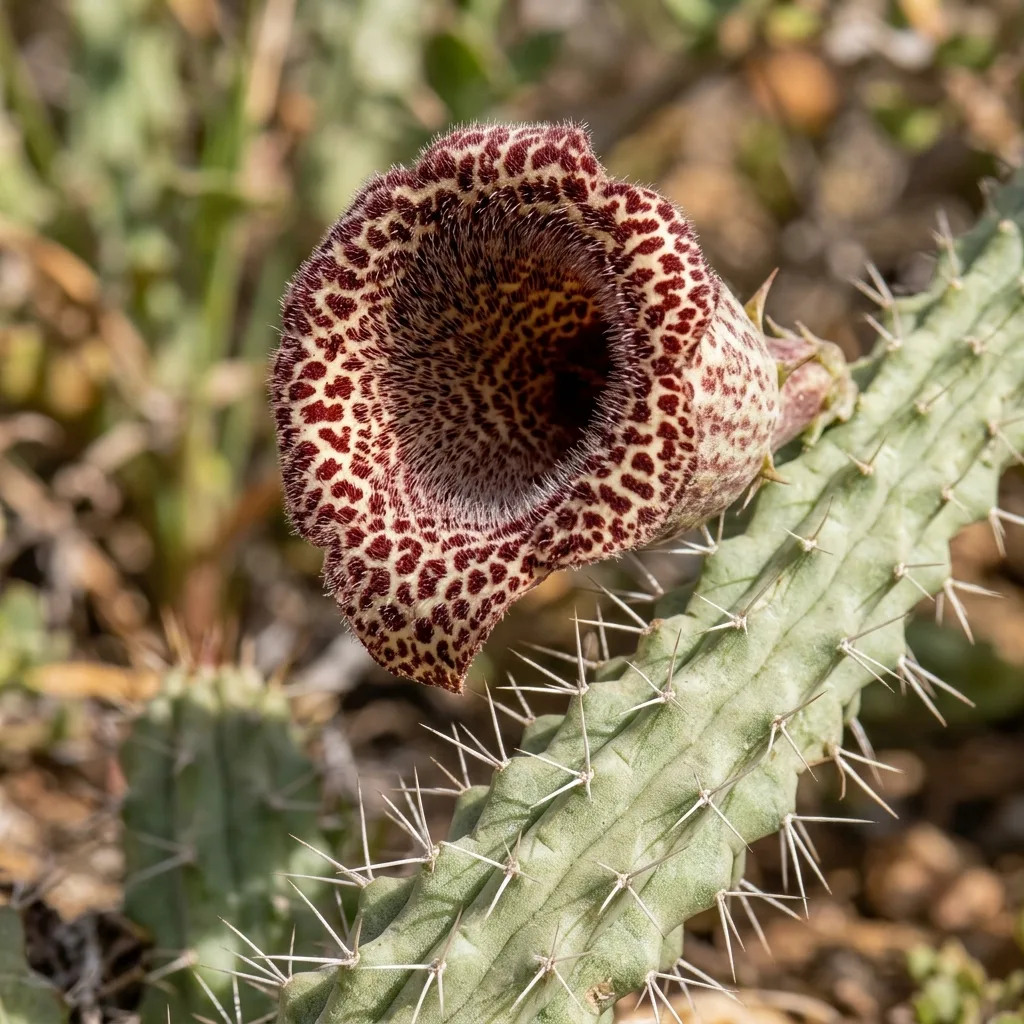
Across the blistering dunes of South Africa's Kalahari Desert and the barren gravel plains of the Great Karoo, an intriguing silhouette rises that might easily be mistaken for an ordinary desert cactus at first glance. Look closer, however, and you will notice 10 to 12 ribbed cylindrical stems crowned with triads of fine white bristles, producing an astonishing summer illusion: gargantuan, speckled, bell-shaped trumpets erupting directly from their modest bases. Known in the botanical community as Tavaresia barklyi and affectionately referred to among collectors as the 'Thimble Flower Succulent' or 'Fairy Thimble', this extraordinary specimen ranks among the most aristocratic and mesmerizing treasures in the entire succulent world.
Join us as we explore the precise physiological requirements, root aeration principles, and flowering triggers of this remarkable member of the Apocynaceae family. Combining scientific rigor with warm, hands-on cultivation wisdom, this comprehensive guide will equip you to grow this desert marvel with absolute confidence.
1. Botanical Identity and Morphological Characteristics
Tavaresia barklyi is a specialized succulent perennial belonging to the dogbane family (Apocynaceae) within the stapeliad tribe (Ceropegieae). While completely unrelated to true cacti (family Cactaceae), it has evolved remarkably similar ribbed, spiny stems through convergent evolution—a brilliant ecological adaptation designed to minimize moisture transpiration while maximizing photosynthetic surface area in hyper-arid habitats. The stems are erect, typically measuring 8 to 15 cm in height, exhibiting 10 to 12 pronounced longitudinal ribs clothed in pale glaucous-grey to olive-green hues. At the tip of each tubercle sits a modified three-pronged bristle structure (one prominent central spine flanked by two shorter lateral ones) that serves to dissipate intense solar radiation and deter grazing herbivores.
The true botanical showstopper, however, lies in its blossoms. Emerging from the basal tubercles of mature stems, the flowers form breathtaking trumpets or thimble-shaped tubes reaching between 10 and 14 cm in length. Their pale cream or sulfur-yellow ground color is densely stippled and streaked with deep maroon-purple leopard patterning. The inner floral throat is lined with velvety papillae and emits a faint, musky organic scent designed to attract pollinating carrion flies. Fortunately for indoor growers, unlike its cousin Stapelia gigantea, the fragrance of Tavaresia is remarkably mild and virtually undetectable unless examined at close quarters.
2. Light Requirements and Indoor Positioning
In its native Kalahari biome, Tavaresia thrives under relentless, unfiltered sunshine. Consequently, when cultivated indoors, this species makes zero compromises regarding solar intensity. Insufficient irradiance triggers rapid etiolation (pale, spindly, attenuated stem growth), softens the ribs, compromises the epidermal cuticle, and entirely suppresses flower bud differentiation.
- Indoor Positioning: An unobstructed south- or southwest-facing windowsill providing at least 5 to 6 hours of direct, intense sunlight daily represents the absolute benchmark for indoor success.
- Winter Placement: As natural photoperiods contract and sun angles drop, position your specimen in the brightest microclimate available. Ensure stems do not physically touch ice-cold window panes, and protect the plant from the parching thermal currents generated by radiators and HVAC vents.
- Summer Acclimation: When shifting your potted Tavaresia outdoors to a balcony, patio, or greenhouse for the summer, never subject it to scorching midday sun abruptly. Provide a 7- to 10-day transition period beneath 30% shade cloth or dappled light to prevent irreversible epidermal photodamage and thermal blistering.
3. Watering Discipline: The 'Soak and Dry' Protocol
The single most catastrophic mistake in Tavaresia husbandry is ignoring the fundamental rules of arid succulent hydration. Stapeliads possess cortical stem tissues with an astonishing capacity for cellular water retention; however, their root systems are exceptionally intolerant of hypoxic (oxygen-deprived), waterlogged conditions. Re-watering while the substrate retains residual core moisture invites aggressive oomycete pathogens and root rot, transforming a turgid stem into a hollow, blackened mass within hours.
Your watering regimen must adhere strictly to the 'Soak and Dry' methodology. Allow the potting medium to desiccate completely—not merely across the top layer, but throughout the entire vertical profile of the pot—before saturating thoroughly. When irrigating, apply water generously until it runs freely through the base drainage holes, and empty the drip saucer immediately; never allow the container to sit in pooled water. During winter dormancy, provided ambient temperatures hover around 12–15°C (54–59°F), restrict watering to once monthly or pause altogether until subtle longitudinal creasing appears along the ribs.
4. Ideal Substrate Mix and Pot Selection
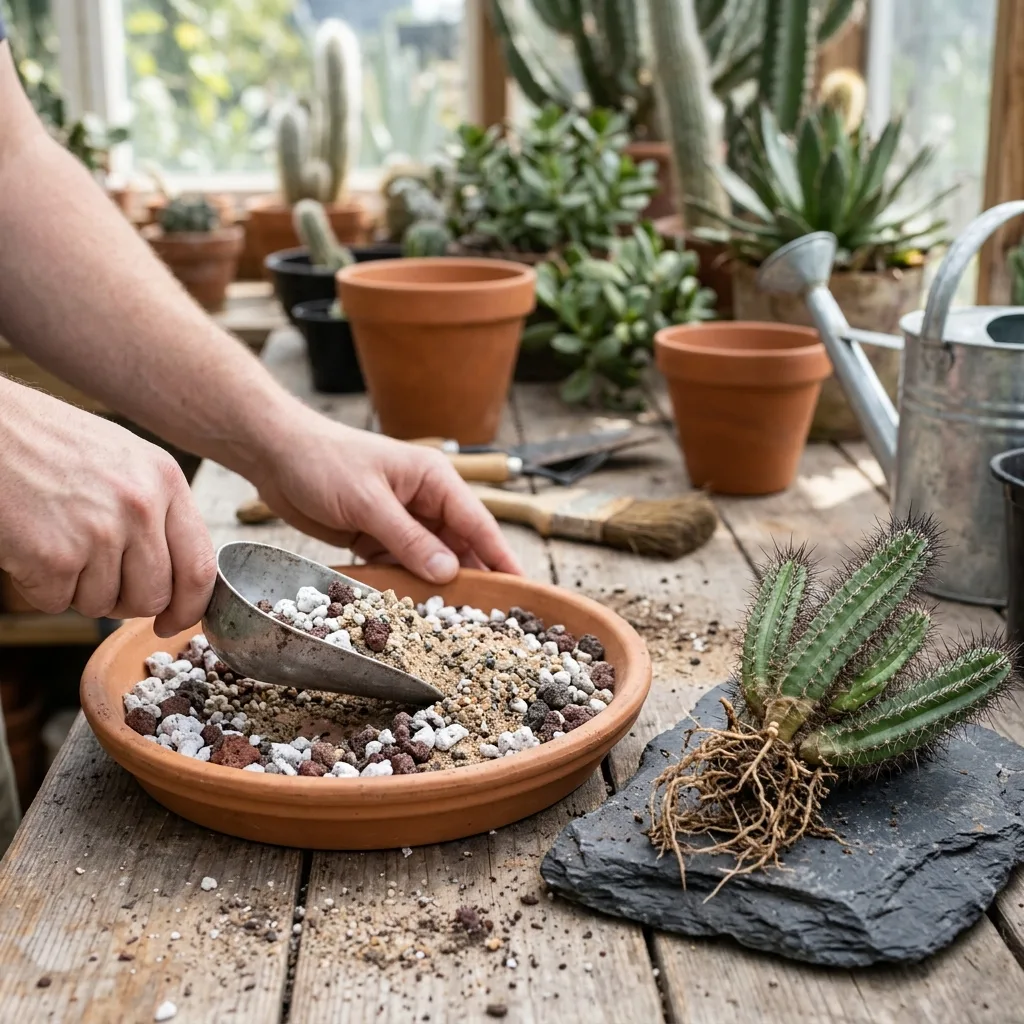
Commercial 'cacti and succulent' potting mixes straight from the bag are an invitation to root failure for this species. Tavaresia demands a highly porous, ultra-inorganic substrate where applied water drains through in seconds, minimizing capillary water retention while maximizing rhizosphere gas exchange. At least 70% to 80% of your blend should consist of coarse, porous minerals and volcanic aggregates.
| Substrate Component | Ratio (%) | Physical / Horticultural Function |
|---|---|---|
| Porous Horticultural Pumice (2–4 mm) | 40% | Delivers superior rhizosphere aeration and enduring structural porosity. |
| Red / Black Volcanic Lava Rock | 25% | Heavy, vesicular aggregate that accelerates swift gravitational drainage. |
| Clinoptilolite Zeolite | 15% | Adsorbs excess nutrient salts and helps buffer against harmful root pathogens. |
| Coarse Quartz Sand / Grit | 10% | Replicates natural desert gravel beds and anchors the fine feeder roots. |
| Fibrous Coconut Coir or Peat | 10% | Provides the bare minimum organic matter to sustain feeder root hair development. |
Regarding containers, choose unglazed terracotta exclusively. The breathable, micro-porous walls of unglazed clay wick away subsurface moisture, reducing root rot vulnerability significantly. Furthermore, because Tavaresia barklyi develops a shallow, lateral root network rather than a deep taproot, wide, low-profile succulent bowls or shallow pans are vastly superior to deep cylindrical pots.
5. Step-by-Step Propagation Techniques
While the Thimble Flower Succulent can be grown from fresh seed, the most efficient, predictable, and rewarding propagation method is taking stem cuttings (basal offsets). To achieve high rooting success rates without pathogen contamination, execute the following protocol:
- Timing: Harvest cuttings during late spring or early summer when ambient temperatures are rising and the mother plant enters active vegetative metabolism.
- Harvesting the Offset: Select a vigorous, fully developed basal branch. Using a surgical scalpel or razor blade sterilized with 70% isopropyl alcohol, excise the offset at its narrow junction with the main stem in a single clean cut.
- Callus Formation (Crucial Step): Never plant a fresh cutting immediately! Set the excised piece on a sterile paper towel in a warm, dry, shaded, well-ventilated room for 5 to 7 days. This allows the cellular cut surface to suberize, forming an impenetrable, fungal-resistant callous barrier.
- Dry Potting: Insert the calloused base 1 to 2 cm deep into the completely dry mineral substrate outlined above. Provide a small support stake if needed. Do not apply water.
- Initiating Hydration: Maintain the cutting in bone-dry medium for 10 to 12 days. In response to moisture stress, root primordia will activate. After day 12, begin light basal watering or bottom-wicking to stimulate root elongation into the surrounding mineral matrix.
6. Common Pests, Diseases, and Clinical Remedies
Despite its formidable desert constitution, Tavaresia barklyi is susceptible to specific cultivation pitfalls and opportunistic pests when environmental balances falter:
- Stem and Root Rot (Black Rot / Fusarium spp.): Manifests as sudden basal softening, dark water-soaked lesions, and structural collapse. Caused directly by overwatering or dense, moisture-retentive soils. To salvage the specimen, unpot immediately, cut back cleanly to healthy, uninfected green tissue, dust the cut surface with elemental sulfur or activated charcoal, and re-root as a fresh cutting after callousing.
- Mealybugs (Pseudococcidae): These pervasive sap-sucking pests establish cottony white nests deep between the stem ribs and bristle bases. Eradicate spot infestations with a cotton swab dipped in 70% isopropyl alcohol. For extensive infestations, apply cold-pressed horticultural neem oil or a systemic insecticide during the active growth cycle.
- Spider Mites (Tetranychidae): Thriving in dry, stagnant indoor environments, these microscopic mites spin fine webbing between ribs, leaving behind stippled, rusty-brown scar tissue. Treat with targeted insecticidal soap or miticide applications, and significantly improve ambient ventilation.
7. Seasonal Care Calendar and Expert Blooming Tips
To witness Tavaresia unleash its spectacular, thimble-like floral trumpets summer after summer, synchronize your cultural practices with its native phenotypic cycle:
- Spring (Awakening): As ambient temperatures consistently exceed 18°C (64°F), gradually increase watering frequency. Once vegetative growth recommences, apply a balanced, low-nitrogen, high-potassium liquid cactus fertilizer diluted to one-quarter strength once per month (excessive nitrogen causes rapid, bloated growth prone to epidermal cracking).
- Summer (Peak Flowering): Provide maximum warmth and direct sunlight. Crucial rule: once floral buds emerge, do not rotate or relocate the pot. Sudden shifts in light angle or ambient conditions often cause these massive, nutrient-heavy buds to abort and drop prematurely.
- Autumn (Transition): As day length declines and evening temperatures drop, taper your watering intervals substantially and cease all fertilizer applications, signaling the tissues to harden off in preparation for dormancy.
- Winter (Dormancy): Maintain your plant in a very bright location where temperatures remain reliably between 10°C and 14°C (50–57°F). Provide just enough water every 4 to 5 weeks to prevent total desiccation and root hair mortality.


Reader Reviews & Comments 4 Reviews
Eleanor Sterling
Julian Vance
Clara Higgins
Marcus Thornton
Leave a Review & Rating
Share your plant care tips, experiences, or questions with our succulent community.