






While trekking across the sun-scorched quartz flats and weathered limestone ridges of South Africa’s Little Karoo basin, spotting the living organism at your feet requires extraordinary visual concentration. Rhinephyllum muirii—commonly cherished among collectors as the night-scented dwarf stone succulent—is one of nature’s most accomplished camouflage masters. During prolonged droughts, this fascinating dwarf member of the Aizoaceae family recedes toward the ground, transforming into what appears to be an inanimate shard of stone to escape the blistering desert heat. Yet, as dusk descends, it unfolds radiant cream-yellow petals that release an intoxicating, sweet perfume into the cooling desert air.
If you have welcomed this rare South African gem to your windowsill or specialized succulent display, you are not merely tending to an ordinary potted houseplant; you are stewarding millions of years of evolutionary brilliance. Recreating the Karoo’s low-humidity, breezy, and mineral-rich conditions in your indoor growing space Is the Thumb Cactus? Mammillaria Matudae Care and Blooming Guide">Is the Orange Snowball Cactus? Botanical Care Tips for Growing Rebutia">is the secret to keeping your plant compact, resilient, and thriving for decades. Brew a warm cup of coffee, and let us step together into the enchanting world of this nocturnal dwarf stone mesemb.
1. Botanical Identity and Morphological Characteristics
Taxonomically nested within the family Aizoaceae and the subfamily Ruschioideae, Rhinephyllum muirii N.E.Br. honors the renowned South African physician and botanist Dr. John Muir. The genus name Rhinephyllum originates from the Greek words rhine (a file or rasp) and phyllon (leaf)—a poetic reference to the distinctive, granulate, file-like texture across its foliage.
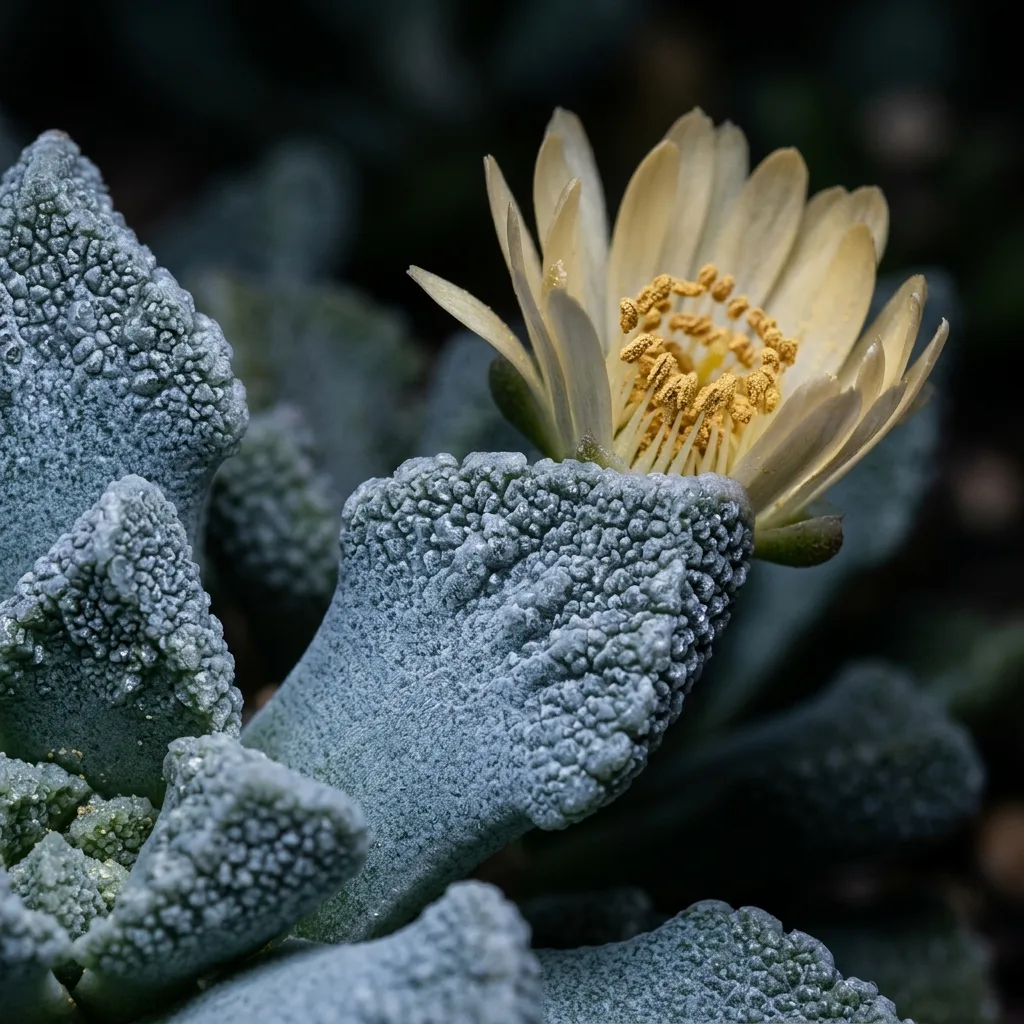
The plant exhibits a dwarf, multi-branched architecture that forms tight, ground-hugging cushions. Arranged in decussate opposite pairs, its succulent leaves measure roughly 1.5 to 3 cm (0.6 to 1.2 inches) in length, featuring a slightly flattened upper surface and a triangular, thickened apex. Chalk-like white tubercles, micro-papillae, and crustaceous pustules stud the epidermal surface; these microscopic structures bounce away harsh solar radiation and shield inner mesophyll tissues from heat damage.
Undoubtedly, this species' most captivating trait is its reproductive phenology. Blooming from late autumn into mid-winter, its daisy-like flowers (spanning approximately 1.5 cm in diameter) open exclusively at twilight and remain active throughout the night (nocturnal anthesis), defying the diurnal habits of most mesembs. The blossoms exude an intense honeyed almond fragrance, an evolutionary adaptation tailored to summon nocturnal hawk moths and night-flying pollinators across the desolate Karoo plains.
2. Light Requirements and Indoor Positioning
In its native habitat, Rhinephyllum muirii basks in unrelenting desert luminosity. Deprived of sufficient photons, the internodes will quickly stretch out of proportion (etiolation), the blue-green compact rosette will dissolve, and the foliage will turn limp and pale. Indoors, place your plant on an unobstructed south- or southwest-facing windowsill that provides at least 5 to 6 hours of direct, unfiltered sunlight daily.
Caution is warranted, however, when transitioning plants from indoor window sills or semi-shaded setups to intense summer outdoor sun. Sudden shifts cause cellular photo-oxidation (sunburn), resulting in permanent white or brown scarring. Gradual acclimation over 10 to 14 days is essential. If natural winter sunlight is scarce in your geographic region, supplement with a 6500K full-spectrum LED horticultural grow light positioned 15 to 20 cm above the foliage for 10 to 12 hours a day to preserve its stony, compact habit.
3. Watering Discipline: The 'Soak and Dry' Protocol
Dousing succulents on a rigid, predetermined calendar is not an act of devotion—it is the quickest route to suffocating their root systems. For arid-zone mesembs like Rhinephyllum muirii, moisture discipline marks the fine line between vitality and demise. Operating via CAM (Crassulacean Acid Metabolism) photosynthesis, the plant opens its stomata strictly under the cover of night, sustaining remarkable internal osmotic pressure that retains water reserves for months.
Our golden rule is unyielding: NEVER water until the substrate has dried out completely from the top crust down to the drainage hole. To accurately gauge dehydration, gently compress the lower leaf pairs. If they feel firm and maintain high turgor, hold off on watering. When the leaf flanks display subtle longitudinal wrinkles and feel slightly pliable, thoroughly saturate the pot until water flows unimpeded through the bottom holes. Discard any residual runoff sitting in the saucer immediately.
4. Substrate Composition and Pot Selection
The root system of Rhinephyllum muirii cannot tolerate dense, peat-heavy, or moisture-retentive potting soils. Evolving among limestone crevices and quartz scree, this species requires an ultra-porous blend that drains in seconds and guarantees ample oxygen diffusion around the root zone.
Choose unglazed terracotta pots fitted with large drainage holes. Terracotta’s micro-porous walls allow moisture to evaporate laterally through the clay, drastically cutting the risk of subterranean rot. Because mature specimens develop a thick, fleshy taproot, select containers that are slightly deeper than wide (typically 6 to 8 cm / 2.5 to 3.5 inches in diameter).
| Substrate Component | Ratio (%) | Botanical Purpose & Advantage |
|---|---|---|
| Pumice (2–4 mm grain) | 35% | Superior micro-porosity, internal air pocket retention, and moisture buffering |
| Crushed Lava Rock (Scoria) | 25% | Root aeration, physical substrate stability, and essential trace minerals |
| Zeolite (Clinoptilolite) | 20% | High cation-exchange capacity (nutrient uptake) and natural fungal inhibition |
| Coarse Washed Quartz / River Sand | 10% | Rapid gravity drainage and replication of natural Karoo scree texture |
| Sifted Cactus Peat / Leaf Mould | 10% | Minimal organic baseline to support delicate root hairs without waterlogging |
5. Step-by-Step Propagation Techniques
You can propagate Rhinephyllum muirii through stem/cluster cuttings or by sowing seeds. Single leaf propagation is almost uniformly unsuccessful in this genus, as detached leaves lack the necessary meristematic tissue found at the crown.
- Cluster Division and Stem Cuttings (Recommended):
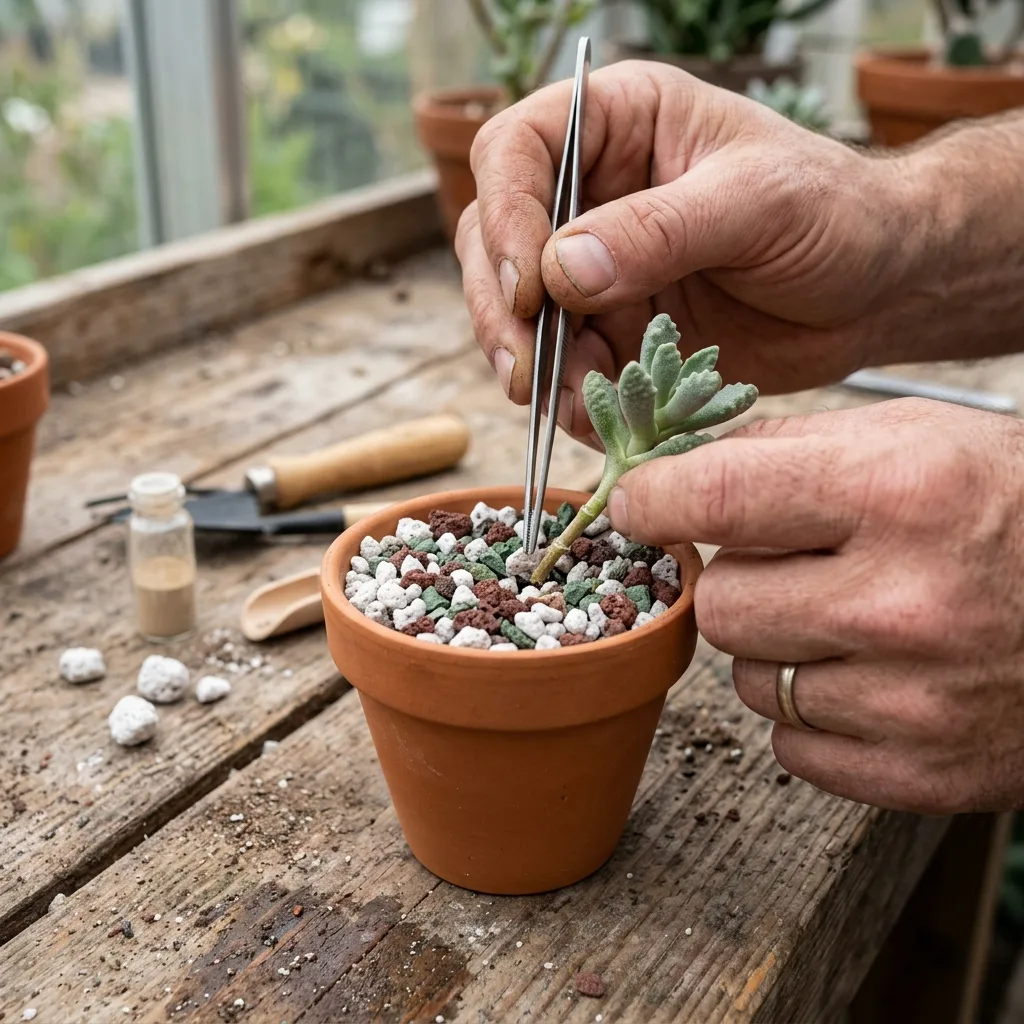
- In mid-spring or right after the post-winter flowering period has concluded, select a vigorous stem segment with at least 2 to 3 pairs of mature leaves and a short piece of stem. Sever it cleanly using a flame-sterilized scalpel.
- Dust the exposed wound with sulfur powder or cinnamon. Never pot the cutting immediately; place it in a shaded, warm, well-ventilated spot for 4 to 6 days until a dry, thickened callus forms over the cut.
- Once callused, insert the base into a completely dry, mineral-dominated pumice mix. Wait 7 to 10 days before introducing light moisture around the edges; root primordia typically anchor within 3 to 4 weeks.
- Propagation from Seed:
- In autumn or early spring, broadcast the microscopic seeds across a sterile, pre-moistened bed of fine pumice and washed sand. Do not bury the seeds; light promotes germination.
- Mist gently with distilled water and seal with a clear dome to retain humidity. Keep the seed tray between 18°C and 22°C (64°F–72°F). Germination occurs within 10 to 20 days. Gradually increase airflow once seedlings emerge, avoiding total desiccation during their first three months.
6. Common Pests, Pathogens, and Solutions
While exceptionally hardy when cultivated in gritty soils, cultural missteps can open the door to opportunistic pests and physiological disorders:
- Root and Crown Rot (Fusarium / Pythium): Characterized by translucent, watery, or blackening tissue at the soil line. The only remedy is immediate surgery: unpot the plant, excise all compromised tissue back to clean, green flesh, treat with sulfur, and air-dry for a week before repotting into pure pumice.
- Mealybugs (Pseudococcidae): These persistent pests nestle deeply in leaf axils and around the taproot crown. Remove visible cottony masses using a cotton swab dipped in 70% isopropyl alcohol. For established root infestations, perform a soil drench with a systemic imidacloprid or acetamiprid formulation.
- Red Spider Mites (Tetranychidae): Thriving in hot, stagnant air, spider mites leave faint, rust-colored stippling across leaf surfaces. Increase cross-ventilation immediately and apply cold-pressed neem oil emulsion or a targeted miticide during evening hours.
7. Seasonal Care Calendar and Horticultural Guidelines
Harmonizing your maintenance routine with the natural biological rhythms of Rhinephyllum muirii ensures lifelong health and prolific seasonal flowering:
- Spring (March – May): Vegetative activity revives. Water thoroughly as soon as the potting mix dries out. Every second month, apply a specialized low-nitrogen, high-potassium cactus fertilizer diluted to 1/4 strength.
- Summer (June – August): High temperatures induce a protective semi-dormancy. Curtail watering sharply; provide moisture only when leaves lose turgidity, watering during cooler evenings. Ensure constant, gentle air movement to prevent heat stress.
- Autumn (September – November): The golden season of growth and floral initiation! Flower buds form at the center of the rosettes. Maximize direct sunlight exposure and resume standard watering upon soil dry-out. Experience the evening perfume as the flowers open!
- Winter (December – February): Post-flowering dormancy phase. Keep ambient temperatures above 5°C to 8°C (41°F–46°F). While dry plants can withstand brief cold drops near 0°C (32°F), wet soil paired with cold is instantly fatal. Maintain an almost bone-dry substrate throughout these months.


Reader Reviews & Comments 4 Reviews
Julian Vance
Marcus Sterling
Eleanor Brooks
Clara Higgins
Leave a Review & Rating
Share your plant care tips, experiences, or questions with our succulent community.