






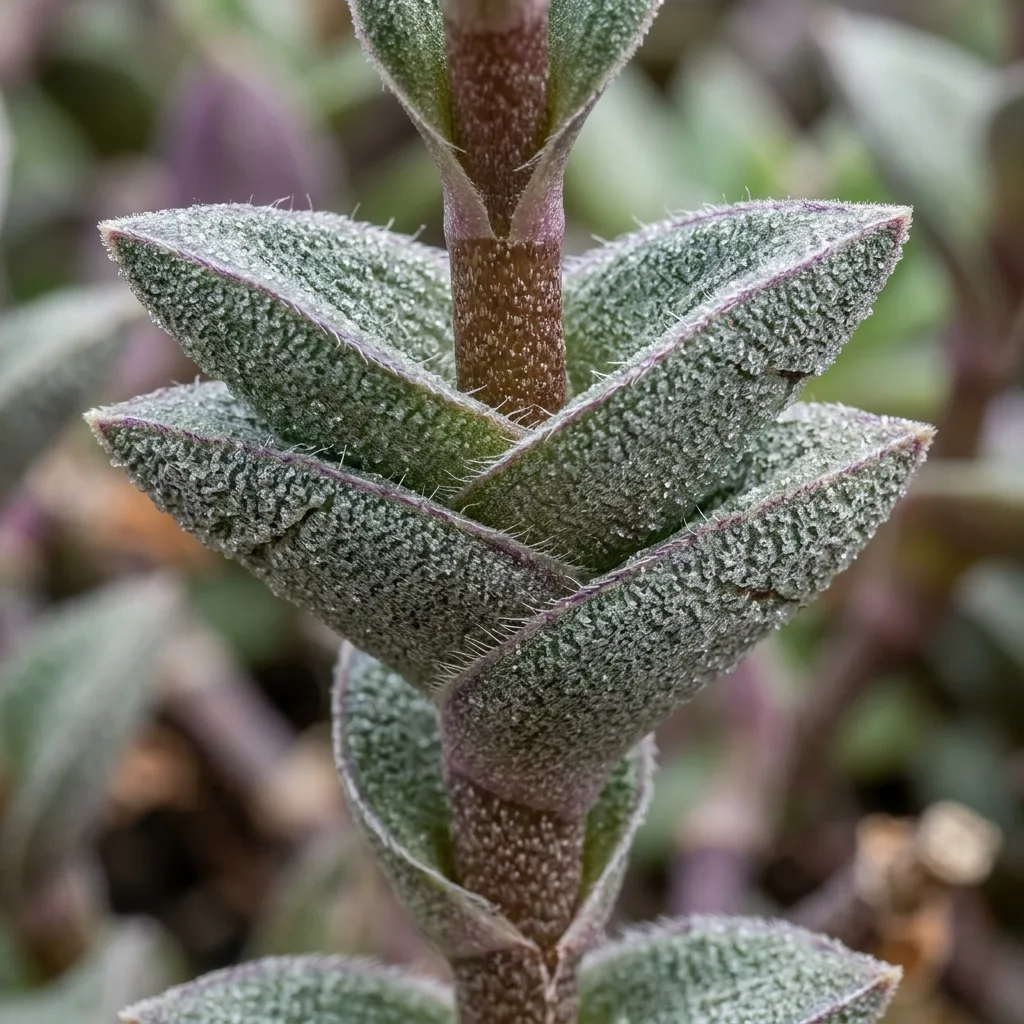
Clinging tightly to shear limestone crevices in the semi-arid canyons of Mexico, Callisia navicularis (historically and widely known as Tradescantia navicularis)—affectionately referred to as the 'Chain Plant' or 'Boat Succulent'—stands as one of the botanical kingdom's most captivating geometric masterpieces. Its thick, fleshy leaves lock over one another in flawless bilateral symmetry, resembling a miniature architectural chain or a fleet of tiny green canoes. Cascading gracefully over the rim of a planter on your windowsill, this botanical marvel bridges the lush charm of the dayflower family (Commelinaceae) with the uncompromising drought resilience of true desert succulents.
When encountering this specimen for the first time, many houseplant enthusiasts mistake it for an artificial synthetic sculpture; the mathematical precision of its leaf arrangement is almost impossibly flawless. Yet beneath this ornamental artistry lies a profound evolutionary adaptation for survival: a translucent epidermal window captures light for photosynthesis, while the deeply boat-shaped (navicular) morphology channels humidity and shields cellular water reserves from excessive solar evaporation. Under balanced light stress, the foliage shifts dramatically from emerald green to rich hues of bronze, dusky plum, and iridescent magenta. Cultivating this living sculpture at home begins with tuning into its natural habitat and biological rhythms.
1. Botanical Identity and Morphological Characteristics
Taxonomically assigned to the Commelinaceae family, Callisia navicularis deviates notably from typical members of the spiderwort alliance through its pronounced succulence. During extended dry spells, the leaves press tightly against one another along the stems, forming an imbricate (overlapping shingle-like) structure designed to minimize moisture transpiration.
- Leaf Morphology: The specific epithet navicularis derives from the Latin word for 'little ship' or 'small boat'. The foliage is arranged distichously (in two opposing vertical ranks), sheathing the stem at the base and tapering into acute, keel-shaped tips that mimic the hull of a vessel.
- Stem and Root Architecture: The stems display a repent (prostrate or creeping) growth habit, establishing a dense mat before gracefully trailing outward. Wherever stem nodes contact bare mineral substrate, the plant exhibits an astonishing capacity to generate adventitious roots almost immediately.
- Flowering Habits: In late spring and throughout the summer months, terminal cymes emerge bearing short-lived yet vivid magenta-pink, three-petaled flowers. While individual blooms open in the morning light and fade by early afternoon, continuous bud production offers weeks of delicate floral interest.
2. Light Requirements and Indoor Positioning
Preserving the tight, compact, geometric stacking of Callisia navicularis depends almost entirely on the quantity and quality of photons it receives. Under suboptimal illumination, the plant rapidly undergoes etiolation—its internodes stretch, the leaves space out awkwardly, and the architectural chain unravels into weak, pale green tendrils.
Position your plant near an east- or west-facing window where it can bask in direct morning or late afternoon sun. If placed along an unshaded southern exposure during peak summer, provide sheer curtain filtering during intense midday hours to protect tender cellular walls from solar scorch (necrosis). During winter months, relocate the specimen to your brightest possible window or support it with a full-spectrum LED grow light delivering 2,500 to 3,000 lumens for 12 to 14 hours daily.
3. Watering Discipline: The 'Soak and Dry' Method
The single most common mistake made by indoor growers is treating Callisia navicularis like its moisture-loving tropical cousins, such as traditional Tradescantia zebrina. Frequent, routine watering suffocates the delicate root cortex of this succulent species, leading rapidly to root rot. Succulents do not equate frequent watering with affection; excess moisture simply cuts off vital oxygen to root hair cells.
Discard strict calendar schedules (such as 'watering once a week') entirely. Instead, gauge the weight of the pot and inspect the deeper soil column. Never apply water until the potting mix has dried out completely from top to bottom—verify this using a dry wooden probe or moisture meter. When moisture is truly depleted, irrigate thoroughly until water flows freely from the drainage holes, and immediately discard any runoff that gathers in the drip tray.
4. Ideal Soil Recipe and Pot Selection
The root system of the Chain Plant is fine and shallow. Standard potting composts and dense peat mixtures hold excessive water, creating an anaerobic environment ripe for fungal pathogens. To thrive, this species demands a mineral-heavy, highly porous substrate that delivers rapid drainage and constant root aeration.
Pair this soil with an unglazed terracotta pot. The porous clay walls facilitate moisture evaporation through the container sides, drastically lowering the risk of basal rot. Because the roots do not delve deep into the soil column, opt for a shallow, wide saucer or bulb pan rather than a deep, cavernous container.
| Substrate Component | Ratio (%) | Horticultural Function |
|---|---|---|
| Coarse Horticultural Pumice (3–5 mm) | 35% | Maximizes macroporosity and ensures rapid drainage. |
| Crushed Lava Rock or Zeolite | 20% | Provides mineral integrity, cation exchange, and structural stability. |
| Coarse River Sand or Quartz Grit | 15% | Prevents compaction and promotes vigorous lateral root formation. |
| Low-EC Coconut Coir or Premium Cactus Peat | 30% | Supplies necessary organic binding while maintaining regulated moisture retention. |

5. Step-by-Step Propagation Techniques
True to its Commelinaceae lineage, Callisia navicularis possesses an extraordinary capacity for vegetative regeneration. Multiplying your collection through stem cuttings is exceptionally straightforward and boasts a near-perfect success rate.
- Harvesting Stem Cuttings: Using a sterilized, razor-sharp blade, sever a robust, compact stem cutting measuring approximately 6–8 cm (2.5–3 inches) in length, ensuring it includes at least 4 to 5 mature leaf nodes.
- Callus Formation: Never insert freshly cut succulent stems into moist soil immediately. Allow the cuttings to rest in a dry, shaded, well-ventilated spot for 24 to 48 hours so the wound can suberize (form a dry, protective callus) to prevent pathogenic infection.
- Setting into Substrate: Gently strip the lowest 1–2 leaf pairs to expose the bare nodes. Insert the lower stem 1–2 cm deep into pre-moistened, gritty mineral mix, or simply pin the cutting horizontally onto the soil surface so the exposed nodes touch the earth.
- Moisture Management: Keep the substrate barely moist using light surface spritzing for the first week. Within 10 to 14 days, fibrous adventitious roots will emerge from the nodal tissue. Once rooted firmly, transition to the standard 'soak and dry' watering protocol.
6. Common Pests, Diseases, and Treatments
When grown in bright light and fast-draining substrate, Callisia navicularis demonstrates outstanding pest resilience. However, suboptimal indoor environments can sometimes trigger complications:
- Mealybugs (Pseudococcidae): These pests conceal themselves inside the tight, protective leaf sheaths along the stem, producing white, cottony secretions. Treatment: Mechanically remove them using a cotton swab dipped in 70% isopropyl alcohol. For extensive infestations, apply cold-pressed neem oil or an insecticidal potassium soap spray in the evening.
- Root Rot (Phytophthora / Fusarium): Triggered by poorly draining soil and persistent overwatering, causing stem bases to turn brown, watery, and structurally necrotic. Treatment: Act swiftly by lopping off healthy stem tips above the affected necrotic zone, sanitizing the tissue, and rerooting them in fresh, dry mineral substrate to salvage the genetic stock.
- Loose, Etiolated Growth: The Art of Scientific Stem Cuttings and Rooting">This is an environmental light deficiency rather than a pathogen. Gradually acclimate the specimen to significantly brighter sunlight or place it under dedicated LED grow lamps, and prune the elongated stems back to stimulate compact, bushy new growth from the base.
7. Seasonal Care Calendar and Expert Tips
Spring (Active Growth Surge): As ambient temperatures stabilize above 15°C (59°F), the plant's metabolic activity rebounds. Increase watering frequency as the substrate dries out completely. Feed once a month using a diluted, low-nitrogen succulent fertilizer (e.g., NPK 5-10-10) at quarter or half strength.
Summer (Sun Bask & Form Retention): During extreme heat waves exceeding 35°C (95°F), the plant may enter a protective semi-dormant state during the hottest midday hours. Monitor leaf turgor carefully; light puckering indicates that moisture reserves are being depleted.
Autumn (Hardening Off): As daylight hours diminish, pull the pot closer to the window glass to maximize light capture. Discontinue fertilizer applications entirely and stretch the intervals between waterings. Protect plants from cold drafts and sudden drops in ambient humidity.
Winter (Resting Period): The plant enters its biological rest phase. Maintain room temperatures ideally between 10°C and 15°C (50–59°F), positioning the pot well away from artificial heat vents and dry radiator convection currents. Water sparingly—often no more than once a month, or only when lower foliage shows visible signs of soft wrinkling.


Reader Reviews & Comments 4 Reviews
Eleanor Vance
Julianna Reed
Marcus Sterling
Arthur Pendelton
Leave a Review & Rating
Share your plant care tips, experiences, or questions with our succulent community.