






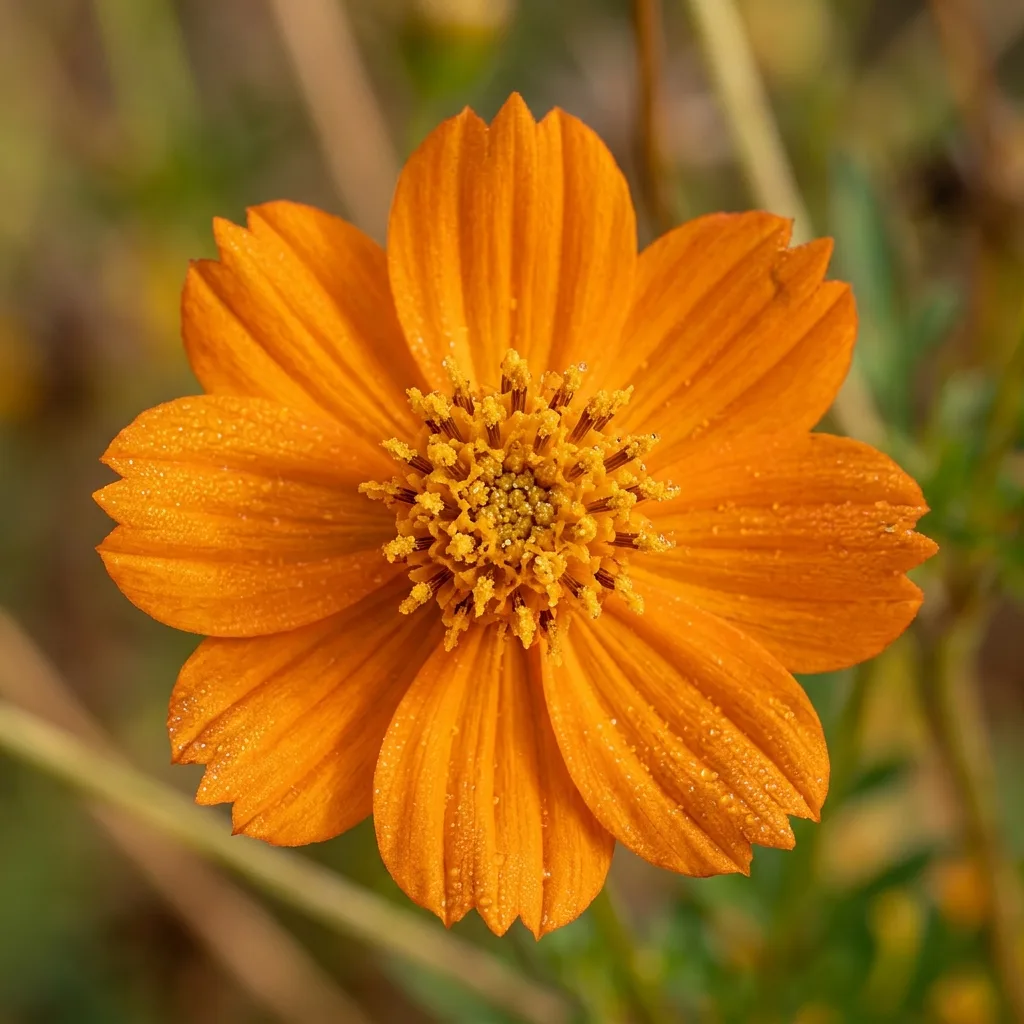
Carrying the vibrant spirit of Mexico's sun-scorched valleys and rocky hillsides, Sulfur Cosmos (Cosmos sulphureus)—often celebrated as the Yellow Mexican Aster—has earned a cherished place among arid plant collectors and xeriscaping enthusiasts alike. Within succulent borders and rockeries, it provides a breathtaking visual contrast, rising above the muted glaucous blues, sea-greens, and dusty rosettes of sedums and agaves with an explosion of fiery red, intense orange, and radiant golden-yellow petals. Honed by natural selection to endure intense solar radiation and minimal rainfall, this seemingly delicate flower reveals itself to be a remarkably rugged warrior that thrives where conventional garden annuals falter.
Unlike temperamental ornamental plants that crave coddling and rich, heavily amended humus, Sulfur Cosmos actively rejects excessive pampering. Its modest, frugal nature makes it a true kindred spirit to succulent lovers. The plant's root system thrives within lean, gravelly, high-porosity substrates, establishing it as one of the most reliable, nectar-rich floral anchors for your drought-tolerant beds, xeriscape borders, and sunny rooftop containers. Drinking in the fiercest direct sunlight and transmuting it into fiery floral brilliance, this Central American native brings not only enduring seasonal color to your landscape, but also an energetic ecosystem buzzing with native bees, hoverflies, and butterflies.
1. Botanical Identity and Morphological Traits
A xerophytically inclined member of the Asteraceae (daisy) family, Cosmos sulphureus is an annual native to Central America and Mexico that freely and reliably self-sows season after season. The plant exhibits deeply dissected, pinnatisect foliage that dramatically minimizes total surface area, mitigating unnecessary transpiration under hot winds. This micromorphological adaptation represents one of its foremost cellular defenses against persistent water stress.
Its composite floral heads (capitula) consist of a dense center of fertile disc florets encircled by radiant ray florets. The vibrant pigmentation—spanning chromatic ranges from warm lemon yellow to deep scarlet and fiery tangerine—relies on dense chromoplast concentrations that serve as natural physiological filters shielding delicate tissues against solar radiation. Below ground, the plant develops an assertive taproot system configured to draw from deeper moisture reserves while completely rejecting surface water stagnation around the root crown. This specific architecture allows it to share the exact same arid microclimate and lean substrate requirements as your favorite cold-hardy succulents and cacti.
2. Light Requirements and Optimal Siting
Sulfur Cosmos is an uncompromising heliophyte: an ardent worshiper of unfiltered sunlight. Its cellular photosynthesis pathways and floral bud induction demand a baseline of at least 6 to 8 hours of direct, blazing sunshine every single day. When deprived of adequate irradiance, the plant quickly undergoes etiolation—stems stretch languidly, cellular walls weaken, and floral production drops off entirely.
If you cultivate this species in containers on an enclosed sunroom or balcony, position it directly against your most unshaded south- or southwest-facing exposures. In open xeriscape beds and rockeries, plant it directly behind Agave, Yucca, or clustered Echeveria plantings as a dynamic, tall floral backdrop under full sun. Furthermore, ensuring consistent ambient air circulation will temper fungal vulnerability, stimulating mechanical tissue strength and creating sturdier, self-supporting stems.
3. Watering Discipline: The 'Soak and Dry' Method
The cardinal rule of succulent culture—the time-tested 'soak and dry' approach—applies seamlessly to Sulfur Cosmos. While emergent seedlings appreciate gentle, even moisture during their first few weeks, the root architecture shifts decisively into an arid regimen once the plant reaches 15 to 20 cm in height. Cellular turgor pressure within the root cortex thrives best when the top 5 to 7 cm of the substrate dries out thoroughly before introducing another drop of moisture.
Just as inundating your succulents out of misplaced affection suffocates root tissues, subjecting Sulfur Cosmos to habitual, frequent garden watering is a lethal misstep. Excess irrigation sparks rampant vegetative growth at the absolute expense of flower production, quickly triggering systemic root rot (pythium and phytophthora complexes). Always water deeply early in the morning directly at the soil line, ensuring moisture never sits prolonged on foliage or open petals.
4. Ideal Soil Mixture and Pot Selection
Cosmos sulphureus actively disdains nitrogen-heavy, richly amended potting soils and dense compost. Excess nutrients encourage the plant to produce massive green foliage and brittle, floppy stems that collapse under summer squalls while stalling flowering mechanisms. What the root system truly craves is granular structural stability, abundant oxygen pockets, and swift, frictionless drainage.
When selecting containers, unglazed terracotta or natural porous stone pots are vastly preferable to plastic. The container should offer a depth of at least 20 to 25 cm to facilitate unrestricted taproot development, paired with ample, unobstructed drainage holes at the base. Here is our recommended substrate formula tailored specifically for arid borders and succulent companion containers:
| Substrate Component | Ratio (%) | Horticultural Role & Root Benefit |
|---|---|---|
| Pumice (3-6 mm particle size) | 35% | Maximizes macroporosity, provides permanent root aeration, and resists compaction |
| Coarse Washed River Sand / Crushed Lava | 25% | Enhances structural weight, ensures immediate runoff velocity, and drains freely |
| Screened Garden Loam or Low-Nutrient Peat | 30% | Offers foundational moisture buffering and minimal organic scaffolding |
| Perlite or Horticultural Zeolite | 10% | Promotes cation-exchange capacity and balances microclimatic moisture pockets |

5. Step-by-Step Propagation Techniques
Direct seed propagation represents the most reliable, anatomically superior method for raising Sulfur Cosmos. While softwood tip cuttings can technically root under controlled conditions, seed-grown specimens establish far sturdier taproots and display incomparably denser, season-long flowering displays.
- Seed Harvesting and Selection: In late summer or early autumn, look for mature flower heads that have dropped their petals. Harvest the curved, needle-like, dark brown to jet-black achenes. Ensure they are dry and brittle before processing.
- Sowing Schedule: Sow outdoors in mid-spring once all threats of frost have passed and native soil temperatures stabilize reliably around 18-22°C (64-72°F).
- Substrate Preparation: Moisten your lean, pumice-rich seedbed. Scatter seeds across the surface and press lightly, dusting with no more than 0.5 cm of fine river sand or perlite. The seeds require gentle light exposure to break dormancy and trigger germination.
- Germination Management: Maintain surface moisture using a fine misting wand. Robust seedlings will emerge within 5 to 10 days. Once seedlings reach 5 cm tall, thin them courageously, leaving 20 to 25 cm between plants to ensure ideal airflow.
6. Common Diseases, Pests, and Therapeutic Solutions
Despite its formidable drought resilience, sub-optimal cultural practices can compromise Sulfur Cosmos. Watch for these common biotic and physiological challenges:
Powdery Mildew (Erysiphe spp.): Manifests as powdery white fungal blotches across foliage under stagnant, humid, or partially shaded settings. Remedy: Move the plant to an open, sun-bathed location with brisk airflow. Prune heavily affected lower leaves using sterilized shears and apply potassium bicarbonate or cold-pressed neem oil at dusk.
Root Rot (Pythium / Phytophthora complexes): Triggered by clay-heavy substrates combined with overwatering. Stems darken at the soil line, followed by rapid, irreversible wilting. Remedy: Withhold irrigation immediately. If caught very early, unpot the specimen, pare back soft necrotic roots, and repot into the dry, pumice-heavy blend specified above.
Aphids and Spider Mites: Clustered colonies targeting tender terminal shoots, especially in excessively warm, sheltered microclimates. Remedy: Avoid harsh chemical synthetic pesticides. Dislodge clusters with a firm jet of water, or apply a gentle potassium-based insecticidal soap spray directly onto the foliage.
7. Seasonal Maintenance Calendar and Master Tips
The life cycle of Sulfur Cosmos harmonizes effortlessly with the rhythm of the changing seasons:
- Spring (Sowing and Pinching): Direct-sow outdoors once spring warmth settles. When young plants stand approximately 15 cm tall, pinch out the central apical terminal shoot. This single horticultural intervention forces aggressive lateral branching and triples the eventual count of flower buds.
- Summer (Floral Flourish & Minimalist Care): Water solely when the substrate runs dry. Conduct regular deadheading by snipping spent flower heads back to a leaf node. This halts seed maturation early, redirecting botanical sugars into an unending burst of brilliant blooms through late summer.
- Autumn (Seed Saving & Naturalization): Permit the final floral flushes to set seed heads undisturbed. Harvest dried seeds into paper envelopes and store in a cool, dark location for next season. Any self-sown seed in open beds will happily emerge spontaneously next spring.
- Winter (Bed Turnover): As an annual completing its lifecycle, stems will naturally decline with the first hard frost. Cut spent plants at ground level, incorporating the foliage into garden compost while leaving root crowns to naturally decay and aerate the soil matrix.


Reader Reviews & Comments 3 Reviews
Julian Vance
Clara Sterling
Marcus Thorne
Leave a Review & Rating
Share your plant care tips, experiences, or questions with our succulent community.