






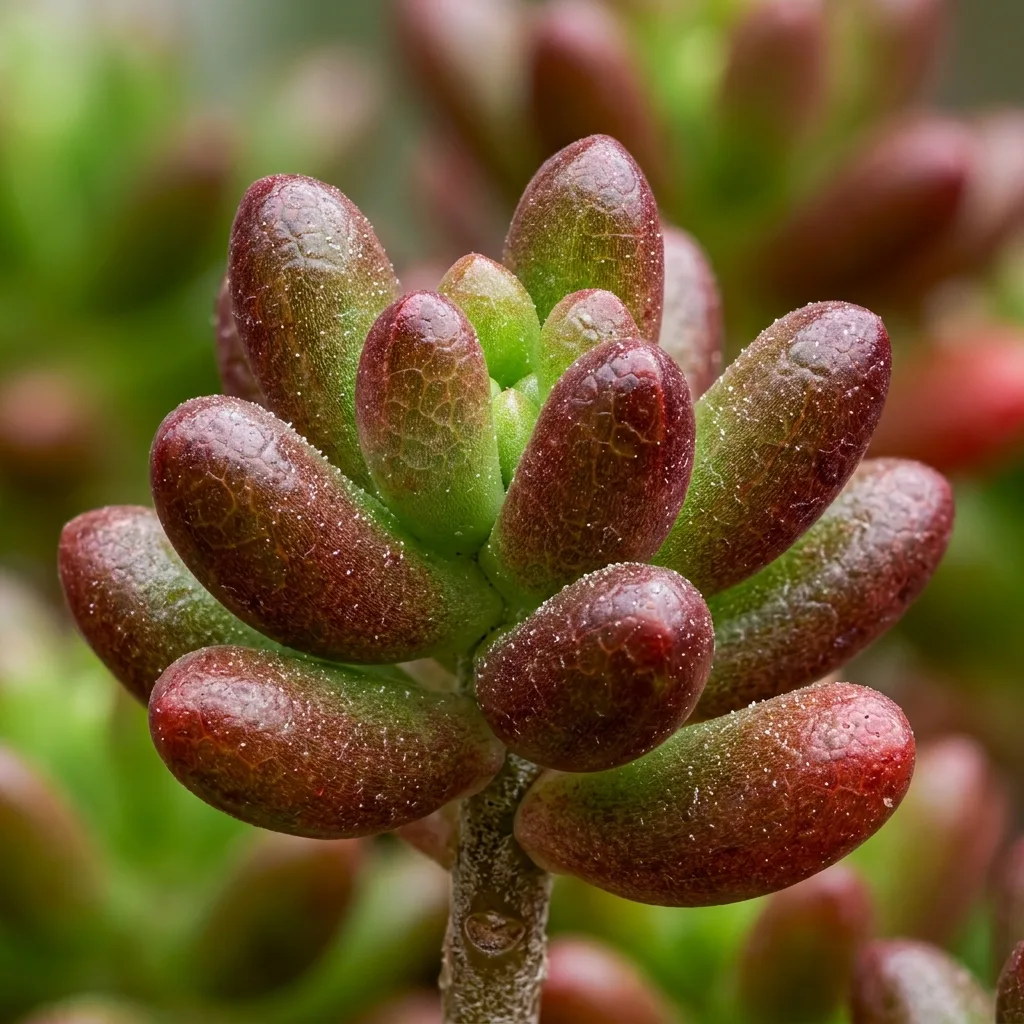
Sedum rubrotinctum is one of the most distinctive and visually gratifying members of the Crassulaceae family. Commonly referred to as the 'Jelly Bean Plant' or 'Pork and Beans', this taxon is an interspecific hybrid of Sedum pachyphyllum and Sedum stahlii. Its cylindrical, bean-shaped leaves represent an evolutionary adaptation to arid environments, packed with specialized water-storage parenchyma cells capable of retaining vast reserves of moisture under severe hydric stress.
What elevates this species among botanical collectors is its capacity to transition leaf tips from emerald green to vivid coral, bronze, and ruby red. This coloration is not a decorative coincidence; it is the direct phenotypic expression of photochemical photoprotective mechanisms and CAM (Crassulacean Acid Metabolism) pathway dynamics operating at the cellular level. This guide details the physiological protocols required to keep your Jelly Bean plant compact, robust, and saturated with brilliant crimson tones without forfeiting structural vitality.
1. Botanical Biology and Physiological Foundations
The foliar anatomy of Sedum rubrotinctum is engineered for extreme water conservation. A thickened waxy cuticle coupled with microscopic epicuticular farina wax minimizes cuticular transpiration. The plant conducts CAM photosynthesis, sealing its stomata during daylight hours to curb vapor loss. Under the cover of darkness, stomata open to fix atmospheric carbon dioxide into malic acid stored within central vacuoles, which is subsequently decarboxylated and synthesized into glucose via solar energy the following day.
The transformation from green to red corresponds to the targeted accumulation of anthocyanin pigments within the vacuoles. High photosynthetic photon flux density (particularly ultraviolet radiation), pronounced diurnal temperature fluctuations (cool nights around 10–15°C / 50–59°F), and measured hydric deficit create controlled physiological stress. To shield chlorophyll from excessive photon excitation and photo-oxidative free-radical damage, the plant upregulates anthocyanin synthesis to act as an internal photoprotective filter. Under deficient light, anthocyanin synthesis ceases, chlorophyll dominance returns, and the plant initiates etiolation—elongating its internodes and weakening stem structural integrity in search of photons.
2. Accurate Diagnosis and Stress Symptoms
Sedum rubrotinctum responds rapidly to microclimatic shifts in its cultivation environment. Interpreting these cellular signals allows for immediate horticultural correction:
- Etiolation (Light Starvation): Internodal distances stretch, stems become thin and decumbent, and foliage shifts to a flat, pale green. This indicates chlorophyll hyper-concentration and inadequate lux/PAR levels.
- Turgor Loss (Dehydration): Foliar surfaces exhibit fine longitudinal wrinkles, and the bean-like leaves soften noticeably due to reduced osmotic pressure within the water-storage parenchyma.
- Edema and Overwatering: Leaves turn translucent, pale yellowish, and excessively turgid, shedding en masse at the slightest vibration. Root-zone hypoxia triggers cellular lysis and root-cortex decay.
- Solar Scorch (Phototoxic Necrosis): Moving an unacclimated plant directly into unshielded midday summer sun causes localized thermal damage, resulting in whitish, bleached patches that turn into dry, brown necrotic scabs.
3. Step-by-Step Cultivation and Propagation Protocol
Follow these precise operational steps to maintain compact, resilient, and richly pigmented Jelly Bean specimens:
- Gradual Light Acclimatization: Never move an etiolated or nursery-grown plant straight into unshielded full sun. Position it in bright morning light for the first week, then incrementally advance its direct sun exposure over 2 to 3 weeks until it receives at least 6 hours of direct light daily.
- Engineered High-Drainage Substrate: The root system requires instantaneous drainage. Blend an inorganic-dominant substrate containing 70% mineral grit (pumice, crushed volcanic lava, coarse perlite) and 30% organic fraction (screened peat or washed coco coir).
- Soak-and-Dry Hydration Protocol: Verify substrate moisture with a subterranean probe or wooden dowel. Never water while residual moisture remains in the root ball. When dry, saturate the pot completely until water flows freely through the drainage orifices; discard all runoff immediately from collector saucers.
- Corrective Beheading and Pruning: Elongated or leggy stems should be excised using a sterilized scalpel 4–5 cm below the compact terminal rosette. Allow the cuttings to form a protective suberized callus in dry shade for 48 to 72 hours before inserting them into dry mineral grit.
- Systematic Leaf Propagation: Undamaged shed leaves should never be discarded. Lay them horizontally over dry, shaded mineral soil without burying them. Within 14 to 21 days, adventitious roots and juvenile rosettes will emerge from the basal meristematic notch.
4. Essential Equipment, Cultivation Parameters, and Standards
| Parameter / Material | Optimum Standard | Cellular & Physiological Justification |
|---|---|---|
| Substrate Formulation | 40% Pumice + 30% Volcanic Scoria + 30% Organic Peat | Maximizes root-zone gas diffusion rates and eliminates anoxic conditions. |
| Light Intensity | 5–7 hours of direct sunlight daily (Morning/Late afternoon) | High PAR stimulates photoprotective anthocyanin synthesis. |
| Thermal Range | Day: 20–28°C (68–82°F) / Night: 10–15°C (50–59°F) | Diurnal delta accelerates CAM organic acid conversion pathways. |
| Irrigation Rhythm | Complete 100% dry-down (7–10 days in summer, 20–30 days in winter) | Facilitates controlled cellular discharge and preserves root hair viability. |
| Container Type | Shallow, unglazed terracotta with large drainage holes | Permits lateral root crawl and allows porous pot walls to vent moisture. |

5. 5 Common Pitfalls and Rescue Protocols
- Watering Under Inadequate Light: The most lethal mistake. Reduced photon availability slows CAM metabolism, halts transpiration, and causes rapid subterranean root rot. Rescue: Unpot the specimen, excise all necrotic black root tissue, prune the stem to clean vascular tissue, let it callus, and reroot in dry grit.
- Foliar Misting and Overhead Spraying: Spraying water over foliage strips the epicuticular farina and creates stagnant micro-droplets that invite fungal blight. Rescue: Discontinue foliar spraying; always irrigate directly into the root zone or via bottom-watering.
- Excessive Nitrogen Fertilization: Nitrogen-rich fertilizers induce rapid, weak cellular elongation, breaking structural turgor and permanently suppressing red pigmentation. Rescue: Apply fertilizer only during active spring growth using a low-nitrogen, high-potassium succulent formula diluted to 25% recommended strength.
- Stagnant Ambient Air: Inadequate airflow indoors creates ideal conditions for mealybug (Pseudococcidae) colonies in leaf crevices. Rescue: Improve ventilation with an oscillating fan; remove pests using cotton swabs dipped in 70% isopropyl alcohol and apply cold-pressed neem oil.
- Disregarding Winter Dormancy: Keeping the plant in heated rooms with summer-level watering during low-light winter months forces weak, etiolated growth. Rescue: Relocate the specimen to a cool (5–10°C / 41–50°F), bright location and suspend watering almost entirely until spring.
6. Seasonal Phenology and Long-Term Care Calendar
Spring (Vegetative Awakening): Cellular activity surges. This is the prime window for repotting, pruning, and stem propagation. Begin structured watering as the substrate dries, supplemented once a month with quarter-strength balanced cactus fertilizer.
Summer (Peak Irradiance and Pigmentation): When adequate airflow is maintained, leaf tips reach vivid coral coloration. However, during heatwaves exceeding 35°C (95°F), the plant may enter estivation (dormancy induced by heat stress); during these periods, scale back irrigation and provide light afternoon shading.
Autumn (Hardening Phase): Dropping nocturnal temperatures trigger maximum anthocyanin saturation, producing intense ruby hues. Taper watering frequency to prepare the plant's vascular tissue for winter cold tolerance.
Winter (Rest and Protection): Sedum rubrotinctum cannot tolerate freezing (-2°C / 28°F triggers intracellular ice crystallization and irreversible tissue collapse). Overwinter in a high-light, cold yet frost-free setting, watering only when leaves display clear visible deflation.


Reader Reviews & Comments 3 Reviews
Eleanor Vance
Marcus Bennett
Chloe Richardson
Leave a Review & Rating
Share your plant care tips, experiences, or questions with our succulent community.