






Clinging tenaciously to sheer basalt rock faces thousands of feet high across Maharashtra's Western Ghats in India, the Indian Frerea (Frerea indica) is a living botanical relic that makes any succulent collector's pulse race. First discovered in 1865 by botanist Nicol Alexander Dalzell, this phenomenal species stands as a critically endangered treasure (IUCN Red List) protected globally under CITES Appendix II. What makes this plant so profoundly captivating is not merely its staggering rarity, but its unique evolutionary design: unlike its leafless carrion flower relatives (Stapeliads), it proudly carries distinct, emerald fleshy leaves and possesses the brilliant survival mechanism of shedding them at will during intense drought.
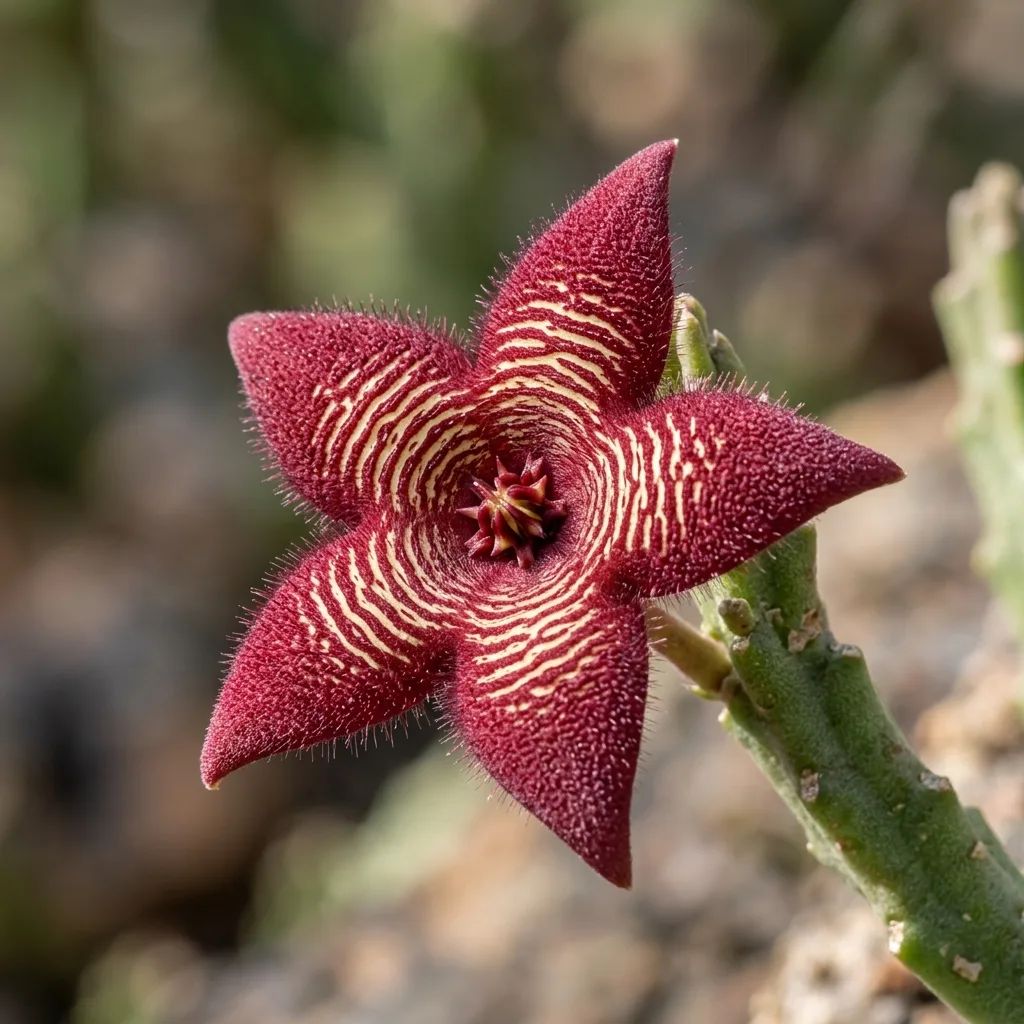
Welcoming an Indian Frerea onto your windowsill is vastly more rewarding than nurturing a standard houseplant; you are actively stewarding an ancient ecosystem's triumph over extreme adversity. Connoisseurs frequently refer to it by its regional Marathi name, 'Shindal Mankundi', or its historic botanical synonym, Caralluma frerei. During the warmth of summer, it yields exquisite, five-pointed starry blooms dressed in rich cherry-ruby velvet and rimmed with delicate markings, resembling miniature, hand-stitched works of natural art. Within this master guide, we will explore how to recreate its cliffside microclimate indoors, safeguarding delicate root zones from fungal collapse while coaxing vigorous seasonal growth and spectacular blooms.
1. Botanical Profile & Morphological Adaptations
Frerea indica is a monotypic genus nestled within the dogbane family (Apocynaceae), subclassified under the milkweed subfamily (Asclepiadoideae) and tribe Ceropegieae. For evolutionary biologists, this species represents an astonishing 'missing link'—the bridge between ancestral leafy rainforest vines and desert-dwelling Stapeliads that completely discarded their foliage in favor of photosynthesizing solely through fleshy, water-storing green stems. Observing its morphology reveals this genius structural transition:
- Stem Architecture: It develops low-slung, fleshy, basally branching cylindrical stems that gently trail over container edges with age. The epidermal surface is smooth, packed beneath with specialized water-storing parenchyma tissue.
- Foliar Dynamics: Glossy, elliptic-to-oblong, emerald-green succulent leaves emerge from stem nodes on almost imperceptible petioles. During the torrential monsoon surge, these leaves shoulder the burden of vigorous active photosynthesis.
- Facultative Drought Deciduousness: When confronting severe ambient drought or sharp thermal drops, the plant deliberately turns its leaves yellow and drops them. This physiological shutdown drives transpiration to near zero, allowing the plant to subsist exclusively on its succulent, chlorophyll-rich bare stems.
- Floral Morphology: Blooms measure roughly 2 to 3 cm in diameter, presenting flattened, five-lobed star silhouettes with recurved margins. The corolla radiates deep crimson-burgundy tones patterned with subtle creamy-yellow striations, covered in a velvet sheen of microscopic glandular hairs.
2. Light Requirements & Indoor Placement
In its native habitat, Frerea indica thrives nestled along west- and northwest-facing basalt escarpments, sheltered from blazing sun by sparse scrub canopies and narrow rocky fissures. Consequently, it strongly dislikes the blistering, unshielded midday sun that true desert cacti endure. While adequate photon exposure governs both photosynthetic velocity and flower bud initiation, achieving harmony between filtered light and gentle direct sun is vital.
Indoors, an unobstructed east- or west-facing window ledge offers an exemplary light profile. The soft, direct morning rays of the first 3 to 4 hours promote dense chlorophyll synthesis, preventing weak, leggy stems (etiolation). If placing your plant near a south-facing exposure, diffuse the harsh sun between 11:00 AM and 4:00 PM during midsummer using a sheer curtain. Under insufficient light, stems turn pale, lose their compact girth, and will fail to set flower buds. Throughout dim winter months, relocate the plant to the brightest area available, supplemented by a full-spectrum LED grow light for 10 to 12 hours daily if natural light levels wane.
3. Watering Discipline: The 'Soak and Dry' Strategy
The single most catastrophic mistake when tending to an Indian Frerea is either treating it like an arid cactus by withholding water for months on end, or treating it like a tropical foliage plant by maintaining perpetual root-zone moisture. Adapted to the heavy monsoon downpours of the Western Ghats between June and September, followed by an arid winter respite, this succulent requires seasonal mindfulness.
From late spring through early autumn (the active vegetative phase), observe a strict 'thorough soak, followed by total dry-out' protocol. Drench the pot until water runs freely out of the drainage holes, and empty the catch tray completely within 15 minutes. Stagnant moisture surrounding the root ball quickly suffocates root xylems, creating an entryway for fungal pathogens. Never water again until the substrate has dried out by at least 80% to 90%, or completely. Insert a wooden skewer down to the bottom of the pot; if it emerges dry with no adhering damp soil particles, it is safe to Water Succulents: The 'Soak and Dry' Protocol, Water-Storage Morphology, and Care Guide">to water.
4. Ideal Substrate Formulation & Potting Selection
The root system of Frerea indica requires continuous oxygen exchange. In nature, it anchors within basalt crevices and mineral detritus containing virtually negligible organic matter. Traditional, dense, peat-based houseplant soils are lethal, locking in moisture and suffocating delicate feeder roots. Your potting blend must drain within seconds while preserving structural macropores.
Always choose unglazed, porous terracotta pots. The breathable clay matrix allows residual moisture to evaporate outward through the container walls, accelerating drying cycles. Furthermore, choose shallow, wide azalea pots or bulb pans rather than deep containers, as Frerea develops an expansive, relatively shallow root system tailored for rocky ledges.
| Substrate Component | Ratio (%) | Botanical Function & Benefit |
|---|---|---|
| Horticultural Pumice (3-5 mm) | 35% | Creates vital macropores, ensuring root xylems remain well-aerated. |
| Lava Rock / Scoria | 25% | Heavy mineral core that provides grit and prevents substrate compaction. |
| Clinoptilolite Zeolite | 15% | Enhances cation-exchange capacity (CEC) and inhibits pathogenic fungi. |
| Coarse Quartz Sand / River Grit | 10% | Maximizes gravitational drainage velocity, mimicking rocky clefts. |
| Fine Coco Coir or Sifted Worm Castings | 15% | Supplies a gentle organic moisture buffer for root tip anchorage. |

5. Step-by-Step Stem Cutting Propagation
While Frerea indica can be grown from seed, declining wild pollinator populations make viable seeds exceptionally hard to source. Fortunately, stem cuttings taken during active growth root reliably and swiftly with proper technique.
- Select Healthy Growth: In mid-spring or early summer, locate a vigorous, fully turgid lateral shoot roughly 5 to 8 cm (2 to 3 inches) long that displays clean foliage.
- Clean Incision: Using a surgical scalpel or razor sterilized in 70% isopropyl alcohol, sever the shoot flush at its junction with the main stem. Dust the cut surface lightly with sulfur powder or ground cinnamon to seal against pathogens.
- Callus Formation: Do not pot the cutting immediately. Rest it in a warm, dry, shaded spot with good airflow for 4 to 6 days until a firm, whitish-tan callus forms over the wound. This step eliminates the primary vector for bacterial stem rot.
- Rooting Medium: Insert the callused cutting about 2 cm deep into an open rooting medium composed of 70% fine pumice and 30% lightly moistened coco coir.
- Incubation & Rooting: Maintain the cutting in bright, indirect light at temperatures between 22 and 26°C (72-79°F). Keep the medium completely dry for the first 10 days, then mist the topsoil lightly. Within 3 to 4 weeks, fresh anchoring roots will establish, signaled by emerging foliage at the tips.
6. Common Pests, Diseases, and Remedial Actions
Despite its resilient woody-succulent core, the Indian Frerea shares the physiological vulnerabilities characteristic of Asclepiads. Watch for these common issues:
- Mealybugs (Pseudococcidae): These cottony, white sap-sucking pests nestle into leaf axils and stem joints. Their feeding causes localized necrosis and distorted growth. Eradicate small outbreaks immediately with a cotton swab dipped in isopropyl alcohol; treat severe infestations with horticultural neem oil or a systemic insecticide like imidacloprid.
- Root Mealybugs (Rhizoecus spp.): Concealed beneath the soil, these pests coat root surfaces in white waxy residue, triggering sudden foliar drop and stunting. Unpot the plant, wash the root system in lukewarm water, let it dry, and repot in a fresh, sterilized mineral mix.
- Stem and Root Rot (Fusarium / Pythium): The consequence of cold roots lingering in soggy soil. Stems soften, discoloring into a dark, water-soaked mush. To save the specimen, cut well above the soft zone into completely clean, green tissue, allow the cutting to callus, and root anew; discard infected bases immediately.
- Spider Mites (Tetranychidae): Thriving in hot, arid indoor air, these arachnids weave faint webbing under leaves, leaving stippled, pale yellow flecks. Improve gentle air circulation, lightly elevate humidity, and spray with an organic miticide if populations persist.
7. Seasonal Care Calendar & Mentorship Advice
Aligning your cultivation rhythm with the seasonal transitions of this plant's homeland ensures long-term vigor and reliable blooming:
- Spring (Awakening): As sunlight strengthens and temperatures climb in late March, incrementally increase watering frequency. In April, as new leaf buds burst, apply a quarter-strength, balanced, low-nitrogen succulent fertilizer (such as an NPK 10-10-10 or a potassium-boosted blend).
- Summer (Growth & Flowering): June through August is the showcase season for those velvety crimson star flowers. Water deeply whenever the pot dries out, and ensure steady airflow and bright, dappled sunlight.
- Autumn (Preparation): Taper watering intervals starting in September and cease all fertilization. This gradual stress hardens stem tissues and prepares cellular walls for cool winter dormancy.
- Winter (Dormancy & Protection): Keep your plant safely above 10°C (50°F) at all times, ideally maintaining temperatures between 12 and 15°C (54-59°F). Halt regular watering, misting the soil base only when stems show slight shriveling, and preserve bright ambient light.


Reader Reviews & Comments 3 Reviews
Julian Vance
Clara Higgins
Arthur Pendelton
Leave a Review & Rating
Share your plant care tips, experiences, or questions with our succulent community.