






Journeying from the arid shrublands of South America into our living rooms and greenhouses, certain cacti display the most captivating paradoxes in the botanical world. That miniature, bright red dome nestled in standard 2-inch (5.5 cm) nursery pots at garden centers is a man-made botanical marvel that turns the fundamental laws of nature upside down. Perched like a glowing ruby atop a deep green column, the light red Gymnocalycium mihanovichii—universally celebrated as the Moon Cactus or Ruby Ball Cactus—is entirely devoid of chlorophyll, rendering it completely incapable of photosynthesis. Unable to survive even a single week on its own root system, this delicate mutant relies entirely on the life-support system of the green rootstock underneath. That charming little specimen you brought home is, in truth, an intricate surgical symbiosis where two distinct desert survivors merge into a single thriving organism.
Far too many houseplant enthusiasts experience heartbreak just months after bringing this miniature wonder home, watching it unexpectedly soften, deflate, or rot. The primary reason stems from a failure to recognize that the top crimson sphere and the lower green column possess radically divergent physiological requirements. One is an albino mutation highly vulnerable to sunburn, while the other is an energetic tropical climbing cactus acting as an industrial photosynthetic factory. In this comprehensive guide, we will dissect the cellular biology of this dual hybrid partnership, establishing scientific protocols—from mineral porosity to dormancy rhythms—to keep your Moon Cactus vibrant, plump, and structurally robust for years to come.
1. Taxonomic Identity, Areole Architecture, and Spine Morphology
Within taxonomic botany, Gymnocalycium mihanovichii belongs to the family Cactaceae and the genus Gymnocalycium (derived from the Greek for 'naked calyx', referring to the flower buds lacking spines or hairs). Native to the harsh Gran Chaco region spanning Paraguay and Argentina, wild-type specimens sport mottled brownish-green, heavily camouflaged stems. However, during the 1940s, Japanese horticulturists isolated spontaneous seedling mutations lacking chlorophyll-producing genes, christening them the 'Hibotan' cultivars. In the absolute absence of green chlorophyll, secondary protective pigments—chiefly carotenoids and betalains—dominate the cell sap, imparting that mesmerizing light red, salmon, and coral palette. For authoritative phylogenetic profiles, consult the comprehensive species database at Kew Plants of the World Online.
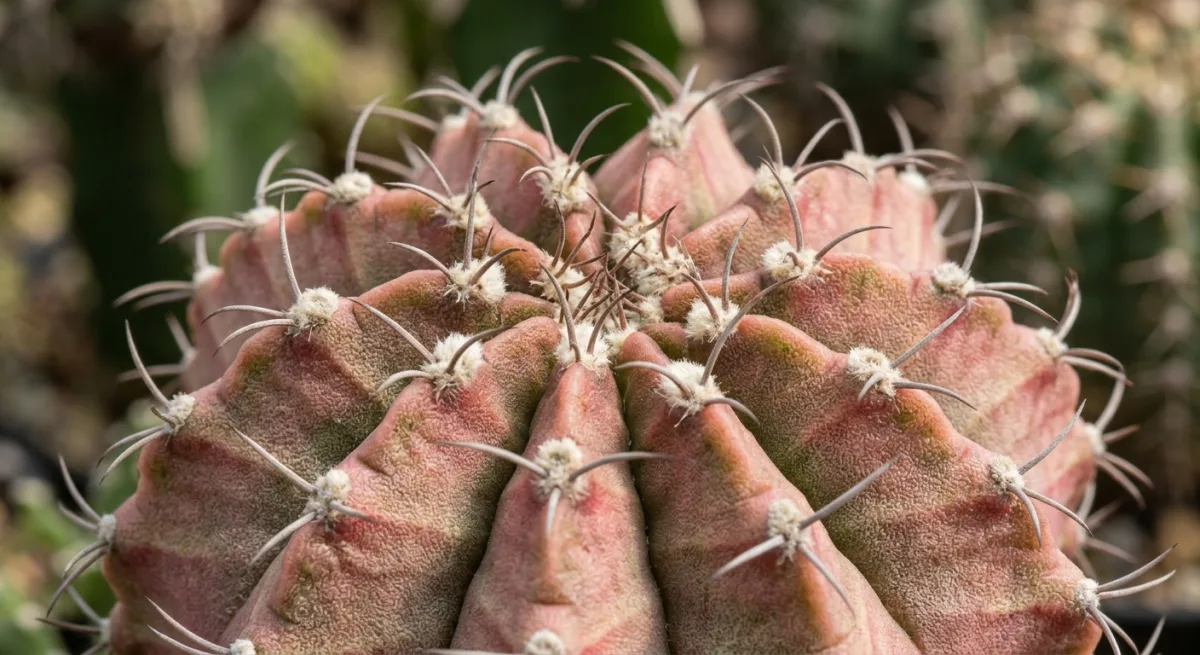
Morphologically, the scion displays 8 to 12 prominent, slightly notched ribs etched with subtle horizontal cross-bands. Arranged along the margins of these ribs are the areoles—the specialized meristematic pads defining the cactus family. On this light red Gymnocalycium, the spines are remarkably slender, recurved, and pale grayish-brown; they gently curve along the epidermis rather than protruding aggressively. While spines in wild ancestors provide shade and disrupt desiccating wind currents, here they serve as a delicate ornamental crown. The supporting base below is almost universally Hylocereus undatus (the Dragon Fruit cactus). Triangular in cross-section, succulent, and loaded with active chloroplasts, this rootstock is the genuine hydrostatic and metabolic engine driving the red guest above.
2. Light Requirements, Solar Intensity, and Air Circulation
The photosynthetic lighting requirements of a grafted Moon Cactus demand a delicate, deliberate balance that differs sharply from standard desert species. Because the red tissues lack chlorophyll, they possess virtually no natural photoprotective shield against intense ultraviolet (UV) radiation. If placed directly behind an unshaded south-facing window under blistering midday sun, cellular photo-oxidation and thermal necrosis (sunburn) will trigger rapidly. The vivid red hue will first turn dull and bleached, followed by irreversible pale yellowish-white scarring and tissue collapse.
The ideal placement is a spot receiving bright, indirect sunlight or dappled morning light (such as an east- or west-facing window filtered through a sheer curtain). A minimum of 5 to 6 hours of strong, diffused ambient daylight is mandatory to fuel the rootstock's photosynthetic apparatus. Conversely, relegating this cactus to a dim office desk will cause the base Hylocereus to undergo severe etiolation—stretching, thinning, and losing structural integrity until it can no longer support the weight of the red crown. Furthermore, environmental air circulation must remain active rather than stagnant, allowing the stomata to execute efficient gas exchange during their nocturnal CAM (Crassulacean Acid Metabolism) cycle.
3. Irrigation Protocols and Critical Winter Dormancy
In standard 2-inch production pots, the substrate volume is minuscule and dries rapidly; nevertheless, overwatering remains the single greatest killer of grafted cacti. Soaking your succulents on a strict calendar is not an expression of care; it starves root tissues of dissolved oxygen and suffocates root hairs. Irrigation must always be dictated by substrate dryness rather than the calendar. Insert a thin wooden skewer all the way to the bottom of the pot; if it emerges bone-dry without adhering soil particles, it is safe to water thoroughly.
When applying water, direct the stream exclusively around the root zone, taking great care never to splash water onto the graft union (the vascular cambium fusion line). Trapped water droplets along this surgical seam invite opportunistic fungal pathogens into the vascular ring. During winter (November through February), the cactus enters an obligatory dormancy period. Ambient temperatures should ideally be maintained around 12–15°C (54–59°F), and watering frequency must be cut back sharply to once every four to six weeks. Because the rootstock (Hylocereus) is of sub-tropical origin, it lacks the frost hardiness of high-altitude alpine cacti; never expose it to temperatures below 5°C (41°F), or the root system will suffer catastrophic cellular collapse.
4. High-Mineral Substrate Chemistry and Pot Selection
Commercially purchased Moon Cacti in 2-inch pots are almost universally shipped in pure, peat-dense nursery blends or compressed coconut coir to minimize freight weight. In home environments, these dense organic mediums behave unpredictably: they either remain swampy and sodden for weeks or dry into an impenetrable, hydrophobic brick that repels hydration and suffocates delicate roots. To ensure long-term vitality, your first essential intervention is repotting into a gritty, porous, mineral-dominant substrate.
Resist the urge to move into an oversized container; transition from a 2-inch (5.5 cm) pot into one no larger than 2.75 to 3 inches (7–8 cm) in diameter, equipped with generous bottom drainage holes. Unglazed terra cotta pots are ideal; their porous clay walls facilitate bilateral evaporative transpiration, keeping the rhizosphere cool and well-aerated.
| Substrate Component | Ratio (%) | Horticultural Function & Botanical Benefit |
|---|---|---|
| Horticultural Pumice (2–4 mm) | 40% | Creates continuous macro-pores, ensuring rapid oxygen diffusion and preventing compaction. |
| Crushed Lava Rock / Zeolite | 25% | Releases trace minerals, absorbs excess moisture spikes, and buffers against root rot pathogens. |
| Coarse Quartz Sand (Washed) | 15% | Accelerates gravitational drainage and prevents soil clumping around the root collar. |
| Sterile Leaf Compost / Aged Peat | 20% | Supplies the baseline organic cation exchange capacity (CEC) needed to sustain the rootstock. |
5. Flowering Triggers and Nutrient Management
Many casual indoor gardeners assume the light red Gymnocalycium is nothing more than a static, decorative orb. In reality, a mature scion that experiences a proper cool, dry winter dormancy will reward you in late spring and summer with exquisite, silky flowers. Buds emerge from the upper areoles surrounding the sunken apical depression, opening into multi-petaled blossoms of soft shell-pink, ivory, or pale grayish-white that create a striking chromatic contrast against the crimson body.
To encourage robust flower formation, apply a balanced, low-nitrogen, high-potassium, and high-phosphorus liquid cactus fertilizer (such as an NPK 5-10-10 or 4-8-12 formulation) once a month from April through August. Heavily nitrogenous fertilizers must be strictly avoided; excess nitrogen triggers rapid, bloated cellular water uptake, thinning the cuticular wax and rupturing epidermal tissues, leaving the plant susceptible to fungal penetration. Always apply fertilizer to pre-moistened soil, diluted to half or quarter the manufacturer's labeled strength.
6. Propagation, Offset Removal, and Grafting Techniques
The light red Gymnocalycium mihanovichii cannot be propagated by seed. When seeds from mutant flowers germinate, the resulting completely albino seedlings die as soon as their endosperm reserves are exhausted, because they cannot synthesize sugars. The only viable path for propagation is vegetative: harvesting the tiny spherical offsets ('pups') that form on the areoles of the mother scion and grafting them onto vigorous green rootstocks.
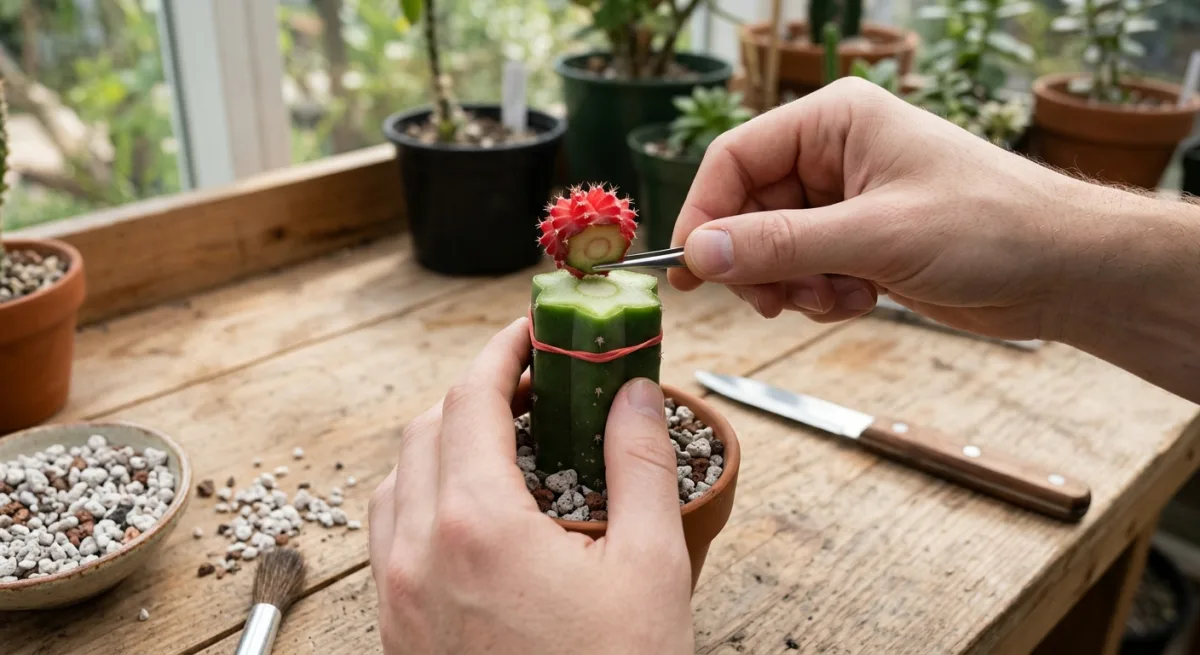
- Rootstock Preparation: Select an actively growing, well-rooted stem of Hylocereus or Trichocereus. Using a razor-sharp, flame-sterilized scalpel or razor blade, make a clean, horizontal decapitation cut. Gently bevel (chamfer) the outer edges downward at a 45-degree angle to prevent the drying center from forming a concave cup that pulls the graft apart.
- Offset Harvesting: Gently twist a 1–2 cm wide pup free from the mother scion. Using a sterile blade, slice off the bottom millimeter horizontally in a single swift cut to expose clean vascular tissue.
- Vascular Cambium Alignment: Place the pup cut-side down onto the cut surface of the rootstock. Overlap the circular vascular rings (the internal transport rings seen as faint concentric circles) of both plants so that they intersect at least at one point. This intersection is vital for establishing new vascular bundles.
- Securing the Union: Loop two elastic rubber bands over the top of the pup and under the base of the pot in a crisscross pattern, applying moderate, even downward tension. Keep the plant in a shaded, warm, well-ventilated space for 10 to 14 days until the callus fusion is complete, then carefully remove the bands.
7. Fungal Pathologies and Pest Management
The primary pathological threats to grafted Moon Cacti are soil-borne fungal pathogens such as Fusarium, Phytophthora, and Pythium. Fungal rot typically strikes in one of two ways: it either invades through damp, oxygen-deprived roots, traveling upward and turning the green rootstock into a brown, waterlogged mush, or it breaches the graft junction, liquefying the red dome from the inside out. Any palpable softening of the red head or dark discoloration near the base warrants immediate triage.
If rot has started in the lower rootstock, act immediately before it reaches the top. Use a sterile blade to sever the red scion cleanly above the infected zone. Inspect the cut surface for clear, unblemished tissue, let it dry for several hours, and immediately regraft it onto a healthy, freshly prepared green rootstock. Regarding insect pests, mealybugs (Pseudococcidae) frequently hide within the deep rib furrows and areole crevices of the red scion. At the first sign of cottony white filaments, spot-treat them using a cotton swab dipped in 70% isopropyl alcohol, ensuring adequate air circulation to prevent secondary fungal infections.


Reader Reviews & Comments 1 Review
No comments yet. Be the first to share your succulent experience!
Leave a Review & Rating
Share your plant care tips, experiences, or questions with our succulent community.