






Hailing from the dry tropical thickets and coastal scrublands of eastern Brazil to the sunniest perches in our homes, the Rose Cactus (Pereskia grandifolia) stands as one of the plant kingdom's most captivating paradoxes. Encountering it for the first time in a nursery or greenhouse, you might understandably exclaim, 'How on earth is this a cactus? It has broad, lush green leaves and blossoms that look just like wild pink roses!' You would be entirely justified in your surprise; yet, if you look closer at the woody stem, the characteristic woolly cushion areoles and needle-sharp spines nestled at the leaf axils immediately betray its true identity as an ancient member of the Cactaceae family. If you have recently welcomed a Rose Cactus into your collection and find yourself asking, 'What do I do with this plant now?', pull up a chair, brew a warm cup of coffee, and let us decipher the secrets of this living botanical relic together.
In everyday horticultural parlance, terms like 'rose cactus' or 'rose succulent' are often applied loosely to two distinct plant groups: the rosette-forming succulents (such as mountain rose Greenovia or rosette-shaped Echeveria cultivars) and the true, ancestral leafy cactus genus Pereskia. While our primary focus here is elevating the magnificent, authentic Rose Cactus (Pereskia grandifolia) to its absolute peak vitality, the physiological and substrate principles detailed below will provide crystal-clear clarity for caring for both this leafy marvel and any rosette succulent that graces your windowsill.
1. Taxonomic Identity, Areole Structure, and Spine Morphology
Tracing the evolutionary chronicle of cacti reveals that tens of millions of years ago, all ancestral cacti bore true, functional foliage. As continental climates shifted toward persistent aridity, most lineages discarded broad lamina to minimize evaporative water loss, migrating photosystem machinery entirely into swollen, succulent stems. The remarkable genus Pereskia represents a living transitional bridge that survived this divergence. Pereskia grandifolia is an exceptional primitive shrub-cactus that retains broad, glossy green leaves while simultaneously bearing sharp, prominent spines derived from distinct areoles along its woody shoots.
Morphologically, the presence of areoles is the defining botanical signature distinguishing true cacti from other succulent plant families. Along the stems of your Rose Cactus, where the leaf petioles attach, you will observe tiny, felted, woolly cushions. These areoles are specialized, condensed lateral meristem centers from which the plant produces new vegetative shoots, showy pink inflorescences, and formidable defensive spines. Rosette succulents like Echeveria or Greenovia belong to the Crassulaceae family and lack areoles entirely; their leaves cluster tightly around a central core without specialized spine cushions. Inspecting these woolly areoles on your specimen confirms without a shadow of a doubt that you are stewarding an ancient matriarch of the cactus lineage.
2. Light, Sun Intensity, and Ventilation Standards
Unlike conventional globular desert cacti, the Rose Cactus combines the traits of an aggressive tropical shrub with the water-conserving physiology of a succulent. Because its broad leaves are rich in active chlorophyll, it utilizes standard C3-type photosynthesis during the daytime alongside partial succulent adaptations. Consequently, it has a high metabolic demand for bright illumination, yet its delicate leaf blades can scorch and turn crisp if subjected to harsh, unfiltered midday solar radiation concentrated through glass windowpanes.
The optimal placement for Pereskia grandifolia is an east-facing window bathed in generous morning sunlight, or a south-to-west exposure softened by sheer curtains providing 6 to 8 hours of brilliant, dappled light daily. In chronically dim corners, the plant quickly undergoes stress: lower foliage turns chlorotic and drops, new stems become etiolated (pale, elongated, and structurally weak), and flower bud initiation halts altogether. Furthermore, active air exchange around the foliage and soil collar is essential; stagnant, humid air creates ideal breeding conditions for foliar fungal pathogens.

3. Watering Cycles and the Critical Winter Dormancy Regime
The most frequent pitfall among enthusiasts caring for a Rose Cactus is either treating it as an arid, leafless desert cactus by withholding moisture for months on end, or treating it as a thirsty tropical houseplant by allowing it to sit perpetually in stagnant runoff. Succulents are never nurtured through over-attentive watering; keeping roots submerged in saturated media merely suffocates root hairs by cutting off interstitial oxygen. During the active growing period of spring and summer, a leafy Rose Cactus transpires significantly more water than an Echinocactus or Mammillaria of comparable size due to its extensive leaf surface area.
Follow the soak-and-dry protocol: allow the substrate to dry out substantially—roughly the top 50% to 75% down the pot—before watering thoroughly. Insert a clean wooden skewer or your finger deep into the soil; if moisture is detected, hold off. When you do water, drench the root ball until water flows freely from the drainage holes, and always empty the drip saucer after 15 minutes. As autumn transitions to winter and ambient temperatures settle around 12–15°C (54–59°F), the plant enters a necessary semi-dormancy. During this rest phase, drastically reduce watering frequency, supplying just enough moisture every few weeks to keep the main woody stems from severely shriveling.
4. High-Mineral Cactus Substrate and Pot Requirements
The root system of Pereskia grandifolia is robust, fibrous, and fast-growing, yet its root cortex is intensely vulnerable to anaerobic conditions. Dense, peat-heavy commercial potting soils act like waterlogged sponges, suffocating capillary feeder roots and initiating black, necrotic stem rot at the soil line. Your potting medium must be structured so that excess water drains through in a matter of seconds, leaving behind open, aerated, mineral-rich macro-pores.
| Substrate Component | Volumetric Ratio (%) | Horticultural & Physical Function |
|---|---|---|
| Pumice (3–6 mm particle size) | 35% | Delivers exceptional internal porosity, oxygen retention, and prevents compaction. |
| Crushed Lava Rock / Zeolite | 20% | Provides structural weight, micro-mineral buffering, and steady nutrient exchange. |
| Coarse River Sand / Quartz Grit | 15% | Creates immediate free-drainage channels; prevents fine particle siltation. |
| Washed Coco Coir / Fine Bark Fibers | 20% | Retains a measured baseline of hydration necessary to sustain leafy transpiration. |
| Aged Worm Castings or Sifted Compost | 10% | Supplies a gentle, organic biological buffer and inoculates beneficial soil microbes. |
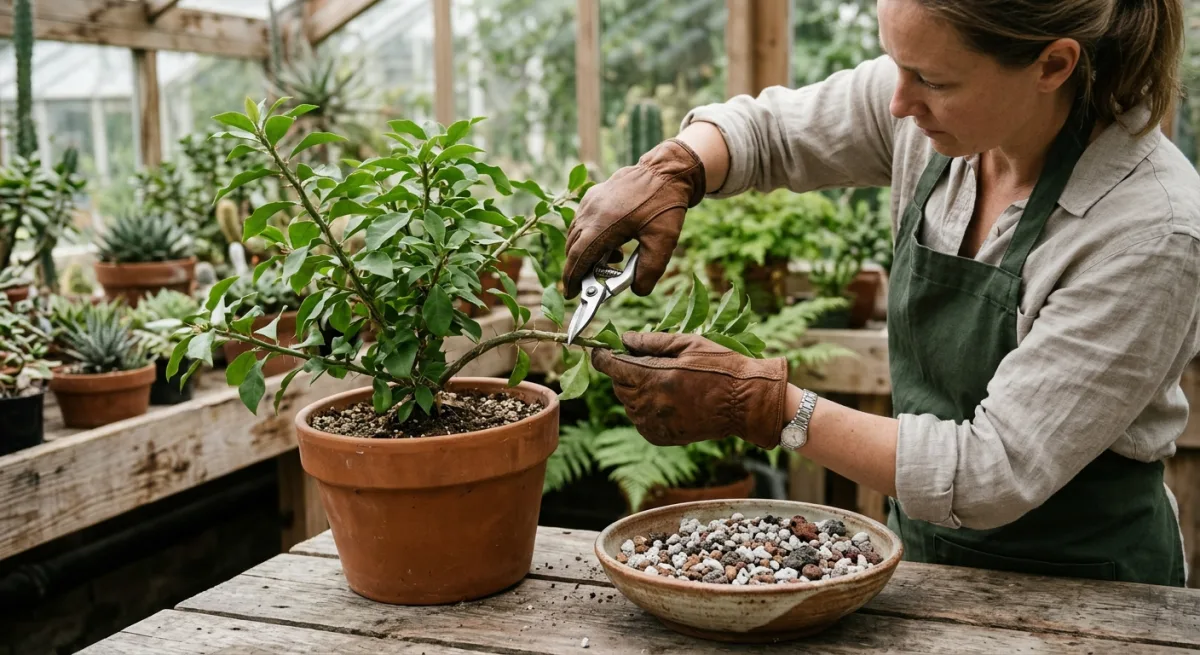
When selecting a container, unglazed, breathable terracotta pots are overwhelmingly superior to glazed ceramic or plastic. The porous clay walls facilitate lateral moisture evaporation throughout the entire depth of the pot, preventing the core of the root ball from lingering in waterlogged stasis that could lead to vascular fungal blockage.
5. Blooming Strategies and Nutritional Support
The crowning glory of Pereskia grandifolia is its spectacular inflorescence. Clusters of showy blossoms, measuring 3 to 5 cm (1.2 to 2 inches) across, burst forth from terminal shoot tips in mesmerizing shades of candy pink to purplish rose. At the flower's center lies a dense rosette of golden-yellow stamens, presenting a dramatic, painterly contrast against the vibrant petals. To coax this display within an indoor environment, you must synchronize with the plant's seasonal rhythm.
The secret to profuse blooming is a cool, bright winter dormancy followed by abundant spring warmth and sunlight. Keep the plant in a cool room (12–16°C / 54–61°F) over winter with dry roots. As late February ushers in lengthening photoperiods, move it into bright, warm sunshine to activate floral meristems. From April through September, feed the plant every 3 to 4 weeks with a specialized cactus fertilizer that is low in nitrogen and fortified with phosphorus and potassium (such as an NPK 5-10-10 or 4-8-12 formulation), diluted to half strength. Excessive nitrogen will trigger rampant, oversized green foliage at the absolute expense of flower formation.
6. Propagation, Stem Cuttings, and Grafting Techniques
Propagating the Rose Cactus is one of the most gratifying experiences in succulent cultivation. In late spring or early summer, use a razor-sharp, sterilized pruning shear to take a 10–15 cm (4–6 inch) semi-hardwood stem cutting from a healthy branch. Carefully strip the lowest two or three leaves to expose the nodes. The critical step is allowing the cut to heal: place the cutting in a dry, warm, ventilated area away from direct sunlight for 3 to 5 days until a firm, whitish callus forms over the wound.
Once callused, insert the cutting roughly 3 cm deep into a propagation bed composed primarily of pumice and perlite with a hint of coco peat, maintained lightly moist. Strong roots typically develop within 3 to 4 weeks, swiftly followed by fresh leaf shoots emerging from the upper areoles. A fascinating horticultural fact: because Pereskia stems possess an exceptionally vigorous, active vascular cambium, expert nursery propagators frequently utilize them as robust, disease-resistant understocks for grafting epiphytic cacti like Thanksgiving cacti (Schlumbergera) or Easter cacti (Rhipsalidopsis) into stunning, weeping standard tree forms.
7. Defending Against Rot and Fungal Risks
The most pervasive threat to Pereskia grandifolia is basal root collar rot brought on by fungal pathogens such as Fusarium or Phytophthora thriving in waterlogged, poorly aerated soil. Warning signs include a softening, translucent, dark-brown or black discoloration creeping upward from the soil line, accompanied by spontaneous leaf drop upon the slightest touch. If this occurs, unpot the specimen immediately, excise all blackened, decayed root tissues back to pristine white vascular tissue, treat the cuts with sulfur or cinnamon powder, and re-root the remaining healthy green stem as a fresh cutting.
On the pest front, mealybugs (Pseudococcidae) pose the primary threat, concealing themselves inside the crevices of woolly areoles and along tender new growth where they pierce plant tissues to siphon cellular sap. At the first sign of cottony white webbing, dab the insects directly with a cotton swab dipped in 70% isopropyl alcohol. For extensive infestations, spray the entire plant systematically with cold-pressed neem oil or a horticultural soap solution during the evening hours to avoid phototoxic leaf burn.


Reader Reviews & Comments 4 Reviews
Eleanor Vance
Marcus Sterling
Julian Thorne
Clara Higgins
Leave a Review & Rating
Share your plant care tips, experiences, or questions with our succulent community.