






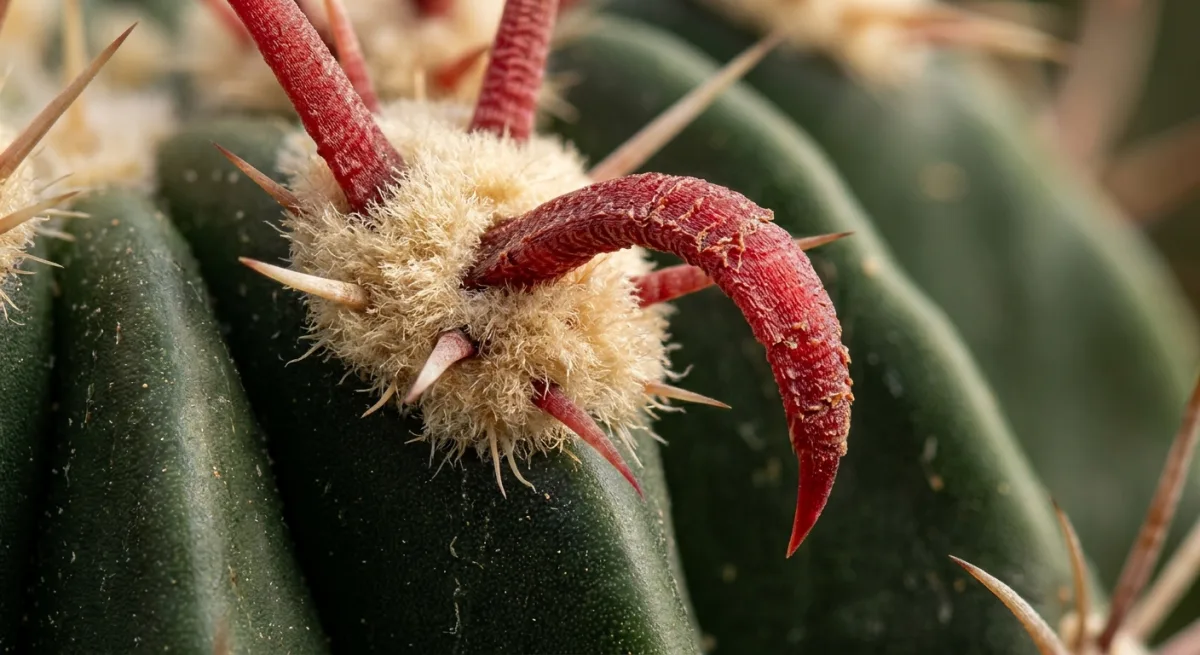
Rising like an architectural desert sculpture under the relentless sun and searing Pacific winds of Mexico's Baja California peninsula, Ferocactus gracilis holds an exalted status among succulent connoisseurs. Commonly celebrated as the 'Fire Barrel Cactus', this iconic desert dweller resembles a living torch ignited amidst arid plains, crowned with curved, blood-red spines radiating from woolly areoles. Yet, when cultivating this wild desert marvel indoors or on a sunny terrace, replicating its evolutionary desert biology is paramount to long-term success.
Many enthusiastic growers make the mistake of treating the Fire Barrel Cactus like any generic houseplant succulent. However, Ferocactus gracilis represents sophisticated physiological engineering far beyond an ordinary fleshy stem. Its deeply channeled vertical ribs operate like a hydraulic accordion, expanding rapidly to store torrential desert rainwater and contracting tightly during extended droughts to minimize surface exposure. Preserving its health in a container without sacrificing root integrity or muting its fiery anthocyanin pigments begins with honoring this ancient desert architecture.
Few gardening pleasures rival standing in the greenhouse on a quiet morning with a warm cup of coffee, watching the first light ignite the crimson spines of Ferocactus gracilis into a glowing halo. In this master guide, we combine scientific botanical precision with practical, hands-on mentorship, detailing everything from photoperiods and winter rest regimes to mineral substrate calculus and bloom induction.
1. Taxonomic Identity, Areole Architecture, and Spine Morphology
Belonging to the subfamily Cactoideae within the Cactaceae family, Ferocactus gracilis begins life as a solitary globose sphere before gradually elongating into a commanding cylindrical barrel. While mature wild specimens can reach heights of 1.5 to 3 meters with a girth of 30 to 40 cm, container-grown specimens remain stately, slow-growing botanical investments. The epidermis is defined by 16 to 24 prominent, acute ribs with deep furrows running vertically along the stem.
The defining visual spectacle of the Fire Barrel Cactus lies within its felted areoles. The central spines—reaching up to 7 to 10 cm in length—are flattened, cross-ridged, and gracefully recurved at the tips into predatory hooks. While juvenile spines emerge in a vibrant, translucent ruby red, they slowly weather to a silvery rose or chalky gray as they age. This vivid coloration is driven by protective anthocyanin and betalain pigments that act as natural sunscreen, shielding tender apical meristems from lethal ultraviolet radiation. Radiating outward are slender, paler, whitish radial spines that interlace to form a protective lattice, diffusing direct sunlight across the photosynthetic epidermis.
2. Light Parameters, Sun Exposure, and Aeration Standards
Attempting to cultivate a Ferocactus in medium indirect light or a shaded interior is the horticultural equivalent of placing an alpine plant in a humid jungle. The Fire Barrel Cactus demands a minimum of 6 to 8 hours of unfiltered, direct sunlight daily. In inadequate lighting, the apex stretches and narrows into an unsightly conical shape—a condition known as etiolation that permanently disfigures the plant's structural symmetry.
Equally critical to high light intensity is continuous air circulation. In their natural habitat, coastal and desert drafts constantly dissipate thermal heat loads from the cactus body and prevent moisture accumulation in the woolly areole recesses. Indoors, an unobstructed south- or southwest-facing window is non-negotiable. During warm seasons, positioning the plant on an open terrace or well-ventilated patio promotes robust spine density. However, transitioning a plant from indoor winter shelter directly into scorching midsummer rays must be conducted gradually over 10 to 14 days using shade cloth to prevent irreversible epidermal sunburn.
3. Irrigation Dynamics and the Essential Winter Rest Protocol
Irrigation for Ferocactus gracilis hinges on the strict 'soak and dry' principle. Cactus root parenchyma cells require periods of absolute dryness between waterings to facilitate essential gas exchange. Keeping the root zone constantly damp asphyxiates micro-root hairs, creating an entry point for opportunistic soil-borne fungal pathogens.
Throughout the active growing season (spring through early autumn), saturate the potting mix thoroughly until water drains freely from the drainage hole, and always empty the catchment saucer within 15 minutes. From November through late March, initiating a cold, dry dormancy period is the cornerstone of its survival:
- Temperature Range: Position the specimen in a bright, cool, frost-free location maintained between 5°C and 10°C (41°F to 50°F).
- Winter Watering: Cease watering almost entirely. A modest accordion-like contraction of the ribs is a natural, healthy adaptation to conserve cellular hydration. A few tablespoons of water once every 6 to 8 weeks is all that is required to prevent root desiccation.
- Bloom Induction: Without this cool, dry vernalization period, Ferocactus cannot trigger apical floral bud initiation.
4. High-Mineral Substrate Architecture and Pot Selection
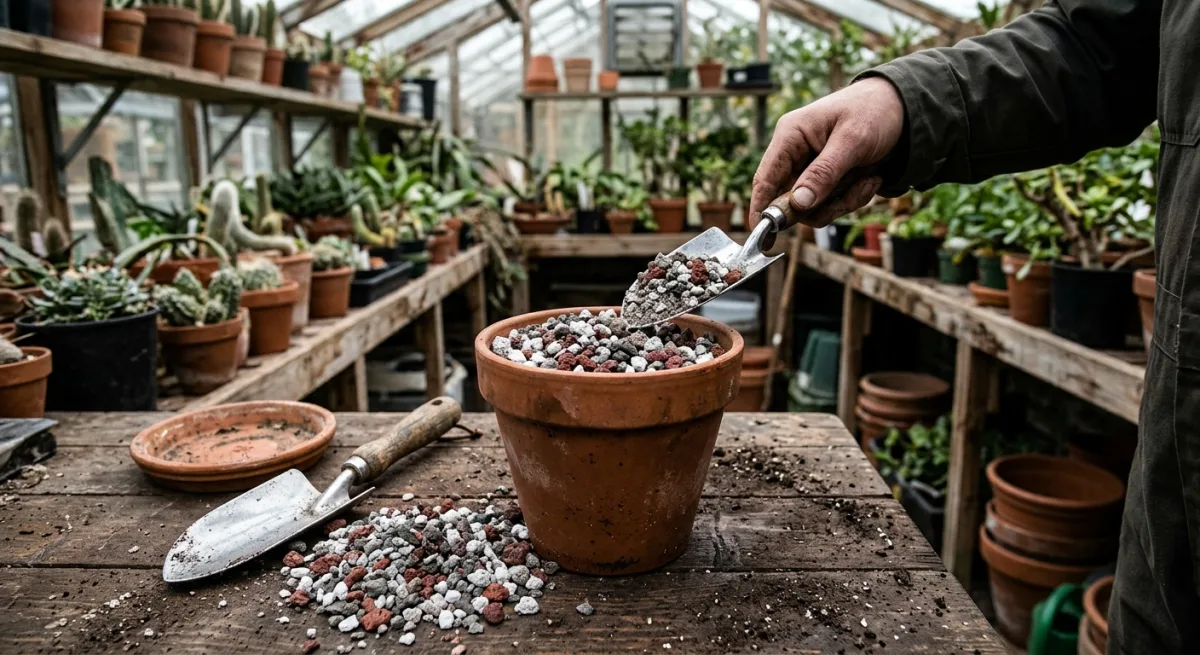
Standard peat-based potting soils from big-box stores are hazardous for Ferocactus gracilis. Decomposed peat hardens into an impenetrable hydrophobic brick when dry, yet remains waterlogged for weeks when wet, inevitably suffocating the root crown. The Fire Barrel Cactus requires an ultra-porous, gritty substrate mimicking the decomposed granite and volcanic detritus of Baja California.
Unglazed terracotta containers are unmatched because their porous clay walls facilitate bilateral moisture evaporation and root aeration. Glazed ceramic or plastic pots trap water and extend dry-out periods dangerously. Because barrel cacti develop a high center of gravity as they mature, opt for broad-based, stable pots rather than tall, narrow vessels to prevent accidental tipping.
| Substrate Component | Ratio (%) | Horticultural Function |
|---|---|---|
| Pumice (3-6 mm grading) | 40% | Provides macro-porosity, oxygen channels, and moisture buffering |
| Crushed Lava Rock / Coarse Zeolite | 25% | Enhances root anchoring, mineral exchange, and structural drainage |
| Coarse Quartz Sand / Horticultural Grit | 15% | Stabilizes substrate density and prevents substrate compaction |
| Sifted Quality Compost or Coco Coir | 20% | Supplies minimal organic cation-exchange capacity and baseline hydration |
5. Flowering Induction and Nutritional Guidelines
When an adult Ferocactus gracilis blooms, it puts on a dramatic show. Funnel-shaped flowers measuring 4 to 5 cm emerge around the woolly apex in mid-to-late summer, displaying satiny yellow petals centered with fiery red midstripes or solid glowing scarlet tones. These are eventually followed by yellow, fleshy, scale-clad seed capsules.
However, flowering requires patience: the Fire Barrel Cactus will not bloom during its juvenile years. A specimen typically needs to attain a diameter of at least 15 to 20 cm and reach reproductive maturity, which often requires 8 to 12 years of consistent care. To optimize blooming prospects:
- Enforce a strict, cold, dry winter dormancy regime.
- During the active spring-to-midsummer cycle, provide a monthly feeding of low-nitrogen, high-potassium, and phosphorus fertilizer (such as NPK 4-8-12 or 5-10-10) diluted to half strength.
- Avoid high-nitrogen fertilizers entirely; excessive nitrogen causes rapid, bloated tissue expansion, causing structural skin ruptures and weakening spine production.
6. Propagation: Seed Sowing and Grafting Techniques
Ferocactus gracilis is almost universally a solitary, non-clustering barrel that rarely offsets from the base. Consequently, propagation relies almost exclusively on seed propagation.
Seed Propagation: In early spring, scatter clean seeds over a sterile bed of fine pumice, decomposed granite, and sieved coco grit. Cover lightly with a millimeter of coarse sand. Maintain steady moisture and temperatures between 22°C and 26°C (72°F to 79°F) under bright, indirect light; germination occurs within 14 to 21 days. Seedlings remain tender, rounded green buttons for several months before developing their first distinct red hook spines.
Grafting: To accelerate growth in delicate juvenile seedlings or protect vulnerable varieties, micro-grafting onto vigorous rootstocks like Trichocereus spachianus or Echinopsis can be utilized. However, authentic barrel cacti are most valued and aesthetically imposing when cultivated on their own extensive, natural root systems.
7. Defending Against Fungal Pathogens and Pests
The primary hazard facing the Fire Barrel Cactus stems from invisible soil pathogens. In saturated, poorly aerated potting mixes, fungal invaders such as Fusarium oxysporum and Phytophthora invade through fragile root tips and block the vascular xylem bundles. If the base of the stem softens, yellows, or turns dark brown, basal stem rot is underway.
Regarding insect pests, mealybugs love to hide in the protective wool of the apical areoles, producing waxy white cotton-like deposits. Spider mites may target new epidermal tissue near the crown during hot, stagnant weather, causing permanent rusty-brown scabbing. Treat isolated outbreaks immediately using a cotton swab dipped in 70% isopropyl alcohol, and apply horticultural systemic treatments or neem-based applications for persistent infestations.


Reader Reviews & Comments 3 Reviews
Marcus Vance
Julian Thorne
Clara Higgins
Leave a Review & Rating
Share your plant care tips, experiences, or questions with our succulent community.