






Imagine trekking across the vast Sonoran Desert or navigating Arizona's fiery red canyons: for months on end, not a single drop of rain touches the earth, the scorching sun bakes the cracked ground, yet towering green columns stand proud and vibrant. These resilient desert fortresses Are Cacti Poisonous to Children? Hazards, Spine Injuries, and Child-Friendly Cactus Care">are cacti! Spanning from a cozy bedroom windowsill to sweeping arid badlands, these extraordinary plants are nature's most brilliant survivalists. For curious kids, stepping into the world of cacti feels like opening a comic book superhero's arsenal: with stems that expand like sponges, spines armored like chainmail, and surprise flowers that pop open under the moonlight, they are true wonders of biological engineering.
Welcoming these charming succulents onto our indoor shelves is one of the most rewarding ways to teach young learners patience, resource conservation, and ecological harmony. These prickly stars of the succulent kingdom are the ultimate hands-on tool for grasping a vital horticultural truth: 'Pouring water on a plant every day isn't an act of love; it deprives the roots of vital oxygen and inadvertently drowns them.' Grab your magnifying glasses, and let us dive into the microscopic secrets, desert marvels, and safe home-growing practices of these desert champions together.
1. Taxonomic Identity, Areole Structure, and Spine Morphology
Botanists identify genuine cacti through a very specific botanical passport: membership in the Cactaceae family. The golden rule for determining whether a succulent is a true cactus lies in discovering specialized structures called 'areoles'. Areoles are circular, cushion-like growth nodes spaced along the ribs or tubercles of the stem that look like tiny velvet buttons. If a plant lacks areoles, it is not a true cactus—even if it is covered in sharp needles (for instance, many thorny African euphorbias look deceptively like cacti, yet they completely lack areoles).
Why Do Cacti Really Need Special Soil? Scientific Reasons and Root Rescue Protocol">do cacti carry sharp spines instead of lush, broad leaves? Millions of years ago, ancestral cacti flourished with flat green foliage just like deciduous trees. As their native habitats became increasingly arid, broad leaves turned into a dangerous liability by evaporating precious moisture into the dry air. Through evolutionary brilliance, cacti modified their leaves into slender, hardened spines. These spines do far more than fend off hungry desert herbivores; they serve as miniature parasols that cast protective micro-shadows across the stem, while channeling morning condensation straight down to the root zone. Some species even produce silky white hairs (trichomes) that act like cozy thermal sweaters, shielding the plant from frigid desert nights and blazing ultraviolet radiation by day.
2. Light Intensity, Sun Exposure, and Aeration Standards
Cacti are true heliophiles—creatures that celebrate direct sun. Their photosynthetic machinery relies heavily on abundant photon energy to synthesize food and maintain compact cellular architecture. Indoors, a potted cactus requires a minimum of 5 to 6 hours of unfiltered or gently diffused bright light daily. South- or southwest-facing windowsills provide the optimum solar sweet spot for vigorous development.
When a cactus is stranded in a dimly lit corner, it undergoes 'etiolation'—a survival reflex where the plant stretches frantically toward the nearest light source. The tip grows spindly, pale, and structurally weak, permanently distorting its natural geometry. Beyond radiant light, cacti crave fresh, circulating air. Stagnant, humid microclimates encourage fungal spores to settle on the epidermis. Opening windows regularly refreshes ambient carbon dioxide levels and allows the plant's cuticle to breathe freely.

3. Watering Cycles and the Critical Winter Dormancy Regime
The crown jewel of cactus physiology is CAM (Crassulacean Acid Metabolism) photosynthesis. While ordinary garden plants open their microscopic leaf pores (stomata) during the day to take in carbon dioxide, cacti keep their stomata tightly sealed beneath the desert sun to halt water transpiration. Once twilight falls and temperatures plummet, they open their pores, capture carbon dioxide, store it as malic acid, and process it using stored solar energy the following morning. Thanks to this hydraulic brilliance, they survive weeks—even months—without rain.
When watering, always adhere to the fundamental 'soak-and-dry' principle. Never add a single drop of water until the substrate has dried out completely from top to bottom. A fun, dependable test for kids is inserting a wooden skewer deep into the potting mix: if it emerges cool and stained with damp soil, wait; if it pulls out bone-dry and clean, it is time for a thorough drench. Between November and February, temperate cacti enter winter dormancy. During this chilly resting phase, place them in a cool spot (50–59°F / 10–15°C) and withhold irrigation almost entirely. A cool, bone-dry winter rest is the secret trigger that prompts dramatic spring blooming.
4. High-Mineral Cactus Substrate and Pot Requirements
Dense garden loam or heavy potting soil acts like wet cement around cactus roots, suffocating their gas exchange pathways. Cactus root systems demand an airy, granular substrate that allows water to surge through the bottom drainage holes within seconds. Unglazed terracotta pots are far superior to glazed ceramic or plastic containers, as their porous clay walls naturally evaporate residual moisture from the root ball.
| Substrate Component | Material Description | Target Ratio (%) | Botanical Benefit |
|---|---|---|---|
| Primary Mineral Matrix | Pumice (3–6 mm grain size) | 40% | Creates stable air pockets, preventing compaction and water stagnation. |
| Inorganic Nutrient Buffer | Crushed Lava Rock & Zeolite | 25% | Anchors fine roots, absorbs excess moisture, and gradually releases trace minerals. |
| Structural Drainage Aid | Coarse River Sand / Horticultural Quartz | 15% | Prevents substrate caking and preserves microscopic drainage channels. |
| Organic Foundation | Sifted Peat or Coco Coir Fiber | 20% | Offers light anchoring media and minimal organic nutrients for root hairs. |
5. Blooming Tactics and Nutritional Support
One of the most frequent questions children ask is: 'Can my spiky cactus really grow flowers?' The answer is an emphatic yes! In nature, every cactus species possesses the genetic blueprint to bloom, unfurling blossoms in dazzling neon pinks, sunny yellows, fiery oranges, and satiny whites. To coax blooms out of your indoor plant, two conditions are non-negotiable: a cool, dry winter resting phase and abundant direct sunlight when spring emerges.
From mid-spring through late summer (active growing season), nourish the cactus once a month with a specialized, low-nitrogen, high-phosphorus and potassium liquid fertilizer. Dilute the fertilizer solution to half the strength recommended on the bottle label. Excess nitrogen causes the succulent tissue to bloat rapidly, leading to unsightly epidermal tears and making the plant vulnerable to rot.
6. Propagation, Offsets, and Grafting Methods
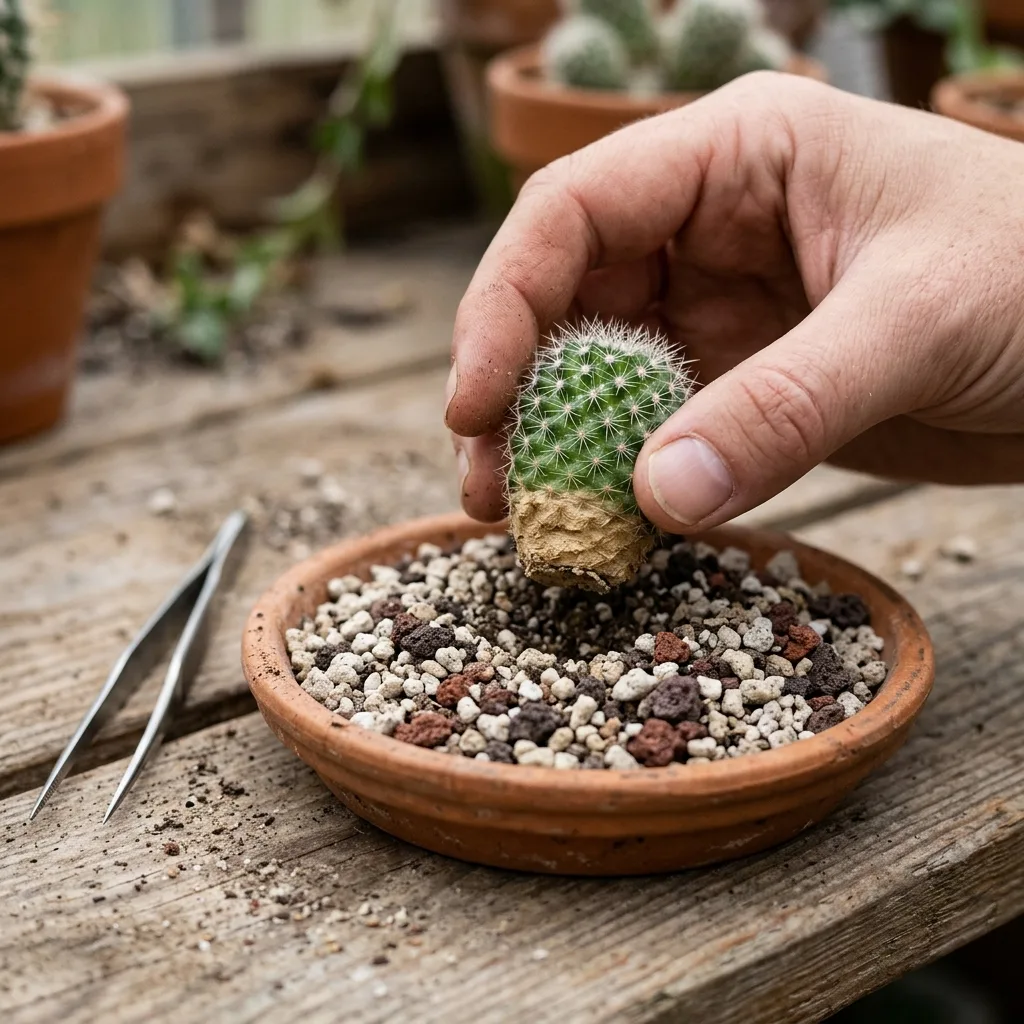
Multiplying cacti is a captivating biology project for young green thumbs. The simplest technique involves harvesting 'pups'—miniature baby offsets that sprout around the base of the mother plant. Using kitchen tongs, silicone tweezers, or a thick fold of heavy canvas, gently twist the offset until it releases from the parent body. Crucially, never plant fresh offsets directly into moist soil!
Allow the harvested cutting to rest in a dry, shaded, well-ventilated spot for 3 to 5 days so the wound develops a tough protective layer of scar tissue called a 'callus'. Once this callous shield forms, settle the pup gently atop dry, gritty mineral mix. Within a few weeks, fine pinkish-white root tips will venture down into the pebbles. For a quirky laboratory look, kids love colorful 'Moon Cacti' (Gymnocalycium mihanovichii forma rubra). These bright neon globes lack chlorophyll and cannot photosynthesize independently; botanists surgically unite them onto a vigorous green rootstock (such as Hylocereus), demonstrating the wonders of symbiotic plant grafting.
7. Defending Against Rot and Fungal Pathogens
A cactus's greatest enemy is rarely a chewing bug—it is over-attentive human care. Root rot begins below the soil line and manifests as a dark, soft, waterlogged discoloration spreading upward from the stem base. If detected early, you can rescue the top of the plant by cleanly slicing away all damaged, mushy tissue with a sterile craft knife until only pristine green flesh remains. Dust the fresh cut with powdered cinnamon (a potent natural antifungal agent), let a thick callus form, and re-root the salvageable crown in dry pumice.
If you spot tiny, cotton-like white tufts tucked inside the areoles or under the stem ribs, your plant is hosting mealybugs. Dip a cotton swab into 70% isopropyl alcohol and dab the pests directly to dissolve their waxy armor, then follow up with a light misting of cold-pressed neem oil to keep your desert warrior spotless and thriving.


Reader Reviews & Comments 3 Reviews
Eleanor Vance
Clara Higgins
Marcus Sterling
Leave a Review & Rating
Share your plant care tips, experiences, or questions with our succulent community.