






Hailing from the stony slopes and arid scrublands of South Africa’s semi-desert Karoo plateau to the sunniest corners of our living rooms, Orbea variegata—famously known as the Starfish Succulent, Toad Plant, or Carrion Flower—stands out as one of the botanical world's most mesmerizing oddities, displaying leathery, leopard-patterned star flowers. Thriving naturally in nutrient-poor gravel deposits and rocky fissures, this fascinating member of the Apocynaceae family (formerly categorized within Asclepiadaceae) possesses a highly specialized physiology that leaves it vulnerable to sudden cell collapse and fungal decay when exposed to common indoor care missteps. In this authoritative clinical guide, we explore everything from sudden basal softening and systemic root rot to opportunistic pathogens and step-by-step surgical propagation protocols to save your prized specimen.
1. Orbea Variegata Botanical Morphology and Architectural Vulnerabilities
Orbea variegata lacks true vegetative foliage; instead, it conducts all its photosynthetic activity through four-angled, toothed, fleshy green stems. This leafless architecture is an evolutionary marvel designed to eliminate transpirational surface area, keeping water loss to an absolute minimum. Operating via Crassulacean Acid Metabolism (CAM), the plant opens its microscopic stomata exclusively at night to capture carbon dioxide. However, this same physiological adaptation implies that its internal parenchyma tissues have an extraordinarily low tolerance for prolonged soil moisture and poor rhizosphere gas exchange.
Its subterranean foundation consists of a shallow, fibrous, and delicate root network. Designed by nature to spread laterally rather than deep into the subsoil, these roots are primed to capture brief flashes of desert rainfall and rapidly transition back to drought dormancy. When confined to a container where irrigation cannot flush and evaporate within hours, these thin feeder roots become choked of oxygen within minutes. This cellular asphyxiation triggers immediate necrosis, paving an open entryway for soil-dwelling fungal pathogens.
2. Root Rot (Rhizosphere Necrosis): Diagnostic Symptoms, Pathogens, and Etiology
Root rot represents the most destructive threat faced by Orbea variegata enthusiasts. The syndrome is inherently deceptive: as the fine roots die and vascular conduits break down, the stems are starved of moisture, causing the above-ground tissues to wrinkle, dull, and pucker. Well-intentioned growers often misdiagnose this limp state as dehydration and promptly pour on more water, which catastrophically accelerates the pathogen invasion.
The primary fungal and oomycete culprits exploiting saturated substrates include:
- Phytophthora and Pythium species (Oomycetes): Highly motile water molds that flourish in cold, soggy, poorly aerated potting mixes. They dissolve the cellular cortex of young feeder roots, reducing them to a translucent, slimy mush.
- Fusarium oxysporum: An aggressive vascular wilt pathogen that penetrates damaged root hairs and colonizes the xylem channels. It blocks internal sap movement, causing one side of an angled stem to blacken, collapse, and shrivel seemingly overnight.
- Rhizoctonia solani: A damping-off pathogen that targets the collar of the plant right at the soil surface, forming sunken, water-soaked brown lesions that girdle the stem base.
Confirming an active root rot outbreak requires vigilant tactile and visual checks: watch for a jelly-like softening at the soil-stem junction, the transformation of healthy epidermis from mottled olive-green to a bruised blackish-brown, a distinct sour or sulfurous odor wafting from the pot, and stem segments that loosen or pull away from the soil with zero mechanical resistance.
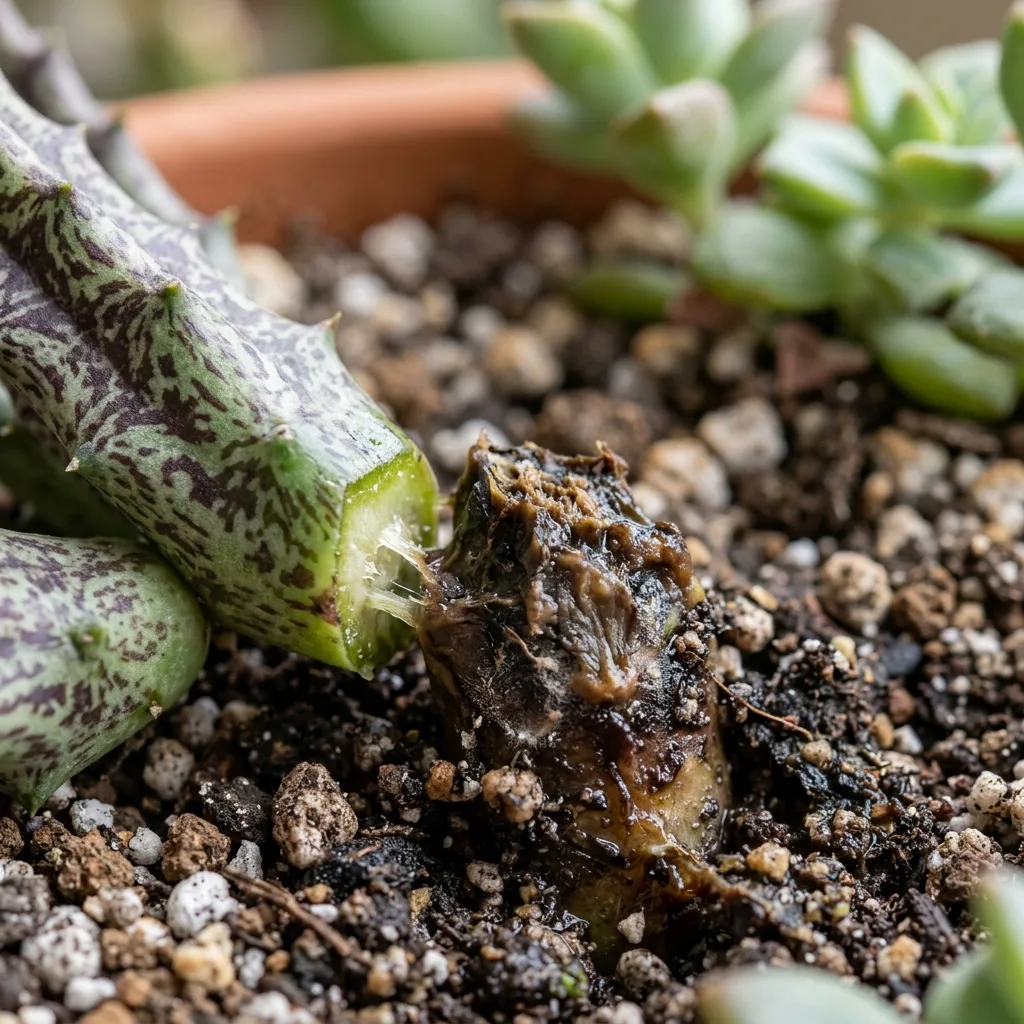
3. Step-by-Step Emergency Surgical Rescue (Stem Amputation and Re-Rooting)
Once fungal pathogens have established a foothold within the root system and lower stem tissues, systemic or contact chemical fungicides alone are rarely enough. The necrotic tissue must be completely excised mechanically. If you fail to surgically eliminate every contaminated cell, the infection will travel uninterrupted up the internal vascular bundle, melting the entire clone.
Execute this surgical intervention with strict botanical discipline:
- Unpot and Examine: Gently unpot the specimen. Rinse away the old substrate under lukewarm running water to meticulously expose the root crowns. Differentiate between healthy, firm, off-white root filaments and dark, hollow, stringy dead tissues.
- Radical Tissue Excision: Using a razor blade or surgical scalpel sterilized in 70% isopropyl alcohol or passed through a flame, perform a clean horizontal cut at least 1 to 1.5 cm (0.5 inch) above the uppermost visible sign of discoloration, slicing cleanly into pristine white-and-green tissue.
- Inspect the Vascular Core: Closely inspect the cross-section. The internal parenchymal flesh must be uniform in color, displaying no orange, rusty-brown, or black specks or vascular rings. If even a microscopic discolored pinprick remains, re-sterilize your blade and cut another half-centimeter higher.
- Antiseptic Dressing: Dust the freshly exposed cut surface liberally with finely ground sulfur powder or culinary cinnamon (which exhibits mild natural antifungal properties). This creates an immediate dry barrier against airborne spores.
- Callus Formation: Never place a fresh cutting straight into potting media. Lay the amputated stem flat in a warm (20–24°C / 68–75°F), dry, and well-ventilated space sheltered from harsh direct sunlight for 5 to 8 days. The wound must develop an impenetrable, leathery, dry callus layer over the entire cross-section.
- Rooting Induction: Once thoroughly callused, rest the stem upright on a dry, inorganic-rich medium consisting mostly of pumice, coarse perlite, or volcanic grit. Withhold all liquid water for the first 7 to 10 days; rely strictly on ambient air warmth. Within 2 to 4 weeks, fresh, pale pink or white adventitious root tips will emerge directly from the base to anchor the cutting.
4. Ideal Substrate Engineering and Pot Dynamics for Orbea Variegata
A custom-blended, ultra-porous potting mix is your most reliable defense against fungal root infections. Off-the-shelf commercial cactus soils typically retain far too much peat and organic matter, holding moisture around the root zone for days too long. The ideal medium must feature extreme porosity, a high mineral fraction, and instantaneous drainage.
We recommend the following specialized mineral blend:
- 30% Horticultural Pumice (2–4 mm particle size)
- 25% Crushed Lava Rock (Scoria) or Horticultural Zeolite
- 20% Coarse Quartz Sand or Washed River Grit (never fine construction or saline sea sand)
- 15% Screened Low-Fiber Cocopeat or Fully Matured Leaf Compost
- 10% Coarse Perlite or Expanded Clay Pellets
For container selection, unglazed terracotta is vastly superior to all alternatives. While plastic and glazed ceramic pots trap ambient water vapor against root walls, unglazed terracotta features porous clay walls that allow moisture to evaporate laterally from the soil column, guaranteeing rapid drying cycles. Always select shallow containers (bulb pans or succulent bowls) rather than deep pots, ensuring multiple wide drainage holes remain completely unobstructed.
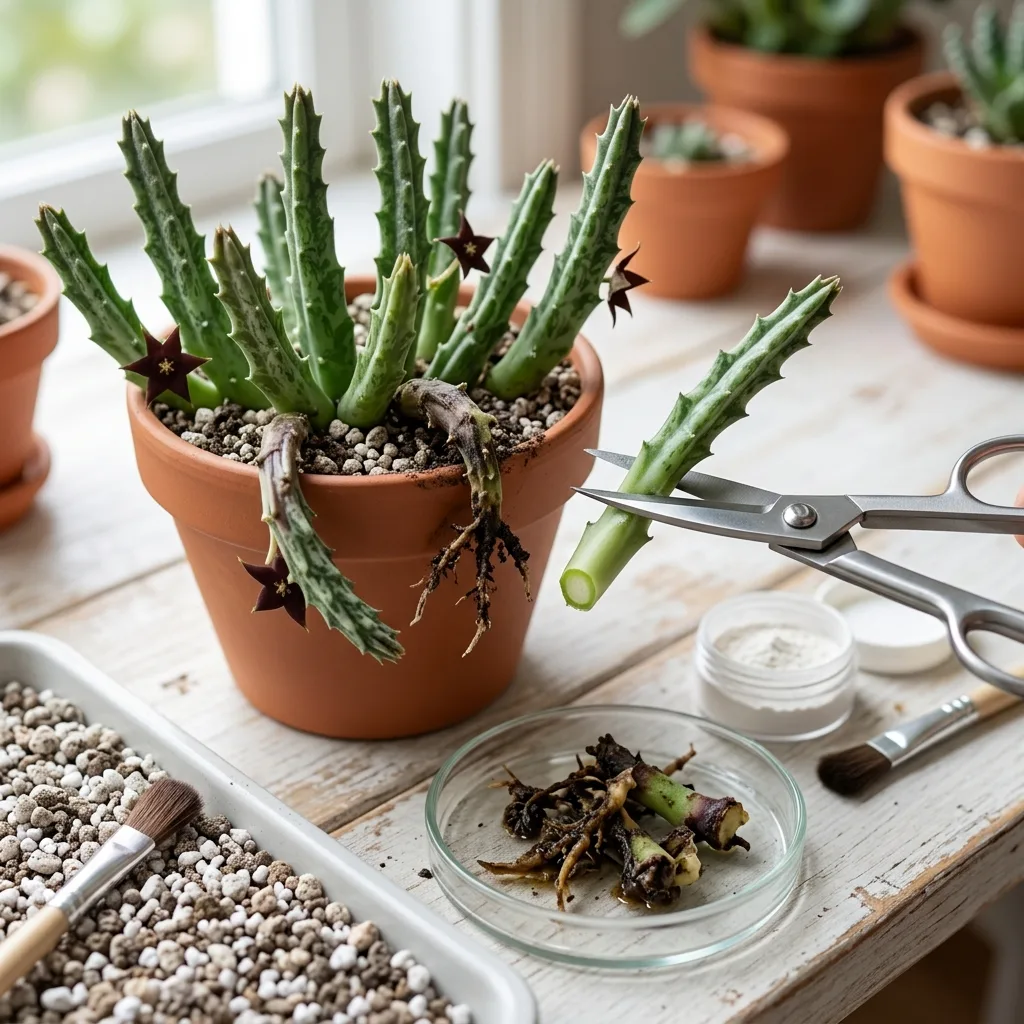
5. Other Common Pathological Threats and Insect Pests
Beyond root-zone oomycete and fungal pathogens, Orbea variegata can encounter several other biotic challenges in home and greenhouse collections:
- Stem Blight and Anthracnose (Colletotrichum spp.): Thriving in stagnant, humid environments, this fungal issue manifests as sunken, circular black lesions along the four-angled stem ridges. Counter this by improving cross-ventilation and administering preventive copper-based sprays or bio-fungicides like Bacillus subtilis.
- Mealybugs (Pseudococcidae): These pervasive sap-suckers congregate within the grooves, behind stem teeth, and directly on tender root necks. By draining vascular sap, they stunt vegetative growth and excrete sticky honeydew, which invites black sooty mold. Eradicate localized clusters using cotton swabs dipped in 70% ethyl alcohol, followed by horticultural neem oil or targeted systemic treatments (such as Acetamiprid).
- Spider Mites (Tetranychidae): Thriving under hot, bone-dry conditions, these microscopic arachnids pierce stem tissue, leaving behind a dull, silvery-brown, corky scar along the epidermis. Introduce gentle air movement and treat early outbreaks with sulfur dust or an appropriate acaricide.
6. Seasonal Preventive Cultivation Schedule
Maintaining cellular turgor and supporting natural immune responses is far easier than treating advanced tissue rot. Follow this seasonal maintenance chart to keep your Orbea variegata robust and vibrant throughout the year:
| Cultivation Parameter | Spring & Summer (Active Growth) | Autumn (Flowering Phase) | Winter (Rest / Dormancy) |
|---|---|---|---|
| Watering Frequency | Soak thoroughly only after the substrate has dried out completely for 2–3 days. | Keep barely damp to sustain flower buds; avoid heavy, lingering saturation. | Once a month at most, or just a few spoonfuls if stems show severe wrinkling. |
| Light Requirements | Bright, dappled light; protect from scorching, direct mid-day summer sun. | High ambient light with 3–4 hours of gentle direct sun to boost flower pigments. | The brightest available south- or west-facing windowsill. |
| Temperature Range | 22°C to 32°C (72°F – 90°F) is optimal. | 16°C to 24°C (60°F – 75°F) triggers abundant floral bud set. | 10°C to 15°C (50°F – 59°F). Keep above 8°C (46°F) to prevent chilling rot. |
| Air Circulation | Constant, gentle outdoor air movement or fan circulation. | Well-ventilated ambient indoor or greenhouse environment. | Strictly avoid humid, still rooms with zero air exchange. |
The secret to keeping Orbea variegata thriving long-term comes down to replicating its native habitat: gritty, fast-draining substrate, dry intervals that give the root zone time to breathe, and gentle air circulation. Give your plant these natural conditions, and come autumn, it will reward your care with its spectacular, leopard-spotted star blooms.


Reader Reviews & Comments 3 Reviews
Eleanor Vance
Marcus Bennett
Julian Thorne
Leave a Review & Rating
Share your plant care tips, experiences, or questions with our succulent community.