






Perched upon the sheer limestone cliffs of Hidalgo and Veracruz, Mexico, standing tall like an ancient desert sage beneath an unyielding sun, Cephalocereus senilis captures the hearts of discerning plant collectors through its cascade of long, undulating, silvery 'locks'. This striking, wig-like mantle is far more than a whimsical aesthetic gift of nature; it is a sophisticated cellular sunshield evolved over millennia to deflect lethal ultraviolet radiation and insulate against freezing desert nights. As I often remind our visitors over coffee at the Sukulentler.com greenhouse: when you bring this cactus home, you are not merely decorating a windowsill—you are hosting millions of years of geological and ecological adaptation right in your living room.
Commonly revered as the 'Old Man Cactus', this monolithic botanical treasure is the ultimate study in patience, resilience, and calibrated care. Its slow metabolic rate, dictated by its Crassulacean Acid Metabolism (CAM) photosynthetic cycle, means that impatient hands eager for rapid growth will quickly bring about its demise. Dousing this plant with frequent water is never an expression of affection; it is an unwitting sentence of suffocation for its air-hungry root architecture. Let us translate the subtle, ancient language of this botanical icon through rigorous horticultural science.
1. Taxonomic Identity, Areole Architecture, and Spine Morphology
Cephalocereus senilis is a columnar (cereoid) cactus nestled within the tribe Cereeae of the family Cactaceae. While reaching towering heights of up to 15 meters and stem diameters exceeding 40 centimeters in its wild native canyons, potted indoor specimens adopt a leisurely, stately pace, rarely adding more than 2 to 5 centimeters of vertical growth per year. The central column is structurally supported by 20 to 30 sharp vertical ribs (costae). These longitudinal ribs function much like an accordion bellows, allowing the stem to expand safely as internal parenchyma tissues swell with stored water during rare deluges, and contract without epidermal tearing during prolonged droughts.
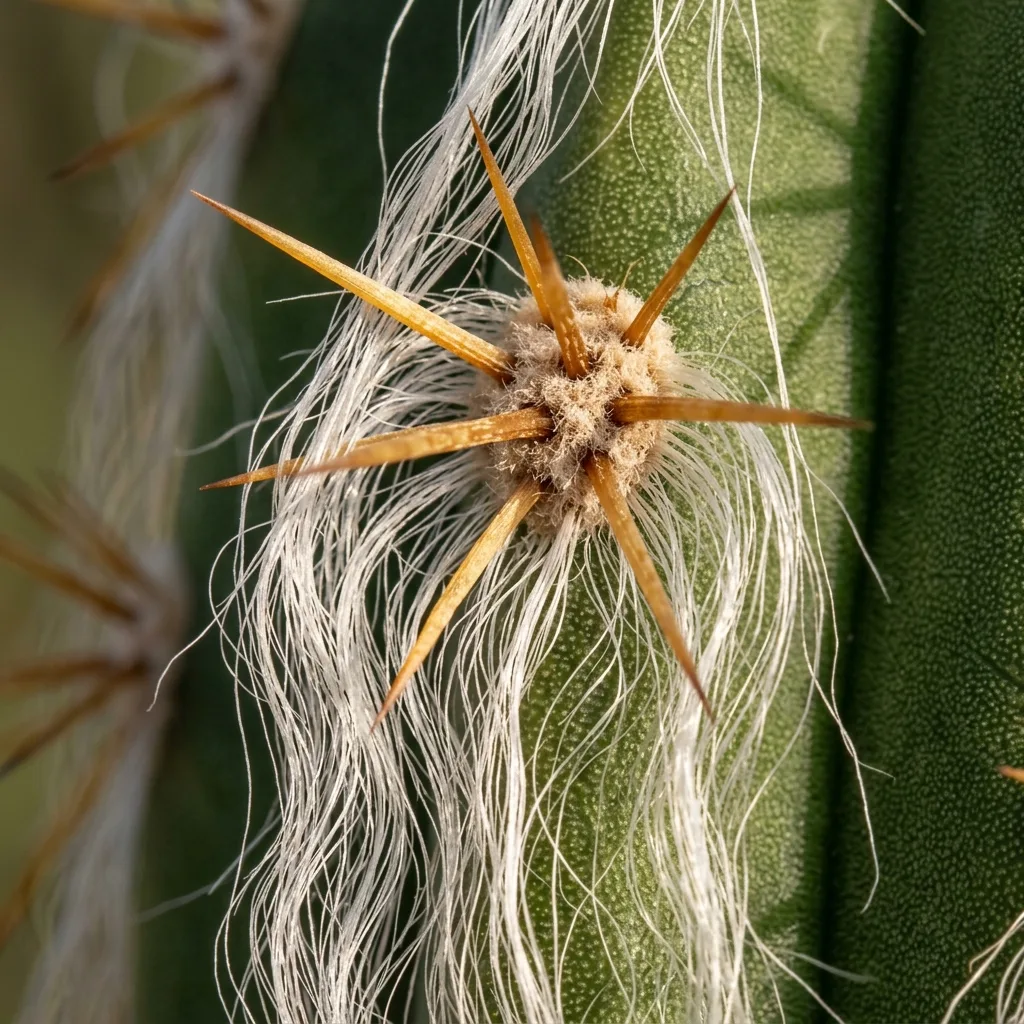
What truly elevates this species into living sculpture is its modified areolar spination. Deep within the core of each areole lie 1 to 5 stiff, yellowish-gray central spines that serve as the primary physical defense against herbivory. Encircling them is an opulent shroud of 20 to 30 elongated, flexible, and lustrous radial bristles—botanically classified as modified trichomes—that impart its characteristic bearded silhouette. These white hairs are composed entirely of hollow, air-filled, non-living cellular casings. This internal air space acts as an optical prism and thermal barrier, scattering intense solar irradiance and slashing the thermal footprint reaching the photosynthetic epidermis by up to 50%. It is, quite literally, an exquisite thermal overcoat crafted by the plant itself.
2. Light Requirements, Solar Intensity, and Atmospheric Aeration
The secret to preserving that dense, blindingly white, and robust coat of hair hinges upon one non-negotiable factor: intense, unfiltered, direct sunlight. Subjecting this desert titan to a dim room or diffuse light inevitably triggers severe etiolation—an unsightly, fragile narrowing of the apex as it stretches frantically toward light—accompanied by sparse, yellowing bristles. Physiologically, when light levels drop, the cactus receives a cellular signal that defensive shielding is superfluous, promptly shutting down trichome production.
Indoors, an unobstructed southern or southwestern exposure is imperative, providing a bare minimum of 6 to 8 hours of unfiltered sunlight daily. Just as vital, however, is dynamic air movement. In stagnant, humid, or poorly ventilated spaces, the plant's dense coat of hair traps ambient moisture against the stem, establishing an ideal microclimate for the germination of fungal spores, especially Botrytis and Fusarium. During the warmer spring and summer months, opening adjacent windows or operating a gentle circulation fan to maintain continuous, fresh air exchanges is paramount.
3. Irrigation Dynamics and the Crucial Winter Dormancy Regime
The water economy of Cephalocereus senilis is governed strictly by the 'soak-and-completely-dry' discipline. Throughout the active vegetative phase from April through September, the substrate must be saturated thoroughly only after the root ball has completely dried out from top to bottom. Any runoff collecting in the saucer below must be discarded within 10 minutes to prevent capillary saturation. Crucially, water should always be delivered directly to the mineral soil at the base; never irrigate from overhead onto the hairs or the delicate apical meristem. Wetting the trichomes leads to unsightly mineral crusting, hair matting, and devastating crown rot.
By late October, as day lengths shorten and ambient temperatures cool toward 10–12°C (50–54°F), the cactus initiates its winter dormancy. Water must be scaled back drastically and withheld almost entirely from November through mid-March. This cool, dry resting phase triggers an essential physiological response: cellular water tension (turgor) drops, concentrating the vacuolar cell sap with natural sugars and salts that act as an internal antifreeze, safely locking the plant into metabolic stasis.
4. High-Mineral Substrate Architecture and Pot Selection
Adapted exclusively to mineral-rich limestone crevices in its native habitat, the Old Man Cactus has zero tolerance for organic-heavy, peat-laden, moisture-retentive commercial potting soils. The root xylem requires constant access to oxygen pockets, meaning the potting matrix must be hyper-porous, structurally stable, and fast-draining.
| Component | Proportion (%) | Agronomic Function & Ecological Benefit |
|---|---|---|
| Pumice (3–6 mm) | 35% | Superior internal porosity, root zone aeration, and moisture buffering |
| Lava Rock (Scoria) | 25% | Trace iron/mineral release and long-term aggregate structural stability |
| Zeolite (Clinoptilolite) | 15% | High cation-exchange capacity (CEC); binds harmful root zone toxins |
| Coarse Limestone Grit | 10% | Replicates natural habitat pH; imparts a gentle, beneficial alkalinity |
| Sifted Coir or Leaf Mold | 15% | Minimal organic matrix to retain beneficial mycorrhizal colonies |
Regarding containers, choose heavy, unglazed terracotta pots without exception. Glazed ceramic, plastic, and glass containers trap moisture along their inner perimeters, preventing evaporation and encouraging water pooling around the root crown. The container should also match the vertical balance of the specimen; a pot depth roughly one-third the height of the column provides optimal stability and root spread without trapping excessive volume.

5. Inducing Bloom and Calibrating Nutrition
Witnessing a Cephalocereus senilis burst into flower in a domestic setting is one of the crowning achievements of cactus horticulture. Flowering occurs strictly when the specimen reaches botanical maturity, typically requiring between 10 to 20 years of age and a height of at least 1 to 2 meters. Blossoms emerge exclusively from a specialized, dense, lateral woolly structure known as a pseudocephalium that develops near the apex. These nocturnal, funnel-shaped flowers are creamy-pink, richly fragrant, and naturally pollinated by desert bats.
Even for young specimens that are years away from blooming, a thoughtful nutritional strategy is essential to maintain rigid cellular walls and dense hair count. High-nitrogen fertilizers are disastrous: they cause rapid, flaccid tissue expansion, increase susceptibility to fungal pathogens, and yield thin, limp bristles. Instead, feed the plant once a month between May and July using a low-nitrogen, high-phosphorus, high-potassium formula (such as NPK 5-10-10 or 4-8-12), diluted to half or quarter strength.
6. Propagation: From Seedlings to Grafting
Propagating the Old Man Cactus is primarily achieved via two avenues: seed cultivation and stem cuttings from rare basal offsets. Viable botanical seeds should be surface-sown in spring over a sterilized mineral sand bed at temperatures of 21–24°C (70–75°F). Keep the substrate lightly moist beneath a transparent dome with bright, indirect light. Germination usually occurs within 2 to 4 weeks; remarkably, the micro-seedlings begin developing their signature white whiskers when barely a few millimeters tall.
When taking stem cuttings from offsets, use a surgically sharp, flame-sterilized scalpel. The cut wound must be dusted with sulfur powder to prevent fungal infection and cured in a dry, shaded, well-ventilated spot for at least 2 to 3 weeks until a thick, firm callus forms across the entire cut. Planting an uncalloused cutting directly into soil invites immediate bacterial decay. In commercial cactus nurseries, slow-growing seedlings are frequently top-grafted using a flat-grafting technique onto vigorous rootstocks like Echinopsis or Myrtillocactus geometrizans to dramatically accelerate growth rates during the first few seasons.
7. Defending Against Pests, Mealybugs, and Rot
By far, the most insidious threat to Cephalocereus senilis is the dreaded mealybug (Pseudococcidae), which finds perfect camouflage amidst the plant's white, woolly radial hairs. Their waxy secretions blend seamlessly with the cactus bristles, making early detection a challenge. Conduct a thorough inspection of the stem grooves and areole clusters at least once a month using a magnifying lens and a focused light beam.
Never spray oil-based foliar treatments, such as pure neem oil, onto the coat of this cactus; the oils will permanently mat the silky fibers, trapping debris and leaving behind an unappealing, grimy gray hue. Instead, spot-treat isolated mealybugs with a fine artist's paintbrush dipped in 70% isopropyl alcohol. For widespread infestations, drench the root zone with a systemic insecticide during an active growth watering cycle. If the base of the column feels soft, spongy, or discolored, unpot the plant immediately, amputate rotted root systems or stem tissue until clean green vascular tissue appears, treat the wound with sulfur, let it callus for a week in dry shade, and reset into fresh, purely mineral substrate.


Reader Reviews & Comments 4 Reviews
Marcus Sterling
Julian Vance
Clara Davenport
Eleanor Higgins
Leave a Review & Rating
Share your plant care tips, experiences, or questions with our succulent community.