






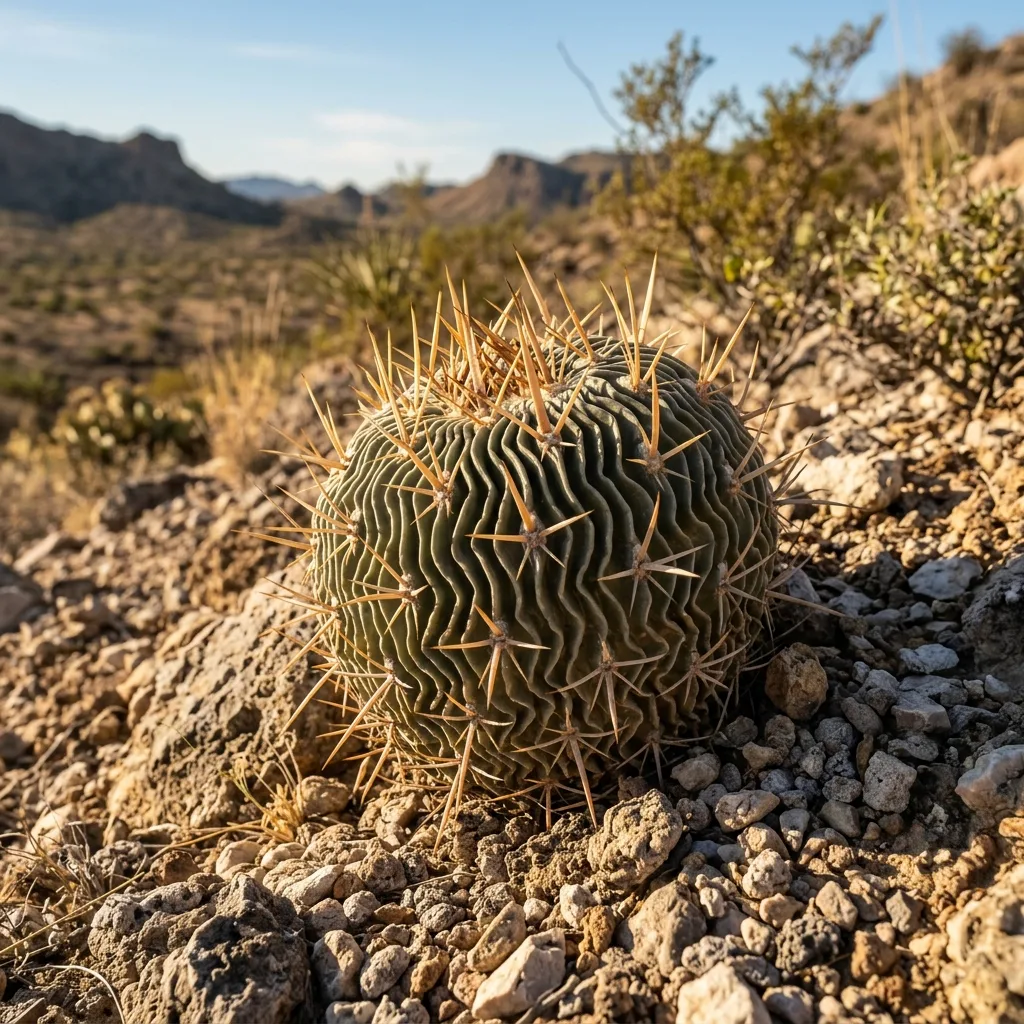
One of the most extraordinary and rare members of the cactus family (Cactaceae), Obregonia denegrii—colloquially known as the 'Artichoke Cactus'—represents the seamless convergence of succulent foliage and pinecone anatomy within a solitary cactus body. Endemic to the arid, limestone-rich slopes of the San Vicente canyon in Tamaulipas, Mexico, this monotypic genus grows semi-submerged in the wild, having evolved an exceptional geophytic defense mechanism to endure punishing desert extremes.
Threatened by severe habitat loss and illegal overcollection, the species is strictly protected under CITES Appendix I, standing as a true benchmark of patience and technical prowess for serious collectors. Its triangular, fleshy tubercles (leaf-like modified stem structures) are densely packed with chloroplasts and execute Crassulacean Acid Metabolism (CAM) photosynthesis nocturnally to reduce moisture loss to zero. Beneath the stem lies a substantial, tuberous taproot that contracts during prolonged droughts, physically pulling the plant flush with the mineral surface to evade blistering solar radiation.
1. Taxonomic Identity, Areole Structure, and Spine Morphology
Taxonomically placed within the tribe Cereeae, the genus Obregonia is represented by a single species (monotypic): Obregonia denegrii. What fundamentally sets this taxon apart from classical globular or columnar cacti is the complete absence of ribs, replaced entirely by spiraling, imbricate (overlapping like roof tiles) fleshy tubercles. These tubercles are inversely triangular in cross-section, with a flattened upper surface and a distinctly keeled lower plane, evoking an unfolding artichoke head.
Areoles are situated precisely at the acute apex of each mature tubercle. In juvenile growth, areoles produce a dense tuft of white trichomes (woolly hairs) accompanied by 3 to 4 thin, flexible, feather-like spines. As the tubercles mature, these spines desiccate and readily shed, proving that the species relies far more heavily on cryptic visual camouflage and bitter alkaloid chemistry than physical armor for its survival. The epidermal layer is coated with a delicate, waxy cuticle designed to inhibit cuticular transpiration, shifting in hue from pale grayish-green to a muted olive green.
2. Light Regimes, Sun Intensity, and Ventilation Standards
In its native habitat, Obregonia denegrii thrives in the rocky fissures of limestone crevices, sheltered beneath the filtered canopy of low scrub and desert shrubs (such as Acacia species). Consequently, when cultivated behind glass, it is notably vulnerable to harsh, unmitigated midday sun. Intense ultraviolet radiation triggers protective anthocyanin pigments in the outer layers of the tubercles, turning the plant a stressed reddish-brown and potentially causing permanent tissue necrosis through chloroplast destruction.
An optimal lighting regime provides 4 to 5 hours of direct early-morning sun followed by intense, bright, but diffused light for the remainder of the day. To sustain efficient photosynthetic activity and completely rule out etiolation (etiolated elongation that ruins the compact spiral form), ambient illumination should reach 20,000 to 30,000 lux. Continuous air circulation is equally vital; stagnant, humid air promotes the germination of fungal spores within the woolly areoles between closely packed tubercles. Dedicated greenhouse airflow or open window sills are critical to enable the stomata to open comfortably at night for carbon assimilation.

3. Irrigation Dynamics and the Critical Winter Dormancy Regime
The Artichoke Cactus holds the vast majority of its water reserves within its deep, fleshy napiform taproot rather than its photosynthetic tubercles. This specific anatomical adaptation makes the subterranean system exceptionally sensitive to lingering substrate moisture. During the active vegetative window from spring through mid-autumn, apply the strict 'soak and dry' method: water thoroughly until run-off flows freely from the drainage holes, empty collection saucers immediately, and never irrigate again until the potting mix has become bone-dry throughout.
Winter dormancy is a non-negotiable physiological phase required to preserve root integrity and trigger apical flower initiation the following spring:
- Temperature Parameters: In winter, ambient temperatures should be gradually lowered to a range of 6°C to 10°C (43°F - 50°F). Provided the substrate is entirely dry, the plant can briefly tolerate 2°C (36°F), but freezing conditions must be strictly prevented.
- Absolute Drought: Cease watering completely from November through the start of March. Throughout this period, the tubercles will shrivel, the body will pull inward, and the specimen will appear desiccated; this morphological response is entirely normal and healthy.
- Spring Reactivation: As temperatures rise consistently in March, deliver the season's first moisture lightly via surface misting or a modest portion of lukewarm water to wake up fine root hairs without shocking the main taproot.
4. High-Mineral Soil Formulations and Container Requirements
In Obregonia denegrii husbandry, the boundary between longevity and systemic failure is governed by substrate chemistry. Standard peat-based commercial potting soils act as a death sentence for this species. To accurately recreate its native limestone and gypsum canyons, the medium must be highly porous, macro-aerated, and largely stripped of decomposing organic matter. Maintain a slightly alkaline to neutral pH between 7.0 and 8.0.
| Raw Ingredient | Volume (%) | Botanical & Physical Function |
|---|---|---|
| Pumice or Volcanic Scoria (2-4 mm) | 40% | Provides macro-porosity, high oxygen diffusion, and immediate structural drainage |
| Crushed Limestone or Zeolite | 25% | Delivers essential calcium ions, stabilizes alkaline pH, and captures excess chemical salts |
| Coarse Quartz Sand or Perlite | 20% | Forms structural micro-drainage channels and prevents particle compaction |
| Sifted Mature Leaf Compost or Coco Coir | 15% | Minimal organic fraction restricted solely to support micronutrient and mycorrhizal attachment |
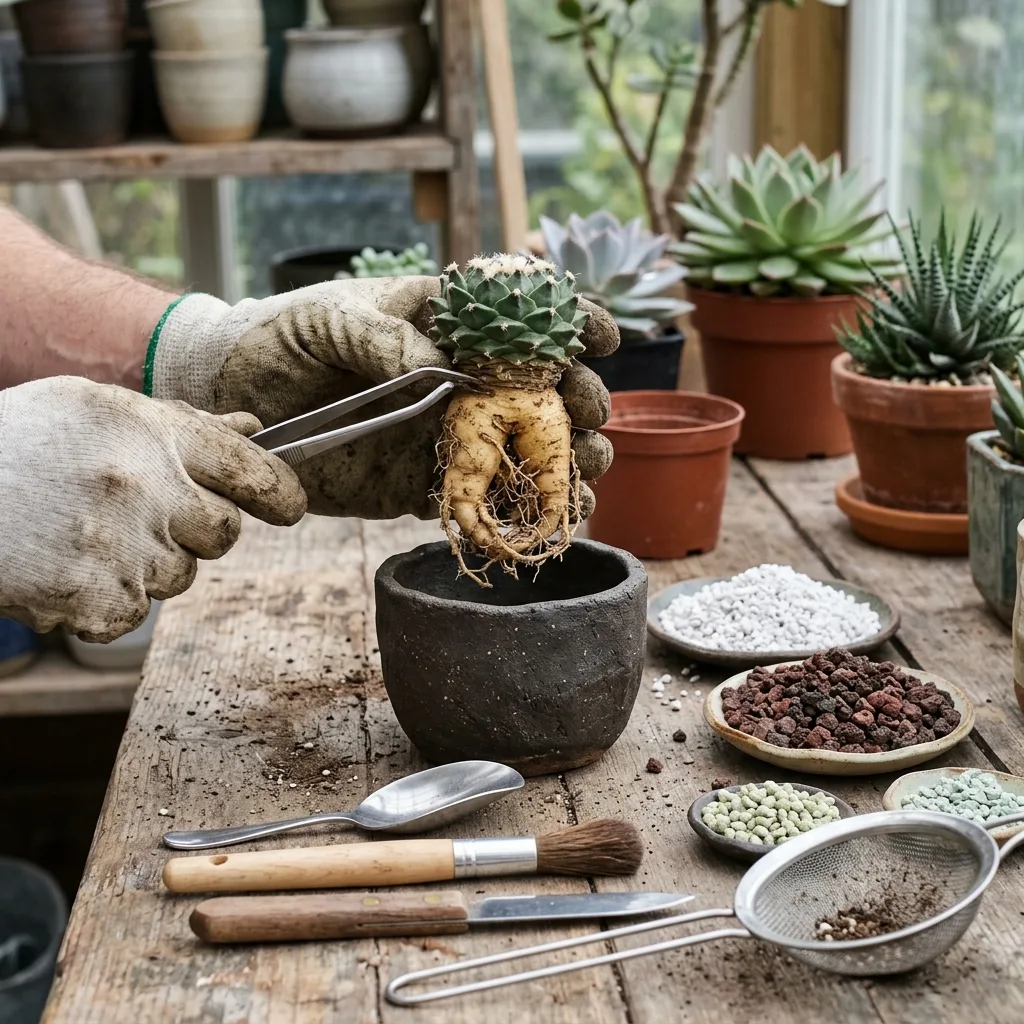
Regarding containers, choose deep, unglazed terracotta pots fitted with expansive drainage holes. Plastic and glazed ceramic vessels trap evaporating moisture, suffocating the large taproot. Container depth must be chosen relative to the length of the carrot-like taproot rather than the horizontal diameter of the rosette; the taproot's apex should never be forced to curl against the bottom of the pot.
5. Inducing Inflorescence and Nutrient Management
Mature Obregonia denegrii specimens that have undergone a rigorous, cold winter rest under bright light produce inflorescences throughout the summer months. Buds arise exclusively from the dense, wool-bearing areoles of juvenile tubercles right at the apical growth center. The resulting funnelform blossoms open in pure white to creamy alabaster tones, occasionally revealing subtle pink streaks along the outer perianth segments. Reaching full expansion during peak midday light, the flowers persist for 2 to 3 days, exuding a gentle, sweet scent.
Fertilizer application demands profound restraint. Excess nitrogen forces the tubercles to accumulate moisture too rapidly, causing structural splitting, thinning the cell walls, and rendering the plant vulnerable to opportunistic pathogens. Feed only once a month during May and July using an ultra-low nitrogen, high-potassium/phosphorus formulation (such as NPK 5-10-15 or 4-8-12), diluted to 1/4 of the manufacturer's suggested strength within the irrigation water.
6. Propagation: Seed Sowing versus Grafting Strategies
Obregonia denegrii almost never offsets naturally; it remains a solitary stem throughout its lifespan. As a result, vegetative stem cuttings are virtually out of the question. Cultivators rely on two distinct approaches for reproduction:
- Propagation from Seed: The most rewarding and botanically sound route to preserve authentic morphology. Seeds must be fresh and surface-sown with gentle pressure onto an 80% inorganic, heat-sterilized germinating mix. Held at stable temperatures between 24°C and 28°C (75°F - 82°F) under high humidity, germination proceeds within 10 to 20 days. Keep in mind that seedlings may take 2 to 3 years just to reach the size of a chickpea.
- Grafting: To bypass seedling mortality and accelerate sluggish growth rates, micro-seedlings are frequently grafted onto vigorous rootstocks like Echinopsis, Trichocereus pachanoi, or Hylocereus undatus. Grafted specimens grow with remarkable vigor, often achieving blooming maturity in under two years. However, they frequently lose their characteristic flattened, geophytic posture, becoming unnatural, bloated globes. In subsequent seasons, the scion can be severed, dried thoroughly, and rooted independently on its own base (degrafting).
7. Defending Against Crown Rot and Pathological Threats
The single greatest biological hazard for the Artichoke Cactus resides in the basipetal tissues where the lowest tubercles connect with the fleshy taproot. When compacted medium coincides with excessive soil moisture and low oxygen, pathogenic oomycetes and fungi like Pythium, Phytophthora, and Fusarium rapidly infiltrate vascular pathways. Early clinical signs include translucent yellowing and softening of the basal tubercles, accompanied by dark, spongy lesions at the soil level. If detected, unpot the specimen immediately, excise every trace of discolored tissue with a sterile scalpel back to immaculate vascular bundles, dust the open wound with sulfur or ground cinnamon, and allow it to callus in a dry, shaded location for at least 10 days before resetting into clean mineral grit.
Among insect vectors, root mealybugs (Rhizoecus cacticans) pose the most persistent threat. Residing completely out of sight beneath the substrate, these subterranean pests pierce the epidermis of the taproot to extract sap, introducing secondary fungal entry points. A preventative systemic insecticide drench in early spring, coupled with careful mechanical cleaning of root systems during scheduled repotting, ensures long-term cultivation success.



Reader Reviews & Comments 3 Reviews
Julian Vance
Clara Hensley
Marcus Sterling
Leave a Review & Rating
Share your plant care tips, experiences, or questions with our succulent community.