






Washed by crisp Atlantic winds and veiled in coastal sea mist, a quiet botanical wonder clings to the sheer basalt cliffs of the Canary Islands: Monanthes polyphylla, affectionately known among plant enthusiasts as the Miniature Pinecone Succulent. Resembling tiny, tightly packed geometric pinecones, this extraordinary species bypasses the showy, sprawling growth of giant succulents in favor of micro-scale elegance and flawless cellular architecture. At first glance, a flourishing colony might easily be mistaken for a patch of lush rock moss; look closely, however, and you will discover that each microscopic rosette is sculpted from dozens of succulent micro-leaves arranged in impeccable mathematical symmetry.
As one of the most distinctive dwarf members of the Crassulaceae family, this species behaves like living geological history on our windowsills. Having evolved exclusively within the hyper-specific microclimates of volcanic crevices, Monanthes polyphylla relies on a delicate, hair-like root system intolerant of wet substrate, paired with a fascinating semi-dormancy phase during the heat of midsummer. Once you understand its seasonal biological rhythm, it will reward your care by weaving a living emerald carpet across shallow pottery.
In this complete care guide, you will uncover every horticultural secret needed to recreate the rugged basalt ecology of the Canary Islands right in your home. From root xylem dynamics and summer rest cycles to custom mineral substrate blends, we explore every botanical detail step by step.
1. Botanical Identity and Morphological Characteristics
Monanthes polyphylla is a dwarf, perennial succulent species strictly endemic to the western and central Canary Islands, thriving notably on Gran Canaria, Tenerife, and La Palma. The genus name Monanthes is derived from the Greek words for 'single flower' (a bit of a historical misnomer for the genus as a whole), while the specific epithet polyphylla literally translates to 'many-leaved'—a vivid descriptor of the exceptionally dense, overlapping foliage that defines each rosette.
The plant produces exceedingly compact, conical to hemispherical rosettes that rarely exceed 1 to 2 cm (0.4 to 0.8 inches) in diameter. Rather than putting energy into vertical height, individual rosettes produce lateral stolons and micro-offsets from their base, gradually knitting together into a continuous, dense mat. The leaves are cylindrical-clavate (club-shaped, thickening slightly toward the apex), capped with microscopic papillae and specialized cuticular waxes designed to curb transpirational water loss in exposed coastal cliff niches. Between late spring and early summer, delicate, wiry peduncles emerge from the centers of mature rosettes, lifting star-shaped, yellowish-green to pink-tinged blossoms into the air. These tiny flowers feature prominent nectar glands evolved to attract specialized micro-pollinators.
2. Light Requirements and Indoor Positioning
In its native habitat, Monanthes polyphylla does not bake on open, sun-scorched desert sand dunes. Instead, it colonizes shaded, north- and northwest-facing basalt fissures, pockets of volcanic cliffs, and humid, misty crevices. Consequently, its photic requirements differ significantly from standard desert succulents like Echeveria or Agave.
The gold standard for this species is bright, abundant, but gently filtered light. Soft, early-morning sunbeams provide the gentle photosynthetic energy needed to keep rosettes tightly clenched and structurally sound. Conversely, harsh, direct midday summer sun will quickly cause irreversible chlorophyll scorching, dehydration of the fragile leaf tissue, and collapse of the rosette crown. Indoors, an unobstructed east-facing windowsill or a spot set slightly back from a southwest window with sheer curtains provides an ideal balance. In inadequate light, the plant quickly undergoes etiolation: the dense conical rosettes unravel, stretching out on pale, weak stems that disrupt its signature pinecone architecture.

3. Watering Discipline: The 'Soak and Dry' Protocol
The single greatest hazard when cultivating dwarf alpine and rupicolous succulents is an overabundance of domestic attention—specifically, overwatering. The root system of Monanthes polyphylla consists of fine, fibrous, capillary roots. If submerged in oxygen-deprived, waterlogged soil for more than a day or two, these delicate roots suffer cellular lysis and rapid fungal decay (root rot). Your watering regimen must strictly adhere to the 'Soak and Dry' method.
During its primary active growth spurts in autumn and early spring, saturate the substrate thoroughly only after it has completely dried out from top to bottom. Ensure that any run-off collected in the saucer beneath is emptied within 15 minutes. As midsummer temperatures peak, Monanthes polyphylla initiates a protective metabolic slowdown—a survival strategy known as semi-dormancy. During this hot period, significantly taper watering frequency, offering only light, occasional moisture to prevent the rosettes from shriveling completely. In winter, cooler indoor temperatures slow evaporation, meaning watering intervals can naturally be extended to once every three to four weeks.
4. Ideal Soil Mix and Pot Selection
The ideal substrate for Monanthes polyphylla must faithfully mimic the porous, weathered volcanic scree of its native archipelago. Standard peat-based commercial potting soils hold ambient moisture far too long, spelling almost certain death for this species. Your mix should consist of roughly 70% to 80% porous, sharp-draining inorganic minerals.
| Substrate Component | Ratio (%) | Botanical & Physical Function |
|---|---|---|
| Pumice (2–4 mm grit) | 35% | Provides high porosity, continuous aeration to capillary rootlets, and balanced water retention |
| Volcanic Lava Rock (Scoria 2–3 mm) | 25% | Improves root anchorage, releases natural trace minerals, and ensures rapid drainage |
| Zeolite (Clinoptilolite 2–4 mm) | 15% | High cation-exchange capacity (CEC); buffers essential nutrients and binds harmful mineral salts |
| Sieved Coco Coir | 15% | Lightweight, peat-free, non-acidic organic base preventing absolute desiccation |
| Coarse Quartz Sand or Perlite | 10% | Maintains open substrate channels, promoting rapid micro-root propagation |
Pot selection is just as decisive as soil texture. Monanthes polyphylla does not develop a deep taproot; its root structure spreads horizontally just beneath the soil line. Deep containers inevitably trap a cold, sodden mass of soil beneath the root zone where air cannot penetrate. Opt instead for wide, shallow bonsai pots, terracotta bulb pans, or rustic ceramic dishes with generous drainage holes. Unglazed terracotta is particularly advantageous, as its porous walls promote lateral evaporative cooling and optimal aeration.
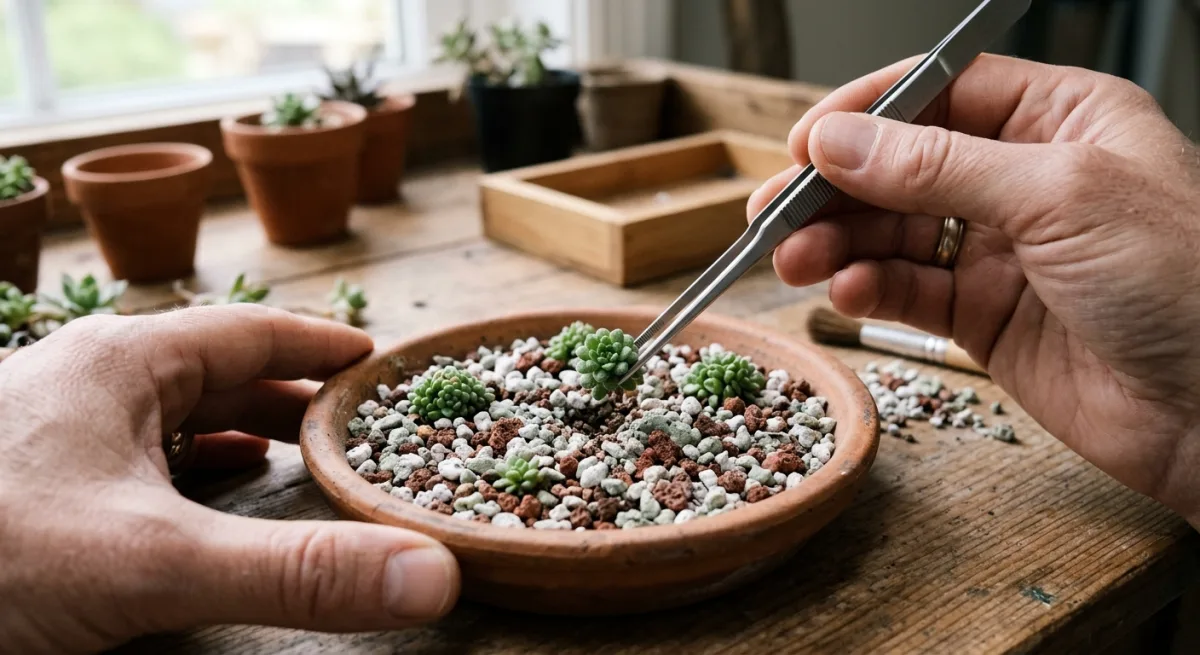
5. Step-by-Step Propagation Techniques
Thanks to its natural mat-forming habit, propagating Monanthes polyphylla is one of the most rewarding and straightforward tasks in succulent cultivation. While it can be grown from ultra-fine seed, dividing natural rosette runners (stolons) is the most efficient and reliable method.
- Harvesting Rosette Cuttings: In mid-spring, locate a healthy, mature rosette producing its own small stem or runner at the base of the mother cluster. Using a sterile, sharp scalpel or precision micro-snips, sever the connective stolon cleanly.
- Callus Formation: Never place fresh succulent cuttings directly into moist soil. Rest the severed rosette in a dry, shaded, well-ventilated spot for 2 to 3 days. This allows the wounded plant tissue to form a protective suberized callus, blocking out bacterial and fungal pathogens.
- Substrate Placement: Fill a shallow propagation dish with the mineral-heavy substrate formula detailed above. Gently rest the callused rosette on the surface of the dry grit, nestling the base slightly into the gravel without burying the photosynthetic foliage.
- Moisture Management: Withhold all moisture for the first 7 to 10 days. Afterward, begin lightly misting the surface gravel around the cutting every few days. Within 3 to 4 weeks, delicate pink-and-white rootlets will anchor firmly into the volcanic minerals.
6. Common Pests, Diseases, and Troubleshooting
While fundamentally resilient against systemic issues when kept in airy conditions, minor cultural oversights can quickly open the door to opportunistic pathogens and pests. The two primary challenges are mealybugs and fungal crown rot.
Mealybugs (Pseudococcidae): The microscopic crevices between tightly overlapping leaves create an ideal, sheltered habitat for mealybugs. If you spot cottony white residues or waxy secretions nestled deep inside a rosette, act immediately. Dip a fine-tipped artist's paintbrush into 70% isopropyl alcohol and meticulously paint the affected crevices to dissolve the insects on contact. For extensive infestations across a dense cluster, apply a diluted systemic insecticidal drench or cold-pressed horticultural neem emulsion during the evening hours.
Root and Stem Rot (Fusarium / Pythium spp.): Overwatering and compacted, airless soil cause rosettes to turn translucent brown, soften, and liquefy from the root plate upward. If this occurs, immediately harvest the remaining firm, healthy upper rosettes above the zone of decay using a sterile blade. Allow these salvage cuttings to callus thoroughly before rerooting them in fresh, bone-dry mineral grit. Safely discard all rotted plant material and contaminated soil.
7. Seasonal Care Calendar and Expert Tips
Aligning your cultivation routine with the seasonal phenology of Monanthes polyphylla ensures lush growth, year after year:
- Spring (March – May): The main active growth phase. Provide plentiful bright, filtered light and resume regular soak-and-dry watering as the soil dries completely. Apply a highly diluted (1/4 strength), low-nitrogen succulent fertilizer once a month.
- Summer (June – August): The semi-dormancy period. During heatwaves, relocate the pot to a cool, shaded spot with generous airflow. Curtail watering to minimal maintenance sips and suspend all fertilization completely until autumn.
- Autumn (September – November): The secondary growth surge. As ambient temperatures drop into the comfortable 18–24°C (65–75°F) range, the plant reawakens. This is the prime window for repotting, separating crowded mats, and rooting new offsets.
- Winter (December – February): Cold resting period. Maintain the plant in a bright, cool indoor area with temperatures kept between 10–15°C (50–59°F). Protect strictly from freezing drafts and frost. Water very sparingly, only when the lower leaves exhibit noticeable dehydration lines.
By respecting its evolutionary heritage—providing high-porosity mineral substrate, thoughtful seasonal watering, and sheltered light—you will cultivate a thriving miniature alpine landscape reminiscent of the ancient basalt crags of the Canary Islands right in your home.


Reader Reviews & Comments 3 Reviews
Eleanor Vance
Marcus Thorne
Clara Higgins
Leave a Review & Rating
Share your plant care tips, experiences, or questions with our succulent community.