






Nature's relentless drive to combine elegance with botanical grit within a single specimen often yields breathtaking intergeneric miracles that unite the finest adaptations of two distinct plant lineages. Carrying the resilient genetic heritage of Sedum stahlii, which braves the blistering sun across Mexico's sheer canyon cliffs, and the symmetrical, high-altitude poise of Echeveria, x Sedeveria 'Jet Beads' (widely cherished among collectors as Jet Beads Stonecrop) represents the crowning pinnacle of succulent hybridization. With its glossy, lacquered surfaces, plump bead-like foliage, and a chromatic palette that transitions under sun stress from vivid emerald green into smoldering bronze and nearly jet-black ruby tones, this plant transforms any bright windowsill into a living jewelry box.
Many plant parents, upon bringing this captivating succulent home, wonder why its leaves gradually lose their high-gloss sheen, why the tight rosette begins to stretch and loosen, or why those signature 'jet-black' obsidian tones fade away into a muted green. In reality, Sedeveria 'Jet Beads' simply asks you to balance the divergent yet complementary genetic demands of its parental genera: Sedum's insatiable hunger for raw sunlight and mineral grit, paired with Echeveria's acute vulnerability to root-zone hypoxia and fungal rot. Drenching your succulent with frequent sips of water is not a token of care; it inadvertently suffocates delicate root hairs by clogging microscopic soil pore spaces and starving the rhizosphere of oxygen.
In this guide, drawing from years of greenhouse cultivation paired with the fundamentals of cellular plant physiology, we explore the exact horticultural steps not just to keep Sedeveria 'Jet Beads' alive, but to coax out its tightest, most lustrous, and strikingly pigmented rosettes.
1. Botanical Identity and Morphological Characteristics
x Sedeveria is an intergeneric hybrid taxon resulting from the deliberate crossing of two sister genera within the Crassulaceae family: Sedum and Echeveria. The cultivar 'Jet Beads' owes its name to its rounded, bead-like leaves that resemble polished jet stone (a lustrous black gemstone derived from fossilized lignite). The key morphological pillars of this plant include:
- Stem and Rosette Architecture: While juvenile specimens form tight, compact rosettes hugging the soil line, mature plants develop semi-woody, upright or gently decumbent cylindrical stems reaching 10 to 15 cm (4 to 6 inches) in length. This versatile growth habit makes 'Jet Beads' equally magnificent as a standalone focal piece in artisanal ceramic pots or cascading along the foreground of mixed succulent arrangements.
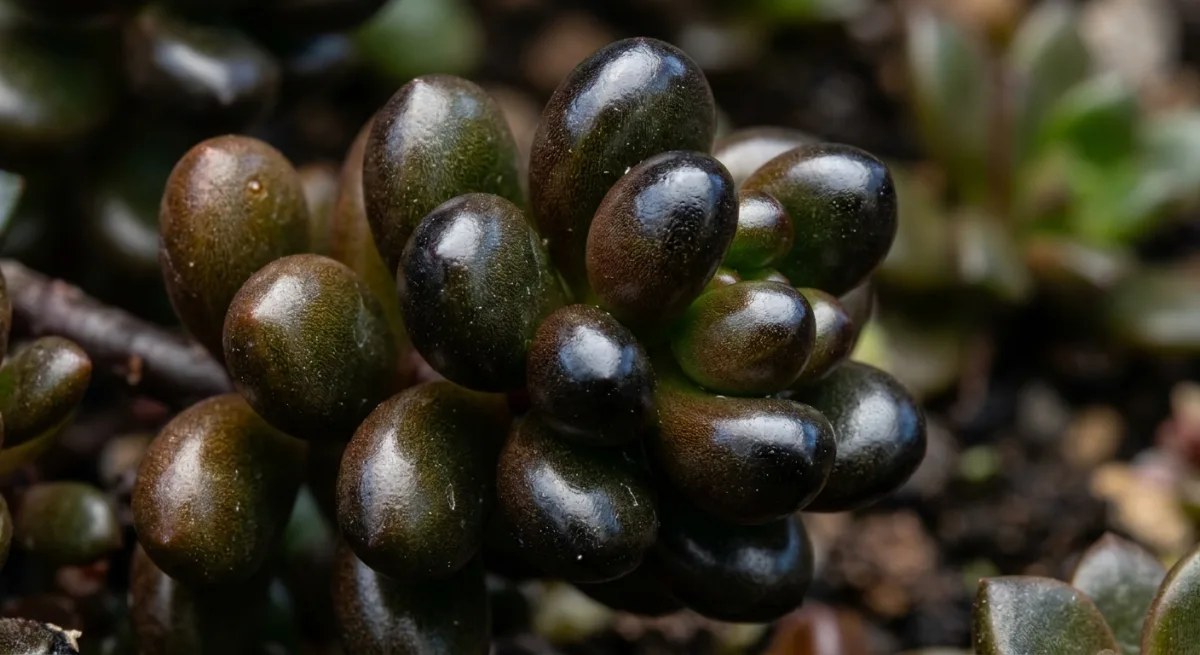
- Foliar Morphology and Cuticular Layer: The leaves range in shape from obovate to plump, barrel-shaped beads. Unlike many Echeveria species that rely on a chalky, powdery farina (epicuticular wax) layer for sun protection, 'Jet Beads' features a smooth, thick, and highly reflective cuticle. This natural glossy shield minimizes cellular transpirational water loss while imparting a distinct wet, varnished aesthetic.
- Pigmentation Biology and Color Dynamics: Under low-light conditions, the foliage displays a lively olive-green hue. However, when exposed to strong ultraviolet (UV-B) radiation combined with a marked day-night temperature differential of 10–12°C (18–22°F) in autumn and winter, the plant dramatically upregulates anthocyanin synthesis. The leaves transition first to burnished copper and mahogany, culminating in an arresting, near-obsidian purplish-brown.
- Floral Biology: In late spring or early summer, slender cymes emerge from the rosette axils, bearing petite, star-shaped blossoms that showcase warm yellow-to-orange petals.
2. Light Requirements and Indoor Positioning
Reflecting the sun-worshipping heritage of its Sedum parentage, Sedeveria 'Jet Beads' demands abundant, unfiltered light. Photons serve as the structural architect of this plant: in insufficient lighting, the internodes (the stem spacing between successive leaves) stretch rapidly, the main stem weakens, and the plant bends gracelessly toward the nearest light source—a physiological phenomenon known as etiolation.
During the peak of midsummer, the scorching midday sun intensified through glass windowpanes can produce localized thermal cell collapse (sunburn). Therefore, during July and August heatwaves, offering sheer, light curtain filtering during peak noon hours—or moving the plant to a well-ventilated balcony exposed to direct morning sun—yields prime results. When grown outdoors in fresh air, the ambient breeze stimulates transpiration and noticeably thickens the glossy protective cuticle.
3. Irrigation Discipline: The 'Soak and Dry' Protocol
The swiftest route to root ruin is watering a succulent on a fixed, calendar-based schedule with small, superficial trickles. Sedeveria 'Jet Beads' operates via Crassulacean Acid Metabolism (CAM), opening its stomata at night to capture carbon dioxide and storing abundant water reserves in its cellular vacuoles. When the root zone remains persistently damp, cellular anoxia (oxygen starvation) sets in, offering opportunistic soil-borne water molds (such as Pythium and Phytophthora) immediate entry into compromised tissue.
The golden rule is straightforward: The Soak and Dry Method.
- Verify with certainty that the entire substrate volume—not merely the top inch, but straight down to the base of the container—is 100% dry. Test this by inserting a wooden skewer to the bottom of the pot (it should emerge bone dry with no adhering soil) or by gauging the pot's weight by hand.
- When it is time to irrigate, drench the pot thoroughly until water flows freely from the drainage holes. The entire root ball must become fully saturated.
- Empty any runoff that collects in the saucer within 15 minutes; never permit the container to sit in stagnant water.
- During the winter dormancy period when metabolic activity subsides, widen irrigation intervals to every 3 to 4 weeks, watering only when the foliage shows subtle tactile softening and faint surface wrinkles.
4. Ideal Substrate Formulation and Pot Selection
Standard, peat-heavy indoor potting soils act as dense moisture sponges, creating a lethal microenvironment for Sedeveria 'Jet Beads'. The root system requires an exceptionally porous, mineral-dominant matrix where water flushes through effortlessly and root hairs maintain constant gas exchange.
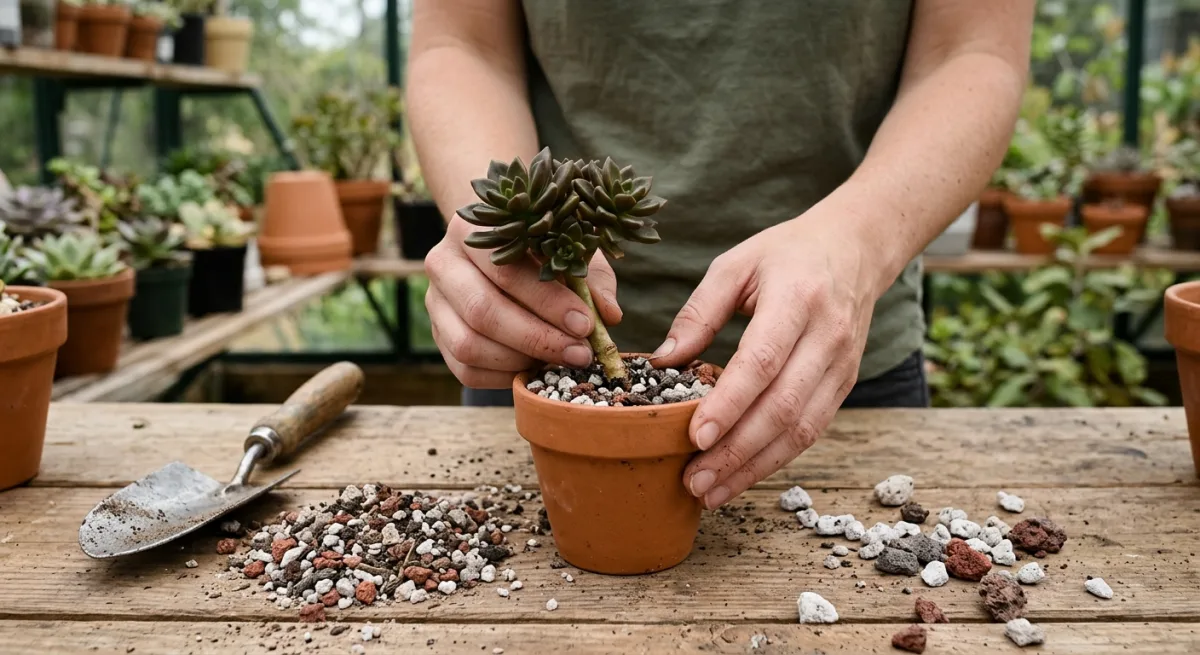
For potting, unglazed, breathable terracotta containers are unrivaled. Their porous clay walls allow moisture to evaporate laterally, dramatically lowering the risk of basal moisture retention and subsequent rot. Ensure the pot has at least one generous drainage hole at the bottom.
| Substrate Component | Ratio (%) | Horticultural Function & Rhizosphere Benefit |
|---|---|---|
| Horticultural Pumice (3–5 mm) | 35% | Creates stable macro-pores, prevents compaction, ensures aeration. |
| Lava Rock (Scoria) / Zeolite (3–5 mm) | 25% | Supplies trace minerals, binds nutrients, purifies the root zone. |
| Coarse Quartz Sand / Coarse Perlite | 15% | Accelerates gravity drainage, prevents silt sedimentation. |
| High-Grade Succulent Peat / Coco Coir | 20% | Provides controlled moisture retention and organic anchoring. |
| Worm Castings (Vermicompost) | 5% | Delivers slow-release organic nutrition and beneficial rhizosphere microbes. |
5. Step-by-Step Propagation Techniques
Thanks to the hybrid vigor (heterosis) inherent to Sedeveria crosses, 'Jet Beads' exhibits remarkable cellular regenerative capacity, making propagation exceptionally rewarding and reliable. You can easily multiply your collection using two primary techniques:
Method A: Leaf Pulling Propagation
- Leaf Selection: Choose a firm, plump, fully developed leaf from the lower-to-mid section of a mature stem.
- Clean Removal: Gently wiggle the leaf from side to side with uniform pressure until it snaps cleanly away from the stem, ensuring the intact crescent of basal meristematic tissue remains attached. Torn or crushed leaf bases will fail to initiate root primordia.
- Callus Formation: Do not place fresh leaves immediately onto damp soil. Allow them to rest in a warm, dry, shaded spot with good airflow for 3 to 4 days so the wound forms a tough, protective callus. This step seals the wound against fungal pathogens.
- Surface Placement: Lay the callused leaves horizontally across a shallow tray of dry or barely moist gritty succulent mix. Withhold active watering until visible pink root filaments and miniature rosettes emerge; once established, lightly direct moisture toward the rooting zone.
Method B: Stem & Tip Cuttings (Beheading)
If your plant has stretched due to winter light deficits or you wish to rejuvenate an older specimen, taking a tip cutting is the ultimate reset. Using a sterilized scalpel or razor, sever the upper rosette 3 to 4 cm (1.5 inches) below the foliage crown. Strip the lowest 2–3 leaves to expose a bare stem segment. Allow the cutting to callus in dry shade for 4 to 5 days. Insert the dry stem into a gritty, pumice-rich mix and withhold water for 10 to 14 days until adventitious roots anchor into the substrate.
6. Common Pests, Diseases, and Targeted Solutions
The resilient, wax-strengthened cuticle gives 'Jet Beads' a natural defense against many ailments that plague soft-leaved succulents. Nonetheless, indoor environments can present occasional challenges:
- Mealybugs (Pseudococcidae): These sap-sucking pests manifest as white, cotton-like clusters nestled deep within the leaf axils. They pierce tissue to feed on phloem sap, causing leaf distortion. Address localized infestations immediately by dabbing them with a cotton swab dipped in 70% isopropyl alcohol. For widespread issues, apply a cold-pressed neem oil spray or an insecticidal potassium soap solution every 5 days in the evening.
- Translucent, Dropping Leaves (Edema & Root Rot): If foliage turns watery, translucent yellow, and drops off at the slightest touch, the root system is suffocating from overwatering. Unpot the plant immediately, excise all discolored, mushy roots, let the healthy stem dry in an airy room for 3 days, and replant into fresh, bone-dry mineral soil.
- Powdery Mildew: In humid, stagnant indoor air, fine white fungal patches can settle across the leaf surface. Increase ambient ventilation immediately and treat the plant with a bio-fungicide or copper-based horticultural spray.
7. Seasonal Care Calendar & Expert Tips
- Spring (Awakening & Vegetative Growth): Metabolic activity accelerates as ambient day lengths expand. Water intake increases. Feed monthly with a balanced cactus/succulent fertilizer diluted to half-strength (low nitrogen, higher potassium) to build sturdy foliage.
- Summer (Light Balance & Thermal Dormancy): When ambient temperatures exceed 32°C (90°F), the plant may enter a protective partial summer dormancy (estivation). Ease up on watering during peak heatwaves and ensure superior air movement around the pot.
- Autumn (Jewel Tone Transition): The most visually rewarding season. Crisp night air paired with luminous autumn sunshine triggers peak anthocyanin synthesis. 'Jet Beads' takes on its signature bronze, plum, and obsidian dress. Plants can safely remain outdoors down to 8–10°C (46–50°F).
- Winter (Rest & Dormancy Discipline): Growth slows considerably. Ambient temperatures should ideally remain above 5°C (41°F)—protect strictly against freezing drafts and frost. Keep watering strictly minimal, cease all fertilization, and position your plant on your sunniest south-facing windowsill.


Reader Reviews & Comments 4 Reviews
Eleanor Vance
Marcus Bennett
Julian Hayes
Clara Higgins
Leave a Review & Rating
Share your plant care tips, experiences, or questions with our succulent community.