






Perched upon the sun-bleached, limestone-strewn ridges of South Africa's Great Karoo region lies one of nature's most formidable blueprints against hyper-arid extremes: the African milk barrel succulent, botanically classified as Euphorbia ferox. Often admired by indoor plant collectors alongside names like the pincushion euphorbia or fierce spurge, this captivating succulent clusters in dense colonies of columnar barrels armed with a fearsome crown of purplish-brown, woody spines. At first glance, virtually every novice plant lover mistakes it for a desert cactus; however, it is in fact an extraordinarily resilient, succulent marvel belonging strictly to the spurge family (Euphorbiaceae).
Concealing an enormous internal water reservoir designed to endure brutal months without a drop of rain, this architectural barrel brings the raw, untamed grace of the Karoo directly to your sunniest windowsills. Thriving far better on deliberate neglect than overzealous pampering, the African milk barrel will happily produce compact offsets and maintain its geometric perfection for decades when given proper care. Let us explore its fascinating morphological anatomy and unveil the botanical secrets to keeping this living desert sculpture thriving in your home.
1. Botanical Identity and Morphological Characteristics
The African milk barrel (Euphorbia ferox) stands as one of the plant kingdom's most brilliant demonstrations of convergent evolution. Despite sharing zero direct genetic lineage with true New World cacti (family Cactaceae), it has independently engineered nearly identical physical adaptations to endure intense solar radiation and prolonged drought. The plant's stem is compressed into a compact, ribbed, cylindrical barrel structure, dramatically minimizing total surface area to curb transpiration and cellular moisture loss. Lining the undulating ridges of these ribs are formidable spines that, unlike the areolar spines of cacti, are actually hardened, persistent sterile flower stalks (peduncles) modified into defensive armor against grazing desert herbivores.
Its epidermal coloration spans from deep, rich emerald to a chalky blue-green that blushes bronze under intense, direct sunlight. The defining taxonomic signature of Euphorbia ferox, however, resides just beneath its cuticle: whenever the epidermis is punctured or bruised, the plant immediately exudes a copious, milky-white latex sap. While this milky discharge forms a sterile seal against microbial pathogens and deters insect pests, it is packed with toxic diterpene esters that are severely irritating to human skin and mucous membranes.
2. Light Requirements and Indoor Positioning
Accustomed to unshielded desert skies, the African milk barrel demands an exceptionally high photon flux density. To maintain its squat, heavily ribbed barrel silhouette and prevent the unsightly, pale stretching known as etiolation, this plant requires at least 5 to 6 hours of unfiltered direct sunlight daily. In domestic indoor settings, placement directly upon an unobstructed south-facing or west-facing windowsill is non-negotiable.
When deprived of sufficient solar energy, the crown begins to narrow into a conical point, its ribs lose their crisp geometric definition, and the entire stem softens into a watery, washed-out green. However, caution is required when transitioning a specimen out of winter dormancy or bringing home a newly purchased plant from a sheltered greenhouse. Sudden, unacclimated exposure to scorching midsummer sun can cause irreversible epidermal solar bleaching or scorched brown patches. Always provide a 10- to 14-day gradual acclimatization period, progressively shifting the plant from bright indirect light into intense direct sun.

3. Watering Discipline: The 'Soak and Dry' Protocol
The swiftest way to lose an African milk barrel is by loving it too much with the watering can. In the succulent world, frequent watering is not nurturing care; it is an oxygen-depriving death sentence that triggers catastrophic fungal infections within days. Metabolically, this species operates via Crassulacean Acid Metabolism (CAM), sealing its stomata firmly throughout the scorching day and exchanging gases exclusively at night to conserve precious hydration.
Your absolute golden rule for hydration is the strict 'Soak and Dry' protocol:
- Never water simply because the topsoil looks dry. You must verify that the substrate has dried out thoroughly all the way to the very bottom of the pot. Insert a thin wooden skewer to the base of the container; if it emerges with any coolness or dark moisture clinging to it, postpone watering.
- When watering day arrives, drench the container generously until water streams freely from the drainage holes, fully saturating the root network. Immediately discard any runoff that gathers in the drainage tray—never allow the root zone to sit in stagnant water for even a single minute.
- During the active spring and summer growing season, a thorough soaking every 10 to 14 days is typically optimal depending on ambient temperatures. As winter descends and ambient temperatures drop to 12–15°C (54–59°F), cut watering back to a minimal monthly splash; in unheated, cool sunrooms, keep the root zone entirely bone-dry.
4. Ideal Mineral Soil Formulation and Container Choice
The shallow, fibrous root architecture of the African milk barrel will rot with terrifying speed in rich, peat-dense potting soils that retain moisture. What it craves is structural porosity: an ultra-gritty, highly aerated mineral substrate through which water cascades under gravity in seconds. Off-the-shelf universal potting soils or moisture-retentive peat blends are lethal for this desert native.
When it comes to vessel selection, unglazed terracotta is the undisputed champion. Its natural microporosity allows moisture to evaporate laterally through the pot walls, accelerating dry-back times and preventing root suffocation. Avoid non-porous glazed ceramics or plastic pots that seal moisture inside. Furthermore, choose a relatively shallow, broad pan rather than a deep pot to comfortably accommodate clustering basal offsets without leaving pockets of unused, soggy soil beneath.
| Substrate Component | Ratio (%) | Particle Size | Functional Role |
|---|---|---|---|
| Pumice Stone | 40% | 3–6 mm | Provides supreme root aeration and an open drainage matrix. |
| Lava Rock (Scoria) | 25% | 2–5 mm | Adds structural anchoring weight and trace mineral/iron release. |
| Zeolite (Clinoptilolite) | 15% | 2–4 mm | Buffers excess moisture and enhances cation-exchange capacity. |
| Coarse River Sand / Quartz Grit | 10% | 1–3 mm | Prevents fine particles from compacting or silting up pores. |
| Sifted Coco Coir / Peat Fiber | 10% | Fine fibrous | Provides minimal organic binding for tender feeder roots. |
5. Step-by-Step Propagation Techniques
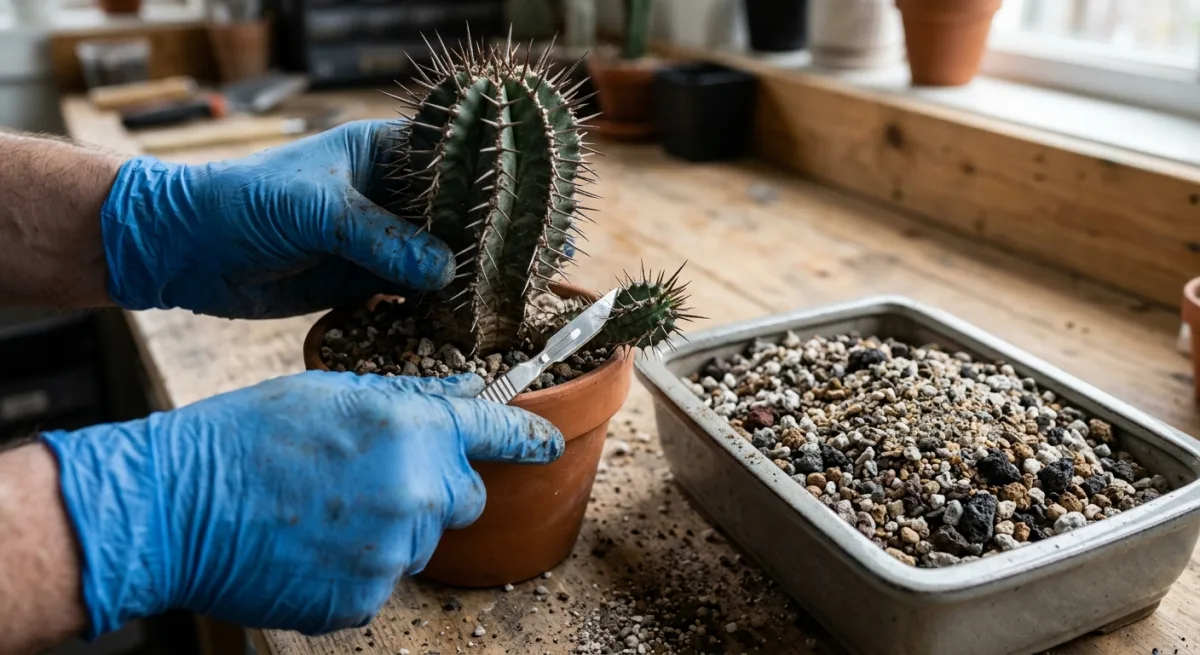
While the African milk barrel can be grown from seed, vegetative propagation via basal offsets (pups) clustering around the mother stem is by far the most reliable, rewarding technique for home growers. Follow this safe, methodical protocol to harvest and root your offsets:
- Safety & Preparation: Put on durable protective gardening gloves and eye protection. Sterilize a razor-sharp scalpel or micro-pruning shear with isopropyl alcohol. Keep a spray bottle of ice-cold clean water and powdered cinnamon ready nearby.
- Harvesting the Offset: Select a vigorous, well-formed pup from the base of the parent plant that has achieved at least 3 to 4 cm (over an inch) in diameter. Make a clean, decisive cut right at the point where it connects to the primary trunk.
- Staunching the Latex Flow: The moment the tissue is severed, milky latex will bleed from both wounds. Immediately mist the cuts with cold water; the rapid drop in temperature causes the latex to coagulate and seal within seconds. Lightly dust both open cuts with cinnamon powder or activated charcoal, which act as natural antifungal barriers.
- Callus Formation: Do not plant the fresh cutting into soil immediately! Place the harvested pup in a warm, dry, shaded spot with good airflow for 7 to 14 days, allowing the wounded cut to cure into a firm, leathery, impervious callus.
- Dry Potting & Root Induction: Set the callused cutting upright into completely dry mineral gritty mix. Do not water at all for the first 10 days. Afterward, lightly spritz only the substrate surface immediately surrounding the stem base once a week to coax new roots downward. Delicate, healthy feeder roots will typically anchor within 4 to 6 weeks.
6. Common Diseases, Pests, and Treatments
While Euphorbia ferox possesses legendary natural hardiness, cultural oversights can quickly open the door to fatal pest invasions or pathogen outbreaks:
- Basal Stem & Root Rot (Fusarium / Phytophthora): Manifests as a yellowing, darkening, or water-soaked spongy collapse starting at the soil line. It is caused solely by overwatering coupled with waterlogged soil. To salvage the plant upon early detection, cleanly slice away all infected tissue with a sterilized blade until only pristine, healthy green tissue remains, allow it to re-callus, and re-root from scratch.
- Mealybugs (Pseudococcidae): These sap-sucking pests disguise themselves as cottony white webbing tucked deep within the ribs and around the spine bases. Eradicate small colonies manually using a cotton swab dipped in 70% isopropyl alcohol; treat severe infestations with systemic horticultural insecticides or pure neem oil sprays applied in the evening.
- Red Spider Mites: Microscopic mites flourish in hot, dry, stagnant air, leaving behind characteristic rust-colored, sandpaper-textured scarring and fine webbing across the epidermis. Treat promptly by increasing gentle air movement and applying specialized miticides or regular insecticidal soap washes.
- Etiolation (Spindling & Distortion): Characterized by an unnatural, pencil-thin apical growth habit and pale, flaccid ribs. This is not an infectious disease, but a biological distress call for photon energy. Relocate the plant incrementally into direct sun; while the stretched narrow midsection will remain permanently narrow, future apical growth will grow stout and healthy again.
7. Seasonal Care Calendar & Expert Horticultural Routine
To preserve the dense, living-fossil geometry of your African milk barrel across the years, harmonize your care routine with its natural seasonal rhythm:
- Spring (March – May): The vegetative awakening phase. Gradually resume routine watering as daylight hours expand. If necessary, repot every 2 to 3 years into fresh mineral substrate. A single application of a balanced, low-nitrogen succulent fertilizer diluted to 1/4 strength can be administered once a month during active growth.
- Summer (June – August): Peak metabolic activity. Excellent ambient ventilation is essential; stagnant, sweltering air combined with moist soil invites virulent fungal pathogens. Maintain the soak-and-dry watering protocol whenever the pot dries out completely.
- Autumn (September – November): Growth naturally decelerates as day length wanes. Cease all fertilization completely. Begin widening the interval between waterings to encourage cellular sap concentration, which helps the plant withstand cooler ambient temperatures.
- Winter (December – February): Dormancy period. Maintain overwintering ambient temperatures ideally between 10–15°C (50–59°F), keeping the plant strictly shielded from frost and drafty drops below 8°C (46°F). Keep the potting medium almost entirely dry, offering only a micro-drink every 4 to 6 weeks to stop the ribs from shriveling excessively.


Reader Reviews & Comments 3 Reviews
Eleanor Brooks
Marcus Vance
Julian Miller
Leave a Review & Rating
Share your plant care tips, experiences, or questions with our succulent community.