






When we gaze upon our spiny companion resting patiently in a small ceramic pot by the windowsill, the very same question often surfaces: Are we looking at a flower, an independent plant, or a miniature tree? Ranging from Mexico's scorching Sonoran Desert to the mist-shrouded foothills of the Andes, and even ascending into the tropical bark canopies of the Amazon basin, these ancient organisms represent one of nature's most astonishing evolutionary marvels. Defying extreme drought with their cellular water-storage capacities, cacti constitute a captivating botanical family (Cactaceae) governed by its own unique morphological principles.
Let us deliver the definitive botanical verdict upfront: A cactus is unequivocally a plant; it produces breathtaking flowers from its own specialized structures, and several colossal species (such as Carnegiea gigantea—the iconic Saguaro) attain a genuine tree-like form anchored by an internal woody framework. Much of the widespread public confusion arises because cacti lack conventional foliage, having transformed their green stems into photosynthetic, succulent water reservoirs. Come along as we decode the taxonomic identity of these extraordinary household guests and uncover the secrets to nurturing them at home just as nature intended in their wild habitats.
1. Taxonomic Identity, Areole Anatomy, and Spine Morphology
In botanical taxonomy, cacti belong to the family Cactaceae, nested within the order Caryophyllales. Every cactus is fundamentally a succulent (as it stores water within specialized parenchymal tissues); however, not every succulent is a cactus. The definitive morphological fingerprint that separates a true cactus from all other fleshy succulents (such as Echeveria, Aloe, or Crassula) is a distinct anatomical organ exclusive to this family: the areole.
Areoles are specialized, cushion-like, modified condensed lateral shoot buds distributed across the cactus stem. A cactus's sharp spines, silky woolly hairs, new lateral offsets, and glorious blossoms emerge solely and strictly from these areoles. If the plant you are examining produces thorns directly out of raw stem tissue without a specialized pad (as observed in thorny euphorbias like Euphorbia trigona), it is not a cactus at all, but rather a succulent convergent mimic. Spines themselves are evolutionary marvels—modified, non-photosynthetic leaves reshaped to reduce transpirational water loss to absolute zero. Beyond deterring herbivores, these spines serve as a microscopic aerodynamic grid that breaks turbulent air currents across the epidermis, casting micro-shadows and conserving precious internal hydration.
2. Light Requirements, Solar Intensity, and Ventilation Dynamics
Cacti are undeniably sun-worshipping flora, yet one of the most catastrophic mistakes in indoor cultivation is abruptly thrusting an unacclimated plant behind an unvented south-facing window where glass magnifies solar heat to scorching levels. Arid desert cacti (such as Echinocactus, Mammillaria, and Ferocactus) demand a minimum of 5 to 6 hours of direct, unfiltered sunlight daily. When deprived of adequate luminous flux, cacti suffer from an irreversible anatomical distortion called 'etiolation'—their growing tips stretch out thin, pale, and conical in a desperate attempt to find light, permanently ruining their geometric symmetry.
In stark contrast, tropical forest epiphytic cacti (such as Schlumbergera—the Holiday Cactus, or Epiphyllum) dwell beneath tree canopies in nature; they must be shielded from harsh, scorching midday sun and kept in bright, dappled, or gently filtered light. Equal in importance to solar energy is continuous air circulation. Stagnant, suffocating indoor air provides the ideal breeding ground for airborne fungal spores to penetrate areoles and epidermis crevices. Opening windows regularly to maintain gentle ambient airflow dissipates micro-humidity around the cuticle, closely mimicking wild desert breezes.

3. Watering Cycles and the Critical Winter Dormancy Period
The metabolic mechanics of cacti diverge sharply from those of standard broadleaf houseplants. Cacti utilize CAM (Crassulacean Acid Metabolism) photosynthesis. To safeguard their moisture reserves against the brutal daytime heat, they keep their microscopic breathing pores (stomata) tightly sealed during the day. Only during the cool of the night do these stomata dilate to capture atmospheric carbon dioxide, converting and storing it internally as malic acid. During the subsequent sunny hours, they break down this acid to produce sugars through photosynthesis while stomata remain shut. Consequently, cacti assimilate water most effectively during cool twilight or early dawn hours rather than under scorching midday heat.
Furthermore, the ultimate biological prerequisite for triggering flower production and longevity is an undisturbed winter dormancy period. From late autumn through early spring (October to March), desert cacti should be positioned in a luminous, cool environment maintained between 8 and 12°C (46–54°F). During this rest phase, irrigation should be curtailed almost entirely—a light droplet delivery once every four to eight weeks, away from the root crown, is plenty. If a cactus is kept in a centrally heated room and watered generously throughout winter, its biological clock remains awake, thoroughly suppressing the initiation of flower buds for the coming spring.
4. High-Mineral Substrate Formulations and Container Physics
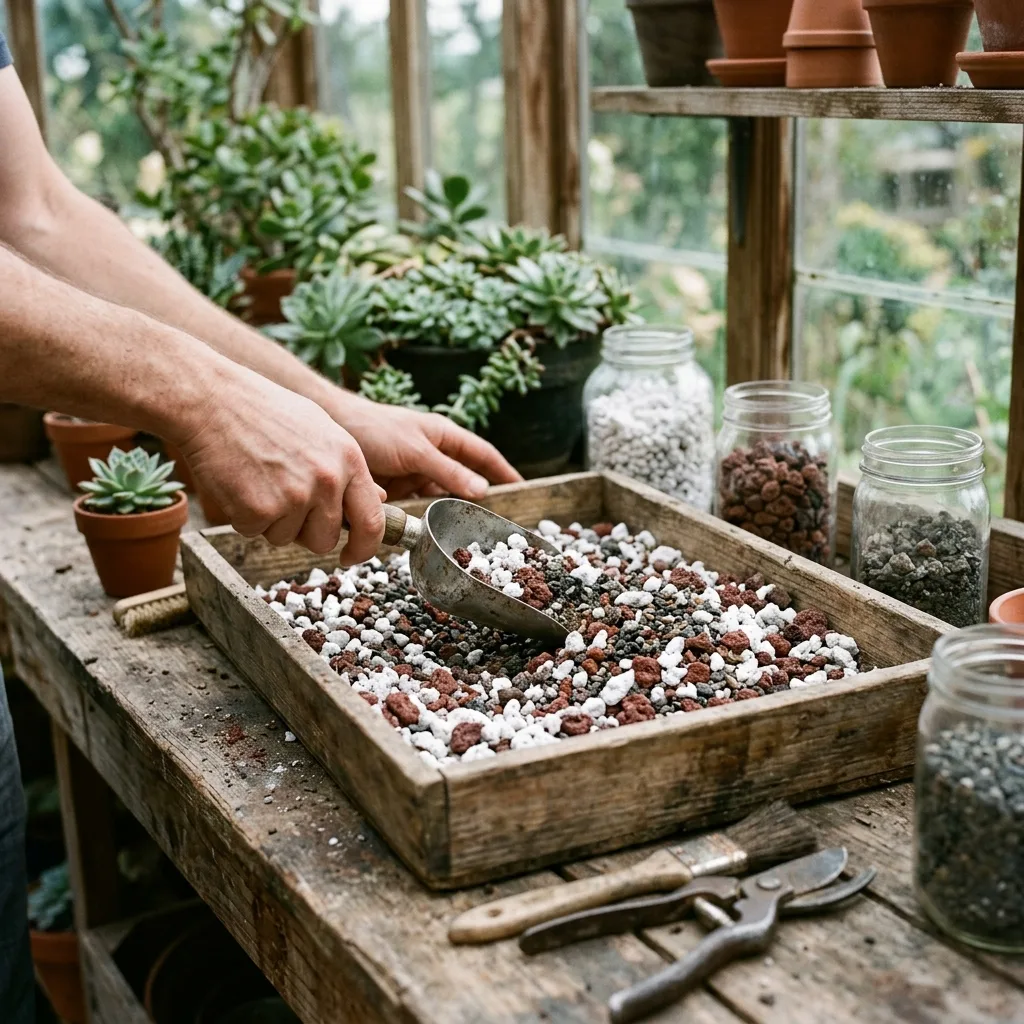
Standard peat-based potting soils sold for generic houseplants represent a slow-motion death trap for cacti. Peat behaves like a waterlogged sponge, starving delicate root hairs of oxygen and shrinking into an impenetrable, hydrophobic brick upon drying that crushes fine roots. Cactus root systems demand an abundance of macro-porosity and rapid drainage, thriving in inorganic mineral granules that shed gravitational water in mere seconds.
An optimal cactus substrate should comprise at least 70% to 80% porous, inorganic mineral aggregates (such as pumice, scoria/lava rock, zeolite, and coarse perlite) balanced by no more than 20% to 30% screened, high-grade organic leaf compost or coco fiber. Regarding container selection, unglazed terracotta pots remain fundamentally superior to non-porous plastic or glazed ceramic vessels, as their porous clay walls breathe, wicking excess moisture outward through evaporative cooling.
| Component Type | Material Specifics | Target Ratio (%) | Functional Contribution to Root Mechanics |
|---|---|---|---|
| Inorganic Mineral | Horticultural Pumice (3–6 mm) | 40% | Forms structural air pockets, ensures immediate drainage, prevents fungal rot. |
| Inorganic Mineral | Crushed Scoria (Lava) & Clinoptilolite Zeolite | 25% | Supplies essential trace minerals, optimizes CEC (cation-exchange capacity), binds toxins. |
| Inorganic Mineral | Coarse River Grit / Quartz Sand | 15% | Maintains gritty physical texture, preventing compaction and root asphyxiation. |
| Organic Fraction | Screened Coco Coir or Aged Leaf Mold | 20% | Provides baseline micro-nutrients and mild moisture retention for nutrient absorption. |
5. Flowering Triggers and Targeted Nutritional Support
A prevalent myth among casual growers suggests that cacti never flower, remaining perpetual globes of austere green spines. The botanical reality is that every single cactus species possesses the genetic capacity to flower. A blooming cactus is not merely surviving; it is actively proclaiming that its micro-environmental parameters have achieved biological perfection, signaling readiness to reproduce.
To coax your cactus into magnificent blooms, respect three non-negotiable principles: 1) Enforce a cold, dry winter dormancy period without interruption, 2) Expose the plant to progressively intense natural sunlight as spring breaks, and 3) Administer a specialized, low-nitrogen, high-phosphorus and potassium fertilizer (such as an NPK 5-10-15 or 4-8-12 formulation). High-nitrogen fertilizers are notoriously destructive to cacti; they cause rapid, watery cellular expansion that stretches and ruptures epidermal tissue, leaving the stem defenseless against bacterial and fungal decay. High phosphorus, conversely, directly stimulates robust root branching and primes areoles for floral bud set. Feed sparingly at half-strength once a month from early spring through mid-summer only.
6. Propagation Dynamics: Stem Cuttings, Pups, and Grafting
Because cacti are evolutionary specialists in regenerative survival, multiplying them is remarkably rewarding. The most accessible propagation route involves taking lateral offsets ('pups') or stem section cuttings. However, severing a healthy pup with a sterilized blade and inserting it immediately into moist soil is the single most common cause of fatal infection.
Freshly cut cactus stems must be set aside in a dry, shaded, and well-ventilated location for 4 to 10 days to form a firm, tough callus layer over the wound. Once this protective suberized tissue has sealed the vulnerable vascular bundles, insert the cutting shallowly into a dry mineral mix. Refrain from routine watering for 2 to 3 weeks until adventitious roots begin to push out, providing only occasional light misting across the substrate surface. For chlorophyll-deficient chimeric mutations (such as the vibrant neon red, yellow, or pink Gymnocalycium mihanovichii—popularly known as the Moon Cactus), grafting onto a resilient, chlorophyll-rich rootstock like Hylocereus is essential, as the scion cannot conduct photosynthesis on its own.
7. Defending Against Fungal Pathogens and Basal Stem Rot
Over 90% of cactus fatalities in domestic settings stem not from neglect or dehydration, but from opportunistic fungal pathogens triggered by overwatering and poor drainage—most notably Fusarium, Phytophthora, and Rhizoctonia species. If your cactus exhibits a soft, discolored base that appears translucent or feels mushy like jelly, advanced root and basal stem rot is underway.
When diagnosed early, emergency surgery can salvage the specimen. Unpot the plant immediately, wash away the contaminated soil, and amputate all necrotic, blackened root fibers. Using a razor-sharp, alcohol-sterilized blade, slice cleanly across the stem above the infection zone until absolutely no brown or orange vascular staining remains visible—only pristine, uniform green and white tissue. Dust the fresh surgical wound with ground cinnamon or sulfur powder to deter microbial spores, allow it to dry and callus thoroughly for up to a week, and repot in fresh, fully sterilized, bone-dry mineral grit to prompt fresh root regeneration.


Reader Reviews & Comments 3 Reviews
Eleanor Vance
Marcus Sterling
Julian Hayes
Leave a Review & Rating
Share your plant care tips, experiences, or questions with our succulent community.