






Picture an evolutionary odyssey stretching from the sun-scorched Chihuahuan Desert in Mexico all the way to your bright living room windowsill. Shaped over millions of years to withstand meager precipitation, brief cloudbursts, and subsequent months of absolute drought, these resilient succulent stems continue to operate under nature’s most unyielding desert laws when welcomed into our homes. The primary reason indoor cacti decline and rot is rarely neglect; tragically, it is an excess of misplaced affection delivered via reckless watering.
Drenching your cactus on an arbitrary schedule is not a gesture of devotion—it deprives the root system of vital oxygen, quietly suffocating it in dark, soggy soil. In their native habitats, these drought virtuosos lock moisture deep inside specialized parenchyma storage cells and practice nocturnal Crassulacean Acid Metabolism (CAM) photosynthesis by opening their stomata only under the cover of night. Indoors, however, they confront an entirely altered microclimate. Stagnant ambient air, filtered window glass, and regulated indoor temperatures radically diminish natural evaporation rates. So, pour yourself a fresh cup of coffee, settle in, and let us explore step-by-step how to hydrate your noble, spiny companions without inducing rot, nurturing their delicate root systems with scientific precision.
1. Taxonomic Identity, Areole Architecture, and Spine Morphology
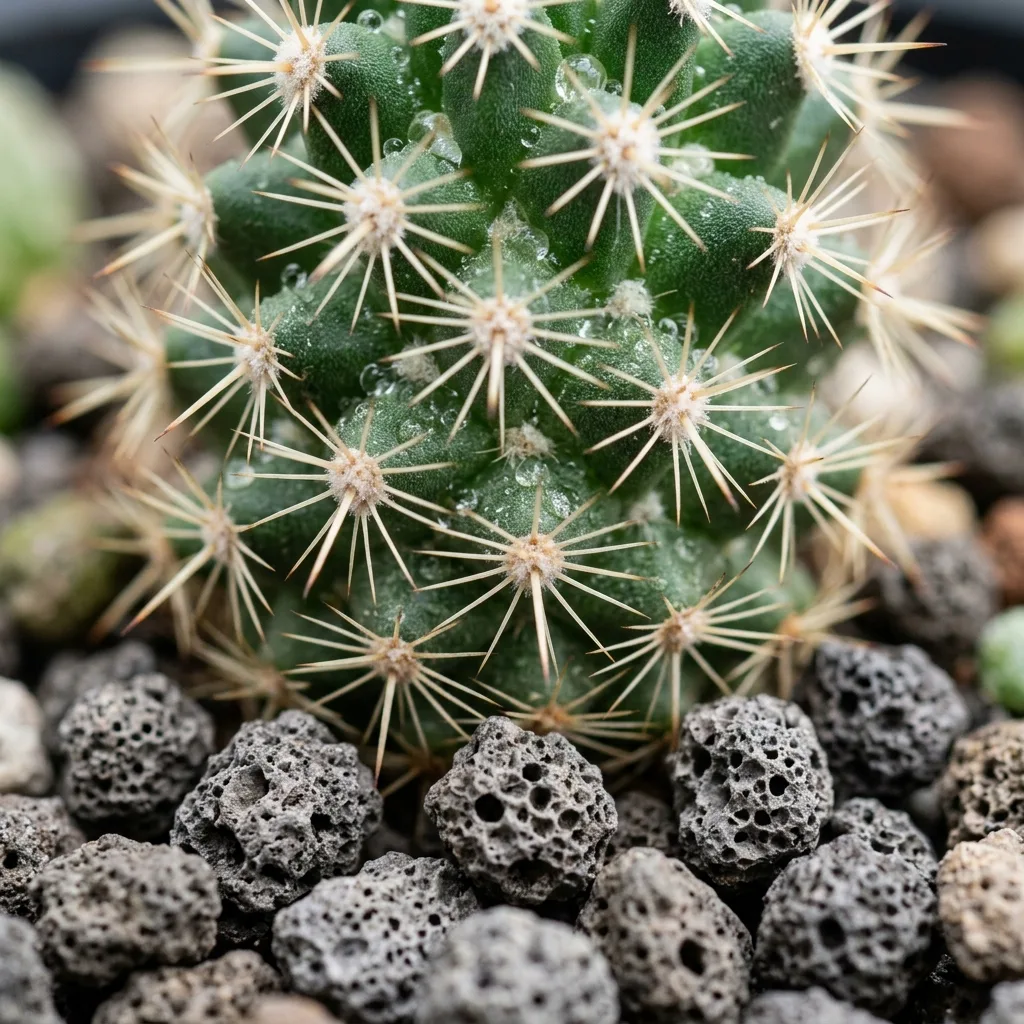
The definitive botanical hallmark that sets cacti (family Cactaceae) apart from all other convergent succulent forms is the presence of specialized, organ-generating structures known as areoles. Areoles are highly condensed, evolutionary modifications of lateral buds, functioning as the exclusive emergence points for spines, glochids, branches, and floral buds. If a fleshy succulent lacks true areoles across its stems, it cannot be classified as a cactus; it is almost certainly a spurge (Euphorbia) or another unrelated arid succulent mimic.
Spines serve purposes far beyond deterring desert herbivores. Their aerodynamic structure establishes a microclimatic boundary layer against dry winds, significantly mitigating transpiration and surface evaporation. Furthermore, their microgrooves act as sophisticated condensation collectors, harvesting morning dew and funneling life-giving droplets directly down toward the root flare. The fleshy cortical tissue (cortex) of the stem behaves precisely like an accordion bellow: expanding rapidly during moisture influx and contracting accordion-style during extended dry periods to regulate internal turgor pressure without tearing cellular walls.
2. Light Exposure, Solar Irradiance, and Ventilation Benchmarks
The single most influential environmental factor dictating indoor watering intervals is photosynthetic photon flux density combined with ambient air exchange. When an indoor cactus receives sub-par light, its metabolic pathways downshift into a dormant or semi-dormant state. With photosynthesis stalled, roots cease moisture uptake, leaving the potting mix wet for weeks on end and extending an open invitation to opportunist fungal pathogens.
Indoor desert cacti should ideally be positioned directly before unobstructed south- or west-facing windows to absorb intense, direct sunlight. Diffuse illumination filtered through sheer window curtains invariably triggers etiolation—resulting in weak, pale, elongated stems—while simultaneously unsettling the plant's hydraulic equilibrium. Facilitating consistent passive air exchange via cracked windows stimulates diurnal stomatal mechanics and ensures the root zone desorbs excess moisture smoothly without suffocating beneficial rhizosphere microflora.
3. The Hydration Cycle and Critical Winter Dormancy Regime
The foundational law of indoor cactus hydration is the revered 'Soak and Dry' protocol. Administering dribbles of water or a weekly teaspoon merely moistens the top half-inch of the substrate, depriving deep root architectures of hydration and triggering root atrophy. When irrigation is due, saturate the pot generously until water flows freely from the drainage apertures. Once drained, instantly empty the collection saucer; roots must never sit submerged in stagnant drainage reservoirs.
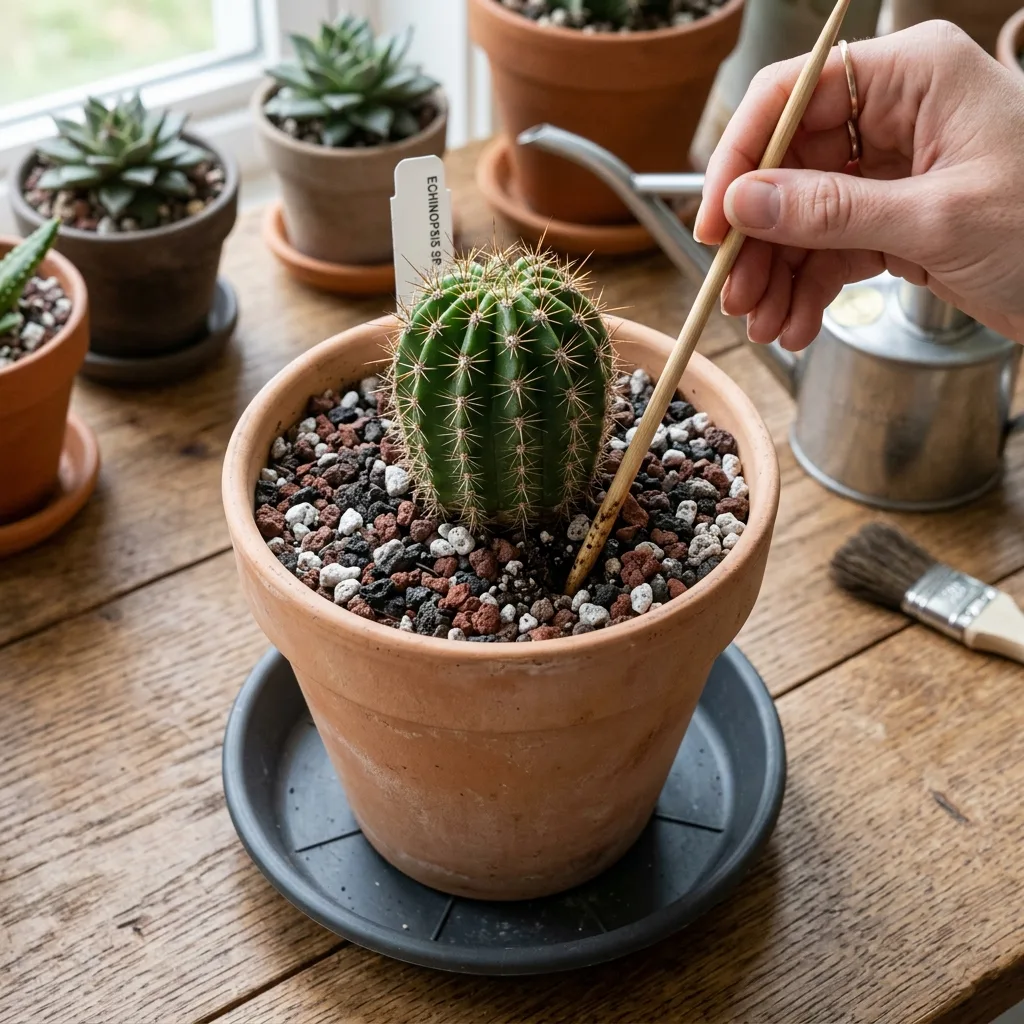
How do you verify when it is truly safe to water again? Only when the substrate has turned bone-dry down to the very base of the vessel! The most reliable diagnostic method is inserting an untreated wooden skewer to the bottom of the pot. If it emerges completely clean and dry, hydration is justified; if it displays even faint moisture or clinging particles, withhold water without hesitation.
The winter cycle (typically late autumn through early spring) constitutes an essential dormancy phase. Solar angles diminish, day lengths contract, and ambient room temperatures should ideally hover around 10–15°C (50–59°F). During this period, indoor desert varieties (such as Echinocactus, Mammillaria, and Ferocactus) halt carbon assimilation almost completely. A dormant indoor cactus should rarely receive water more than once a month; in cool conditions, withholding irrigation entirely for the winter is standard practice. Combining excess soil moisture with chilly ambient air will liquefy sensitive roots within days.
4. High-Mineral Cactus Substrates and Container Physics
Successful indoor watering depends heavily on the residence time of moisture within the pot. Standard peat-based potting soils or heavy garden loams behave like sponges, remaining waterlogged for weeks inside home settings. The xylem vascular cylinders of cacti are inherently unequipped to endure constant wetness; capillary rootlets demand substantial macropores to exchange gases and stave off anaerobic conditions.
Cacti require a grit-heavy, lean substrate dominated by volcanic rock and inorganic aggregates with minimal organic fractions. Moreover, unglazed porous terracotta represents the ideal pot material: its permeable ceramic walls promote lateral evaporation throughout the container profile, halving the timeline for root-zone dry-down compared to non-porous plastic or glazed ceramic alternatives.
| Substrate Component | Ratio | Horticultural Function |
|---|---|---|
| Coarse Pumice (3–6 mm) | 40% | Guarantees maximum aeration, prevents compaction, and facilitates swift gravitational drainage. |
| Crushed Lava Rock / Zeolite (3–5 mm) | 30% | Releases vital trace minerals while buffering moisture retention within micro-porous channels. |
| Sterile Coarse Peat / Coco Coir | 20% | Supplies a baseline organic anchorage matrix with low nutrient-binding capacity. |
| Coarse Horticultural River Sand / Quartz Grit | 10% | Accelerates hydraulic conductivity and protects the basal root flare from moisture entrapment. |
5. Inducing Desert Blooms and Strategic Nutrient Supplementation
A frequent frustration among indoor growers is a persistent lack of flowering. Cacti initiate floral bud primordia based on two environmental cues: a strict, cool winter dormancy accompanied by water deprivation. Experiencing an unheated resting phase at 8–12°C (46–54°F) without watering primes the plant for seasonal renewal. As spring returns with escalating ambient warmth, your initial deep soak replicates natural desert flash floods, triggering systemic flowering cascades.
During active vegetative growth (mid-spring through late summer), supplement every third or fourth watering with a specialized low-nitrogen, high-phosphorus, high-potassium cactus fertilizer (such as an NPK 5-10-10 or 4-8-12 formulation) diluted to half or quarter strength. Avoid generic foliage fertilizers; excess nitrogen stimulates abnormal, hyper-inflated soft tissue growth that easily tears and offers zero structural defense against fungal incursions.
6. Propagation, Offset Division, and Grafting Techniques
Once your indoor specimens thrive under calibrated watering, propagating them is an immensely gratifying venture. Desert cacti multiply effortlessly via basal offsets (pups), lateral stem cuttings, or specialized top-grafting.
Whenever detaching offsets or taking stem cuttings, keep one fundamental principle in mind: never set freshly severed tissue directly into damp substrate! Place the excised cutting in a shaded, well-ventilated space for 4 to 7 days to form a firm suberized callus over the wound. Once fully callused, seat the cutting into completely dry mineral grit, withholding all water for the first 10 days. Stimulate nascent root initiation with dry warmth first, introducing modest bottom moisture only after preliminary root initials appear.
Achlorophyllous cultivars (such as the vibrant red or neon-yellow forms of Gymnocalycium mihanovichii) lack photosynthetic pigments entirely and must rely on a vigorous green rootstock (typically Hylocereus) for survival. When hydrating grafted cacti, calibrate your watering to the rootstock's growth habits, taking rigorous care never to splash water over the fragile vascular graft union.
7. Mitigating and Rescuing Against Root Rot and Fungal Decay
The preliminary diagnostic markers of overwatering manifest as an epidermal dulling, a subtle spongy texture upon light palpation, and an ominous yellowish-brown discoloration spreading upward from the root collar. Soil-borne pathogenic oomycetes and fungi, including Phytophthora and Fusarium, exploit oxygen-deprived root damage, entering the vascular stele and dismantling internal tissues in rapid succession.


Reader Reviews & Comments 3 Reviews
Julian Hayes
Eleanor Vance
Marcus Sterling
Leave a Review & Rating
Share your plant care tips, experiences, or questions with our succulent community.