






When you observe cacti flourishing in their native desert habitats—whether across the arid expanses of the Sonoran, Atacama, or Chihuahuan deserts—it is impossible not to marvel at their resilience against extreme environmental desiccation. These succulents have honed evolutionary adaptations over millions of years, designed to endure months without a drop of rain and instantly absorb rare, torrential downpours directly into specialized parenchymal storage cells. When caring for desert cacti (family Cactaceae) such as the Golden Barrel (Secrets to Growth and Spectacular Blooms">Echinocactus grusonii), Pincushion Cactus (Mammillaria), or Sea Urchin Cactus (Astrophytum) in our homes, the most devastating mistake we make is disregarding this ancient desert memory and treating them like standard tropical houseplants.
Watering a cactus on a casual, frequent schedule is not an act of nurture; it systematically suffocates their delicate root systems. When fine feeder roots are deprived of interstitial soil oxygen, opportunistic soil-borne pathogens proliferate, initiating fatal vascular decay from the inside out. Keeping these desert marvels plump, robust, and capable of producing dazzling seasonal blooms requires understanding the physiological and hydraulic forces governing their tissues. Here are the 11 scientifically grounded golden rules of cactus hydration that will eliminate root rot from your collection once and for all.
1. Taxonomic Identity, Areole Morphology, and Spine Architecture
The definitive anatomical feature that separates true cacti (Cactaceae) from all other succulent plant families (such as Euphorbiaceae or Crassulaceae) is the presence of specialized vegetative axillary bud structures known as 'areoles.' Areoles function as condensed meristematic growth epicenters from which spines, glochids, radial trichomes, lateral branches, and reproductive blooms emerge. This specific morphology directly governs our approach to irrigation.
Cactus spines are highly modified evolutionary leaves. Beyond deterring foraging herbivores, these fibrous structures serve as microclimatic shields. They capture early morning atmospheric condensation and funnel drops straight toward the root collar, all while casting a lattice of micro-shadows that lowers epidermal surface temperatures and curbs transpirational moisture loss.
2. Light Exposure, Solar Irradiance, and Ambient Air Flow
Irrigation can never be separated from ambient light levels. Cacti operate on an evolutionary photosynthetic adaptation known as Crassulacean Acid Metabolism (CAM). To conserve precious moisture under the scorching diurnal sun, they keep their stomata tightly sealed throughout the daylight hours. Only under the cooler conditions of night do their stomatal pores open to sequester carbon dioxide, storing it temporarily as malic acid. The operational efficiency of this metabolic cycle depends intimately on ambient light irradiance and ventilation.

3. The Wet-Dry Hydrological Cycle and Winter Dormancy
The single greatest hurdle for succulent enthusiasts is breaking free from rigid calendar-based watering routines. Prescribing 'water once a week' is a guaranteed recipe for root failure.
4. High-Mineral Substrate Formulations and Container Mechanics
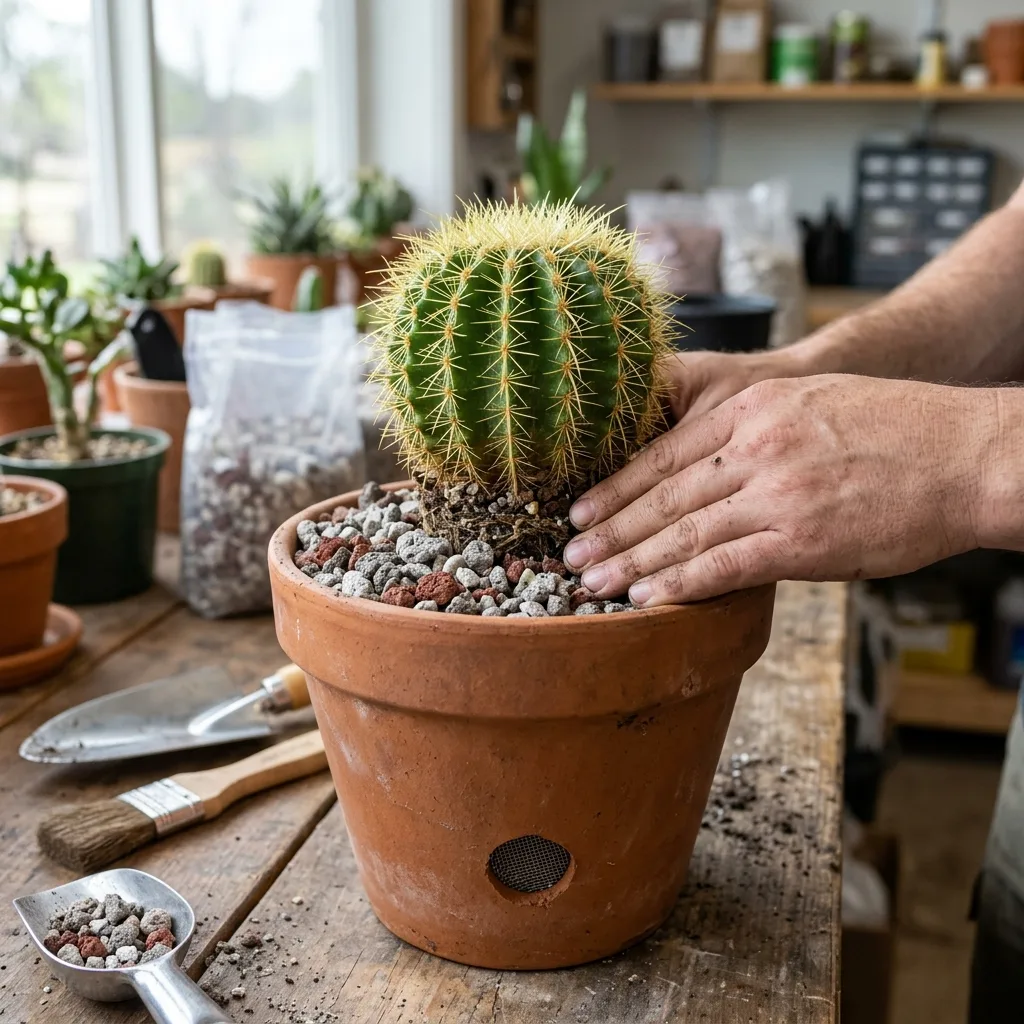
The xylem tissue and delicate root caps of cacti evolved to navigate loose, hyper-porous scree, decomposed granite, and volcanic minerals with high air-filled porosity. Standard bagged potting soil or peaty houseplant mixes hold excessive moisture for far too long, starving roots of vital gaseous oxygen. Achieving mastery over cactus watering depends on the quality and structure of your potting substrate.
| Substrate Component | Ratio (%) | Particle Size | Botanical Function |
|---|---|---|---|
| Horticultural Pumice | 35% | 3 – 6 mm | Root aeration, micro-porous atmospheric moisture exchange |
| Crushed Lava Rock (Scoria) | 25% | 2 – 5 mm | Structural anchoring, prevents compaction, traces of iron |
| Zeolite (Clinoptilolite) | 15% | 2 – 4 mm | High cation exchange capacity (CEC), buffers excess salts |
| Coarse Quartz / Sharp River Sand | 10% | 1 – 3 mm | Creates rapid vertical drainage fissures, prevents settling |
| Sifted Coconut Coir / Well-Aged Leaf Compost | 15% | Fine, screened | Provides modest baseline organic nutrient retention for fine root hairs |
5. Flower Induction Techniques and Nutritional Hydration
Many growers wonder why their mature cacti never bloom. Flower production is not an accident of nature; it is the physiological outcome of a properly executed winter drought followed by strategic spring hydration. Without a cool, bone-dry winter rest period, cacti remain stuck in vegetative stem production and will not initiate reproductive floral buds.
6. Propagation, Offset Division, and Grafting Hydrology
Water control is equally critical when propagating cacti. Whether taking stem cuttings or separating basal offsets (pups), freshly cut tissue must never come into contact with wet soil or standing water before a tough layer of scar tissue (callus) has formed.
Allow cuttings to dry in a shaded, well-ventilated space for 5 to 14 days, depending on stem girth. Once a firm, protective suberized callus has sealed the wound, position the cutting into completely dry, gritty mineral mix. Withhold deep soaking for the first two to three weeks. An unrooted cutting lacks the physiological machinery to absorb bulk water; moisture around the raw basal cut will invite soft rot. When managing grafted specimens (such as the Ruby Ball or Moon Cactus atop a Hylocereus stock), water only the base of the rootstock, ensuring moisture never splashes the delicate surgical graft union.
7. Defending Against Root Rot and Fungal Pathogens
Over 90% of all domestic cactus mortalities trace back to root-destroying fungal pathogens—most notably Phytophthora cactorum, Fusarium oxysporum, and Pythium species—which flourish in chronically wet, hypoxic substrates. Water quality plays an overlooked role in keeping these pathogens at bay.
If you spot blackening, soft mushy skin, or an unpleasant smell near the base of your cactus, immediate intervention is essential. Unpot the specimen, wash away the old substrate, and use a sterile scalpel to excise all discolored, rotting vascular bundles until only pristine green or cream-colored tissue remains. Dust the clean wound liberally with micronized sulfur or powdered activated charcoal, dry the plant in the shade for a full week, and replant in a fresh, bone-dry mineral substrate.


Reader Reviews & Comments 4 Reviews
David Miller
Emma Watson
Marcus Bennett
Clara Higgins
Leave a Review & Rating
Share your plant care tips, experiences, or questions with our succulent community.