






From the scorched expanses of Mexico's Sonoran Desert to the arid plateau of South Africa's Karoo, nature engineered an astonishing evolutionary strategy to combat extreme drought: sequestering water within living plant tissues. The cacti and succulents gracing our windowsills—whether a beloved Jade Plant (Crassula ovata) Care Guide: The Art of Growing, Pruning, and Propagating the Money Tree">Jade Plant (Crassula ovata), a Golden Barrel Cactus (Echinocactus grusonii), or a vibrant Echeveria rosette—are living testaments to millions of years of cellular adaptation. Yet, among casual hobbyists and seasoned plant lovers alike, these two terms are constantly used interchangeably. Do they truly signify the same thing?
Etymologically, 'succulent' traces back to the Latin term succus, meaning 'juice' or 'sap'—a broad physiological classification describing any plant with thickened, fleshy organs engineered to store moisture. Cacti, on the other hand, represent a strictly defined botanical family: Cactaceae. The golden rule of botany is simple and unbreakable: All cacti are succulents, but not all succulents are cacti. In biological taxonomy, it functions exactly like ornithology: every sparrow is a bird, but certainly not every bird is a sparrow!
Discerning the precise botanical identity of the companion on your windowsill is far more than an intellectual curiosity; it serves as your essential biological roadmap. It dictates your seasonal watering cadence, guides the indispensable winter dormancy regime, and determines the exact mineral substrate equilibrium required to keep root tissues oxygenated and thriving.
1. Taxonomic Identity, Areole Architecture, and Spine Morphology
The term 'succulent' does not refer to a formal taxonomic family; rather, it describes a morphological and ecological adaptation. Over 60 distinct plant families exhibit succulent properties, including Crassulaceae (such as Echeveria, Sedum, and the classic Jade Plant), Asphodelaceae (Aloe, Haworthia, and Gasteria), and Euphorbiaceae (spurges). These versatile species sequester water reserves within their foliage, swollen stems, or subterranean tuberous caudices. Conversely, cacti are exclusively members of the Cactaceae family, native almost entirely to the Americas (with the singular exception of Rhipsalis baccifera, which established itself across parts of tropical Africa and Madagascar).
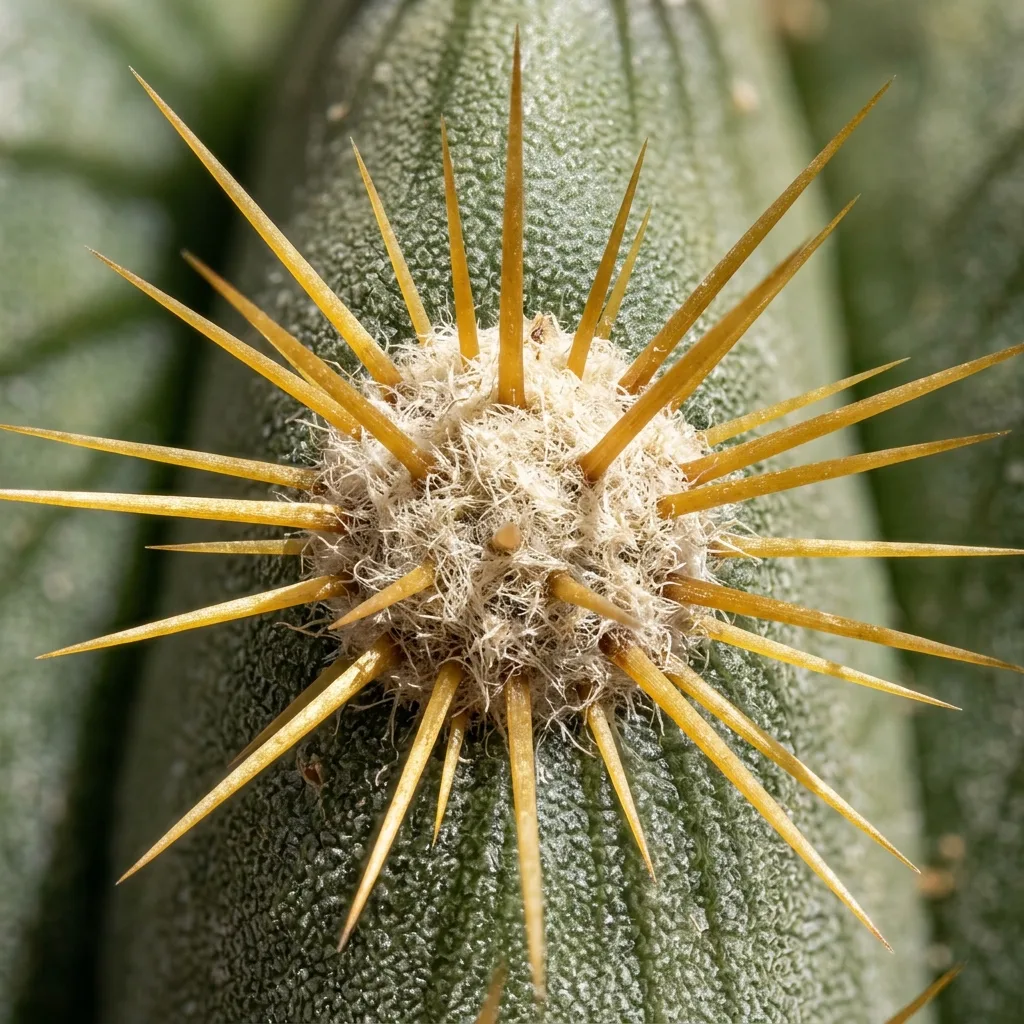
The definitive botanical key to identifying whether a succulent belongs to the cactus family is not the presence of sharp spines, but the existence of specialized structures known as areoles (areolae). Areoles are highly condensed, specialized lateral bud cushions appearing as discrete velvety or woolly mounds across the stem ribs. Spines, hairs, irritating glochids (barbed micro-bristles), lateral offsets (pups), and floral blossoms emerge solely from these distinct areolar organs.
Consider Euphorbia trigona (popularly called the African Milk Tree or Cathedral Cactus). Despite its deceptive columnar habit and menacing thorns, it is not a true cactus. Its thorns emerge directly from the cortex of the stem without an areole cushion, and any puncture immediately exudes an acrid, toxic white latex sap. This taxonomic phenomenon is a textbook illustration of 'convergent evolution'—where distinct plant lineages independently evolve strikingly similar succulent forms to survive unforgiving desert habitats.
2. Light Exposure, Photonic Intensity, and Aeration Dynamics
Although both cacti and fleshy succulents originate in arid ecosystems, their photometric requirements diverge dramatically depending on ancestral microclimates. True desert cacti (such as Mammillaria, Ferocactus, and Echinocactus) demand a high Daily Light Integral (DLI), thriving under a minimum of 6 to 8 hours of intense, unfiltered direct solar radiation. When deprived of sufficient photon density, cacti sacrifice cellular integrity, stretching toward the light source in a pale, conical, structurally weakened condition known botanically as etiolation.
Conversely, many leaf succulents—such as Zebra Haworthia (Haworthiopsis fasciata), Gasteria, and delicate variegated Echeveria cultivars—suffer profound epidermal cellular necrosis (sunburn) under scorching midday rays. Many of these leafy genera produce an ethereal, powdery, silvery-blue coating across their foliage known as farina (epicuticular wax). Farina serves as an organic broad-spectrum sunscreen and hydrophobic shield. Wiping away this delicate barrier with bare hands leaves deep leaf tissues fatally exposed to ultraviolet radiation and pathogen entry.
For both biological groups, adequate ambient airflow is indispensable. Cacti and arid succulents utilize Crassulacean Acid Metabolism (CAM photosynthesis), keeping their microscopic leaf or stem pores (stomata) tightly shut throughout baking daylight hours to eliminate transpirational moisture loss, opening them exclusively in the cool of night to absorb carbon dioxide. Providing a buoyant, well-ventilated nighttime atmosphere accompanied by a gentle drop in ambient temperature is paramount for unhindered metabolic gas exchange.
3. Irrigation Dynamics and the Critical Winter Dormancy Period
Dosing succulents with tiny, frequent dribbles of water is not an act of horticultural devotion; it inadvertently deprives roots of oxygen, keeping the root zone chronically damp and inviting anaerobic decay. The scientifically backed regimen is the celebrated 'soak and dry' method: saturate the root ball thoroughly until water drains freely from the pot's drainage holes, then refrain completely from watering until the substrate has dried out across its entire profile—not merely on the topsoil surface.
The most profound divergence between cacti and broadleaf succulents manifests during their seasonal resting phase, or dormancy. True desert cacti require an authentic cold, dry winter rest from November through early March, positioned in a bright, unheated space kept between 5°C and 12°C (41°F to 54°F). Across these 3 to 4 winter months, desert cacti should receive virtually zero irrigation. This chilly, waterless suspension of growth triggers cellular flower bud induction for spring. In contrast, foliage-bearing succulents require occasional light hydration whenever their lowest leaves show subtle signs of deflation or wrinkling (typically every 30 to 45 days in winter).
4. High-Mineral Soil Formulations and Container Mechanics
Standard retail potting soil and pure sphagnum peat are devastating for cacti and succulents. High-organic media function like moisture-retaining sponges, staying soggy for weeks on end, collapsing macroscopic pore spaces, and suffocating root hairs, leading inevitably to lethal root rot.
In their endemic habitats, cactus roots weave through scree slopes, volcanic fissures, and porous decomposed granite. Therefore, your cactus substrate must consist of 70% to 80% inorganic, porous minerals (pumice, crushed volcanic lava, zeolite, and coarse perlite). Leafy succulents can tolerate a slightly elevated organic fraction (around 30% to 40% clean coco coir or screened worm castings).
| Substrate Component | Ideal Ratio for Cacti | Ideal Ratio for Leaf Succulents | Botanical Function & Benefit |
|---|---|---|---|
| Horticultural Pumice (3–6 mm) | 40% | 25% | Creates stable macro-pores; prevents root suffocation and compacting. |
| Crushed Lava Rock & Zeolite (2–4 mm) | 30% | 20% | Elevates Cation Exchange Capacity (CEC) while accelerating drainage. |
| Coarse Quartz Sand / Grit | 10% | 15% | Prevents substrate caking; adds structural ballast for root anchoring. |
| Washed Coconut Coir (Coco Peat) | 15% | 30% | Provides controlled, uniform moisture retention without hydrophobic shrinking. |
| Sterile Worm Castings / Aged Leaf Compost | 5% | 10% | Delivers a subtle, slow-release foundation of organic micronutrients. |
Regarding containers, unglazed terracotta is the absolute gold standard. Because of its microscopic natural porosity, raw terracotta actively breathes, allowing excess water to wick through the pot walls and evaporate outward. If you choose plastic, resin, or glazed ceramic containers, watering intervals must be monitored with heightened vigilance.

5. Inducing Vibrant Blooms and Nutritional Management
Indoor growers frequently ask: 'Can cacti genuinely bloom indoors?' The answer is an emphatic yes! However, cactus floral emergence is never incidental; it is an evolutionary reward following structured environmental cues. Three biological catalysts govern blooming:
- A Chilly, Dry Winter Resting Period: The cool drought signals winter survival mechanisms, priming apical meristems to shift energy into sexual reproduction (blooming) as temperatures rebound in spring.
- Targeted Phosphorus and Potassium Ratios: During active development (April through September), apply a low-nitrogen, high-phosphorus/potassium liquid mineral fertilizer (such as NPK 5-10-10 or 4-8-12) diluted to half or quarter strength once a month. High-nitrogen feeds induce rapid, watery, pathogen-susceptible cellular growth while completely arresting flower bud initiation.
- Gentle Root Restriction: Cacti and compact succulents dislike cavernous containers. Allowing them to become moderately root-bound encourages the specimen to divert energetic reserves into flower bud formation rather than excessive root expansion.
6. Propagation Tactics, Cuttings, and the Art of Grafting
While many leafy succulents (such as Jade Plants, Echeverias, and Sedums) propagate effortlessly via single leaves resting on a dry mineral bed, desert cacti are propagated through basal offsets (pups), stem segment cuttings, or botanical seed.
When taking stem cuttings, always use a razor-sharp, flame- or alcohol-sterilized knife. Never set freshly severed cactus flesh directly into damp soil. The cut cutting must cure in an airy, shaded spot for 4 to 10 days until cell wall suberization creates an opaque, tough callus. Planting uncured cuttings invites opportunistic soil-borne pathogens to enter the vascular bundle, causing rapid tissue collapse.
Striking ornamental 'Moon Cacti' (bright red, pink, or yellow Gymnocalycium mihanovichii forma rubra) lack chlorophyll and are incapable of independent photosynthesis. These mutants survive solely by grafting: their basal vascular ring is aligned directly against the vascular cambium of a vigorous, photosynthetic host rootstock, typically Dragon Fruit (Hylocereus undatus). This surgical horticultural technique unites two distinct species into a single chimeric living organism.
7. Combating Fungal Pathogens and Reversing Tissue Rot
Over 90% of specimen losses in private collections stem not from insect pests, but from subterranean fungal rot instigated by improper moisture levels and poor soil aeration. Waterlogged substrates invite fungal pathogens like Fusarium, Phytophthora, and Pythium to destroy delicate root hairs before climbing the internal vascular bundles.
Early intervention can save an afflicted specimen. If the base of your cactus turns translucent yellow, yields softly to gentle fingertip pressure, or if your succulent drops jelly-like, water-soaked foliage, collar rot has initiated:
- Unpot the specimen immediately and rinse away every trace of old, infected substrate from the root system under tepid water.
- Using a sterile scalpel, excise every trace of brown, mushy, or discolored root and stem tissue until you encounter purely pristine, firm, pale green or white tissue.
- Dust the exposed wound surfaces thoroughly with elemental sulfur powder or ground cinnamon to provide robust broad-spectrum antifungal defense.
- Allow the amputated plant to sit in a shaded, well-ventilated location for at least 7 full days to establish a callous barrier, then pot into completely dry, purely inorganic pumice grit, withholding irrigation entirely for the first 10 days.


Reader Reviews & Comments 4 Reviews
Oliver Vance
Eleanor Sterling
Chloe Richardson
Marcus Bennett
Leave a Review & Rating
Share your plant care tips, experiences, or questions with our succulent community.