





Stepping into North America's sun-bleached Sonoran Desert, your gaze is immediately drawn to stately silhouettes glowing like silvery halos along the arid horizon: Cylindropuntia fulgida, famously known as the 'Jumping Cholla'. Its dazzling, light-scattering spines act like a suit of botanical armor, making it appear at first glance like an ethereal desert jewel. Yet behind its legendary reputation for 'jumping' lies one of nature's most brilliant biomechanical adaptations designed purely for survival and genetic dispersal.
Evolving amidst relentless desert winds and severe droughts, this cactus does not possess muscles or biological spring mechanisms to literally leap through the air. However, its terminal stem segments are joined by such astonishingly fragile, brittle abscission zones that the gentlest brush of fabric or passing fauna is enough to detach a joint instantly. To an startled onlooker, the segment appears to have actively lunged onto its host. If you wish to cultivate this fierce, architectural desert warrior in your living room, balcony, or xeriscape rock garden, you must respect its wild evolutionary memory and unyielding physiological rules.
1. Taxonomic Identity, Areole Architecture, and Spine Morphology
Classified botanically within the family Cactaceae and the genus Cylindropuntia, this species diverges dramatically from its flat-padded Opuntia (prickly pear) relatives through its cylindrical, heavily tuberculate stem segments (cladodes). Each stem segment is packed with specialized cortical parenchyma cells capable of expanding and contracting dynamically in response to severe moisture stress. Yet the cactus's true evolutionary genius resides within its areoles—condensed, modified bud structures characteristic of all cacti.
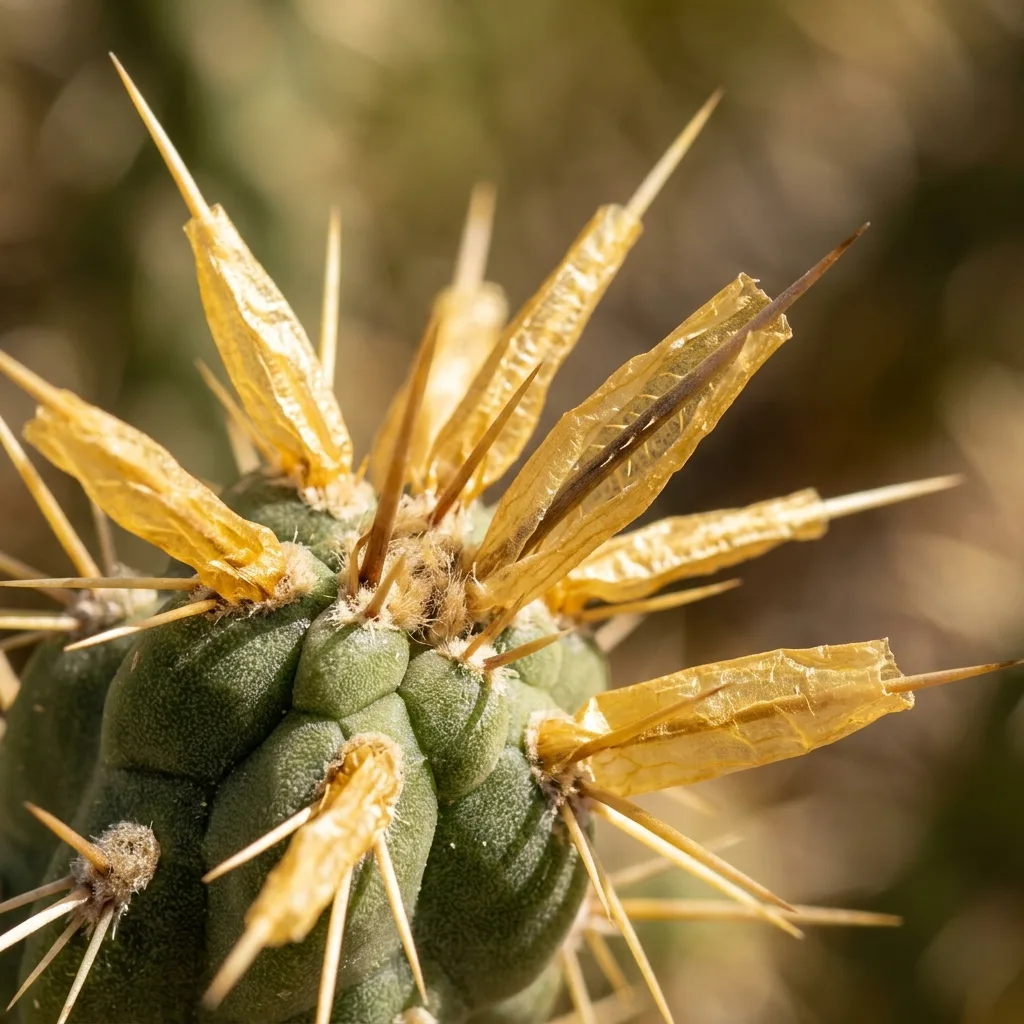
From these areoles erupts a formidable two-tiered defense system: prominent, rigid central spines shielded by papery coverings, and dense basal clusters of microscopic, viciously barbed hairs known as glochids. Microscopic examination of the central spines reveals backward-pointing, razor-sharp imbricate barbs, all sheathed in a shiny, loose, cellulose-based sheath. This reflective sheath acts as a protective mirror against scorched ultraviolet radiation while creating an ultra-low friction barrier during penetration. The moment the barbed tip anchors into tissue, the brittle stem joint detaches effortlessly from the mother plant. In an hyper-arid biome where sexual reproduction via seeds is an energetically costly gamble, this is the cholla's supreme vegetative propagation strategy.
2. Light Requirements, Solar Intensity, and Atmospheric Aeration
Basking in over 300 days of unfiltered, relentless desert sun annually in its native biome, Cylindropuntia fulgida is an absolute photon-hungry specimen. The species regulates its respiration via Crassulacean Acid Metabolism (CAM): to prevent desiccation during blistering afternoons, it keeps its microscopic stomata tightly sealed, opening them exclusively under cool nighttime skies to sequester carbon dioxide. For this complex biochemical engine to synthesize fuel effectively, intense daytime solar radiation is non-negotiable.
When cultivated indoors, an unobstructed south- or southwest-facing window receiving a baseline of 6 to 8 hours of direct, unfiltered sunlight daily is essential. Insufficient irradiance triggers rapid etiolation—resulting in pale, weakened, spindle-like stem development and sparse, fragile spination. Moving your cholla outdoors onto an open terrace, patio, or rock garden through the summer months maximizes structural rigidity, spine density, and radial brilliance. However, stagnant, humid air remains its mortal enemy; continuous atmospheric circulation is the single most important cultural parameter in preventing opportunistic aerial and root-zone fungal blights.
3. Irrigation Dynamics and the Essential Winter Dormancy Protocol
The swiftest way to destroy a jumping cholla is adhering to an arbitrary calendar-based watering regimen. Hydrating desert succulents on a rigid schedule is not an act of attentive stewardship; it systematically deprives root systems of oxygen and induces anaerobic decay. Cylindropuntia roots are anatomically shallow yet expansive, developed by nature to drink in flash desert downpours instantly and channel moisture into mucilaginous water-storage tissues. The potted substrate must dry out entirely down to the very base before introducing a single droplet of fresh water.
From early spring through late summer—its active vegetative growth phase—apply the rigorous 'soak-and-dry' technique. Saturate the potting medium thoroughly until water flows freely and cleanly through the bottom drainage holes, discarding any runoff immediately. Starting in mid-autumn, irrigation must be systematically tapered down to induce natural winter dormancy:
- Dormancy Temperature: Maintain a bright, cool setting stabilized between 5°C and 12°C (41°F - 54°F).
- Winter Irrigation: Cease watering almost entirely from November through late February. Slight shriveling, shrinking, and minor drooping of the cladodes are entirely normal physiological responses; purging cellular water elevates internal solute concentrations, acting as a natural antifreeze against chilling injuries.
4. High-Mineral Soil Formulations and Container Physics
The vascular xylem of Cylindropuntia is exquisitely vulnerable to soil-borne pathogenic water molds (notably Fusarium and Phytophthora species) when subjected to prolonged dampness in peat-heavy soils. Standard commercial potting soils or rich garden mixes represent a structural death sentence. An authentic cholla medium must be predominantly inorganic, discharging surplus moisture within seconds while maintaining structural pore space for root respiration.
| Substrate Component | Ratio (%) | Botanical Function & Physical Benefit |
|---|---|---|
| Horticultural Pumice (3-6 mm) | 40% | Provides sustained root oxygenation, high porosity, and prevents compaction. |
| Crushed Lava Rock / Zeolite | 25% | Enhances capillary action, steadily releases trace minerals, speeds drainage. |
| Coarse Washed River Sand / Quartz Grit | 15% | Replicates natural desert hardpan, eliminates excessive moisture retention. |
| Aged Cactus Peat / Leaf Compost | 20% | Supplies the minimal organic fraction required for cation exchange and anchorage. |
When selecting containers, prioritize unglazed terracotta pots equipped with generous drainage openings. The microporous nature of unglazed earthenware permits moisture to evaporate laterally through the pot walls, ensuring uniform root-ball dry-down and providing a stable ballast against the weight of top-heavy branched segments.
5. Inducing Inflorescence and Strategic Nutrient Management
Upon achieving botanical maturity, Cylindropuntia fulgida produces exquisite, satiny flowers emerging directly from upper areoles, boasting shades of vivid rose, magenta, or coppery bronze. While witnessing this floral display in container cultivation indoors is an exceptional horticultural milestone, it is entirely achievable when physiological prerequisites are met. The ultimate floral trigger is an uninterrupted, dry, chilly winter dormancy period. Without a distinct cold rest, the specimen cannot transition from purely vegetative expansion into generative bud development.
As metabolic activity awakens in early spring, introduce a specialized cactus fertilizer low in nitrogen and elevated in phosphorus and potassium (such as an NPK 5-10-10 or 4-8-12 formulation). High-nitrogen fertilizers cause excessive, bloated, overly soft cellular growth that invites pest predation and structural collapse. Dilute the fertilizer to half or quarter strength, applying it only once a month through the peak growth period. Terminate all supplemental feeding by late summer to prepare the tissues for structural hardening.
6. Propagation, Clonal Cuttings, and Grafting Methodologies
Thanks to its eponymous adaptation, the jumping cholla is arguably one of the most readily propagated cacti on earth. In its native habitat, a dislodged segment snagged on the leg of a passing mammal or carried by flash floods can establish a flourishing, independent clonal colony within days of touching mineral earth.
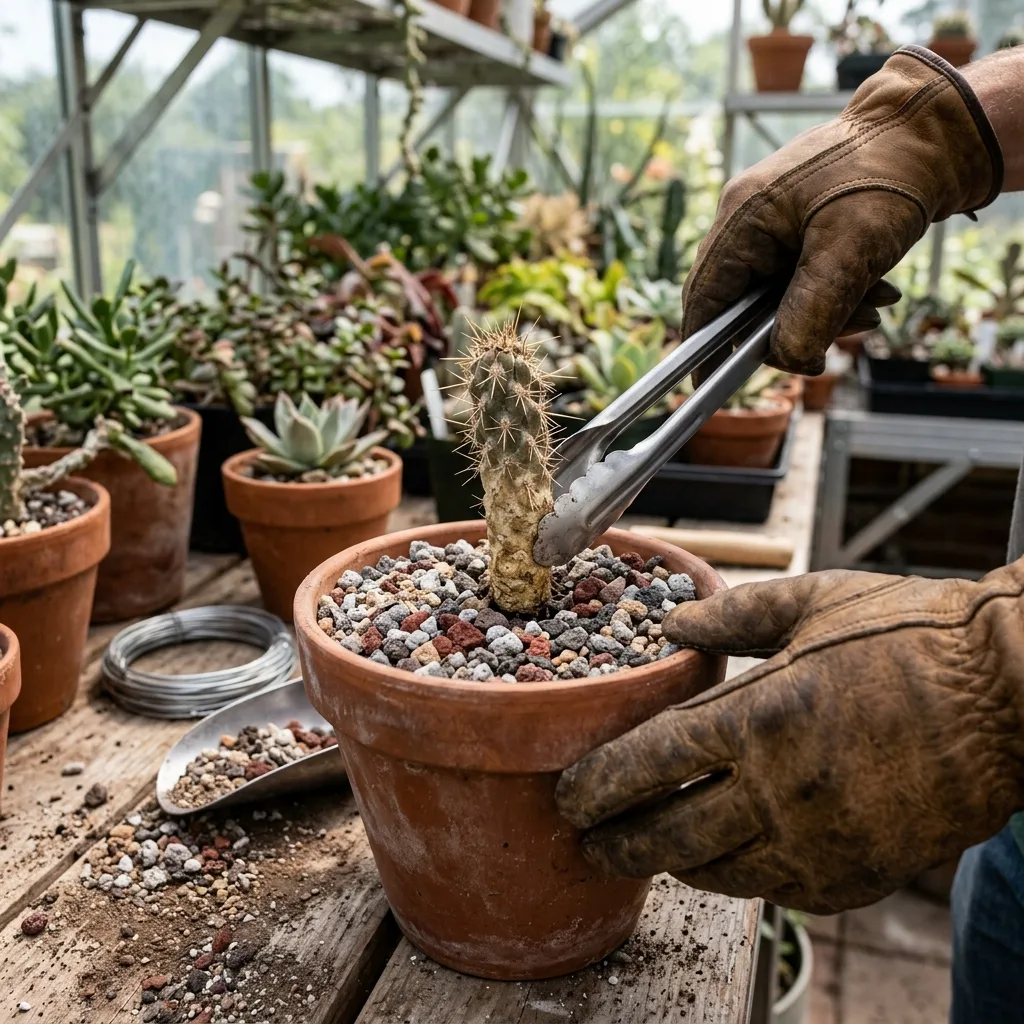
- Segment (Cutting) Harvesting: Never touch the plant with bare hands. Using metal culinary tongs or a folded strip of thick cardboard, gently grasp a mature terminal segment and twist smoothly at the narrow joint until it separates cleanly.
- Callusing Phase: Store the harvested segment in a shaded, warm, dry location with ample ventilation for 5 to 7 days. Allowing the raw vascular tissue to form a dry, hardened, suberized callus layer is paramount to eliminating fungal pathogens at planting.
- Rooting the Cutting: Insert the callused base vertically into dry mineral substrate to a depth of only 1 to 2 cm (approx. 0.5 inches). Do not apply moisture for the first 10 to 14 days. Once adventitious roots begin to develop, mist lightly around the base to stimulate downward root exploration.
- Grafting Protocols: While rarely necessary due to its vigorous natural rooting capacity, rare morphological forms or slow-growing chollas can be apical-grafted onto robust columnar rootstocks like Cereus repandus or Trichocereus.
7. Managing Pathogenic Rot and Common Parasites
While the jumping cholla stands nearly invincible against intense solar radiation and bone-dry arid cycles, human-induced environmental errors can destabilize it rapidly. The most devastating affliction is basal collar rot (Wet Rot), which climbs quickly into the central vascular cylinder. The moment you detect localized softening, dark discoloration, or weeping lesions at the base of a stem, radical surgical intervention is required.
Excise all compromised tissue using a sterilized scalpel until you reach entirely clean, crisp, pale-green tissue showing zero brown vascular staining. Dust the sterile cut surface generously with sulfur powder or ground cinnamon to inhibit secondary fungal spores, allow the cut to dry completely, and root the remaining healthy section afresh. In dry indoor atmospheres, common pests like spider mites (Tetranychidae) and mealybugs (Pseudococcidae) can settle inside the sheltered recesses of the areoles. Rather than drenching the plant in synthetic chemical sprays, spot-treat pests directly using a cotton swab dipped in 70% isopropyl alcohol and dramatically improve indoor air circulation.


Reader Reviews & Comments 3 Reviews
Julianna Reed
Marcus Vance
Edward Thorne
Leave a Review & Rating
Share your plant care tips, experiences, or questions with our succulent community.