






On the sheer volcanic cliffs of the Canary Islands, amidst sweeping winds and the blazing Atlantic sun, thrives an extraordinary marvel: Greenovia dodrentalis (classified botanically as Aeonium dodrentale). Resembling an immaculate green rosebud at first glance, this succulent plant curls its outer leaves inwards into a tight protective chalice during arid summer months to suppress moisture transpiration. Often mistaken by startled plant enthusiasts for a dying or 'drying rose', this morphological closure is, in truth, an evolutionary survival shield millions of years in the making.
Cultivating Greenovia in our living spaces or on sheltered balconies is far more profound than tending to a standard potted houseplant; it is a lesson in honoring nature's seasonal cadence. The frantic searches often voiced by plant lovers on 'how to dry roses' or 'how to preserve dried roses' undergo a poetic transformation when introduced to this living gem. Here, you never attempt to dehydrate the plant; instead, you learn the horticultural craft of keeping its legendary summer-dormant 'dried rose' form vibrant, unblemished, and rot-free until the autumn rains arrive.
1. Botanical Identity and Morphological Characteristics
A distinctive member of the Crassulaceae family, Greenovia dodrentalis is endemic to the north-facing slopes of Tenerife, colonizing basaltic rock fissures at elevations ranging from 150 to 1,200 meters above sea level. Its leaves are spatulate, featuring remarkably smooth margins enveloped in a soft, silvery-blue epicuticular wax known as farina. This delicate coating serves as a natural sunscreen engineered to deflect intense ultraviolet radiation; it should never be rubbed off or handled carelessly, as skin oils leave permanent fingerprints.
The plant's most mesmerizing attribute is its seasonal dimorphism. During its active vegetative phase across winter and early spring, the foliage unfolds outward, assuming a wide, shallow saucer profile. When ambient temperatures climb above 26–28°C (79–82°F), the succulent initiates profound estivation (summer dormancy). The outermost leaves dehydrate into paper-thin protective husks, while the inner juvenile leaves fold tightly into a compact rosebud. Throughout this dormant interval, this papery outer mantle protects the core apical meristem from excessive transpiration and cellular desiccation.
2. Light Requirements and Indoor Placement
Unlike typical desert cacti, the Green Rose succulent cannot tolerate blistering midday sunlight. Its natural habitat on mist-swept northern crevices provides strong, diffuse, ambient light rather than harsh overhead rays. When situating it indoors, east-facing windows offering gentle morning sun, or south-to-west exposures softened by sheer drapery, deliver the optimal photosynthetic spectrum.
Inadequate illumination rapidly degrades its characteristic rosette symmetry; the leaves stretch upward in search of luminosity (etiolation), completely unraveling the compact rose geometry. Conversely, during peak summer when the plant is dormant, unbuffered scorching rays can inflict irreversible chlorophyll scald on the tightly rolled petals. Consequently, between June and September, relocate your specimen to a shaded, well-ventilated, and comparatively cool sanctuary.

3. Irrigation Discipline: The 'Soak and Dry' Protocol
The single most destructive pitfall in succulent cultivation is frequent, shallow watering. For specialized species like Greenovia, routine micro-doses are not an act of care; they suffocate root hairs, deprive the root zone of oxygen, and create an ideal vector for pathogenic fungi such as Fusarium and Phytophthora. The governing golden rule is to permit the substrate to desiccate completely from top to bottom before applying a generous, deep soak that saturates the entire root system.
Hydration demands shift drastically across the seasons:
- Active Period (Autumn to Early Spring): Once the soil profile is entirely dry, drench thoroughly using room-temperature, dechlorinated water until moisture runs freely from the drainage holes. Never allow the pot to sit in standing saucer runoff; discard accumulated water within 15 minutes.
- Dormant Period (Mid-Summer): Once the foliage curls into a firm rosebud, cellular metabolism slows to a near standstill. The roots cannot uptake moisture efficiently. Regular watering during this stage will rot the root system almost overnight. Restrict hydration to a gentle, once-a-month perimeter sip applied at dusk along the pot rim—just enough to stave off total root desiccation. Never pour water directly into the center of the rosette; trapped droplets within the tightly furled petals induce crown rot within 48 hours.
4. Ideal Soil Substrate and Container Selection
Greenovia dodrentalis develops a fibrous, shallow root architecture adapted to minimal inorganic deposits trapped within volcanic crevices. Standard peat-dominant potting soils are disastrous, as they retain excessive water and inevitably trigger subterranean rot. The optimal potting matrix must consist of at least 70% porous volcanic and mineral aggregates.
| Substrate Component | Ratio (%) | Botanical Function |
|---|---|---|
| Pumice (3–5 mm grain) | 35% | Provides superior drainage and ensures optimal root aeration. |
| Lava Grit (Red/Black Scoria) | 25% | Improves structural anchoring and slowly releases trace iron minerals. |
| Zeolite (Clinoptilolite) | 15% | Buffers excess moisture spikes and curbs fungal pathogens. |
| Coco Coir / De-fibered Peat | 20% | Supplies minimal organic foundation and essential base root moisture. |
| Perlite or Coarse Quartz Sand | 5% | Prevents substrate compaction and maintains loose soil structure. |
Always house your plant in unglazed, breathable terra-cotta or fired clay vessels. Non-porous plastic or decorative glazed containers trap moisture along the internal walls. The pot depth should not exceed 8–10 cm (3–4 inches); deeper pots retain an unevaporated column of wet soil at the base that silently suffocates sensitive roots.
5. Step-by-Step Propagation Techniques
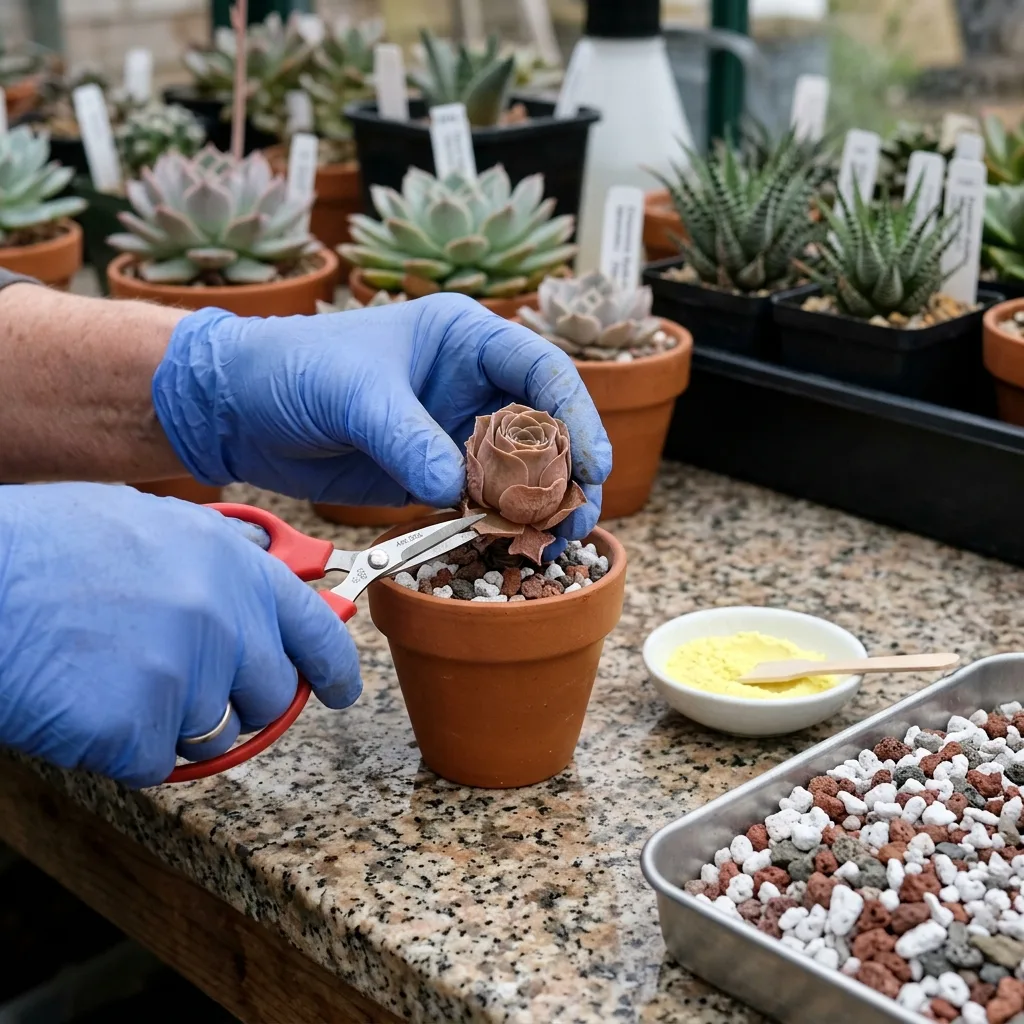
Greenovia species are fundamentally monocarpic, meaning an individual rosette dies after concluding its terminal bloom. Fortunately, G. dodrentalis produces an abundant cluster of stoloniferous offsets—slender subterranean and aerial runners bearing miniature daughter roses—long before any flowering takes place. Follow these steps for successful offset propagation:
- Timing is Everything: The safest window to divide offsets is during early autumn (September–October) as the plant breaks dormancy, or during early spring.
- Harvesting the Offsets: Using a sterilized surgical scalpel or razor-sharp pruning shears, sever the runner stem, leaving at least 1–2 cm of stolon attached to the daughter rose.
- Callus Formation: Never plant freshly cut offsets immediately into damp soil. Lightly dust the wounded stem tissue with crushed horticultural charcoal or ground cinnamon, then place the cutting in a dry, shaded location for 3–4 days to form a firm, protective callus.
- Placement on Dry Substrate: Fill a shallow terra-cotta pot with the inorganic mineral mix described above, completely dry. Rest the base of the callused offset directly upon the soil surface without burying the rosette crown.
- Initial Hydration: Withhold water completely for 7–10 days. From day 10 onward, apply minimal bottom moisture to stimulate nascent root tips downward. Within 3–4 weeks, vibrant pinkish-white rootlets will anchor securely into the gritty mix.
6. Common Pests, Pathogens, and Treatments
The most pervasive pest challenging Greenovia is the mealybug (Pseudococcus). Tucking themselves deep between the tightly overlapping, imbricated leaf tiers, these sap-sucking insects extract vital fluids, causing structural stunting and leaf distortion. Detecting them is notoriously difficult during summer dormancy when they hide in the rosette's innermost core. For minor infestations, delicately clean the affected crevices using a fine cotton swab dipped in 70% isopropyl alcohol. For extensive infestations, apply cold-pressed neem oil or a systemic horticultural insecticide exclusively during evening hours to avoid leaf burn.
Root rot (typically initiated by Rhizoctonia or Pythium fungi) manifests as yellowing, translucent, jelly-like leaves paired with a blackened stem base. This requires emergency intervention: unpot the plant, excise every trace of black or rotted tissue back to clean green vascular tissue, dust the wound generously with micronized sulfur powder, let it air-dry for 7 days in shade, and repot into fresh, completely sterile pumice grit.
7. Seasonal Care Calendar and Horticultural Overview
To sustain the vital rhythmic cycle of your Green Rose succulent throughout the year, follow this seasonal checklist:
- Autumn (Awakening): As evening temperatures drop in mid-September, deliver the first thorough soak. Within 1–2 weeks, the dormant rose will slowly begin unfolding its inner petals. You may administer a single application of balanced, nitrogen-low succulent fertilizer rich in potassium and phosphorus.
- Winter (Growth Peak): Provide maximum bright, indirect light. Maintain ambient room temperatures between 8–18°C (46–64°F). Water whenever the substrate dries through the entire pot profile.
- Spring (Budding Transition): Starting in April, progressively stretch the intervals between waterings. The outer leaves will gradually curl inward. Cease all fertilization completely.
- Summer (Deep Estivation): Transition the pot to full shade and superior air movement. Reduce watering to a negligible perimeter trickle once a month. Never trim away the dehydrated outer leaves; they are nature's indispensable thermal armor for the sleeping rosebud within.


Reader Reviews & Comments 4 Reviews
Eleanor Vance
Clara Higgins
Julian Hayes
Marcus Sterling
Leave a Review & Rating
Share your plant care tips, experiences, or questions with our succulent community.