






Nature's most captivating masterpieces often emerge when two ancient botanical lineages shake hands in the wild or greenhouse. Alworthia 'Black Gem' is a rare intergeneric hybrid uniting the genus Aloe—sovereign of South Africa's sun-baked, rocky plateaus—with Haworthia (reclassified in modern taxonomy as Haworthiopsis), the miniature master of dappled valley shade. In filtered ambient living room light, this exquisite hybrid exhibits an understated emerald-green grace; yet, once exposed to intense, bright daylight, it mobilizes protective anthocyanin pigments, morphing into a mysterious gem of deep bronze, plum, and near-black hues.
Cherished in succulent collections worldwide, 'Black Gem' inherits both Aloe's uncompromising drought tolerance and Haworthia's tidy, compact rosette architecture. However, welcoming this plant into your home requires remembering one cardinal botanical truth: frequent watering is not an expression of care, but rather an unintended asphyxiation of the root system. In this guide, we explore the scientific principles and practical steps required to safeguard your 'Black Gem' against root rot and nurture it into a thriving, multi-offset specimen colony.
1. Botanical Identity and Morphological Characteristics
Taxonomically designated as × Alworthia 'Black Gem', this hybrid is widely recognized by botanists as a cross between Aloe speciosa (or an allied caulescent/spiny Aloe) and Haworthiopsis cymbiformis (or a closely related Haworthia species). This intergeneric hybridization produces pronounced hybrid vigor (heterosis): 'Black Gem' establishes roots more vigorously and exhibits greater physiological adaptability than either parent species.
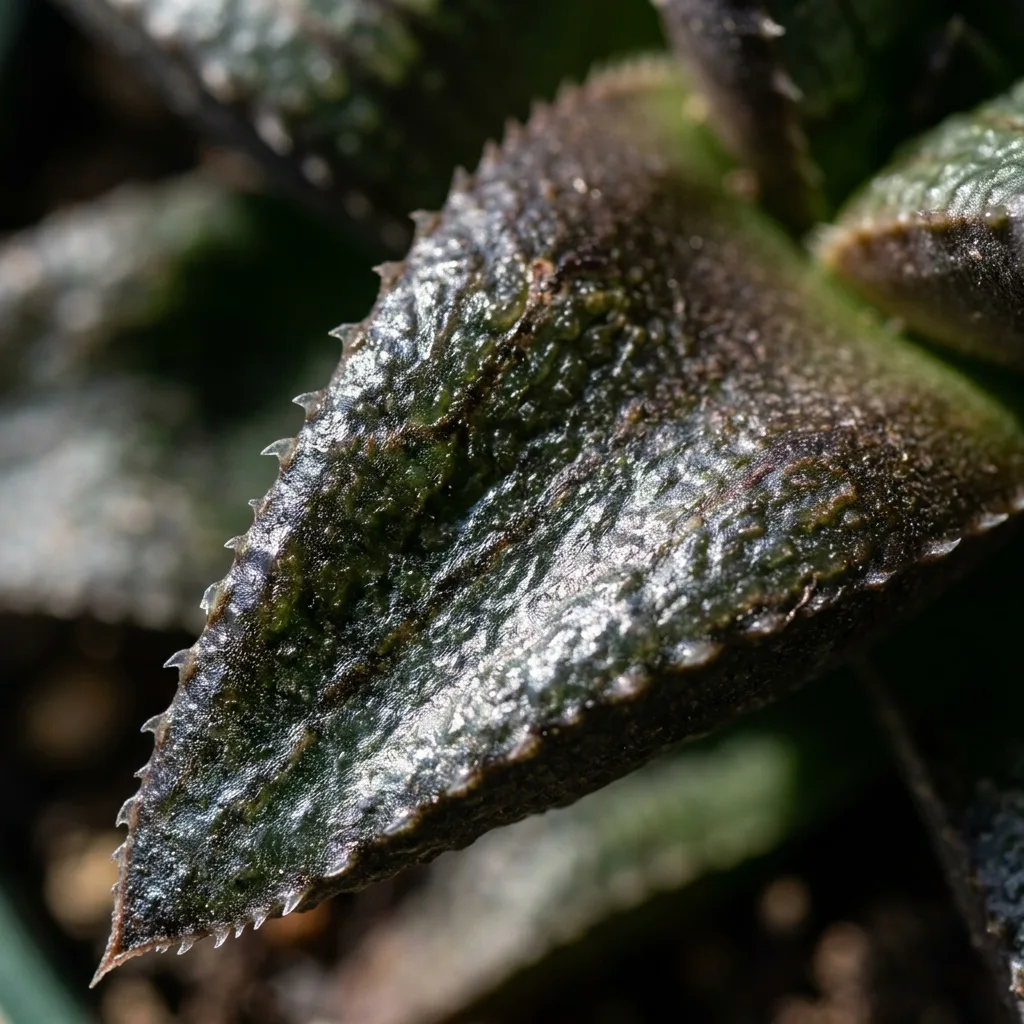
Morphologically, the leaves form a dense rosette that ascends outward from the base in an immaculate spiral phyllotaxy. The leaf cuticle is glossy, glabrous, and distinctly succulent, terminating in a soft, non-pungent cartilaginous mucro derived from its Haworthia lineage. Thanks to an expansive ground parenchyma specialized in mucilaginous water storage, the plant effortlessly withstands extended periods of severe drought. Depending on irradiance, the foliage shifts along a dynamic spectrum from vibrant grass green to charred obsidian and burnished bronze. In late spring and summer, mature specimens send up slender inflorescences bearing tubular, coral-orange blossoms that echo the classic hummingbird-pollinated flowers of their Aloe ancestry.
2. Light Requirements and Indoor Placement
Achieving and maintaining the iconic dark bronze-to-black coloration of × Alworthia 'Black Gem' depends directly on photobiology—specifically light intensity and wavelength. While intense illumination stimulates protective pigmentation, the unbuffered, scorching midday summer sun can overwhelm chlorophyll pigments, resulting in bleached patches and irreversible necrotic sunburn. The ideal environment provides at least 4 to 6 hours of bright, filtered sunlight or gentle morning sun softened by a sheer curtain.
If relegated to a dim, poorly lit corner, the plant promptly exhibits etiolation: the compact rosette loosens, internodes stretch toward the light source, and the dramatic dark tones revert to a dull, washed-out pale green. The premier indoor vantage point for 'Black Gem' is an east- or west-facing windowsill. On an unshaded southern exposure, positioning a light sheer curtain during peak summer heat provides just enough filtration to shield the plant from photo-oxidative stress while sustaining its noble, dark coloration.
3. Watering Discipline: The 'Soak and Dry' Method
The vast majority of succulent losses can be attributed not to underwatering, but to chronic, well-intentioned overwatering. Succulent root cortical tissues quickly undergo hypoxic cellular lysis (breakdown due to oxygen deprivation) when deprived of air in waterlogged conditions, paving the way for opportunistic fungal pathogens. The indispensable golden rule is the rigorous 'soak and dry' protocol.
Before introducing water, verify that the substrate has dried out completely from the top dressing down to the base of the root ball. Insert a dry wooden skewer along the inner perimeter of the pot to the bottom and leave it for five minutes; if it emerges completely dry and free of clinging substrate dust, the plant is ready for water. Apply water thoroughly until it streams freely from the drainage holes, fully hydrating the mineral matrix. Discard any runoff collected in the saucer within 15 minutes. Crucially, avoid letting water settle within the central crown of the rosette, as stagnant moisture trapped between closely packed leaf bases is the leading cause of crown rot.
4. Ideal Soil Mix and Pot Selection
The root system of × Alworthia 'Black Gem' thrives in highly porous, structurally stable mineral substrates engineered for maximum gas exchange. Standard peat-heavy indoor potting soils are lethal over time because they retain water too long and collapse into dense, airless blocks when wet. A premier succulent blend should consist of at least 60% to 70% inorganic, porous aggregate.
| Substrate Component | Ratio (%) | Botanical Function & Root Zone Benefit |
|---|---|---|
| Horticultural Pumice (3–5 mm) | 35% | Creates long-lasting aeration pockets, resists compaction, and drains excess gravitational water rapidly. |
| Crushed Lava Rock (Scoria) | 20% | Maintains open structural porosity, releases micro-minerals (including iron), and anchors roots securely. |
| Coarse Quartz Grit / Zeolite | 15% | Accelerates drainage velocity and creates a stable, well-aerated mineral framework for root hairs. |
| Low-Dust Peat or Washed Coco Coir | 30% | Supplies essential cation exchange capacity (CEC) and safe baseline moisture retention. |
When selecting a container, unglazed terracotta pots remain the premier choice. The breathable, micro-porous clay walls allow moisture to evaporate laterally, preventing cold, wet zones in the core of the root ball. Whichever container style you choose, unobstructed bottom drainage holes are strictly non-negotiable. Glass terrariums and drainage-free decorative glazed planters should be avoided entirely.
5. Step-by-Step Propagation Techniques
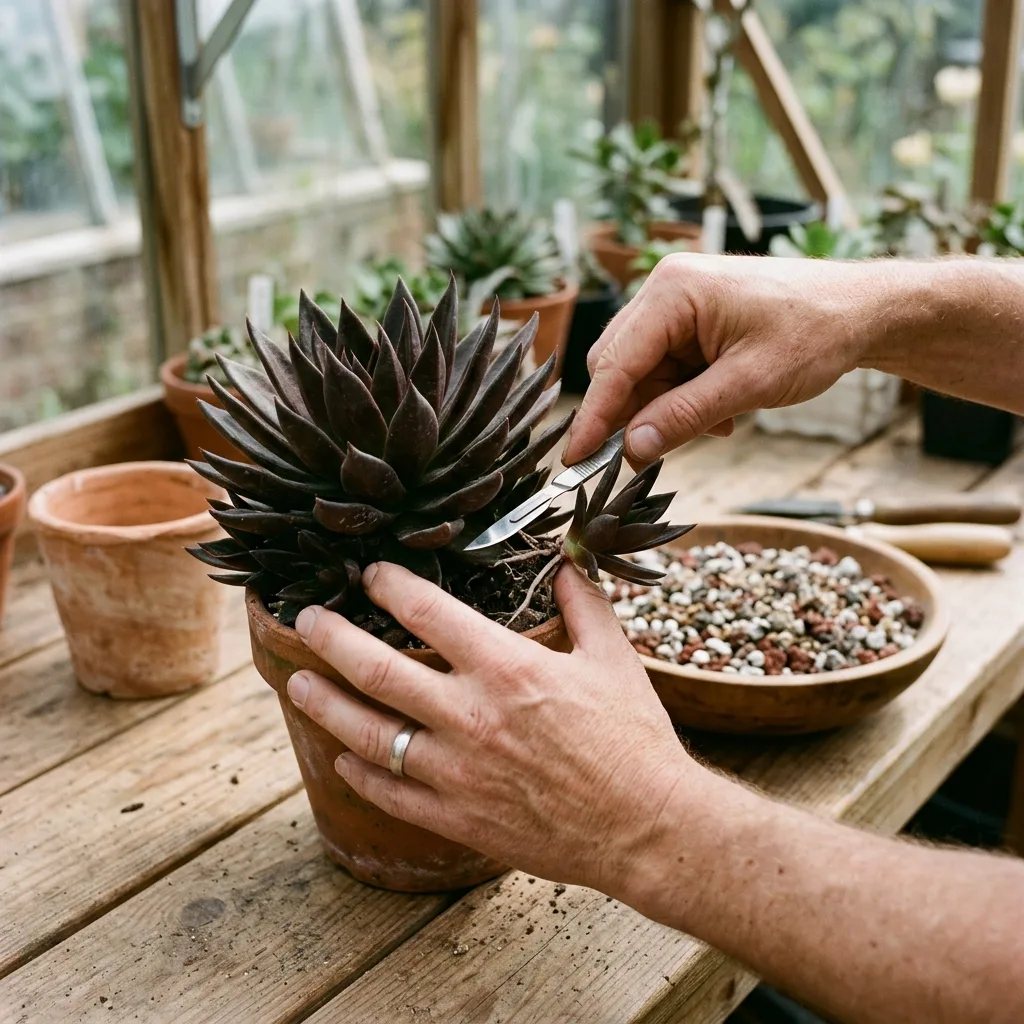
Because × Alworthia 'Black Gem' is an intergeneric hybrid, seeds will not produce plants true to type; propagation must always be performed through vegetative division. Fortunately, the plant produces abundant basal offsets (pups) along underground rhizomes, making clonal division straightforward and rewarding.
- Timing the Division: Carry out division in mid-spring or early summer during active vegetative growth, once lateral pups have attained at least one-third the diameter of the parent rosette.
- Unpotting and Extraction: Gently slip the entire colony from its pot. Tease away the gritty soil from the root mass using your fingers or a soft brush. Locate the connecting stolon running from the mother plant to the pup and sever it cleanly using a flame-sterilized scalpel or pruning shears, taking care to preserve the pup's own feeder roots.
- Callus Formation: Never plant freshly severed offsets immediately into damp soil. Fresh wounds are open entryways for pathogens. Place the offsets in a warm, dry, shaded location with good air movement for 2 to 4 days until the cuts form a firm, leathery, protective callous.
- Potting and Root Establishment: Seat the calloused offsets into small containers filled with the gritty mineral mix described above. Leave the substrate completely dry for the first 4 to 5 days. Afterwards, mist the top of the gritty mix lightly to encourage exploratory root growth. Within 2 to 3 weeks, roots will anchor firmly into the aggregate.
6. Common Pests, Diseases, and Treatments
While exceptionally resilient, 'Black Gem' can show distress when its cultural requirements are compromised. Here is how to diagnose and resolve the most frequent challenges:
- Mealybugs (Pseudococcidae): These soft-bodied pests coat themselves in protective cottony secretions and hide deep within the tightly whorled leaf bases to suck plant sap. Treat minor incursions directly by dabbing them with a cotton swab soaked in 70% isopropyl alcohol. For extensive infestations, apply cold-pressed horticultural neem oil emulsion or a systemic soil-drench insecticide during the active growing season.
- Soft, Translucent, Waterlogged Foliage: The definitive symptom of advanced overwatering and fungal root rot (often Fusarium or Pythium). Immediately unpot the specimen, wash away the soil, and excise all blackened, mushy root tissue and glassy bottom leaves with sterile shears. Dust the clean cuts with powdered sulfur or cinnamon, let the plant dry bare-root for 48 hours, and replant into 100% dry pumice.
- Inward Leaf Curling and Longitudinal Wrinkling: Indicates acute cellular dehydration—either because the plant has been kept dry for too long or because the root system has died and can no longer draw moisture. If the roots are white, firm, and healthy, a thorough drench will restore full leaf turgidity within 48 hours.
7. Seasonal Care Calendar and Expert Tips
Spring (Awakening & Vegetative Growth): As day length expands and ambient temperatures rise, vegetative growth resumes. Apply a balanced, urea-free succulent liquid fertilizer (such as NPK 10-10-10) diluted to quarter-strength once monthly. Spring is the optimal window for repotting, root maintenance, and offset propagation.
Summer (Mid-Season Balance): Under severe midsummer heat, 'Black Gem' may slip into a protective state of semi-dormancy. Cease all fertilization, shield the plant from harsh midday sun, and restrict deep watering to the cooler hours of the late evening when the soil cools.
Autumn (Hardening Off): Gradually scale back watering intervals as ambient temperatures decline and sunlight diminishes. Inspect leaf axils closely for lingering pests before moving patio plants indoors ahead of seasonal frosts.
Winter (Rest Period): Maintain your 'Black Gem' in a cool (10–15°C / 50–59°F), brightly lit location during the winter months. Minimize watering significantly; depending on room humidity and pot size, a light sip once every 3 to 5 weeks is plenty to prevent root desiccation. The plant must never be exposed to freezing conditions below -2°C (28°F).


Reader Reviews & Comments 3 Reviews
Marcus Thorne
Eleanor Vance
Clara Higgins
Leave a Review & Rating
Share your plant care tips, experiences, or questions with our succulent community.