






When winter knocks at the door, watching garden leaves yellow and drop—leaving behind nothing but bare branches and a melancholic void—might seem like an immutable law of nature. Yet across our planet's most ancient terrains—from the sheer limestone escarpments of the Alps to the frost-shattered plateaus of North America and the rocky outcrops of the Mediterranean—a sculptural vitality endures that freezing cold cannot quell. This is precisely where evergreen succulent garden design steps in like botanical alchemy, reversing the conventional seasonal cycle.
Creating an evergreen garden is about far more than just planting ubiquitous conifers. When you combine this design philosophy with succulent taxa that harbor thousands of microscopic water reservoirs within their foliage, biosynthesize antifreeze solutes at a cellular level, and preserve their structural integrity even beneath bleak winter skies, your landscape transforms into an outdoor gallery of living sculpture. By orchestrating cold-hardy Sempervivum (literally 'always living'), resilient Sedum carpets, architectural Yucca spikes, and freeze-tolerant members of the Agave genus, you can establish an ecosystem that stands proud beneath winter snowdrifts while effortlessly laughing off summer droughts.
In this master guide, we explore how to conceive, ground, and nurture a dynamic four-season succulent haven from scratch—one that retains its rich pigmentation and architectural form through the harshest winter gales. From cellular cryobiology to macroscopic drainage engineering, here are the practical answers to cultivating an evergreen landscape that thrives year-round.
1. Botanical Identity and Morphological Adaptations
The structural backbone of an evergreen succulent garden relies on non-deciduous taxa whose cellular membranes do not rupture when temperatures plummet below freezing. A plant's capacity to survive sub-zero thresholds (-15°C to -30°C / 5°F to -22°F) depends not only on Crassulacean Acid Metabolism (CAM) for moisture retention, but also on its ability to concentrate compatible intracellular osmoprotectants—primarily soluble glucose and proline—effectively generating natural cellular antifreeze.
Key botanical keystones to integrate into your evergreen composition include:
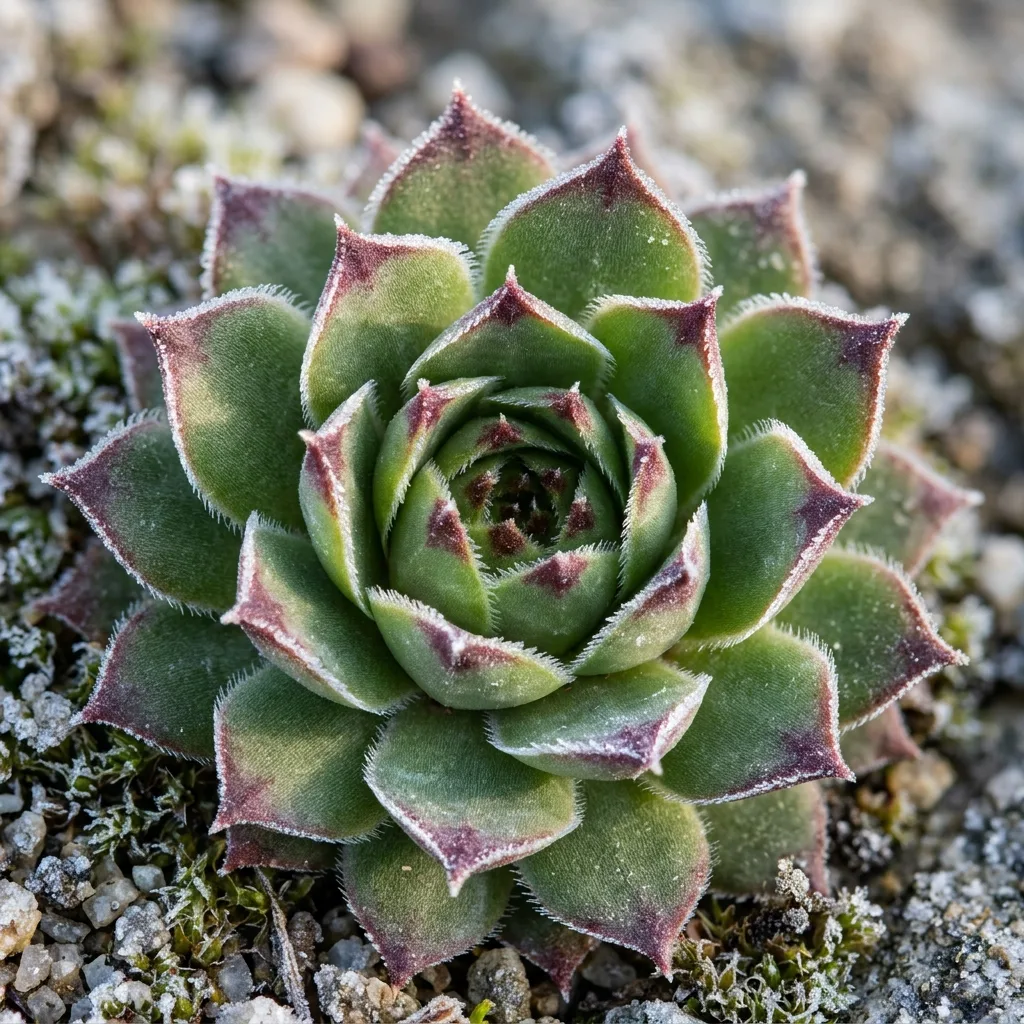
- Sempervivum tectorum & Sempervivum montanum (Hens and Chicks): Cold-hardy down to -30°C (-22°F). Their imbricated rosette morphology naturally channels snow loads away from the apical meristem. In winter, protective anthocyanin pigments surge into the leaf tips, bathing the foliage in deep burgundy, copper, and mahogany hues without tissue decay.
- Sedum (Stonecrop) - Evergreen Species: Non-deciduous groundcovers like Sedum album, Sedum rupestre ('Angelina'), and Sedum spurium form an unbroken living armor over the soil, insulating indigenous soil microbes from lethal freeze-thaw cycles.
- Yucca filamentosa & Yucca glauca: Foundational accent plants imparting structural height; their rigid, sclerophyllous sword-shaped leaves effortlessly shed heavy sleet, ice glaze, and blizzards.
- Hesperaloe parviflora (Red Yucca): Cold-tolerant to -20°C (-4°F), this architectural gem produces arching, evergreen linear foliage with fine marginal threads and towering coral-red floral scapes throughout summer.
- Agave parryi subsp. neomexicana: A jewel of high-altitude deserts featuring compact, geometric rosettes and formidable terminal spines. It stands as the most cold- and moisture-resilient agave taxon for temperate landscape schemes.
2. Photoperiod Needs and Microclimate Siting
When orchestrating an outdoor evergreen succulent scheme, the most pivotal factor to calculate is the shifting winter solar trajectory. Low-angle winter sun combined with lingering surface moisture can predispose soft foliar tissues to freeze-burn necrosis or fungal pathogen proliferation.
Position your beds along south- or southwest-facing aspects. Micro-sites that capture a minimum of 6 hours of unhindered direct sunlight daily empower succulents to preserve cuticle thickness and rich protective pigments. If your terrain receives early morning sun but faces biting northern or northwesterly winds in the afternoon, planting dwarf evergreen windbreaks—such as Pinus mugo—in the background creates a sheltering wind shadow, securing your succulent microclimate.
If you transition potted evergreen succulent arrangements to a sheltered veranda or unheated sunroom for winter, provide a bright, south-facing exposure. To prevent 'etiolation' (unsightly, weak elongation driven by low light and artificial warmth), maintain ambient temperatures strictly between 5°C and 10°C (41°F–50°F), respecting the plant's essential seasonal winter dormancy.
3. Hydration Discipline: The 'Soak and Complete Dry-Down' Rule
The most pervasive misstep in managing an evergreen succulent garden is failing to modulate hydration across seasonal transitions. Throughout the active spring and summer vegetative phases, established plants relish generous, deep irrigation cycles that reach the taproot zone; yet, the soil profile must dry out completely between drenchings.
From late autumn through the end of winter, nature handles watering. In regions with ambient winter precipitation, cold-hardy succulents grown in open beds should never receive supplemental manual watering. Surplus soil moisture expands upon freezing, fracturing root cell walls like shards of glass and triggering irreversible winter crown rot.
The baseline rule remains foolproof: never apply water unless the top 10 centimeters (4 inches) of substrate are parched. In dry summer months, irrigate at twilight to minimize evaporative loss; during unusually arid, frost-free winter stretches in temperate zones, water lightly during warm midday hours directly at the base, keeping moisture clear of center leaf rosettes.
4. Engineered Substrate Matrix and Container Selection
The life engine of any four-season outdoor succulent landscape is an ultra-porous, aggregate-heavy geological substrate that eliminates perched water tables. Dense, clay-laden garden soils turn into anaerobic mires in cold weather, suffocating root systems within weeks.
Building raised beds, rockeries, or berms leverages gravity to draw surplus moisture away from the root profile. The planting medium must consist of at least 60% inorganic, porous mineral aggregates:
| Substrate Component | Ratio (%) | Botanical Function & Benefit |
|---|---|---|
| Horticultural Pumice (3-6 mm) | 35% | Creates microscopic aeration pockets; absorbs excess moisture and releases it gradually. |
| Crushed Lava Rock / Scoria | 25% | Adds structural ballast to anchor root plates while establishing fast-draining macro-pores. |
| Coarse River Sand / Zeolite | 15% | Prevents fine particle compaction, silt sedimentation, and mud formation. |
| Screened Organic Compost / Bark Fines | 25% | Supplies essential micronutrients, humic acids, and stable anchorage for young feeder roots. |
When selecting architectural planters and bowls, prioritize high-fired, frost-proof terracotta or carved natural stone (such as andesite or granite). Conventional low-fire ceramic or cheap non-porous plastic containers trap chilling dampness against root zones and are liable to shatter during hard freezes.

5. Step-by-Step Propagation and Landscape Colonization
Encouraging an evergreen succulent garden to knit into a dense, weed-suppressive carpet over time is remarkably rewarding. Two primary propagation strategies will help you expand coverage across open stone beds:
Offset Division via Stolon Harvesting (For Sempervivum)
- Timing: Initiate propagation in mid-spring when parent rosettes extend robust lateral stolons carrying daughter offsets at least 2 to 3 cm in diameter.
- Severing: Using a sterile, bypass pruning shear or grafting knife, sever the connecting stolon roughly 1 cm from the base of the daughter offset.
- Callusing: Never seat a freshly severed offset straight into moist substrate. Rest the cuttings in a dry, ventilated, shaded area for 48 hours to form a firm suberized callus over the wound.
- Rooting: Press the callused base lightly into your mineral-rich substrate matrix. Until active root hair development anchors the plant (typically 10 to 14 days), hydrate purely via fine misting directed around the outer perimeter of the foliage.
Stem Cuttings for Rapid Gap-Filling (For Sedum)
Prune healthy 7-10 cm stem tips from prostrate stonecrops. Strip the leaves along the lowest 2 cm of the stem and insert the cuttings directly into bare patches throughout your garden beds. Within weeks, adventitious roots will emerge from the nodes, rapidly establishing dense, erosion-resistant ground cover.
6. Troubleshooting Common Pathogens, Pests, and Cultural Ailments
Hardy outdoor evergreen succulents are exceptionally rugged, but extreme climatic swings and drainage failures can spark issues:
- Winter Soft Rot and Crown Collapse (Fusarium / Phytophthora): Caused by protracted cold rain combined with sluggish drainage. Leaves turn translucent, mushy, and foul-smelling. Management: Excise and destroy affected specimens immediately. Drench the surrounding soil with a copper-based botanical fungicide or systemic propiconazole, and blend dry horticultural pumice into the perimeter to restore aeration.
- Mealybugs (Pseudococcidae): Concentrating in the tight recesses of overlapping leaf rosettes, appearing as cottony white nests. Management: Dab clusters directly with cotton swabs saturated in 70% isopropyl alcohol. For larger outbreaks, treat on overcast late afternoons using an organic cold-pressed neem oil solution.
- Snails and Slugs: Emerging during wet spring weather to chew irregular cavities into fleshy succulent leaves. Management: Scatter a topdressing of sharp volcanic rock, crushed oyster shells, or agricultural-grade diatomaceous earth around the plants; the angular edges create an impenetrable physical deterrent.
7. Seasonal Stewardship Calendar
- Spring (Awakening & Renewal): Gently clear away dried, spent winter foliage from beneath rosettes using long tweezers. Apply an early-season feeding with a low-nitrogen, slow-release succulent fertilizer formulation (such as NPK 5-10-10). This window is prime time for expanding beds, splitting offsets, and structural planting.
- Summer (Resilience & Bloom Care): In periods of prolonged heat waves and intense drought, perform deep dusk waterings. If blazing solar glare threatens scorch marks on young or pale varieties, provide temporary 30% shade cloth. Prune spent flower spikes down to the rosette base (remember that flowering Sempervivum rosettes are monocarpic and naturally die after setting seed; clear away the mother plant to let surrounding offsets claim the light).
- Autumn (Acclimatization & Hardening): Discontinue all nitrogen feeding completely by early autumn to allow plant cell walls to harden against approaching frost. Diligently clear falling deciduous tree leaves from your succulent rosettes—wet, rotting foliage trapped on crowns is a primary source of fungal epidemics.
- Winter (Dormancy): Keep hands off and let the plants rest. Halt manual irrigation entirely. In the event of once-in-a-decade arctic blizzards or ice storms, drape unrooted specimens or delicate border varieties with breathable horticultural fleece (agryl frost cloth) until the front clears.


Reader Reviews & Comments 3 Reviews
Julian Vance
Clara Sterling
Marcus Holbrook
Leave a Review & Rating
Share your plant care tips, experiences, or questions with our succulent community.