






When most people hear the word 'cactus', their minds immediately conjure images of spiny, ribbed spheres braving blistering heat amidst arid, calcified plains. Yet Mother Nature is far too inventive to confine the magnificent family Cactaceae to a single biome. Epiphyllum anguliger—fondly known around the world as the Fishbone Cactus or Zigzag Cactus—is an epiphytic marvel native to the lush, mist-draped montane forests of southern Mexico. Anchored high in the canopies of ancient trees, it thrives on dappled light filtering through the overhead canopy. Cultivating this plant successfully at home requires tossing arid desert rules out the window and attuning your instincts to the rhythmic balance of a tropical rainforest canopy.
Its undulating, zigzagging stems cascade out of hanging planters like living botanical sculptures, making it an undeniable centerpiece for indoor plant collectors. However, mistaking this jungle inhabitant for a typical desert succulent—scorching it under direct midday sun and withholding water for months on end—will swiftly lead to severe dehydration, cellular collapse, and stalled growth. Drawing from decades of greenhouse cultivation and core cellular botanical principles, let us decipher the physiological language of this extraordinary epiphyte together.
1. Taxonomic Identity, Areole Morphology, and Spine Evolution
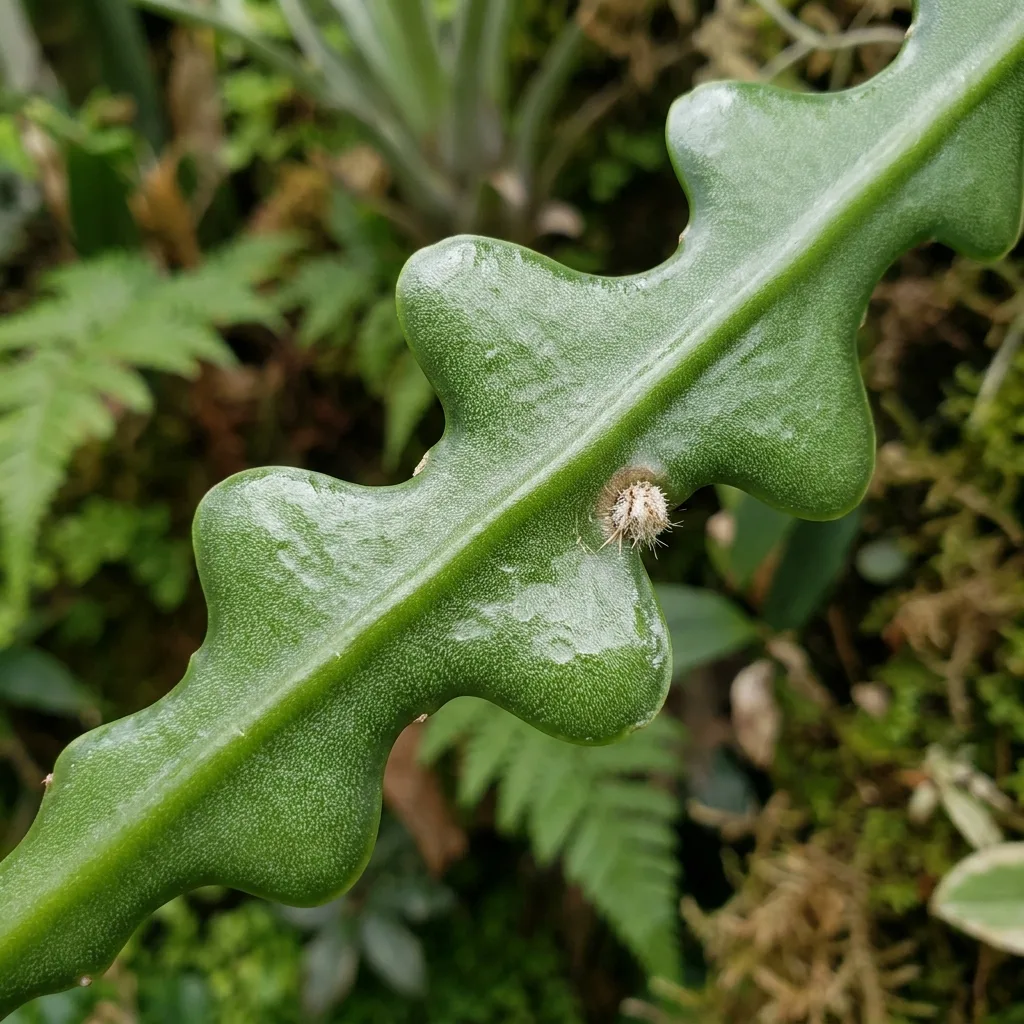
Epiphyllum anguliger (frequently classified in modern botanical taxonomy as Disocactus anguliger) belongs to the tribe Hylocereeae within the family Cactaceae. One of the plant's most captivating evolutionary adaptations is that what appears to be foliage is not composed of true leaves at all. Instead, these are flattened, photosynthetic stems known scientifically as cladodes. Over evolutionary epochs, the plant reduced its true leaves entirely to minimize transpiration and reshaped its stems into broadly lobed, undulating structures designed to capture maximum photons under dappled forest canopies.
The formidable, piercing spines of desert cacti are almost entirely absent in Epiphyllum anguliger. Nestled within the recessed notches of the cladodes are minute areoles that, rather than bearing rigid thorns, produce soft, microscopic hair-like bristles (trichomes). Far from serving merely as passive defenses, these areoles are vital meristematic reproductive centers; they are the exact cellular points from which vigorous new vegetative shoots emerge and where enormous, vanilla-scented nocturnal flower buds burst forth under optimal conditions.
2. Light Requirements, Solar Intensity, and Ventilation Standards
As a natural understory dweller, Epiphyllum anguliger possesses thin cellular cuticles that leave it exceptionally vulnerable to direct, unshielded overhead sunlight. Intense midday solar radiation causes photo-oxidation within the cladode cell walls, leading to irreversible bleached, yellow sunburn scarring. The ideal environment for this species is abundant, bright indirect daylight, morning sun filtered through sheer curtains on an eastern exposure, or a luminous northeast-facing window sill.
Equally critical to ambient illumination is generous air circulation. In their native habitats, epiphytic root systems are exposed to constant, humid breezes flowing through forest branches. Stagnant, stuffy corners where humidity sits trapped without airflow will force the plant's stomata to close down, impeding CAM metabolic gas exchange and establishing an ideal breeding ground for opportunistic fungal lesions. Introducing gentle, continuous air movement that faintly sways the stems will practically double the plant's photosynthetic efficiency.
3. Epiphytic Hydration Cycles and the Critical Winter Dormancy Regime
Dousing succulents with water too frequently is not an expression of care; it inadvertently suffocates root tissues by depriving them of oxygen. For the Fishbone Cactus, however, the hydrological equation is distinctly nuanced. Unlike desert species, Epiphyllum cannot tolerate having its root zone bone-dry for months at a time. The gold standard for epiphytic watering is the 'drench thoroughly and allow the upper profile to dry' rhythm.
Throughout the spring and summer active growth seasons, irrigate generously whenever the top 3 to 4 centimeters (1.5 inches) of the potting substrate feels dry to the touch. Always discard any runoff accumulated in the saucer within 15 minutes to avert basal rot. As late autumn approaches and ambient temperatures dip to around 12–15°C (54–59°F), the plant enters a semi-dormant metabolic rest phase. During this period, hydration frequency should be curtailed substantially, watering lightly only once every 3 to 4 weeks to prevent cellular wrinkling. This cool, carefully managed rest period serves as the primary biochemical trigger that prompts floral bud differentiation come springtime.
4. High-Porosity Substrate and Potting Architecture
Heavy garden soils and conventional peat-dense potting soils represent a suffocating hazard for this plant. In nature, its roots cling to tree forks cushioned by leaf litter, mosses, and decomposing bark, demanding exceptional porosity and rapid gas exchange. The substrate formula must allow water to cascade through effortlessly while preserving just enough fibrous moisture without waterlogging the root collar.
| Substrate Component | Ratio (%) | Functional Botanical Role |
|---|---|---|
| Pine Bark (Orchid Grade) | 35% | Replicates natural epiphytic bark niches and builds open oxygen pockets |
| Pumice (3–6 mm) | 25% | Provides structural inorganic porosity and continuous root oxygenation |
| Coco Coir / Peat | 20% | Offers a mildly acidic organic base with balanced, non-compacting moisture retention |
| Lava Rock or Zeolite | 10% | Facilitates sustained trace mineral release and cation-exchange capacity |
| Worm Castings (Finely Sifted) | 10% | Delivers gentle, biologically active, slow-release micro-nutrients |
When selecting a container, choose breathable unglazed terracotta pots equipped with generous drainage holes or well-drained hanging baskets. Because the root system of Epiphyllum is relatively shallow and spreads laterally rather than anchoring deep into the earth, broad, well-aerated pots will support long-term vascular vigor far better than deep, narrow vessels.

5. Strategies for Inducing Blooms and Nutrient Management
The flowering of Epiphyllum anguliger is one of the grandest spectacles in the plant kingdom: measuring 15 to 20 cm in diameter, the nocturnal blossoms boast lemon-yellow to bronze outer tepals and immaculate white inner petals that unfurl at twilight, saturating the room with a rich, hypnotic vanilla perfume. However, coaxing a Fishbone Cactus into bloom is never an accident—it requires faithful seasonal discipline.
Two environmental conditions are non-negotiable for bud formation: the plant must be moderately root-bound, and it must experience a distinct cool, dry autumn-winter dormancy. Specimens planted into oversized containers channel their metabolic energy into vegetative cladode expansion rather than floral production. From early spring onwards, feed bi-weekly with a specialized, low-nitrogen, high-phosphorus and potassium liquid fertilizer (such as an NPK 5-10-10 formulation) diluted to half strength. Excessive nitrogen applications will yield dense, dark green stem growth at the expense of floral buds, which will fail to initiate or abort prematurely.
6. Propagation, Stem Cuttings, and Rooting Protocols
Multiplying your Fishbone Cactus is both remarkably rewarding and straightforward, boasting one of the highest propagation success rates in the cactus family. The optimal window for taking cuttings is during active vegetative growth in spring or early summer.
- Select Mature Cladodes: Choose a firm, vibrant, mature stem section measuring at least 15 to 20 cm in length. Extremely juvenile or overly woody sections root at a noticeably slower pace.
- Perform a Clean Cut: Using a sharp, bypass pruning shear sterilized with isopropyl alcohol, sever the cladode smoothly at the narrow nodal juncture where it connects to the main stem.
- Callus Formation: Never insert freshly cut stems directly into moist soil. Place the cutting in a shaded, well-ventilated location for 4 to 7 days until the cut edge develops a tough, opaque, grayish-white callous layer. This barrier is crucial for preventing fungal pathogen entry.
- Rooting Substrate: Insert the callused cutting 2 to 3 cm deep into a propagation blend of 70% perlite and 30% lightly moistened coco coir. Maintain ambient warmth and mist the surface lightly when dry. Sturdy, adventitious roots will emerge from the areoles within 3 to 4 weeks.
7. Defending Against Fungal Pathogens and Common Pests
The primary health hazards for Epiphyllum species are basal stem and root rots induced by opportunistic fungal pathogens such as Phytophthora and Fusarium. If you observe water-soaked, translucent, yellowish-brown lesions softening near the base of the cladodes, root rot is already underway. Immediate rescue surgery is required: unpot the specimen, prune away all dark, mushy, or hollow roots, treat remaining healthy stem tissue with powdered cinnamon or sulfur, and reroot the viable upper sections as fresh cuttings.
Among insect pests, mealybugs (family Pseudococcidae) pose the most frequent nuisance. These sap-sucking insects nestle within the sheltered nodal recesses of the zigzag stems and hide beneath fine areolar hairs. For mild occurrences, manually eradicate colonies using cotton swabs dipped in 70% isopropyl alcohol. In the event of a widespread infestation, apply an evening spray of cold-pressed neem oil or horticultural potassium soap solution, repeating weekly across two biological cycles to break their reproductive generation.


Reader Reviews & Comments 3 Reviews
Julian Vance
Clara Higgins
Marcus Sterling
Leave a Review & Rating
Share your plant care tips, experiences, or questions with our succulent community.