






Along the sun-scorched coastal plains of Chile's Atacama Desert—the driest non-polar desert on Earth—it is nearly impossible to spot the living treasures concealed right beneath your boots. Confronted by merciless aridity, Eriosyce odieri survives by contracting its stem almost entirely flush with the rocky earth, sometimes retreating completely beneath the mineral substrate. Sustained for decades primarily by ephemeral morning sea fogs (the legendary camanchaca), this diminutive marvel stands as one of nature's most poignant verses on patience, stoicism, and evolutionary resilience.
Welcoming this ancient geophytic cactus into our private collections and home greenhouses entails a sacred horticultural responsibility that transcends basic plant keeping. The primordial desert memory encoded within its cells recoils from misdirected affection—most critically, that fateful extra glass of water. To genuinely comprehend Eriosyce odieri is to internalize the desert's profound philosophy of water conservation. Join us as we delve deep into the morphology, cellular biology, and precise environmental requirements that will allow this rare species to thrive as the crown jewel of your succulent bench.
1. Botanical Identity and Morphological Peculiarities
Occupying an aristocratic echelon within the family Cactaceae, Eriosyce odieri (historically classified under Neoporteria odieri or Thelocephala odieri) is a miniature, geophytic cactus characterized by an extremely depressed-globose, disc-like stem. In its native habitat, mature specimens seldom exceed 5 to 6 centimeters in diameter. During peak periods of prolonged drought, the plant dehydrates and retracts subterraneanly, resurfacing toward the ground level only upon capturing the elusive hydration of seasonal winter rains or condensation from sea fog.
Its most alluring diagnostic trait is its remarkably somber epidermal pigmentation, fluctuating between crape olive-green, ash grey, and deep chocolate-purple tones. This deep coloration is driven by a heavy concentration of protective anthocyanin pigments, designed to shield photosynthetic tissue from brutal ultraviolet radiation. The stem features low, flattened tubercles crowned with minute, pectinate spines that curve flat against the body like delicate spider legs. During the spring blooming cycle, the woolly apical areoles produce spectacular, widely opening campanulate flowers displaying creamy-yellow petals, frequently highlighted with soft pink or salmon-red midveins. Subterraneously, the plant anchors itself via a massive, tuberous napiform taproot that functions as a critical reservoir for water reserves and non-structural carbohydrates.
2. Photoperiod Dynamics and Indoor Positioning
Having evolved under the fierce, unfiltered irradiance of the high Atacama, Eriosyce odieri is uncompromisingly photon-hungry. When subjected to sub-optimal light intensities, the specimen rapidly sacrifices its native flattened morphology, triggering irreversible etiolation as the apical meristem stretches upward into an unsightly columnar habit. This morphological distortion disrupts chloroplast efficiency, compromises epidermal cuticular integrity, and permanently ruins the specimen's compact aesthetic value.
Within an indoor setting, the single finest location for this species is directly against an unobstructed southern or south-western exposure, where it can absorb a minimum of 6 to 8 hours of unfiltered direct solar radiation daily. Do not fear the radiant heat accumulated behind standard window glazing during high summer; provided that ambient air movement remains continuous and brisk, Eriosyce odieri relishes high light and warmth. In darker winter gardens or north-facing residences, artificial supplemental lighting is mandatory: deploy full-spectrum horticultural LED fixtures delivering an absolute minimum of 250–300 µmol/m²/s of Photosynthetically Active Radiation (PAR) at canopy level.

3. Hydration Discipline: The Pure 'Soak and Dry' Protocol
The single most destructive pitfall among succulent enthusiasts is treating irrigation as a tactile gesture of love. In the case of Eriosyce odieri, overzealous watering is an act of suffocation. The voluminous tuberous taproot is composed of dense parenchymatous storage tissues optimized for extreme drought tolerance. If moisture lingers around this sensitive subterranean organ for more than 48 to 72 hours, cellular lysis quickly ensues, inviting lethal opportunistic fungal pathogens—most notably Fusarium oxysporum and Phytophthora cactorum.
Your irrigation regime must adhere strictly to a rigorous 'soak and dry' methodology. During the prime vegetative growth windows of spring and early autumn, drench the substrate thoroughly until water flows freely from the container's drainage apertures, then immediately discard any excess collected in the catch tray. When applying water, direct the stream strictly toward the soil line, taking meticulous care never to wet the dense woolly apex; stagnant water droplets trapped within the apical depression are an open invitation to catastrophic crown rot.
4. Substrate Engineering and Container Selection
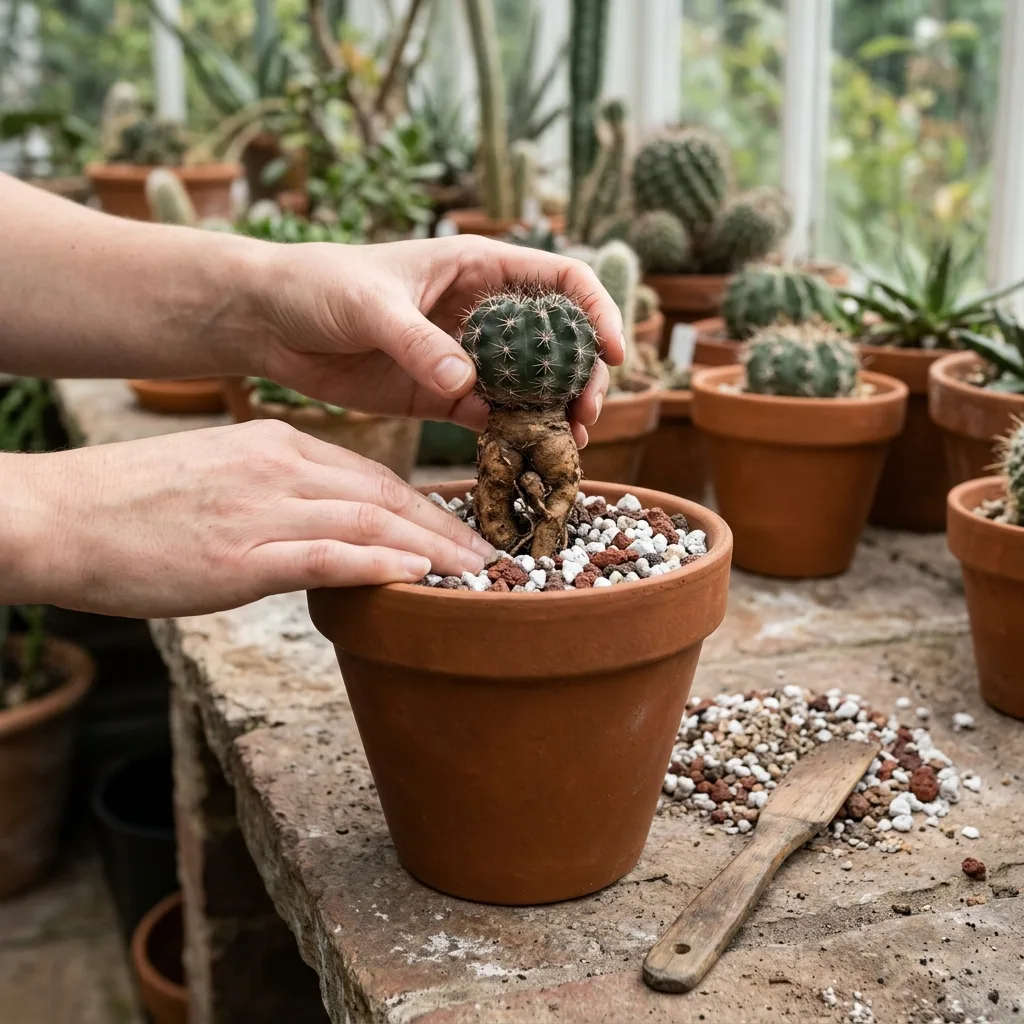
Standard commercial cactus soils—even those labeled as premium blends—contain far too much organic matter for this ultra-succulent xerophyte. Thriving natively amidst fragmented andesite, fractured granite, quartz debris, and mineral dust, Eriosyce odieri unequivocally abhors peat, bark, and acidic humic components. The finished substrate mix must possess an open macroporosity of 75% to 80%, allowing irrigation water to flush completely through the root zone within seconds.
The following mineral-dominant formulation has been perfected under our greenhouse trials to eliminate root rot vectors and replicate authentic Atacama drainage dynamics:
| Substrate Component | Ratio by Volume (%) | Botanical Function & Structural Benefit |
|---|---|---|
| Pumice (2–5 mm grade) | 40% | Provides structural aeration and delivers oxygen directly to root xylem. |
| Crushed Lava Rock (Scoria) | 25% | Supplies essential trace minerals and prevents structural compaction. |
| Zeolite (Clinoptilolite) | 15% | Enhances Cation Exchange Capacity (CEC) and neutralizes toxins. |
| Coarse Silica / Quartz Sand | 10% | Mimics the natural desert lithology and resists silt accumulation. |
| Sterilized Coir or Aged Leaf Mold | 10% | Provides the absolute baseline organic buffer for micro-nutrients. |
When selecting a container, two botanical imperatives apply: First, the vessel must be deep and conical to afford the substantial downward-plunging taproot ample vertical clearance. Second, discard glazed containers and non-breathable plastic pots in favor of unglazed, high-fired terracotta. The natural micro-porosity of unglazed clay facilitates lateral gaseous exchange, drawing excess moisture evenly out of the lower substrate horizon.
5. Step-by-Step Propagation Protocols
Because Eriosyce odieri exhibits a predominantly solitary growth habit, vegetative propagation through lateral offsets or stem cuttings is rarely an option. Cultivating this species from seed represents the most botanically authentic and rewarding pathway. Follow these sterile micro-propagation steps to achieve high germination rates:
- Seedbed Preparation: Prepare an entirely mineral seedbed consisting of sifted fine pumice and coarse quartz sand. Thoroughly sterilize the blend via dry-heat baking or autoclaving to eliminate lurking fungal spores. Fill a shallow, heavily perforated seedling flat.
- Sowing: Distribute the minuscule seeds across the surface. Do not cover them with substrate; Eriosyce seeds exhibit positive photoblastism and require light cues to trigger germination. Simply press them lightly into the grit using a sterile spatula to ensure firm contact.
- Moisture & Humidity Dome: Saturate the substrate from below using distilled or boiled rainwater. Enclose the flat within a transparent, sealed humidity bag or place a clear propagation dome overhead to maintain ambient relative humidity above 90%.
- Thermal & Light Cycling: Position the germination chamber under diffused horticultural lights maintaining a diurnal thermal fluctuation: 22–26°C (72–79°F) daytime and 15–18°C (59–64°F) nighttime. This diurnal temperature shift is the universal ecological trigger breaking seed dormancy for Atacama flora.
- Weaning & Aeration: Once tiny, reddish spherical seedlings emerge (typically within 10 to 21 days), gradually puncture the cover over several weeks to introduce fresh air and reduce relative humidity, preventing damping-off.
6. Pathogen Defense, Pest Management, and Triage
Despite its formidable exterior, this desert survivor is acutely vulnerable to infestations of mealybugs (Pseudococcidae) and, far more insidiously, subterranean root mealybugs (Rhizoecus spp.). Concealing themselves beneath woolly apical tufts or feeding upon root parenchyma, these sap-suckers deplete vascular reserves and create entry vectors for secondary necrosis. At the first sign of infestation, manually eradicate visible clusters using a cotton applicator saturated with 70% isopropyl alcohol, followed by a targeted root drench with a systemic insecticide such as acetamiprid.
Spider mites (Tetranychidae) thrive in the hot, stagnant, arid microclimates favored by growers, feeding upon the tender apical epidermis and leaving behind permanent, rust-colored scar tissue. Combat them by elevating ambient ventilation and deploying sulfur-based miticides. If the lower stem begins to display unnatural softening paired with a yellowish-brown discoloration, root rot has progressed into the vascular cylinder. Your only recourse is immediate surgical excision: unpot the specimen, sever all compromised tissues back to pristine green vascular tissue using a flame-sterilized scalpel, dust the wound with elemental sulfur or cinnamon powder, and allow the callusing process to proceed in dry shade for at least two full weeks before attempting re-rooting in pure pumice.
7. Annual Phenological Care Calendar
Aligning your horticultural care with the biological clock of Eriosyce odieri is the true secret to sustaining vigorous vitality and inducing regular floral displays:
- Spring (March – May): Seasonal awakening. Deliver the first gentle bottom watering in early to mid-spring once daytime temperatures consistently climb. Beginning with the second watering, apply a balanced, low-nitrogen, high-potassium cactus fertilizer formulated at one-quarter strength. Apical flower buds will begin developing within the woolly apex.
- Summer (June – August): Metabolic slowdown. As severe midsummer heat sets in, the plant enters estivation. Space waterings far apart, irrigating exclusively during cooler dusk hours to avoid boiling roots in damp substrate. Maximize lateral cross-ventilation.
- Autumn (September – October): Secondary vegetative push. Provide consistent, moderate hydration as substrate dries completely between cycles. As daylight hours dwindle toward late October, taper waterings down systematically to initiate tissue desiccation in preparation for cold tolerance.
- Winter (November – February): Obligate cold dormancy. Maintain the plant in a bright, dry, unheated environment held steadily between 5°C and 10°C (41–50°F). Cease all irrigation entirely throughout this window. This chilling period is the physiological trigger required to activate floral bud meristem differentiation for the coming spring season.


Reader Reviews & Comments 4 Reviews
Julian Vance
Clara Montgomery
David Sterling
Siobhan Kelly
Leave a Review & Rating
Share your plant care tips, experiences, or questions with our succulent community.