






Perched upon the sheer, wave-battered sea bluffs of coastal California, wrapped in cooling blankets of marine fog, gleams a living silver jewel: Dudleya caespitosa. Known affectionately in horticultural circles as 'Sea Lettuce' or the 'Coastal Dudleya', this exceptional Crassulaceae member represents an evolutionary masterpiece perfected over millennia within the unforgiving microclimates of the Pacific shoreline. Relentless maritime winds, abrasive salt spray, and bone-dry limestone fissures that see not a drop of summer rainfall have shaped a plant whose cellular physiology stands worlds apart from common indoor houseplants.
Cultivating Dudleya caespitosa within our living spaces and specimen collections is far more than potting up everyday ornamental greenery; it is an invitation to welcome the ancient rhythm of coastal fog cycles right onto your windowsill. The primary heartbreak succulent collectors experience with this species stems from treating it like a standard Mexican Echeveria or Graptopetalum—namely, saturating it with water during midsummer heat. In truth, Dudleya's biological heartbeat pulses to an entirely reversed seasonal cadence.
Join us as we explore this coastal marvel's biological inner workings—from the microscopic wax crystals adorning its chalky foliage down to its hydraulic xylem conduits—and uncover the exact horticultural disciplines needed to cultivate a compact, radiant, and resilient colony in your own home.
1. Botanical Profile and Morphological Adaptations
Dudleya caespitosa belongs to the genus Dudleya within the family Crassulaceae. As designated by its specific epithet 'caespitosa' (meaning tufted, clumping, or forming low cushions), it is a polymorphic species that naturally branches and offsets over time to create dense, magnificent colonies. Its leaves vary from narrow and cylindrical to strap-like or semi-flattened, spiraling outward in dense architectural whorls from a stout, semi-woody central caudex.
The plant's most astonishing line of defense is its heavy secretion of epicuticular wax crystals across the leaf cuticles, scientifically termed farina. This delicate, chalk-white coating is not merely an aesthetic triumph; it serves as a microscopic mirror reflecting intense ultraviolet radiation, acts as a protective shield against corrosive maritime salt drift, and dramatically curtails transpirational water loss from leaf stomata under desiccating coastal breezes.
In late spring, slender, arched inflorescences ascend gracefully from the leaf axils, bearing clusters of vibrant, star-shaped yellow blossoms. In their native California coastal scrub, these nectar-rich blooms serve as a vital lifeline for indigenous wild bees and foraging hummingbirds.
2. Illumination Dynamics and Indoor Positioning
While the Pacific maritime bluffs that Dudleya calls home are often veiled in cool afternoon fog banks, the plant receives unobstructed, razor-sharp morning and midday sun at an intense angle. Consequently, Dudleya caespitosa exhibits high photon flux density demands when grown indoors.
Aim to provide at least 6 hours of unfiltered direct sunlight, or slightly diffused light behind sheer drapery in ultra-hot microclimates. Deficient lighting inevitably triggers etiolation—the stress-induced elongation of stems toward light sources. During etiolation, the tight, compact geometry of the rosette collapses, internodes stretch unsightly distances apart, and the breathtaking silver wax coating thins out into a lackluster dull green.
For indoor growers, an unobstructed south- or southwest-facing exposure is paramount. However, keep in mind a vital physiological nuance: Dudleya craves radiant light, not suffocating heat. Stagnant, poorly ventilated window sills where glass temperatures climb above 90°F (32°C) trigger severe heat stress and premature shutdown. Consistent room ventilation and gentle ambient airflow around the foliage are indispensable.

3. Irrigation Discipline: The 'Soak and Dry' Protocol
The single most consequential turning point in Dudleya stewardship is embracing their inverted Mediterranean growth cycle (winter-active phenology). Dudleya caespitosa metabolizes and grows vigorously throughout the cool, wet months of late autumn, winter, and early spring. Conversely, when scorching summer heat arrives, it retreats into an estivation-like dormancy (summer sleep) to guard its cellular water reserves.
Your watering calendar must strictly reflect these seasonal boundaries:
- Autumn and Winter (Active Growth Phase): Execute the 'soak and dry' method with precision. Once the substrate has dried out entirely down to the bottom drainage hole, drench the container thoroughly until water runs freely from the drainage apertures. The root hairs absorb moisture eagerly during this phase, restoring high cellular turgor pressure in the fleshy leaves.
- Summer (Dormancy Phase): As ambient temperatures climb persistently past 82–86°F (28–30°C), Dudleya throttles back its metabolic activity. Drenching the soil during this high-heat dormancy creates an oxygen-starved breeding ground for anaerobic pathogenic fungi, rapidly melting roots. In summer, restrict watering to a meager sip every 3 to 4 weeks around the pot rim—just enough to keep the finest capillary root hairs from desiccating completely.
4. Substrate Engineering and Planter Dynamics
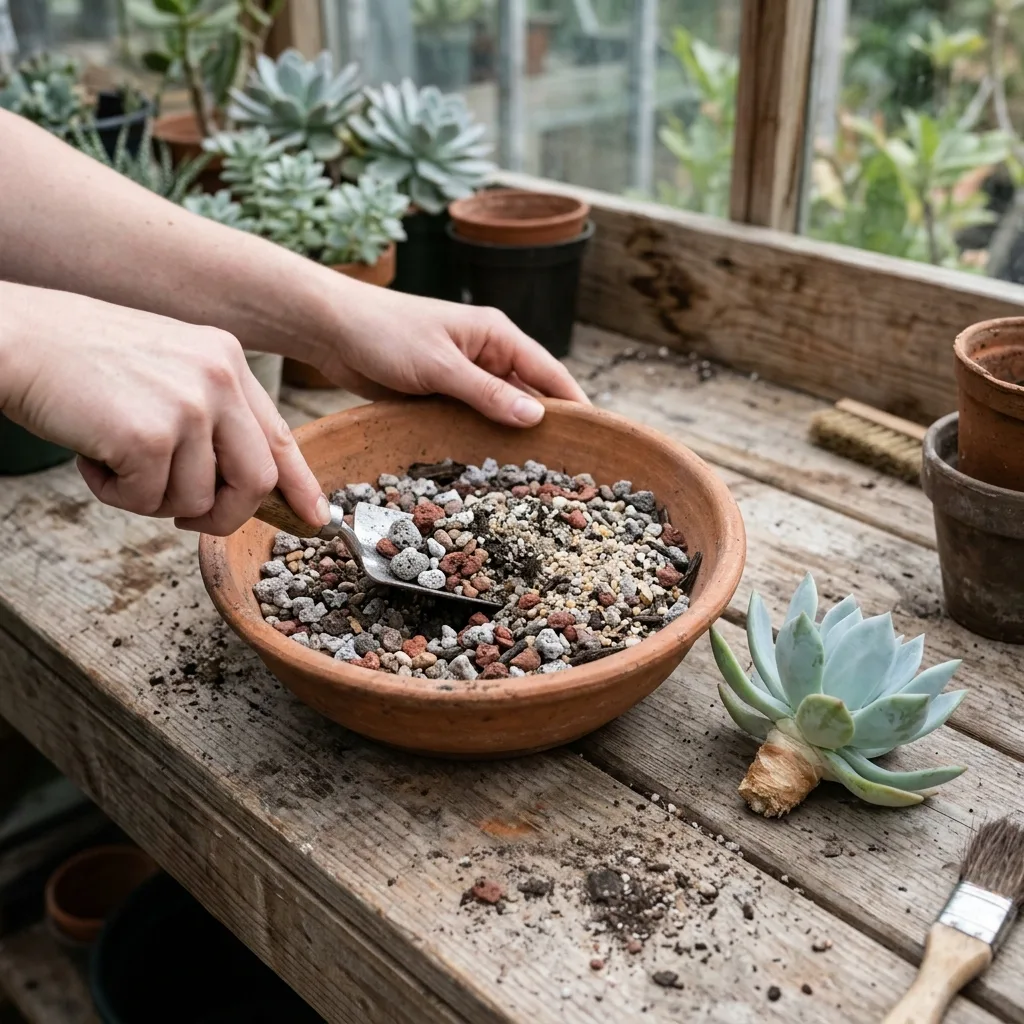
Rooting naturally in vertical limestone crevices, granitic outcroppings, and decomposed coastal dunes, Dudleya caespitosa demands an ultra-porous, lean potting medium virtually devoid of heavy moisture-retaining organic matter. Its capillary roots and xylem vessels require an immediate, refreshing surge of oxygen right after each saturating drench.
When selecting a planter, opt exclusively for unglazed terracotta with ample drainage holes. The porous clay walls breathe, wicking surplus moisture out through the sides and keeping delicate root zones naturally cool via evaporative cooling. Broad, shallow containers ('bulb pans') suit this offsetting, mat-forming succulent far better than deep, narrow pots, which trap stagnant moisture pockets at the bottom.
| Substrate Component | Ratio (%) | Botanical Function |
|---|---|---|
| Pumice (1/8" to 1/4" grade) | 40% | Provides sustained macroporosity and structural aeration for root respiration. |
| Crushed Lava Rock / Red Zeolite | 25% | Keeps the root zone cool, offers slow trace mineral exchange, and resists compaction. |
| Coarse Horticultural River Sand / Quartz Grit | 15% | Maximizes rapid gravitational drainage, replicating windswept coastal cliffs. |
| Coarse Peat or Aged Coconut Coir | 20% | Supplies trace humic acids and a stable, non-hydrophobic moisture-buffering base. |
5. Step-by-Step Propagation Protocol
When propagating Dudleya caespitosa, taking stem cuttings (rosette beheadings) or dividing mature side offsets yields extraordinarily high success rates compared to seed sowing. Individual leaf propagation is notoriously unsuccessful with Dudleyas because leaves clasp the woody caudex so tightly that the basal meristematic tissue is almost invariably damaged during detachment.
- Select the Optimal Window: Carry out propagation strictly in mid-to-late autumn (October through November) when the specimen emerges refreshed into its cool-season growth cycle. Severing offsets from a summer-dormant Dudleya invites severe desiccation and failure.
- Identify Vigorous Offsets: Locate a well-developed lateral rosette measuring at least 1.5 to 2 inches (4–5 cm) across that has begun forming its own basal neck.
- Aseptic Excision: Using a surgical scalpel or razor blade sterilized with 70% isopropyl alcohol, sever the offset's narrow woody connection to the mother plant with a clean, deliberate cut.
- Callus Formation (Wound Curing): Never pot up fresh, unhealed cuttings! Place the cutting in a dry, shaded, well-ventilated room for 4 to 7 days. This allows the wounded vascular tissue to form a dry, protective suberized callus, creating an impenetrable barrier against fungal spores.
- Rooting in Dry Mineral Substrate: Gently nestle the callused cutting upright into completely dry mineral gritty mix. Withhold moisture entirely for the first 10 to 14 days; the slight internal dehydration will stimulate endogenous root primordia to venture outward in search of water. After two weeks, begin light bottom-watering to nurture the emerging roots.
6. Common Pathogens, Pests, and Remediation
Though an exceptionally rugged coastal survivor, Dudleya caespitosa will quickly exhibit symptoms of distress when basic horticultural boundaries are breached:
- Mealybugs (Pseudococcidae): These pervasive pests adore secreting themselves deep within the protected leaf bases and rosette crevices. At the first sign of white, cottony webbing, spot-treat the invaders directly using a precision cotton swab saturated with 70% isopropyl alcohol. For severe infestations within dense clumps, apply a systemic insecticidal drench during active winter growth.
- Crown and Root Rot (Phytophthora & Fusarium): Triggered by overwatering, stagnant soil, or moisture standing in the crown. The lower foliage turns translucent, jelly-like, and blackened. Promptly unpot the specimen, excise all infected tissue with sterile tools back to healthy white vascular tissue, dust the wounds with powdered sulfur or ground cinnamon, allow the bare-root plant to desiccate in open air for 5 days, and replant in bone-dry mineral substrate.
- Snails and Slugs: When Dudleya collections are maintained outdoors on verandas or rockeries, their turgid, nutrient-dense leaves represent prime forage for terrestrial gastropods. Conduct nocturnal inspections or install mechanical copper barrier tape around your staging benches.
7. The Seasonal Care Calendar and Master Horticultural Notes
Aligning your cultural practices with Dudleya caespitosa's inherent chronobiology ensures year-round health and stunning silver coloration:
- Autumn (September – November): The awakening. As night temperatures cool down, progressively ramp up irrigation frequency. Undertake any necessary repotting or division. Once fresh emerald-silver growth erupts from the rosette apex, apply a low-nitrogen, balanced succulent fertilizer diluted to 1/4 strength.
- Winter (December – February): Peak vegetative vigor. Position the container in your brightest, most sun-drenched southern exposure. Protect from heavy freezing (maintain minimum temperatures above 40°F / 5°C). Water deeply whenever the gritty mix dries out completely.
- Spring (March – May): Blooming phase. Elegant flower scapes emerge and blossom. Maintain consistent hydration. Once blooms fade, excise the drying flower stalks cleanly at their base to redirect energetic resources away from seed production.
- Summer (June – August): Deep estivation and rest. Halt regular watering almost entirely. Protect the specimen from scorching, magnified midday glasshouse sun by relocating it to a bright, cool, well-ventilated location in open shade. Expect outer leaves to shrivel and wrap tightly around the core—this is natural cellular conservation, so resist the urge to 'rescue' it with extra water!


Reader Reviews & Comments 4 Reviews
Marcus Thorne
Eleanor Vance
Clara Higgins
Julian Sterling
Leave a Review & Rating
Share your plant care tips, experiences, or questions with our succulent community.