






When you hold a fallen succulent leaf in your palm, you are essentially holding a self-contained biological hydration reservoir and an entire genomic library. From the vertical cliffs of Mexico to the arid, rocky expanses of the Karoo Desert, succulents have evolved to regenerate entire colonies from a solitary fragment of tissue sheared away by gale-force winds or foraging wildlife. Whenever enthusiastic plant lovers step into our greenhouse or join our propagation masterclasses, their very first and most eager question is invariably: 'Is propagating succulents truly difficult, and how do we guarantee success?'
To give you a frank and reassuring answer: No, propagating succulents is definitely not difficult; however, it demands reverence for a strict biological discipline that never forgives impatient meddling or smothering over-care. Those accustomed to rooting conventional tropical houseplants in water glasses frequently apply the identical reflex to succulents, only to harvest gelatinous, rotten tissue and profound disappointment. In succulent propagation, the golden rule is 'deliberate, informed neglect.' These drought-hardened masters of CAM (Crassulacean Acid Metabolism) require their cellular trauma to completely callous over before a single droplet of moisture touches their tissue.
In this scientific guide, we will examine the cellular anatomy of reproducing beloved genera such as Graptopetalum, Echeveria, Crassula, and Sedum step by step. We will demystify how to nurse plump rosettes from standalone leaves, rejuvenate leggy stems via decapitation cuttings, and cleanly divide basal offsets without shocking the mother plant.
1. Botanical Identity and Morphological Mechanisms
The miraculous regenerative prowess of succulents rests upon the totipotent character of their meristematic tissues—undifferentiated cells capable of dividing and developing into any specialized vegetative organ. When you cleanly harvest an Echeveria or Sedum leaf from the central axis, the basal meristematic cells situated at the petiole junction detect environmental shifts. In response, they initiate organogenesis, differentiating first into root primordia (adventitious roots) and subsequently into a fresh shoot apical meristem (a miniature pup rosette). The specialized storage parenchyma cells inside the mother leaf supply 100% of the metabolic water, starches, and minerals necessary to sustain the developing pup until it establishes autonomous subterranean root systems. For this reason, the mother leaf remains the infant's absolute life-support system until it naturally shrivels and detaches.
2. Photoperiod Requirements and Indoor Microclimates
A regenerating leaf cutting or freshly decapitated stem does not possess the physical resilience or photon tolerance of an established adult specimen. While an established, sun-hardened Echeveria secretes a thick coating of farina (epicuticular wax crystals) to refract scorching ultraviolet rays, a recently detached leaf exposed to raw, direct midday sun will suffer severe cellular rupture: internal water reservoirs boil, destroying phospholipid membranes and turning the tissue into a translucent, boiled slush within a few hours.
The optimal microclimate for succulent propagation is a warm (20–24°C / 68–75°F) perimeter offering bright, indirect, filtered sun and steady air exchange. An east-facing windowsill that filters gentle morning rays through sheer drapery or a northeastern exposure provides the precise spectral quality necessary to activate phytohormones and initiate auxin transport without subjecting vulnerable tissues to thermal stress.

3. Irrigation Protocol: The Science of the 'Soak and Dry' Method
The central pillar of arid horticulture remains immutable during propagation: frequent light sprinkles do not communicate affection; they deprive vulnerable roots of oxygen and cultivate anaerobic blight. Irrigation during the propagation pipeline must be calibrated across three sequential physiological stages:
- Callusing Stage: For the initial 3 to 5 days following severance, absolutely NO WATER must come into contact with the cuttings. The severed wound requires direct exposure to ambient dry air to synthesize a protective, suberized cork layer (callus) that seals the vascular bundles against opportunistic pathogens.
- Rooting Stage: As soon as delicate ruby or pink adventitious root filaments appear, place the leaf flat on completely dry mineral substrate. From this point onward, lightly moisten only the root vicinity once weekly, stimulating the roots to plunge downward in search of moisture.
- Rosette Development Stage: Once the infant rosette reaches approximately 1–2 cm in diameter and the mother leaf has completely desorbed its moisture reserves and dried into a crisp husk, transition fully to the classic 'soak and dry' cycle. Saturate the root ball thoroughly until water drains freely from the pot's bottom orifices, then permit the substrate to desiccate entirely before providing subsequent hydration.
4. Substrate Physics and Propagation Tray Selection
Substrate mechanics and structural porosity are significantly more crucial for fragile infant root systems than for mature plants. Newly formed root tips are exceptionally sensitive to compaction and prolonged saturation. To facilitate rapid, uninhibited root expansion, prioritize an inorganic, highly porous growing medium. Propagation trays should be shallow (ideally 4–6 cm deep, unglazed terracotta or ceramic flats) with ample drainage perforations across the base to eliminate stagnant water pockets.
| Component | Proportion (%) | Agronomic & Botanical Function |
|---|---|---|
| Coarse Horticultural Pumice (2–4 mm) | 40% | Promotes macroscopic pore space, high gas exchange, and root rot deterrence |
| Crushed Volcanic Lava (Scoria) | 20% | Provides structural root anchoring, continuous mineral leaching, and porosity |
| Sterile Low-Nutrient Peat or Coco Coir | 25% | Retains minimal structural moisture and soft organic substrate for nascent root hairs |
| Clinoptilolite Zeolite | 10% | High cation-exchange capacity (CEC); balances water retention and prevents fertilizer salt burn |
| Coarse River Sand / Quartz Grit | 5% | Improves substrate density, surface run-off, and prevents mechanical compaction |
5. Step-by-Step Propagation Methodologies
A. Leaf Propagation
Leaf pulling yields remarkable success rates for species within the Crassulaceae family, particularly Echeveria, Graptopetalum, Sedum, and Pachyphytum. Select plump, fully turgid, pristine leaves from the lower-to-middle whorls of the rosette. Rather than pulling downward—which tears the petiole—gently pinch the leaf base and wiggle it horizontally side to side until you hear a crisp 'click' as it separates cleanly from the stem. Retaining the intact crescent-shaped basal meristem is paramount; if the petiole snaps and leaf tissue remains adhered to the stem, that leaf is botanically incapable of generating new apical tissue.
Arrange your harvested leaves flat across a clean paper towel or dry ceramic plate in a warm, shaded, well-ventilated room for approximately three days. Once the callus forms, place them horizontally on top of dry propagation medium. Do not bury the leaf; the nascent roots will instinctively orient downward toward the mineral moisture gradient via geotropism and hydrotropism.
B. Decapitation and Stem Cuttings (Beheading)
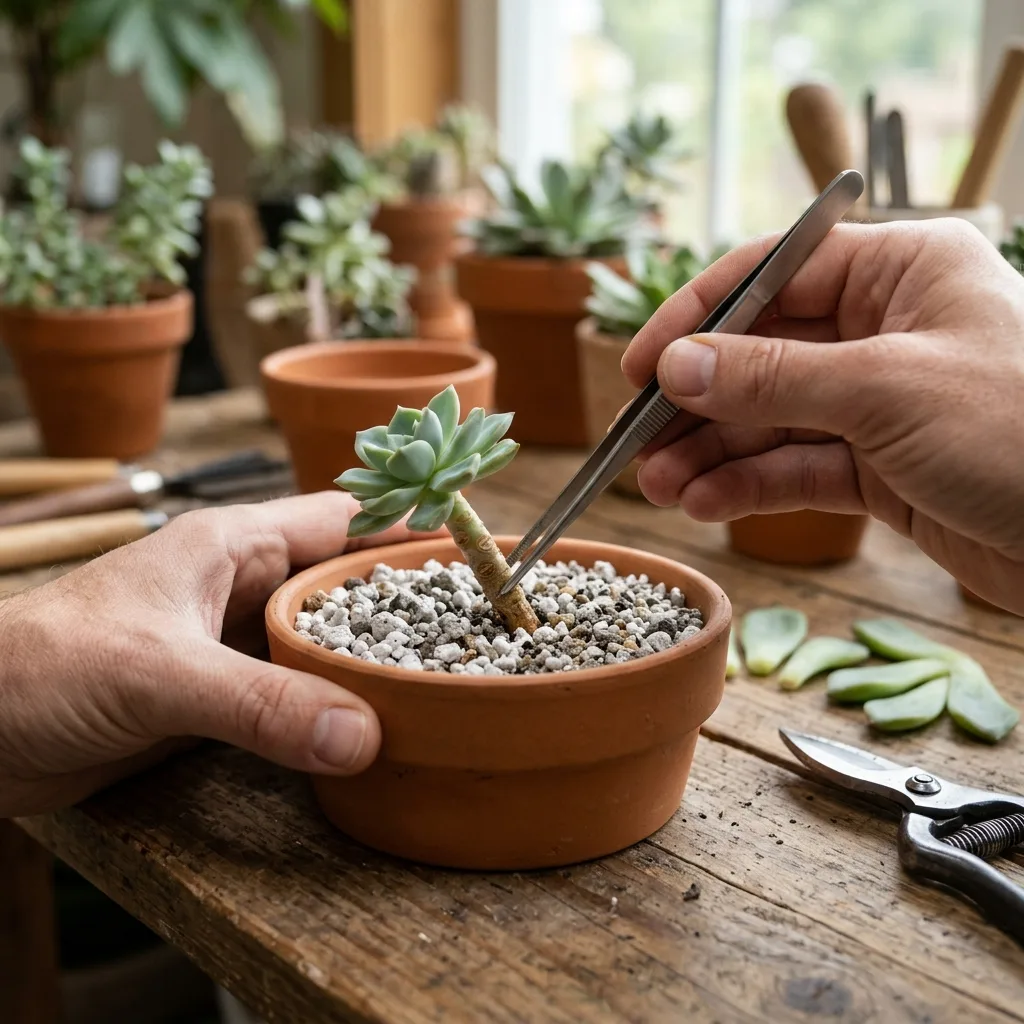
Decapitation is the most decisive, restorative technique for rejuvenating etiolated succulents that have stretched abnormally due to insufficient light. Using an alcohol-sterilized scalpel, razor, or micro-serrated blade, sever the elongated stem roughly 2–3 cm beneath the compact, symmetrical upper rosette. Gently strip away 2 to 3 rows of lower leaves from the severed head to expose a clean length of bare stem.
Allow the severed rosette to dry in bright, filtered shade for 4 to 7 days until the cut stem seals into a hard, leather-like callus. Insert the callused stem upright into completely bone-dry mineral potting mix. Defer the first watering for at least 7 to 10 days post-planting. Do not discard the rooted stump! Kept in bright light and watered judiciously, the remaining base will erupt with dozens of fresh lateral offsets along its dormant nodal meristems within a few short weeks.
C. Offset Division (Pups)
Genera such as Haworthia, Sempervivum, Aloe, and clustering Echeveria prolifically produce miniature carbon copies of themselves (pups) along their subterranean stolons or base. Allow these offsets to attain at least one-third the size of the mother specimen before removal. Gently unpot or clear the surface soil around the junction, severing the connecting stolon with a sterile blade as near to the parent stem as feasible. If the pup has already established its own independent root network, it can be potted into dry substrate immediately; if severed rootless, allow it to dry for 3 days before planting.
6. Common Pathogens, Insect Vectors, and Curative Protocols
The hyper-hydrated, tender cell walls of developing succulent pups present an alluring target for opportunistic pathogens and sap-sucking pests. The two most formidable propagation adversaries are fungal soft-rot agents (specifically Fusarium and Pythium) and subterranean root mealybugs (Rhizoecus species).
If a propagation leaf shifts toward a translucent, watery yellow or gelatinous brown consistency, it indicates an irreversible systemic fungal attack. Immediately extract and discard the compromised tissue with sterile tweezers to prevent spore migration to neighboring cuttings. For cottony white mealybug clusters, apply spot treatments using a cotton swab dipped in 70% isopropyl alcohol, or treat early infestations with a mild, cold-pressed emulsified neem oil spray applied exclusively at dusk to avoid phytotoxic leaf scorch.
7. Seasonal Propagation Calendar and Master Horticulturist Notes
- Spring (Active Growth Surge): The undisputed zenith for succulent propagation. Lengthening photoperiods and temperate ambient warmth maximize endogenously synthesized auxins. Both leaf and apical cuttings root with unmatched speed and vigor.
- Summer (Aestivation & Thermal Stress): When ambient greenhouse temperatures consistently breach 35°C (95°F), many arid species enter protective semi-dormancy (aestivation). Avoid major decapitations during heat waves, and shield young rooting flats from scorching midday ambient radiation.
- Autumn (The Second Golden Window): As temperatures moderate back into the 20–25°C (68–77°F) sweet spot during September and October, succulents initiate a secondary vegetative growth flush. Root development is exceptionally dependable before winter sets in.
- Winter (Dormancy & Radiational Cooling): Unless you cultivate under full-spectrum horticultural LED grow lights paired with regulated seedling heat mats, avoid propagating succulents in winter. Sluggish metabolisms combined with persistent substrate dampness and reduced light lead almost universally to fungal mortality.


Reader Reviews & Comments 4 Reviews
Marcus Sterling
Chloe Bennett
Eleanor Vance
Julian Thorne
Leave a Review & Rating
Share your plant care tips, experiences, or questions with our succulent community.