






Do you remember that tiny, tulle-wrapped pot placed gently into your palm as an elegant keepsake of enduring love? Succulents gifted as wedding favors are often the unsung heroes of a captivating journey—traveling from the rugged, craggy cliffs of Mexico or the semi-arid plateaus of South Africa into specialized propagation nurseries, and finally onto festive banquet tables. Yet for many guests, these living tokens turn into a melancholic memory within mere weeks, rotting away from excess moisture or stretching helplessly in dim living rooms.
Beneath that thumbnail-sized rosette lies an exquisite Crassulacean Acid Metabolism (CAM) biology designed to brave scorching desert winds, underpinned by extraordinary cellular resilience. Dousing a succulent with daily splashes of water is not an act of love; it deprives the root zone of oxygen and unintentionally drowns the specimen. Given an immediate horticultural rescue, a high-porosity mineral substrate, and adequate photons, that humble keepsake can transform into the crowning botanical jewel of your home collection.
In this master guide, we identify the exact botanical profiles of the most common 'wedding favor' succulents and outline an immediate, step-by-step action plan the moment you bring your green favor home.
1. Botanical Identity and Morphological Adaptations
Commercial growers do not select event favors at random; they pick taxa that root vigorously, display miniature rose-like rosettes, and sustain compact structural integrity under stress. The most frequent varieties include:
- Echeveria elegans and Echeveria 'Lola': Native to Mexico, these aristocrats form symmetrical rosettes cloaked in a protective, glaucous epicuticular powder.
- Sedum rubrotinctum and Sedum pachyphyllum: Affectionately termed 'jelly beans,' these cheerful dwarfs store high-viscosity sap within plump, cylindrical leaves.
- Graptopetalum paraguayense: Revered for their opalescent, pearlescent leaves, these 'ghost plants' are legendary survival masters across harsh climatic swings.
- Haworthiopsis attenuata (Zebra Plant): Indigenous to South Africa's Eastern Cape, these structural beauties boast raised white tubercles and superior low-light tolerance.
- Sempervivum tectorum: Cold-hardy alpine survivors featuring intricate geometric architecture and prolifically offsetting stolons.
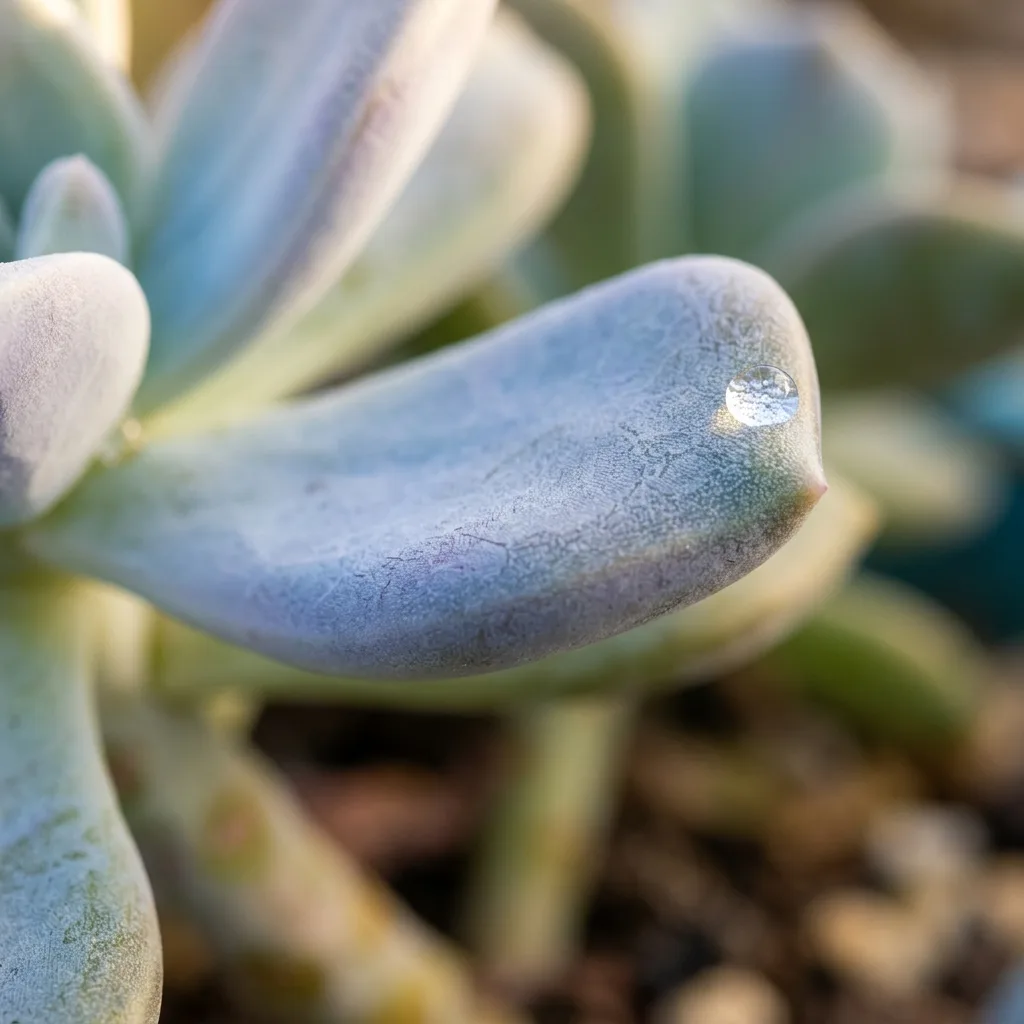
The thick parenchyma tissue of these leaves allows the plant to sequester moisture in the form of mucilage inside enlarged cellular vacuoles. Notice that powdery, chalky film dusting the epidermis? That is farina (epicuticular wax)—the plant's bespoke, natural sunscreen. Never wipe it off or leave fingerprint smudges; these microscopic wax crystals shield the sensitive epidermal cells from solar radiation and prevent fungal spore germination.
2. Photon Equilibrium: Lighting and Indoor Acclimation
The single most pervasive hazard awaiting favor succulents in domestic quarters is etiolation—the unsightly, attenuated stem elongation triggered by insufficient photoperiods. In their native habitats, Echeveria and Sedum taxa absorb between 5 to 6 hours of bright, unfiltered or gently dappled solar radiation. When relegated to a dim coffee table, the plant shifts into survival mode, depleting carbohydrate reserves to stretch its internodes toward the nearest light source, forfeiting its tight rosette form.
However, throwing a sheltered, greenhouse-pampered succulent onto a sun-baked balcony ledge will instantaneously scorch the cuticle, causing irreversible necrotic patches. The gold standard is a gradual acclimation protocol: position the specimen on an east-facing windowsill where it can bask in soft morning rays, or set it just behind a sheer curtain on a south- or west-facing sill. Gradually intensify ambient light exposure over 7 to 10 days until the plant adapts comfortably to full solar radiance.
3. Irrigation Protocol: The Scientific 'Soak and Dry' Method
Close to 90% of favor succulent mortality stems from a lethal cocktail of overwatering and undrained containers. When delicate root xylem structures are sealed in perpetually damp substrate, anaerobic, opportunistic soil-borne pathogens—chiefly Pythium and Phytophthora—decimate the root system within days.
The undisputed golden rule is the 'Soak and Dry' protocol. It is never enough for just the crust of the soil to dry out; the growing medium must be fully devoid of moisture from top to bottom before receiving another drop. To confirm this, insert a clean wooden skewer deep into the root ball. If it emerges with dark soil clinging to it or feels cool to the touch, postpone watering. When it slides out completely dry and clean, provide a comprehensive drenching until water flushes freely through the drainage apertures.
4. Substrate Engineering and Container Selection
Wedding favors are customarily distributed in 2-inch (4–5 cm) disposable plastic nursery cells, or worse, sealed decorative tins and ceramic cups completely devoid of drainage holes. Wholesale propagators rely on uniform, peat-heavy plug mixtures to minimize production costs. Pure peat presents an extreme paradox: it holds swamp-like moisture when damp, yet turns hydrophobic like hardened brick when dry.
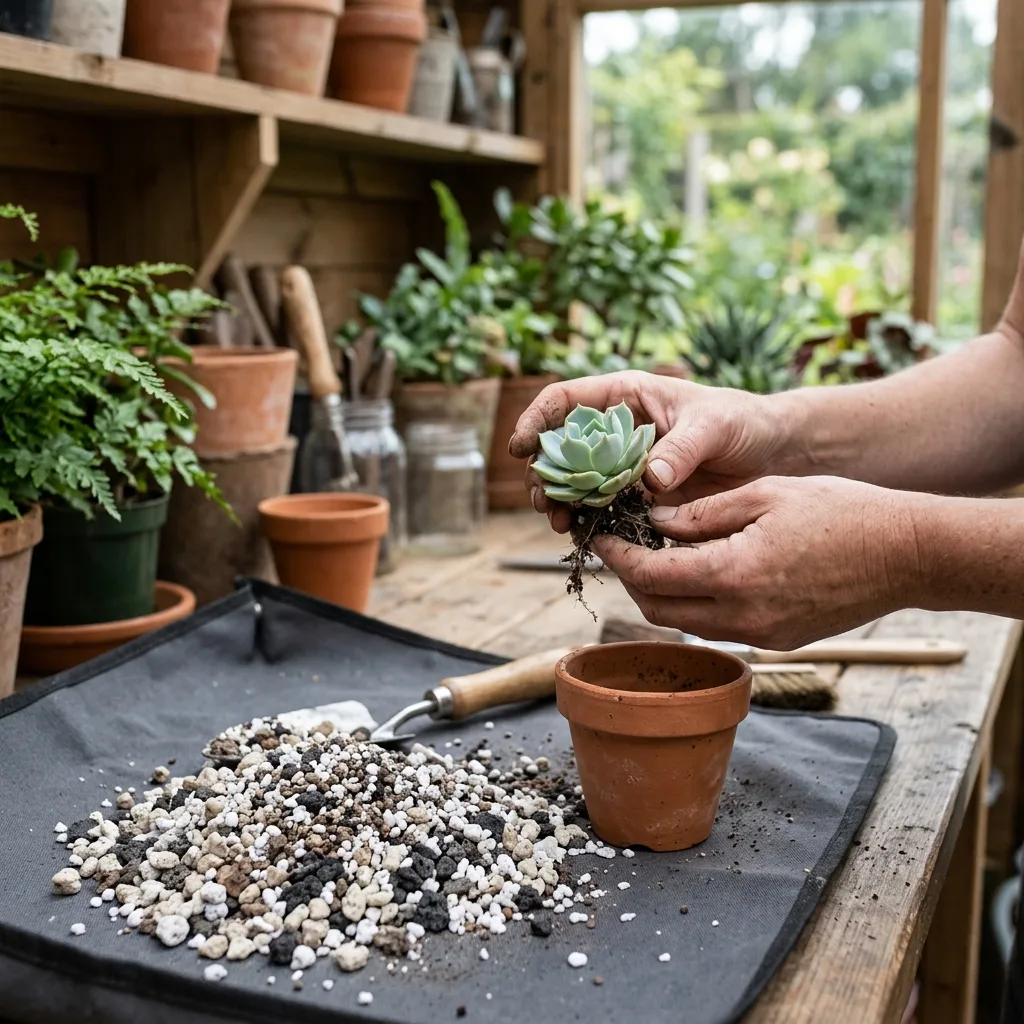
To guarantee longevity, liberate the specimen into an unglazed, porous terracotta pot equipped with a generous drainage hole, bedded in an inorganic, gritty aggregate:
| Component | Proportion (%) | Botanical Function |
|---|---|---|
| Pumice (3–5 mm grain) | 40% | Optimal aeration, rapid capillary drainage, and prevents compaction |
| Crushed Lava Rock / Zeolite | 20% | Microporous framework, cation-exchange capacity, root stability |
| Washed Coarse Perlite or Diatomite | 15% | Ultralight drainage facilitator, stimulates fine feeder roots |
| Aged Succulent Peat / Worm Castings | 25% | Balanced, pathogen-free organic base for slow nutrient uptake |
Avoid the temptation of overpotting. Choose a container only 1 inch (2–3 cm) wider than the root perimeter. An excessively large pot acts as an unwanted water reservoir, retaining moisture long past the plant's metabolic consumption limits.
5. Step-by-Step Propagation Techniques
From that single wedding favor, you can multiply your plants exponentially, commemorating the original celebration across dozens of descendant pots. Two reliable horticultural methods stand out:
- Single Leaf Cuttings: Locate a plump, pristine lower leaf. Gently twist it side to side with uniform pressure until it snaps cleanly away from the stem axis with an audible pop. The basal meristem must remain intact; ragged tears will not generate roots. Place the harvested leaf in a dry, shaded station for 2 to 3 days to permit suberization (callus formation). Rest the callused leaf horizontally atop a tray of moist, gritty pumice. Within several weeks, delicate pink adventitious roots and a miniature rosette will emerge.
- Apical Decapitation (Rescuing Leggy Specimens): If your succulent has stretched into an awkward stalk, sanitize a surgical scalpel and slice cleanly through the stem roughly 2 cm below the apical rosette. Strip off any basal leaves to expose a short trunk segment. Let the cut callous in a warm, dry spot for 4 days before setting it upright into bone-dry succulent substrate. Withhold moisture for 14 days while initial root primordia develop. Meanwhile, the decapitated mother stem left in the pot will erupt with multiple lateral pups along its dormant nodes.
6. Common Pathogens, Pests, and Diagnostic Interventions
The most persistent pest plaguing favor succulents is the insidious mealybug (Pseudococcidae). These critters disguise themselves as cottony, white tufts sheltered in the tight crevices between leaf joints, piercing the cuticle to drain phloem sap and crippling new growth. Treat small colonies immediately using a cotton swab dipped in 70% isopropyl alcohol, or emulsify cold-pressed neem oil with horticultural soap for a comprehensive systemic spray.
If lower leaves turn translucent, squishy, and drop at the slightest nudge, your plant is undergoing systemic root and vascular rot. Uproot the plant without delay. Pare away all blackened, necrotic, or mushy root filaments using sterilized shears. Dust the remaining clean stem with sulfur powder or ground organic cinnamon (a proven natural antifungal), let it dry thoroughly, and initiate re-rooting in fresh mineral pumice.
7. Seasonal Stewardship Calendar and Expert Care Tips
Aligning your cultural practices with the biological calendar ensures your wedding favor flourishes into an heirloom plant:
- Spring (Active Awakening): The vegetative growth cycle resumes. This is the prime window for root pruning, substrate renewal, and pot upgrades. Apply a low-nitrogen, balanced liquid succulent fertilizer at quarter-strength once monthly.
- Summer (Metabolic Balance): With high solar elevation, certain genera (like summer-dormant Aeoniums or heat-stressed Echeverias) pause vigorous growth. During heatwaves, water strictly during cooler evening hours and provide dappled shade to prevent heat scorch.
- Autumn (Pigment Induction): Wide thermal shifts between warm afternoons and crisp nights stimulate anthocyanin and carotenoid production, dressing leaf margins in vibrant hues of magenta, crimson, and plum.
- Winter (Dormancy): Plants dramatically slow their CAM processes. Reduce irrigation frequency to once every 3 to 5 weeks. Ensure leaves do not touch freezing window glass, maintaining an ambient thermal baseline above 45–50°F (7–10°C).


Reader Reviews & Comments 4 Reviews
Eleanor Vance
Marcus Sterling
Chloe Bennett
Julian Miller
Leave a Review & Rating
Share your plant care tips, experiences, or questions with our succulent community.