





Imagine tiny, chalk-white buttons nestled deeply into the fractured fissures of sun-scorched limestone cliffs in the Chihuahuan Desert. Epithelantha micromeris, affectionately known as the Button Cactus, represents one of evolutionary nature's most flawless architectural responses to extreme aridity and blistering ultraviolet radiation. Frequently searched by succulent enthusiasts under terms like 'epithelantha micromeris button cactus succulent care', this remarkable species resembles an inanimate mineral specimen at first glance, owing to its compact body and dense, felted mesh of chalk-white spines. Yet, beneath this miniature facade lies millions of years of cellular survival genius.
When you introduce this plant—which guards every drop of internal moisture behind a reflective crystalline shield—into your living space or balcony, you cannot simply offer it an ordinary potting mix; you must construct a balanced simulation of its ancient desert provenance. Drenching cacti and succulents out of misguided affection is not love; it deprives their root systems of vital oxygen and suffocates them from below. Let us unravel the cellular secrets of this exquisite button cactus and help it flourish as the crown jewel of your curated collection.
1. Taxonomic Identity, Areole Architecture, and Spine Morphology
Belonging to the tribe Cacteae within the family Cactaceae, Epithelantha micromeris exhibits monomorphic, exceptionally slow-growing globular growth. The generic name Epithelantha derives from the Greek roots signifying 'flowering atop the tubercle,' while the specific epithet micromeris translates to 'composed of tiny parts.' In its native habitat, individual stems rarely exceed 5 to 7 centimeters in diameter, gradually clustering from the base over decades to establish tight miniature colonies.
The plant's most captivating feature is its intricate areole morphology. The cylindrical-to-globular stem is enveloped by hundreds of minuscule, spirally arranged tubercles (nipple-like projections). Each areole generates between 20 and 40 remarkably slender, chalk-white radial spines. These spines interlock in overlapping layers so impeccably that they obscure the underlying green, chlorophyll-rich epidermis entirely. This structural density serves critical physiological functions: the spine mantle acts as a microclimatic shade screen, breaks desiccating wind currents, and forms micro-channels that funnel morning dew condensation straight to the root crown.
2. Light Exposure, Solar Intensity, and Ventilation Standards
In the Chihuahuan Desert, the Button Cactus thrives under full, unfiltered sunshine on exposed limestone ledges. Consequently, the single most widespread error in indoor cultivation is placing this species on dim desks or poorly lit display shelves. Deprived of adequate light intensity, an Epithelantha rapidly falls victim to etiolation—stretching out unnaturally toward light sources, forfeiting its flat-topped globular architecture, and transforming into a weak, conical tower. Once a cactus etiolates, that structural deformity is permanent; it can never revert to its original squat form.
Position your specimen on an unobstructed south- or southwest-facing windowsill where it receives at least 6 hours of direct sunlight daily. If you are concerned about intense summertime glass magnification, do not pull the plant into the shade; simply increase fresh air circulation. Stagnant air is lethal to cactus cellular metabolism. A gentle, continuous breeze keeps surface temperatures safe and prevents red spider mites and fungal spores from establishing holdfasts within the spine matrix.

3. Hydration Cycles and the Vital Winter Dormancy Regime
Epithelantha micromeris operates via Crassulacean Acid Metabolism (CAM). To minimize transpirational water loss in searing heat, it keeps its stomatal pores sealed during daytime hours, performing the light reactions of photosynthesis internally. Only under the cover of night does it open its stomata to absorb and store carbon dioxide as malic acid. This highly conserved physiological dynamic underscores how precious moisture is to its inner parenchyma cells.
Throughout its active vegetative phase from mid-spring to early autumn, employ a strict 'soak and dry' watering strategy. Never add water until the entire substrate column has dried completely from top to drainage hole. When watering, apply moisture strictly around the base; prevent water from pooling in the dense woolly apex (the cephaloid flowering center), as trapped moisture deep in crown areoles quickly triggers crown rot.
4. High-Mineral Substrate Formulation and Potting Requirements
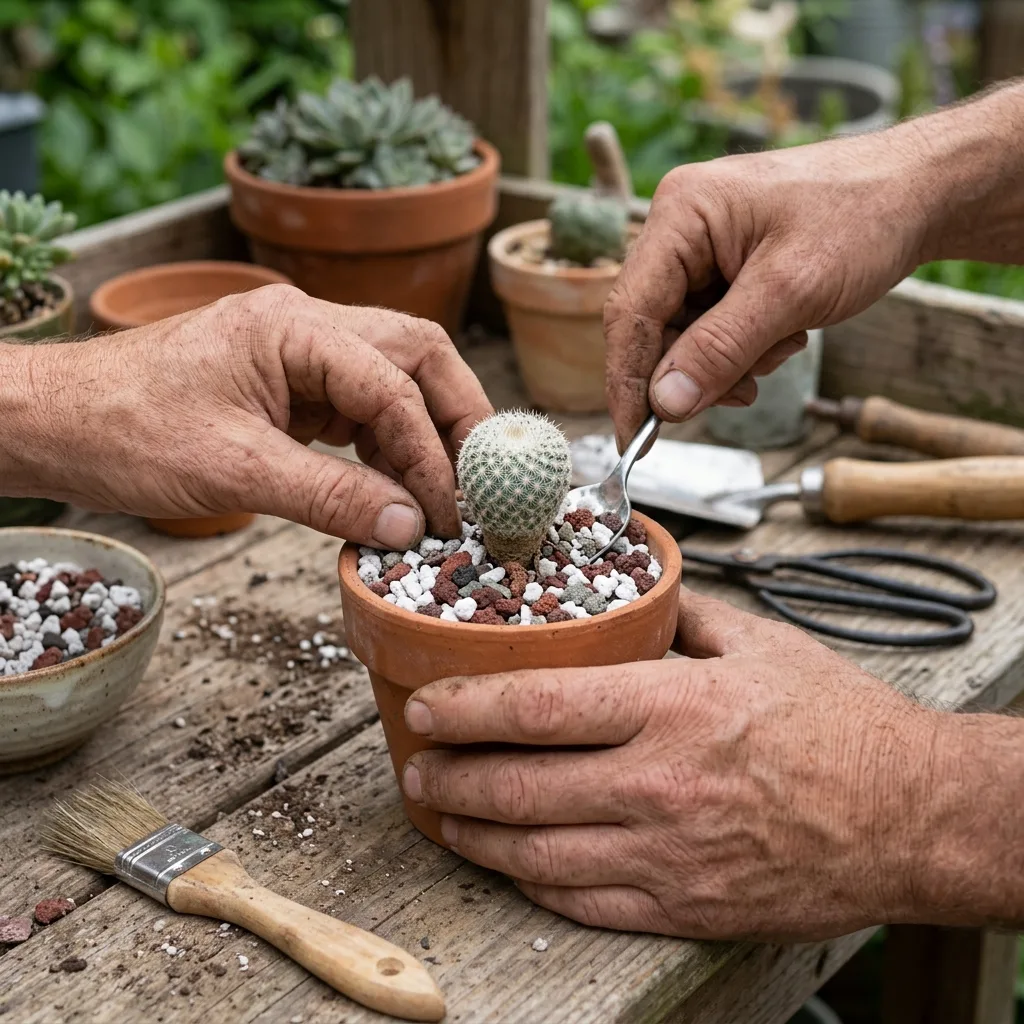
The root system of the Button Cactus consists of a slender taproot anchored to a delicate network of fibrous feeder roots. These subterranean tissues will suffocate within days if potted in peat-rich, moisture-retentive commercial potting soils, quickly falling victim to pathogenic water molds. What this species demands is an open, gritty, highly inorganic substrate that drains instantly while funneling atmospheric oxygen down around the root cortex.
Unglazed terracotta containers are the undisputed gold standard. Terracotta's micro-porous walls allow residual water to evaporate laterally, preventing cold, saturated soil pockets. Ensure the container has ample drainage holes, and select a pot only slightly wider than the diameter of the cactus; oversized pots retain excessive moisture reserves that the miniature root ball cannot process.
| Substrate Component | Ratio (%) | Botanical Function |
|---|---|---|
| Pumice (2–4 mm grain) | 40% | Maximum structural porosity, aeration, and balanced moisture retention |
| Lava Grit / Red Scoria | 25% | Inorganic ballast, trace mineral release, and rapid drainage paths |
| Zeolite (Clinoptilolite) | 15% | Superior Cation Exchange Capacity (CEC), nutrient buffering, toxin binding |
| Crushed Limestone / Coarse Grit | 10% | Natural calcium supply, sustains preferred alkaline pH balance (7.5–8.0) |
| Screened Quality Compost / Worm Castings | 10% | Minimal organic baseline for fine feeder root anchorage |
5. Flowering Induction and Targeted Nutrient Management
The blooms of the Button Cactus emerge like delicate miniature gems from the dense, woolly cushion at the stem apex. Measuring merely 5 to 8 millimeters across, these subtle blossoms display pale pink, creamy blush, or translucent white petals. A flowering Epithelantha is the ultimate confirmation that the plant navigated a cold, dry winter dormancy successfully and received sufficient UV radiation during spring awakening.
Following successful pollination, the true decorative spectacle begins: the development of cylindrical, fleshy seed capsules known colloquially as 'chili' or 'finger' fruits. These bright, glossy coral-red fruits emerge outward from the apical wool and persist for weeks. In their native habitat, these vibrant capsules contrast vividly against the white spine cloak, attracting desert birds that consume the sweet pulp and disperse the seeds across cliff ledges.
Adopt a minimalist philosophy toward supplemental nutrition. Nitrogen-heavy fertilizers force rapid, watery cell elongation that weakens the epidermis, leading to cuticle splitting and fungal infections. Fertilize only twice per season—once in May and once in July—using a low-nitrogen, high-potassium/phosphorus liquid cactus fertilizer (such as NPK 4-10-15) diluted to half or quarter strength.
6. Propagation: Seeds, Offsets, and Grafting Dynamics
Propagating the Button Cactus can be achieved through two primary horticultural paths: growing from seed and detaching basal offsets. Seed propagation remains the most rewarding yet patience-testing discipline in cactus cultivation.
- Propagation from Seed: Once the scarlet fruit capsules dry and wrinkle, harvest the tiny black seeds. Surface-sow them over an inorganic base of fine pumice and zeolite; do not bury them deep. Maintain slight humidity under cover at 22–26°C (72–79°F) in bright, indirect light. Germination occurs within 7 to 14 days, though seedlings may require two full years to attain marble dimensions.
- Basal Offset Division: Mature specimen clumps occasionally produce basal pups. In early spring, gently excise an offset using a flame-sterilized scalpel. Allow the cut pup to rest in a dry, shaded area for 4 to 5 days until a firm callus forms over the wound. Seat the callused pup atop completely dry mineral grit and refrain from watering until roots initiate, offering only ambient air humidity.
- Grafting Considerations: To accelerate growth rates, growers often graft juvenile Epithelantha heads onto vigorous rootstocks like Echinopsis or Hylocereus. While grafted plants swell and pup rapidly, specimens cultivated on their own roots retain a much flatter, denser, naturally armored, and authentic habit.
7. Defending Against Fungal Pathogens and Cryptic Pests
The primary cause of mortality in Epithelantha micromeris cultivation is basal stem and root rot induced by opportunistic fungal pathogens such as Fusarium or Phytophthora. Because the stem is shrouded under an unbroken mantle of white spines, tissue softening and necrotic darkening often progress unseen until collapse is imminent. If the apex feels spongy upon gentle touch and the collar has turned brown or glassy, rot has invaded the vascular ring.
Regarding insect pests, subterranean root mealybugs (Rhizoecus) and micro-scale red spider mites pose the gravest hazards. Inspect root balls during repotting for white, powdery webbing. Spider mite attacks typically manifest as subtle rust-colored lesions forming on the stem beneath the spine canopy. Counter these immediately by applying sulfur dust or horticultural neem formulations while concurrently increasing ambient ventilation.


Reader Reviews & Comments 4 Reviews
Julian Vance
Clara Higgins
Marcus Sterling
Eleanor Brooks
Leave a Review & Rating
Share your plant care tips, experiences, or questions with our succulent community.