






In the botanical world, certain species appear at first glance to be the handiwork of a master textile artisan rather than mere nature. Belonging to the subtribe Stapeliinae within the Apocynaceae family and recognized as a monotypic genus, Edithcolea grandis—affectionately known as the Persian Carpet Flower—stands at the pinnacle of these botanical wonders. Endemic to the semi-arid, rocky canyons of Yemen, the Socotra Archipelago, Somalia, Ethiopia, Kenya, and Tanzania, this captivating succulent was named after botanist Edith Cole, who first collected and documented the type specimen during an 1895 Somali expedition.
Edithcolea grandis is an extremophile adapted to hyper-arid desert conditions, scorching katabatic winds, and dense limestone outcrops. In habitat, it typically roots under the dappled shade of low-growing acacia scrub or wedges itself into vertical rock crevices. Among collectors, it carries a storied reputation for both its magnificent floral architecture and its acute root sensitivity. The intricate, radially symmetrical mosaic veining across its corolla resembles an opulent silk Persian rug, presenting one of the most sophisticated evolutionary adaptations in the plant kingdom.
While cultivating this species in domestic or greenhouse conditions is widely regarded as a badge of horticultural mastery, the risk of lethal root rot remains extraordinarily high for growers unfamiliar with its distinct physiology. In this guide, we examine the complete cultivation protocol for Edithcolea grandis on rigorous scientific foundations, spanning cellular adaptations, photosynthetic cycles, ideal mineral substrates, and microclimatic triggers for blooming.
1. Botanical Profile and Morphological Features
Edithcolea grandis is an aphyllous (leafless), perennial succulent with a decumbent, spreading stem architecture. The stems are typically 4- to 5-angled, exhibiting a pale grey-green to olive-green epidermis that flushes into deep bronze-red hues under intense solar exposure. Along the stem ribs sit prominent, broad-based tubercles tapering into sharp, spine-like teeth. These modified structures protect photosynthetic stem tissues while facilitating boundary-layer microclimate regulation to suppress evaporative moisture loss.
The centerpiece of the plant is undoubtedly its sensational pentamerous, star-shaped flower, spanning anywhere from 8 to 13 centimeters in diameter. The corolla features an ivory, pale-cream, or greenish base densely overlaid with raised, concentric rings and flecks of deep maroon, violet, and chocolate brown. The perimeter of the corolla lobes is fringed with dark purple, clavate, hair-like trichomes that oscillate with the slightest ambient air currents. This sophisticated morphological display evolved specifically to attract primary pollinators—namely calliphorid carrion flies and other dipterans—by pairing microscopic visual mimics of decaying tissue with faint, sulfurous olfactory cues.
At the metabolic level, Edithcolea grandis is an obligate CAM (Crassulacean Acid Metabolism) succulent. It keeps its stomata sealed tight during the blistering heat of the day to eliminate transpirational water loss, opening them exclusively during the cool of the night to assimilate carbon dioxide into malic acid. This biological adaptation explains why the species is so sensitive to nocturnal ambient temperatures, root-zone hypoxia, and stagnant nighttime air.
2. Light Requirements and Indoor Placement
Although it endures the unyielding sun of the Horn of Africa in its native habitat, wild specimens almost exclusively thrive in the filtered, dappled canopy cast by thorny desert scrub. Unmitigated midday summer sun—especially magnified behind glass panes in a greenhouse or windowsill—can induce catastrophic cellular chlorophyll breakdown, photoinhibition, and irreversible epidermal necrosis.
The optimal placement indoors is near an unobstructed south- or southeast-facing window providing at least 5 to 6 hours of bright, filtered sunlight daily. Under insufficient illumination, stems undergo rapid etiolation (becoming weak, spindly, and pale), and flower bud initiation ceases entirely. When exposed to optimal light levels, the stem ribs synthesize protective anthocyanin pigments, adopting a rich, reddish-bronze blush—a reliable physiological marker of appropriate light intensity.

3. Watering Discipline: The 'Soak and Dry Completely' Method
Inappropriate watering frequency is the single most common cause of mortality in Edithcolea grandis. The species possesses a delicate, fibrous root system that suffocates and undergoes cellular lysis within hours under anaerobic conditions. Therefore, the governing rule of irrigation is: 'Soak Completely, Dry Out Entirely'.
Throughout the active growing season (late spring through early autumn), water only when the potting substrate has dried out completely down to the base of the container. When applying water, ensure moisture never pools in stem crevices, axial fissures, or tubercle depressions; standing moisture at apical points invariably promotes fungal lesions. Always irrigate with room-temperature, lime-free, and dechlorinated water.
As seasonal temperatures drop below 18°C in late autumn, systematically taper watering. During winter dormancy, irrigation should be curtailed almost entirely depending on the ambient warmth. Applying just a few drops of water once a month—merely to prevent total root hair desiccation and extreme stem shriveling—is sufficient to preserve root viability without inviting rot.
4. Ideal Substrate Formulation and Pot Selection
Edithcolea grandis cannot survive long-term in off-the-shelf commercial cactus soils. The primary role of the potting medium is not nutrient retention, but rapid hydraulic conductivity (draining within seconds) and unobstructed root-zone aeration. An overwhelmingly mineral substrate is your single best defense against basal stem and collar rot.
Container selection is equally vital. Unglazed, porous terracotta pots or broad, shallow ceramic bulb pans should be chosen exclusively. Edithcolea does not form a deep taproot; its root system consists of shallow, horizontally expanding fibrous roots. Deep pots retain a perpetually moist, anaerobic reservoir of muck at the base, systematically suffocating the root tips.
| Substrate Component | Ratio (%) | Horticultural Function & Botanical Benefit |
|---|---|---|
| Pumice (3-6 mm) | 35% | Superior drainage, porous matrix providing root-zone oxygenation |
| Red Lava Rock (Scoria) | 25% | Structural ballast, trace mineral replenishment, zero moisture retention |
| Coarse Zeolite or Graded Grit | 20% | Cation exchange, toxic compound binding, and rapid substrate dry-down |
| Sterile Coco Coir Peat | 10% | Minimal organic buffer and root-contact moisture distributor |
| Coarse Horticultural Perlite | 10% | Weight reduction and preservation of micro-capillary air channels |
5. Step-by-Step Propagation Techniques
The Persian Carpet Flower can be propagated via two primary routes: stem cuttings and seed germination. While seeds offer genetic diversity, stem cuttings are the most practical and rapid method for home growers. Due to the high susceptibility of open wounds to bacterial and fungal vectors, strict aseptic technique is non-negotiable:
- Selecting a Healthy Segment: In late spring or early summer, locate an actively growing, robust, disease-free lateral stem segment measuring at least 6-8 cm in length.
- Sterile Excision: Disinfect a surgical scalpel or razor blade with 70% isopropyl alcohol. Sever the segment cleanly at the joint where it attaches to the main axis in a single, smooth cut without crushing the vascular bundle.
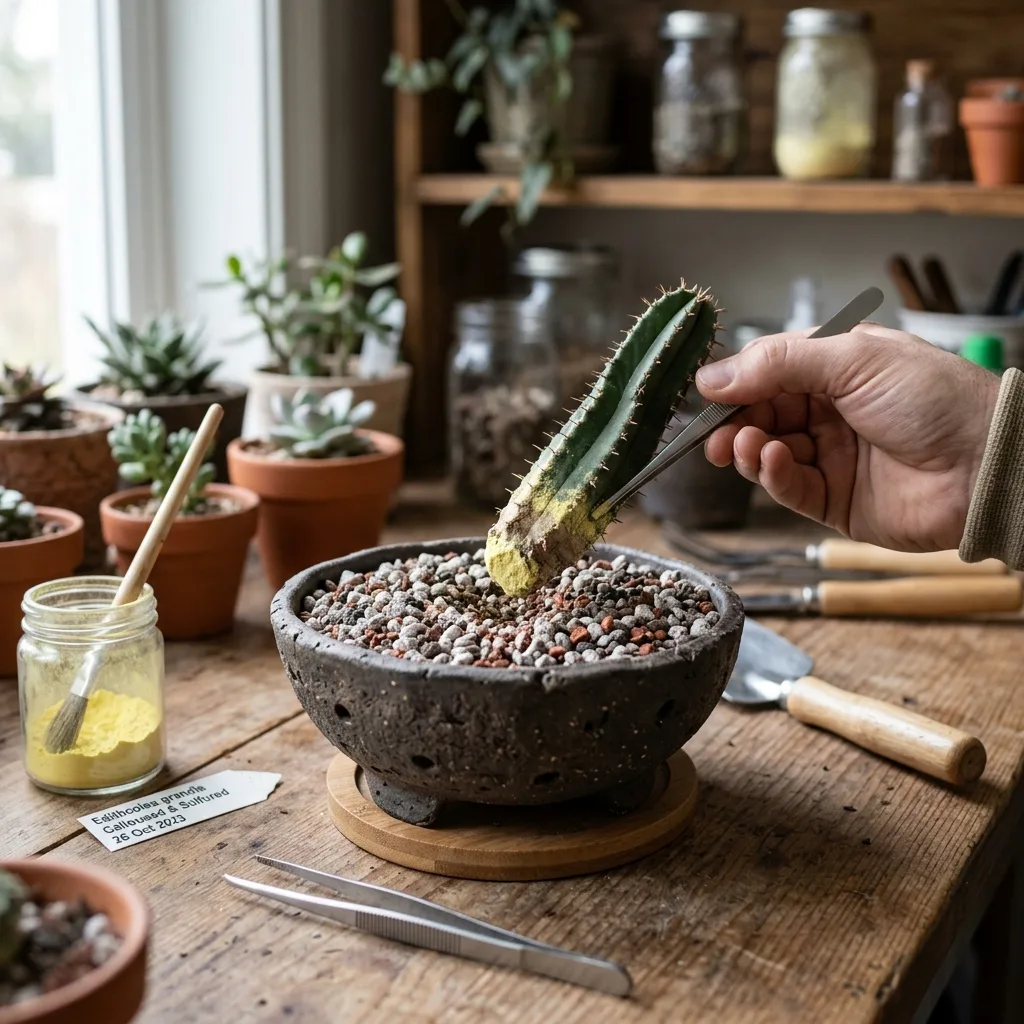
- Callusing and Antiseptic Treatment: Immediately dust the severed cut surface with micronized elemental sulfur or activated charcoal powder to seal the wound against pathogens. Store the cutting in a dry, shaded, well-ventilated spot for 7 to 14 days until a hard, white, suberized callus forms over the cut.
- Rooting Medium: Seat the callused cutting in a dry mix composed of 90% graded pumice and 10% coarse grit. Lay it slightly horizontal rather than burying it vertically; never insert the cut base deeper than 1 cm into the medium.
- Initial Moisture Discipline: Keep the substrate completely dry for the first 10 days. After day 10, mist the surface around the cutting lightly once every few days. Adventitious roots will begin forming within 3 to 6 weeks.
6. Common Pathologies, Pests, and Interventions
Nearly 90% of issues encountered when growing Edithcolea stem from fungal pathogens exacerbated by cultural mistakes. Below is an identification and treatment guide:
- Basal Black Rot (Fusarium and Pythium spp.): Manifests as sudden softening, blackened discoloration, and jelly-like water-soaking at the soil line. Spreads aggressively. Intervention: Unpot immediately. Slice away all necrotic tissue with a sterile blade until only pristine green and white parenchyma remains. Bathe the viable portion in a broad-spectrum systemic fungicide, let dry thoroughly, and reroot as a fresh cutting.
- Mealybugs (Pseudococcidae): Form cottony, white protective clusters, particularly within the intercostal furrows between tubercles. They pierce epidermal walls to drink vascular sap, inducing chlorosis and providing entry for secondary infections. Intervention: Manually eradicate with a cotton swab dipped in 70% isopropyl alcohol. Severe infestations require systemic applications of imidacloprid or acetamiprid.
- Root Mealybugs: Present as chalky, white powder along the interior pot walls and root hairs, paralyzing nutrient and water uptake. Intervention: Discard the soil completely. Wash roots thoroughly in warm water, submerge in a systemic insecticidal drench, and repot into fresh, sterile mineral substrate.
7. Seasonal Maintenance Calendar and Expert Protocols
Synchronizing your care regimen with the natural phenological rhythm of the Persian Carpet Flower guarantees long-term health and vigorous blooming cycles:
- Spring (Awakening): As nighttime ambient temperatures reliably exceed 15°C, initiate light watering. Supplement every third watering with a low-nitrogen, high-phosphorus, high-potassium fertilizer diluted to one-quarter strength.
- Summer (Peak Flowering): The plant's metabolic activity reaches its zenith. Maximize lateral air circulation. Once flower buds set, do not relocate or rotate the container; sudden microclimatic variations trigger immediate bud abortion. Water thoroughly whenever the substrate dries completely.
- Autumn (Pre-Dormancy Hardening): Begin spacing waterings further apart and halt all fertilization. Maximize sun exposure as natural daylight hours wane to encourage cuticular thickening before winter.
- Winter (Absolute Dormancy): Maintain ambient temperatures strictly above 12-13°C (optimal range: 15-18°C). Keep the plant in a dry, ventilated room with the potting medium kept bone dry to prevent cold-induced collar collapse.


Reader Reviews & Comments 3 Reviews
Julian Vance
David Sterling
Claire Montgomery
Leave a Review & Rating
Share your plant care tips, experiences, or questions with our succulent community.