






We all know that sudden jolt of sheer panic when inspecting your prize succulent or beloved tropical houseplant and discovering an established colony of mealybugs, spider mites, or aphids. Our immediate, instinctive reaction is to reach for an insecticide spray and eradicate these microscopic invaders without hesitation. Yet, in our well-intentioned rush to protect our plants, we often set the stage for a catastrophe far more lethal than the pests themselves: phytotoxicity—the direct chemical intoxication and tissue necrosis of botanical structures caused by synthetic or natural pesticides.
Plants—particularly fleshy succulents and thin-cuticled tropical foliage—possess an exquisitely delicate protective barrier where tissue interfaces with the ambient environment. The breathtaking, silvery-blue farina wax observed on genera such as Echeveria or Dudleya is far more than an ornamental aesthetic; it serves as a microscopic epicuticular armor shielding mesophyll cells from ultraviolet radiation, dehydration, and pathogens. An inappropriately formulated insecticide, an excessive active-ingredient concentration, or a chemical application under harsh midday sun can dissolve this protective wax in seconds, exposing sensitive leaf mesophyll cells to acute chemical burns and solar radiation scorch.
If your plant exhibits sudden spots, crisp marginal burns, water-soaked translucent patches, or abrupt defoliation mere hours or days following an application, you are confronting acute chemical injury rather than active pest damage. In this comprehensive master guide, we explore how chemical insecticides disrupt plant metabolism, how to differentiate phytotoxicity from infectious pathological diseases, and how to scientifically rehabilitate a chemically burned plant right down to the cellular level.
1. Early Diagnostic Symptoms and Microscopic / Visual Cues
Phytotoxicity occurs when pesticide compounds penetrate the plant cuticle, systematically disrupting chloroplasts, degrading cellular plasma membranes, and mechanically occluding stomata. Unlike the localized, punctate stylet punctures created by sap-sucking pests, chemical burns emerge simultaneously across broad tissue planes, notably pooling in leaf depressions and striking fragile new flush where the cuticle is thinnest.
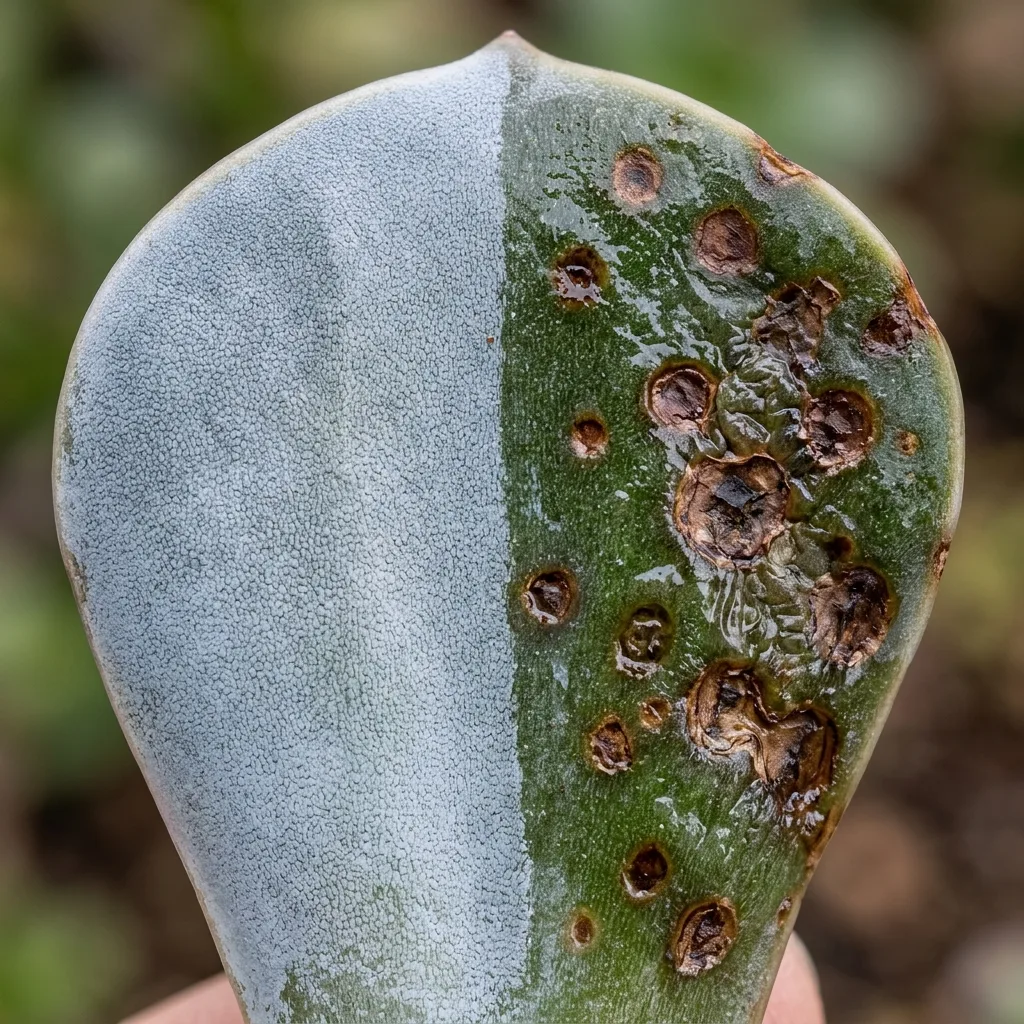
- Necrotic Drop Burns: Where aerosol or liquid sprays gather and bead into droplets—typically leaf tips and rosette indentations—distinct circular or amorphous brown-to-black dry lesions form. As the carrier liquid evaporates, active chemical concentrations amplify exponentially, blistering the underlying epidermal and mesophyll tissue.
- Marginal Chlorosis and Tip Scorch: As systemic or contact chemicals are translocated toward leaf margins through vascular bundles, leaf peripheries first turn pale yellow (chlorosis), followed by a papery, brittle browning (marginal necrosis).
- Farina and Cuticular Dissolution: In succulents especially, sprays containing organic solvents, emulsifiers, or mineral oils instantly strip the epicuticular wax. The leaf sheds its characteristic powdery, matte finish, appearing glossy, unnaturally dark green, and vitreous or water-soaked.
- Epinasty and Meristematic Distortion: Apical meristems, petioles, and nascent foliage bend erratically downward or cup inward in abnormal rosette conformations. Hormonal homeostasis and mitotic cell division become destabilized by intense chemical stress.
- Abrupt Leaf Abscission: In response to acute chemical trauma, the plant synthesizes massive amounts of stress ethylene. This triggers wholesale shedding of entirely green, turgid leaves at the slightest vibration, a phenomenon particularly notorious in Ficus, Crassula, and Peperomia species.
2. Underlying Causes and Environmental Triggers
Commercial insecticides are calibrated in controlled laboratories to meet specific safety thresholds; however, home microclimates and greenhouse dynamics can rapidly transform even a mild compound into a phytotoxic acid. Understanding the physiological drivers behind chemical injury is vital to preventing irreversible plant loss.
The foremost error lies in the concentration fallacy. Assuming that 'adding just a splash more will wipe out pests faster' signs a death warrant for sensitive plant cells. Doubling recommended application rates dramatically spikes solution osmotic pressure, stripping water from vacuoles and inducing rapid chemical plasmolysis (cellular dehydration and collapse).
Ambient temperature and solar irradiance represent the second major trigger. Numerous insecticides—including elemental sulfur, neem oil, insecticidal soaps, and horticultural mineral oils—exhibit direct phototoxicity above 28°C (82°F). Liquid droplets serve as microscopic optical lenses; passing sunlight focuses intense thermal energy onto leaf surfaces, burning chlorophyll pigments and creating deep necrotic depressions.
A third precipitating factor is treating plants under moisture stress. A dehydrated plant with low cellular turgor pulls foliar-applied chemicals through open stomata with alarming rapidity. Because intracellular water reserves are depleted, the chemical compound cannot be diluted internally, driving concentrated toxins straight into the xylem and phloem streams.
3. Natural and Organic Pest Management Protocols
To eliminate phytotoxicity risks entirely—or to protect a recovering plant that cannot endure further chemical trauma—we must pivot toward gentle, biological, and mechanical solutions. Organic management aims to suppress pest thresholds without compromising botanical defense structures.
The premier line of defense is targeted mechanical eradication. Rather than drenching a plant in broad-spectrum foliar sprays, localized infestations of mealybugs or armored scales can be eliminated individually using cotton swabs lightly moistened with diluted 70% isopropyl alcohol. This surgical approach preserves the broader canopy and safeguards delicate farina wax from indiscriminate dissolution.
For widespread infestations across extensive foliage, pure potassium salt formulations (insecticidal soaps) offer a dependable safety profile. Their mode of action involves dissolving the protective lipid-wax exoskeleton of soft-bodied insects, resulting in rapid dehydration without injecting synthetic toxins into plant cells. However, insecticidal soap must always be misted during evening twilight—never in bright sunlight—and the canopy should be thoroughly rinsed with tepid water the following morning.
Additionally, introducing beneficial biological controls—such as mealybug destroyer larvae (Cryptolaemus montrouzieri) or predatory mites (Phytoseiulus persimilis)—establishes an organic protective ecosystem indoors and in greenhouses without any risk of chemical leaf burn.
4. Chemical and Systemic Application Safety Protocols
When battling tenacious, exponential pest outbreaks, systemic or synthetic interventions may become unavoidable. The objective, however, remains absolute: eradicate the pest while preserving host tissue viability. Adhering to dilution ratios, application intervals, and safety margins is non-negotiable.
The reference matrix below outlines optimal dosing rates and phytotoxic risk metrics for primary active ingredients used in indoor and succulent horticulture:
| Active Ingredient | Target Pests | Recommended Dose (per 1 L Water) | Application Frequency | Phytotoxicity Risk & Horticultural Notes |
|---|---|---|---|---|
| Imidacloprid (Systemic Neonicotinoid) | Mealybugs, soft scale, aphids | 0.5 - 1.0 ml | 14 - 21 days | Low. Applied as a systemic soil drench, foliar burn risk is virtually nonexistent. |
| Acetamiprid (Systemic) | Whiteflies, thrips, mealybugs | 0.4 - 0.6 g | 10 - 14 days | Very Low. Superior safety profile on delicate succulent foliage and tropical orchids. |
| Abamectin (Acaricide / Contact) | Two-spotted spider mites, eriophyids | 0.25 - 0.5 ml | 7 days (max 2 consecutive) | Moderate. Can cause leaf tip chlorosis at elevated temperatures (>26°C / 79°F) under bright light. |
| Cold-Pressed Neem Oil (Azadirachtin) | Preventative, broad-spectrum larvae | 3 - 5 ml (+ 1 ml mild soap) | 7 - 10 days | High. Prone to severe phototoxic scorching under light; permanently strips succulent farina. |
| Bifenthrin / Deltamethrin (Pyrethroid) | Caterpillars, aphids, adult thrips | 0.3 - 0.5 ml | 14 days | Moderate to High. Petroleum-based EC (Emulsifiable Concentrate) formulations scorch cuticles. |
Prior to broad application, always perform a 'phytotoxicity spot test.' Apply your diluted solution to a single, mature lower leaf with a cotton swab and observe for 48 hours. If no chlorosis, blistering, or translucency develops, you may proceed with whole-plant treatment.

5. Quarantine and Decontamination Procedures
A structured isolation regimen serves two critical purposes: halting the migration of lingering pests and stabilizing plants reeling from chemical stress. Foliage weakened by chemical burns features degraded immune signaling, leaving it vulnerable to opportunistic fungal and bacterial pathogens.
- Strict Physical Isolation: Relocate injured or infested plants at least 2 meters (6 feet) away from your main collection, choosing a space with gentle air movement free of harsh drafts.
- Emergency Rinse (Residue Removal): If you observe sudden tissue collapse within 1 to 4 hours post-application, wrap the pot and substrate securely in a plastic bag and place the plant under a gentle, lukewarm shower. Wash away remaining chemical films from both upper and lower leaf planes.
- Container and Tray Sterilization: Pests and mites frequently hide eggs along pot rims and saucers. Wipe container exteriors and drip trays thoroughly using a 10% bleach solution or 70% isopropyl alcohol.
- Sterile Debridement: Prune away tissue that has fully liquefied, blackened, or crisped into parchment using a scalpel or shears disinfected in 96% alcohol. Decaying necrotic tissue invites secondary Botrytis cinerea (gray mold) colonization. Dust cut margins lightly with sulfur powder or ground cinnamon to suppress fungal entry.
6. Rehabilitation Protocol and Post-Injury Care
A plant emerging from acute phytotoxic shock behaves much like an intensive care patient. The single most catastrophic error during this vulnerable phase is applying chemical fertilizer. The vascular bundles and root hairs of a chemically injured plant are severely compromised; introducing mineral salts increases osmotic stress, desiccating the roots and finishing off the plant.
Step one of rehabilitation is moving the specimen away from direct sun into bright, indirect, filtered light. Because photosynthetic machinery (chloroplasts and thylakoid membranes) has been chemically disrupted, the plant cannot process intense photon energy and will quickly suffer photo-oxidative cellular breakdown.
Calibrate your irrigation schedule carefully. A plant that has shed foliage or sustained cuticular burns experiences drastically curtailed transpiration rates. Watering on your former schedule will leave the root zone saturated for weeks, compounding chemical injury with anoxic root rot. Allow at least 60% to 70% of the soil profile to dry out completely before irrigating. Maintaining an open, porous potting medium with coarse pumice, volcanic scoria, and coarse perlite guarantees root zone oxygenation.
Withhold all nitrogen-heavy fertilizers until the apical meristem generates fresh, fully formed, healthy growth (typically 4 to 8 weeks). To gently encourage recovery, integrate cold-pressed liquid kelp (seaweed extract) at a micro-dose (1 drop per liter) into irrigation water. Kelp provides natural cytokinins, betaines, and trace minerals that stimulate cellular regeneration and help mitigate abiotic chemical shock.


Reader Reviews & Comments 3 Reviews
Julian Vance
Clara Davenport
Marcus Sterling
Leave a Review & Rating
Share your plant care tips, experiences, or questions with our succulent community.