






Nature's most resilient survival architects, succulents evolved across extreme topographies—from the hyper-arid canyons of Mexico to the rocky expanse of South Africa's Succulent Karoo. Specialized parenchymal tissues engineered for cellular water storage, paired with Crassulacean Acid Metabolism (CAM) that fixes carbon dioxide exclusively at night to curtail transpiration, render them true marvels of drought endurance. However, when we extract these evolutionary masterpieces from their native habitats and introduce them into modern living spaces—be it an indoor windowsill or a wind-whipped terrace—the physiological dynamics alter radically.
The common lament that 'succulents die so easily' stems directly from a failure to appreciate how indoor and outdoor microclimates exert diametrically opposed pressures on succulent physiology. Confined within four walls, stagnant air currents and sub-par photon fluxes set the stage for root hypoxia and cellular asphyxiation. Conversely, outdoors, unmitigated deluges, late frosts, and scorching solar noon irradiance can trigger acute photonecrosis and cellular collapse. Frequent watering is never an expression of plant affection; without adequate transpiration, it merely suffocates the root architecture in an anaerobic grave.
In this master guide, you will discover the cellular mechanisms required to rescue your succulents from dim living-room corners, restore their compact symmetry, and harden them into sculptural, resilient specimens capable of weathering the full spectrum of outdoor seasons.
1. Botanical Biology and Physiological Foundations
A succulent's metabolic vitality is inextricably linked to two environmental levers: the ambient evapotranspiration rate and the incident photosynthetic photon flux density (PPFD). The most formidable barrier confronting an indoor succulent is photon deprivation. Deprived of sufficient photons, the plant undergoes etiolation driven by the asymmetric accumulation of auxins on the shaded side of the stem, compelling it to stretch frantically toward available light. Internodal spacing widens, chlorophyll density diffuses, and the prized structural rosette unravels into a pale, weakened silhouette.
In stagnant indoor environments, moisture trapped within the potting substrate fails to evaporate for days or even weeks. This creates a persistently waterlogged, anaerobic microenvironment around the delicate root hairs, inviting opportunistic oomycetes and fungal pathogens like Fusarium and Phytophthora to breach the root cortex. By contrast, outdoor environments offer maximum air movement; continuous gentle airflow thins the boundary layer on leaf surfaces, suppressing leaf temperatures and accelerating convective gas exchange through the substrate surface.
Outdoors, however, the primary cellular hurdle shifts to ultraviolet radiation and dramatic diurnal temperature swings. Under intense solar irradiance, succulents synthesize photoprotective anthocyanins and carotenoid pigments to shield cellular membranes and DNA from photo-oxidation, manifesting in breathtaking flushes of ruby, amethyst, and bronze. Simultaneously, the glaucous, powdery bloom known as epicuticular wax (farina) serves as the plant's endogenous mineral sunscreen. Never wipe or handle leaves carelessly; this hydrophobic crystalline shield can take months—or even an entire vegetative cycle—to regenerate.
2. Accurate Diagnosis and Symptom Recognition
Discerning whether your specimen is flourishing or faltering requires decoding subtle cellular stress signals. Indoor and outdoor stress manifestations speak entirely different morphological languages:
- Etiolation from Light Deficit (Indoor): The core of the rosette turns pale chartreuse or blanch-white, leaf tips curl downwards to maximize surface area capture, and the central stem stretches vertically.
- Root Asphyxiation and Moisture Saturation (Indoor): Basal leaves turn translucent, turn a sickly yellowish-glassy hue, detach at the slightest brush, feel like water-filled gelatin, accompanied by a sour, anaerobic odor from the drainage holes.
- Sunburn / Photonecrosis (Outdoor): Sudden unacclimated exposure to direct midday sun manifests as bleached, silvery-white patches that rapidly harden into irreversible, corky brown necrotic scabs on the upper foliar surface.
- Dehydration and Plasmolysis: Basal foliage displays fine micro-wrinkles, the leaf lamina loses hydrostatic turgor and feels leathery or deflated, and outer leaf margins draw inwards toward the core.
- Freeze Damage (Outdoor): Intracellular water freezes and expands, puncturing cell walls; upon thawing, the affected foliar tissues turn deep black, collapse into a watery pulp, and rot.

3. Step-by-Step Implementation Protocol
Bridging the indoor-outdoor divide demands a calculated environmental acclimation protocol:
- Indoor Photonic Positioning: Position succulents on an unobstructed south- or west-facing windowsill, placed no further than 30 cm from the glass, completely free of sheer curtains. If natural light falls below 2,000–2,500 lux, deploy a full-spectrum LED grow light (delivering 200–300 µmol/m²/s PPFD) for 12–14 hours daily.
- Outdoor Acclimation (The 14-Day Hardening Protocol): Never transition an indoor plant directly into full summer sun. Execute a progressive 14-day schedule: Days 1–4 in bright, open shade; Days 5–9 exposed strictly to soft early morning sun (prior to 10:00 AM); Days 10–14 in dappled light, moving finally to full outdoor exposure.
- The 'Soak-and-Dry' Hydration Dynamic: Never water on a calendar schedule; let substrate moisture depletion dictate frequency. Insert an unfinished wooden dowel down to the bottom of the root ball. Only water when the dowel emerges bone-dry and dust-free from base to tip. The dry interval will be noticeably longer indoors and substantially compressed outdoors under high wind and heat.
- Container Selection and Porosity: Opt exclusively for unglazed terracotta pottery for both environments. Terracotta's porous clay walls facilitate omnidirectional evaporation, discharging moisture radially through the vessel walls rather than relying solely on surface transpiration. Ensure ample, unobstructed basal drainage ports.
- Outdoor Deluge Management: During prolonged, cold spring or autumn rain systems, move potted collections beneath covered eaves or porch overhangs to prevent root chilling in persistently saturated media.
4. Required Equipment, Materials, and Substrate Metrics
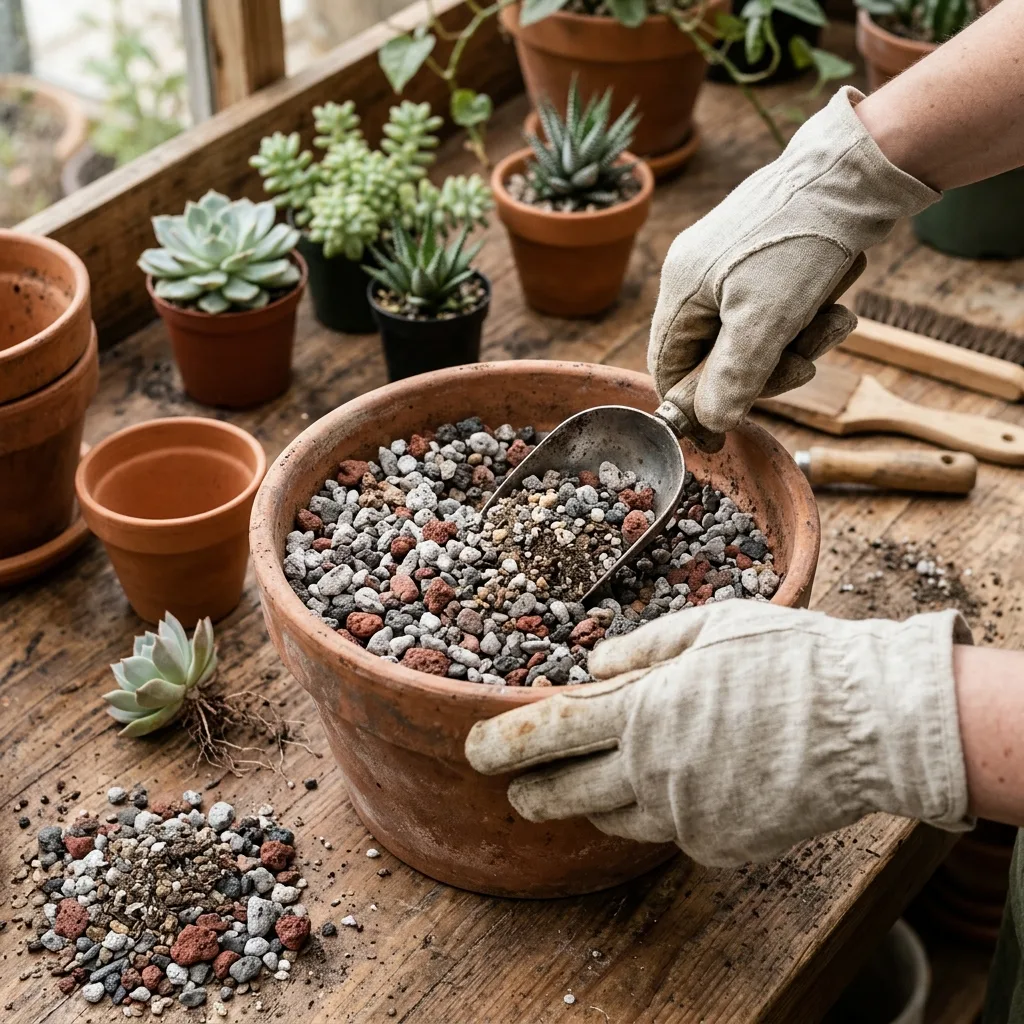
Long-term vigor hinges upon tailor-made mineral substrates calibrated to the ambient microclimate. Because outdoor evaporation is aggressive, a marginal increase in organic moisture retention is permissible, whereas indoor environments mandate a heavily inorganic, rapid-draining aggregate ratio to counteract stagnant airflow.
| Component / Parameter | Indoor Protocol | Outdoor (Balcony/Garden) Protocol | Physiological Rationale |
|---|---|---|---|
| Inorganic Aggregate (Pumice/Lava Rock/Zeolite) | 70% – 80% (3–6 mm particle size) | 50% – 60% (3–8 mm particle size) | Root cortex oxygenation and rapid gravitational drainage |
| Organic Fraction (Washed Coir/Worm Castings) | 20% – 30% sieved, low-dust coir | 40% – 50% high-grade composted peat/coir | Cation exchange capacity (CEC) and micro-nutrient retention |
| Light Threshold (Photon Flux) | Min. 6 hours direct light / 2,500+ lux | Min. 5–7 hours direct or lightly filtered sun | Mitigates etiolation; fuels anthocyanin and farina synthesis |
| Watering Frequency Trigger | 100% dry throughout pot + 3–4 days rest | Immediately once 100% dry (during active summer) | Protects fine feeder roots from rotting; preserves turgor |
| Air Circulation Needs | Dedicated oscillating fan or daily window drafting | Ambient breeze (sheltered from gale-force winds) | Disrupts the laminar boundary layer; drives transpiration |
| Pot Material | Strictly unglazed terracotta or breathable fabric | Terracotta, heavy ceramic, or cedar planters | Prevents anaerobic root rot via evaporative wall cooling |
5. Five Critical Mistakes and Emergency Recovery
- Mistake: Foliar Misting: Spritzing water onto succulent rosettes does not hydrate the plant; it merely traps water droplets in foliar axils, activating fungal rot (Erwinia and stem rot). Succulents drink exclusively through mycorrhizae and root hairs.
Remedy: Discontinue misting immediately. Employ bottom-watering (submerging the pot halfway in water until capillary action dampens the surface) or use a precision, narrow-spout watering can directed exclusively onto the soil surface. - Mistake: Enclosing in Undrained Decorative Vessels: Terrariums, glass bowls, and undrained novelty ceramics seal root systems within a subterranean swamp.
Remedy: Unpot the plant immediately. Excise all blackened, decayed roots using a flame-sterilized scalpel. Dust the cuts with powdered sulfur or cinnamon, allow the callous to form for 48 hours in warm shade, and replant into unglazed terracotta with drainage holes. - Mistake: Abrupt Exposure to Midday Sun: Moving a desk-bound succulent directly onto a blazing patio in July causes irreversible foliar necrosis within hours.
Remedy: Do not amputate scorched leaves immediately; undamaged portions continue to drive baseline photosynthesis. Shift the plant back into bright shade and re-initiate the 14-day progressive acclimation protocol. - Mistake: Standard Bagged Potting Soil: Peat-heavy nursery soils act like sponges, retaining excessive water and subsequently baking into a hydrophobic, root-choking brick upon drying.
Remedy: Gently dislodge the old nursery soil by swishing the root ball in tepid water. Cleanse the root system thoroughly, dry on paper towels, and repot into a 70% pumice/zeolite mineral blend. - Mistake: Winter Proximity to Heating Vents and Radiators: Placing succulents near active heat sources artificially forces them out of winter dormancy in dim conditions, triggering weak, disfigured growth.
Remedy: Move the plants at least two meters away from heat sources to the coolest, brightest room available (ideally 10–15°C) and reduce watering to minimal maintenance levels throughout the winter.
6. Seasonal Calendar and Long-Term Results
Synchronizing your cultural practices with the succulent's internal circadian and phenological calendar is the ultimate hallmark of a master grower:
- Spring (Awakening and Active Vegetative Push): When nighttime temperatures stabilize above 10°C, initiate outdoor acclimation. Endogenous cytokinin synthesis surges. Gradually step up watering intervals and administer a single dose of balanced, low-nitrogen liquid fertilizer diluted to quarter-strength.
- Summer (Heat Stress and Peak Radiance): In extreme heat (>35°C), numerous genera (notably Aeonium, Dudleya, and select winter-grower Haworthia) enter estivation (summer dormancy). Root water uptake slows to a crawl; hold back on generous watering during heatwaves. For indoor plants, maintain continuous air movement to prevent fungal colonization.
- Autumn (Color Intensification and Cellular Hardening): Wide diurnal temperature fluctuations (10–12°C delta between day and night) trigger spectacular anthocyanin displays. Succulents naturally condense their cell sap to lower their cellular freezing point. Cease fertilization entirely and stretch watering intervals.
- Winter (Dormancy and Cold Protection): When frost threatens and sustained temperatures dip below 5°C, tender species (most Echeveria, Crassula, and Kalanchoe) must be moved indoors. Hardy alpine stonecrops and Sempervivum can safely remain outdoors under shelter. Reduce indoor watering to once every 3–5 weeks.
By honoring these cellular requirements and microclimatic balances, your succulents will cease merely surviving—they will consolidate into tight, jewel-like rosettes, send up vibrant seasonal inflorescences, and mature into enduring botanical sculptures that grace your living spaces for decades.


Reader Reviews & Comments 4 Reviews
Eleanor Vance
Marcus Thorne
Bradley Cooper
Julianne Reed
Leave a Review & Rating
Share your plant care tips, experiences, or questions with our succulent community.