






Across the sun-baked limestone washes and gravelly alluvial fans of the Mojave and Sonoran deserts, the arrival of early spring's balmy breezes awakens a truly breathtaking sight: the Desert Candle (Caulanthus inflatus). A rare and captivating desert annual within the mustard family (Brassicaceae), this botanical curiosity emerges like a glowing, lemon-yellow wax sculpture rising upright from the desert floor. Its swollen, hollow, chlorophyll-laden golden stem is an evolutionary masterpiece, brilliantly engineered to optimize photosynthetic surface area while conserving precious cellular water reserves under severe desert aridity. Yet, when horticulturists and collectors attempt to cultivate this wild marvel in containers or greenhouses, its specialized capillary root system and hollow moisture-storing stem—fine-tuned for prolonged drought—become extraordinarily vulnerable to opportunistic fungal pathogens at the slightest hint of excess soil moisture.
The most heartbreaking challenge growers face is collar rot: that majestic candle-like stem suddenly turns translucent and water-soaked at the soil line, liquefies into a gelatinous mush, and collapses virtually overnight. When soil-borne pathogens like Pythium, Rhizoctonia, and Fusarium invade its low-moisture-adapted feeder roots, water transport through the xylem halts and cell walls rapidly dissolve. In this comprehensive guide, we will explore the cellular physiology of this rare desert beacon, recognize the subtle early warning signs of vascular decay, and recreate the pristine microclimate necessary to salvage and nurture your plant back to radiant health.
1. Early Warning Signs & Microscopic / Visual Diagnostics
The Desert Candle (Caulanthus inflatus) has a unique anatomy that whispers distress early on, yet collapses rapidly once infection reaches the vascular threshold. Its inflated, hollow stem architecture creates a warm internal conduit through which fungal mycelia can climb unchecked. To execute a successful rescue, monitor your plant closely for these vital clinical indicators:
- Basal Translucence and Blanching: At the crown where the stem meets the substrate, the natural golden-chartreuse hue transforms into water-soaked, translucent, pale-brown spots—the definitive visual marker of crown and collar rot.
- Loss of Internal Turgor Pressure: A healthy stem feels like a firmly inflated, taut balloon. If gentle pressure with your thumb leaves a persistent indentation, cellular turgidity has broken down and internal parenchyma cells have undergone necrotic lysis.
- Premature Bud Abscission: When the purplish-indigo apical flower buds turn brown, shrivel, and abort before unfurling, vascular wilt has compromised the root cortex; the plant can no longer pump water and vital minerals to its bloom spikes.
- Cortical Root Sloughing: Inspecting the root system reveals dark, slimy filaments instead of resilient, creamy-white feeder roots. If the outer root cortex slides off like a sheath when gently pulled, leaving behind a bare stele thread, root rot is fully active.
- Superficial Mycelial Webbing: Examining the inorganic surface grit around the root collar under a hand lens will frequently reveal fine, cottony white hyphae (indicative of Sclerotium or Rhizoctonia fungal colonies).
2. Root Causes & Environmental Triggers
Evolutionarily, Caulanthus inflatus is shaped by the hyper-arid, well-draining screes and limestone bajadas of California's Mojave Desert. In an ecosystem receiving merely 70 to 120 mm of erratic annual rainfall, moisture penetrates instantaneously through loose pebbles and evaporates within hours beneath constant, dry wind currents. In potted culture, rot is almost invariably triggered by environmental mismatch:
- Organic Substrate Traps & Peat Suffocation: Standard potting soils and peat-heavy mixes act like dense sponges. When the delicate capillary roots of Desert Candle remain enveloped in wet organic matter, they experience rapid hypoxia (oxygen deprivation). As asphyxiated root cells die, they release exudates that invite pathogenic spores to germinate.
- Air Stagnation and Low Vapor Pressure Deficit (VPD): Indoors or in unventilated greenhouses, ambient boundary layers stagnate. The plant's protective, waxy cuticular farina suppresses transpiration, internal hydrostatic pressure builds excessively, and micro-ruptures appear in the dermal tissue, granting easy entry to secondary invaders.
- Cold, Saturated Rootzones: Irrigating during cool evening hours or when ambient temperatures hover below 15°C (59°F) provides prime conditions for water molds like Pythium ultimum. Frequent watering is never an expression of plant love; without rapid dry-down cycles, it is an unintentional sentence to root asphyxiation.
- Excessively Deep Planting: Upon seed germination, the hypocotyl (the critical transition junction between root and stem) requires continuous airflow. Heaping substrate or fine grit against the soft crown Is the Orange Snowball Cactus? Botanical Care Tips for Growing Rebutia">is the single most common cultural cause of stem decay.

3. Organic Remedies & Natural Control Strategies
During the earliest stages of vascular infection, before relying on heavy synthetic compounds, growers can activate the plant's endogenous defenses and revitalize the rhizosphere using these proven organic protocols:
- Biological Inoculation (Trichoderma harzianum): Drenching the root zone with beneficial biofungi creates a living shield around tender feeder roots, physically occupying infection sites and outcompeting aggressive soil pathogens. Apply a wettable Trichoderma powder suspension during initial planting or early potting adjustments.
- Topical Micronized Sulfur Powder: If you identify a localized, superficial lesion or micro-fissure at the stem collar, brush medical-grade micronized sulfur directly onto the wound. Sulfur alters localized surface pH, halts fungal spore germination, and stimulates the rapid formation of protective corky callus tissue.
- Activated Charcoal and Pure Cinnamon Paste: Mix fresh, organically sourced ground cinnamon (rich in antifungal cinnamaldehyde) in equal parts with powdered activated horticultural charcoal. Blend with a few drops of sterile water to form a viscous paste, and apply over clean margins after surgically scraping away necrotic tissue.
- Silica-Rich Horsetail Decoction (Equisetum arvense): An unrefined botanical tea brewed from dried horsetail delivers bioavailable organic silica. When sprayed onto the epidermis, it cross-links within epidermal cell walls, mechanically thickening the plant's outer armor against fungal hyphae penetration.
4. Chemical & Systemic Fungicide Protocol
When stem decay progresses rapidly and organic barriers cannot stabilize tissue loss, immediate systemic intervention is necessary. Systemic active ingredients travel via xylem and phloem vessels throughout the plant's vascular cylinder to arrest fungal proliferation from within. Use this calibrated, safe regimen formulated for sensitive desert flora:
| Active Ingredient | Target Pathogens | Dosage (Per 1 Liter Water) | Application Frequency | Application Method |
|---|---|---|---|---|
| Propamocarb Hydrochloride | Pythium spp. (Water molds & root/collar rot) | 1.5 ml / Liter | Every 10 days (Max 2 cycles) | Targeted root drench around collar zone |
| Azoxystrobin | Rhizoctonia, stem blight, powdery mildew | 0.8 ml / Liter | Every 14 days (Max 2 applications) | Micro-mist foliar spray & substrate drench |
| Fosetyl-Aluminium | Phytophthora, vascular wilt, inner stem rot | 2.0 g / Liter | Every 12 days (2 cycles total) | Systemic foliar absorption spray |
| Copper Oxychloride | Superficial bacterial & fungal soft rot | 1.0 g / Liter | Single application (Curative) | Spot-paint with soft brush over scraped tissue |
Always execute chemical treatments during twilight or cool evening hours. Applying fungicidal compounds under harsh direct sunlight can degrade the plant's waxy farina and cause severe epidermal phototoxicity (chemical leaf scorch).
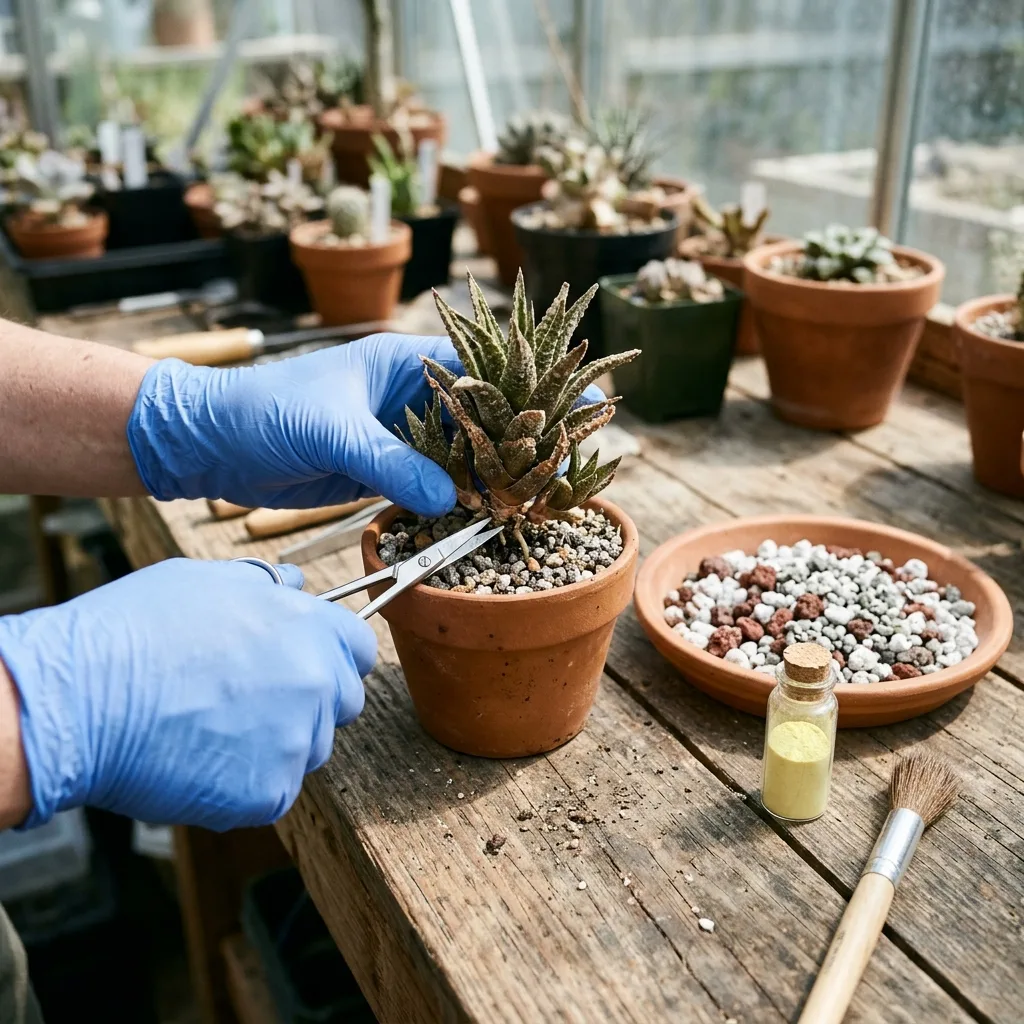
5. Quarantine & Sterilization Protocols
An infected Caulanthus inflatus is an active bio-vector that can jeopardize neighboring xerophytic plants and prized desert cacti. Implement these strict containment steps immediately upon detecting disease:
- Strict Spatial Isolation: Move the afflicted plant at least 3 meters (10 feet) away from other desert specimens into a well-ventilated, bright, and low-humidity quarantine microclimate.
- Flame or Alcohol Tool Sterilization: Scalpels, grafting knives, or razors must be flamed red-hot or immersed in 70% isopropyl alcohol for 60 seconds before and after every surgical incision into plant tissue.
- Vessel Decontamination: Discard infected plastic pots immediately. If utilizing unglazed terracotta, soak the pot in a 10% household bleach solution for two hours, rinse thoroughly, and bake in a dry oven at 110°C (230°F) for 45 minutes to eradicate lingering fungal resting structures.
- Substrate Disposal: Never discard the infected mineral mix into garden compost heaps. Seal the root-bound soil inside a secure trash bag for household municipal disposal; dormant Fusarium chlamydospores can remain viable in substrates for over five years.
6. Plant Rehabilitation & Recovery Nursing Care
Once pathogenic infection has been curtailed, restoring the Desert Candle's structural rigidity demands patience, calm observation, and dedicated convalescent care:
- Filtered Phototherapy: Keep the recuperating plant out of blistering mid-afternoon sun, but do not starve it of energy. Provide 6 to 8 hours of bright morning sunlight filtered through 30% shade cloth, or position under a 6500K full-spectrum horticultural LED bar (approx. 250–300 µmol/m²/s) to fuel rhizogenesis.
- Enforced Total Dry-Down: Withhold all irrigation for 10 to 14 days following treatment. The Desert Candle will draw sparingly upon its internal stem water reserves, and the localized drought signal will stimulate the production of fresh, uninfected lateral root primordia.
- Continuous Micro-Breeze Simulation: Mount a miniature USB-powered oscillating fan approximately 1 meter from the plant to maintain gentle, uninterrupted 24-hour air movement. This dynamic air layer dissipates stagnant micro-humidity around the collar and prevents reinfection.
- Sub-Irrigation Reintroduction: Reintroduce moisture solely through bottom-watering. Place the pot into a shallow saucer of tepid water for 3 to 5 minutes, allowing capillary action to dampen only the bottom third of the mineral mix. Never pour water directly over or near the swollen stem base.


Reader Reviews & Comments 4 Reviews
Garrett Vance
Dr. Eleanor Vance
Chloe Henderson
Julian Miller
Leave a Review & Rating
Share your plant care tips, experiences, or questions with our succulent community.