






Look across the steep volcanic cliffs of Mexico’s Querétaro and Hidalgo valleys, and you will see colossal spheres glistening under the blazing sun as though cast from pure molten gold. Echinocactus grusonii, universally known as the 'Golden Barrel Cactus' or affectionately dubbed the 'Mother-in-Law’s Cushion', exemplifies nature's supreme engineering in the most unforgiving arid terrains on Earth. While its wild populations remain critically endangered due to historical dam construction, this iconic species continues to thrive across the globe on sun-drenched windowsills and in botanical conservatories as an enduring living monument.
Cultivating a Golden Barrel in your living room or sunlit balcony creates a bond far deeper than tending to an ordinary houseplant. This cactus is an emblem of patience, biological resilience against the passage of decades, and breathtaking geometric perfection. Truly understanding Echinocactus grusonii requires delving into its cellular water storage dynamics, nocturnal CAM (Crassulacean Acid Metabolism) respiration, and the ingenious microclimatic armor provided by its interlocking golden spines. Join us with a warm cup of coffee in the greenhouse as we explore how to safeguard this desert monarch from root rot and preserve its regal form for generations to come.
1. Taxonomic Identity, Areole Architecture, and Spine Morphology
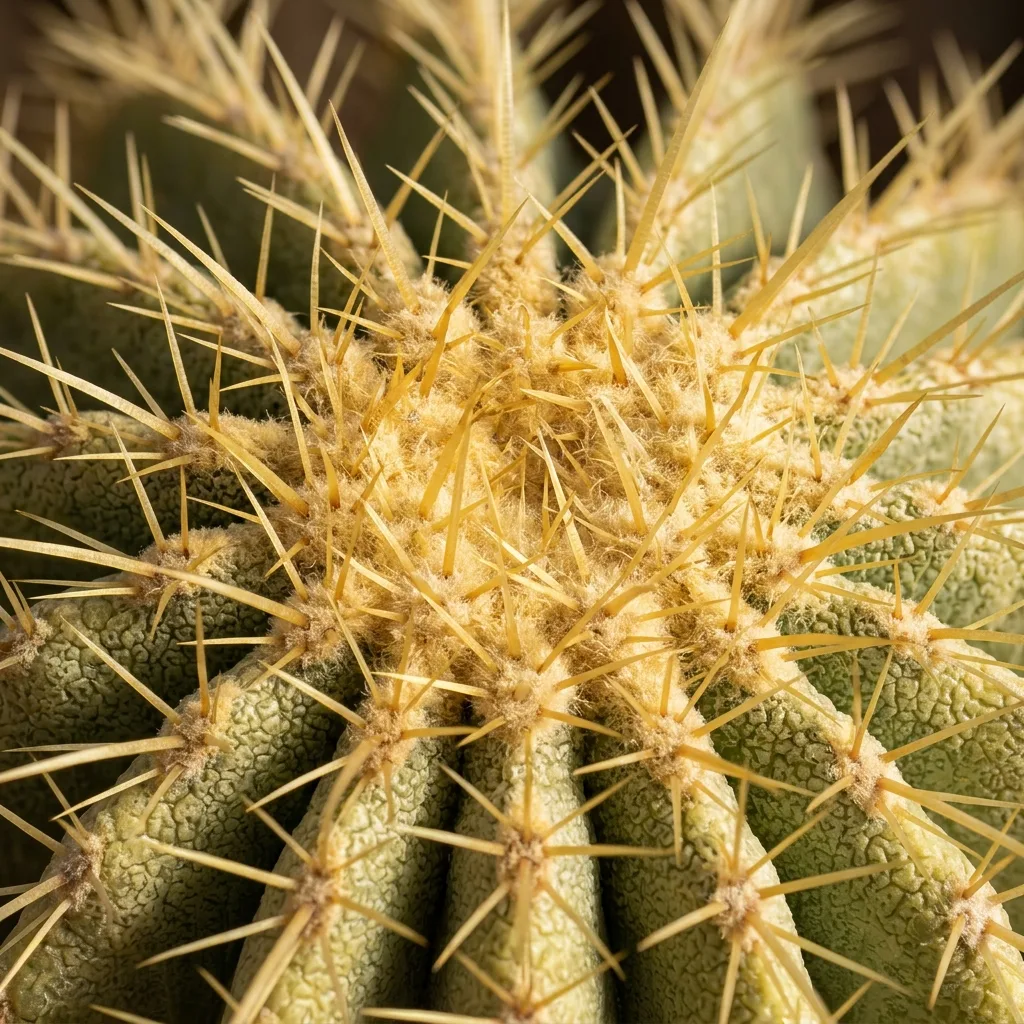
As one of the most distinguished representatives of the Cactaceae family, Echinocactus grusonii displays pronounced, irregular tubercles in its juvenile phase before organizing into crisp, symmetrical vertical ribs as it matures. A fully grown specimen can boast between 30 and 40 prominent ribs. Arranged along the crests of these ribs are densely felted yellow areoles, which serve as the primary meristematic growing points. Each areole produces an intricate array of 8 to 10 radial spines flanked by 3 to 5 heavier, slightly recurved central spines that thrust outward like bowstrings.
Far from being mere defenses against herbivores, these spines are botanically modified leaves that act as an intricate sunshade, casting a continuous micro-shadow across the epidermis to shield chlorophyll reserves from lethal ultraviolet radiation. Furthermore, the specialized surface microstructure of the spines condenses morning desert dew and channels precious moisture drops directly downward toward the root collar. While young specimens maintain a near-perfect spherical silhouette, decades of steady growth gently depress the apical crown, producing the definitive barrel profile. Under optimal lux values, these spines maintain a radiant, incandescent gold; in low-light environments, they turn pale, brittle, and lifeless.
2. Light Requirements, Sun Intensity, and Atmospheric Circulation
The Golden Barrel is an absolute photophile. Throughout its active growing window from early spring to mid-autumn, it demands a minimum of 6 to 8 hours of unfiltered, direct sunlight daily. Light deprivation triggers the collector's worst nightmare: etiolation. Once the apex narrows into an unsightly conical peak seeking light, that classic spherical geometry is permanently lost; new growth can never fully remediate structural deformities.
However, abrupt shifts are equally perilous. Transferring a cactus that spent the winter indoors straight into scorching spring sun induces irreversible epidermal photobleaching—manifesting as bronze scorch marks followed by white, calloused scars. Outdoor moves require an acclimatization window of 10 to 14 days behind light shade cloth. Crisp airflow is just as indispensable as lumens; stagnant indoor air prompts nocturnal stomata closure and provides an ideal breeding environment for airborne fungal spores settling deep within the felted areoles.
3. Watering Cycles and the Crucial Winter Dormancy Protocol
The golden rule every succulent enthusiast must etch into memory is simple: frequent watering does not convey love; it chokes root hairs and asphyxiates the plant. Echinocactus grusonii must strictly follow a rigorous 'soak and dry' regimen. During the active season (April to September), ensure the entire soil column has dried down to the base of the pot before saturating it thoroughly until water drains freely from the drainage holes. The specialized root parenchyma cells swiftly uptake moisture, plumping the accordion-like ribs.
As temperatures descend below 15°C (59°F) in late autumn, the plant enters physiological dormancy. From November through late March, watering must cease entirely, or be limited to a minimal hydration pass every 6 to 8 weeks merely to prevent root hair desiccation. The optimum overwintering temperature window sits between 8°C and 12°C (46°F–54°F). Kept bone-dry, this cactus can briefly withstand temperatures approaching 0°C (32°F); in damp soil, however, ambient temperatures of 5°C (41°F) will trigger swift, lethal root rot.
4. High-Mineral Substrate Formulations and Container Selection
The root system of Echinocactus grusonii is intensely susceptible to prolonged moisture. The moment xylem channels become oxygen-starved, opportunistic pathogens like Fusarium and Phytophthora invade. Consequently, commercial peat-heavy potting soils serve as a virtual death sentence. The ideal medium must be inorganic, draining excess gravitational water within seconds while preserving ample air cavities around the root zone.
For potting, unglazed terracotta containers remain unbeatable thanks to the natural evaporative transpiration through their clay walls. Furthermore, because a mature barrel cactus possesses a high center of gravity, wide, shallow, heavy-bottomed pans are superior to narrow, tall pots to eliminate tipping hazards.
| Substrate Component | Ratio (%) | Botanical & Functional Role |
|---|---|---|
| Pumice (3–6 mm) | 35% | Superior porosity, gas exchange, and root aeration |
| Lava Rock / Zeolite | 25% | Structural root anchorage and mineral micronutrient buffering |
| Coarse River Sand / Quartz Grit | 20% | Prevents compaction and creates rapid drainage channels |
| Sifted Quality Peat / Worm Castings | 20% | Baseline organic matter and slow-release nutrient uptake |

5. Flowering Induction and Strategic Nutrient Regimes
Witnessing a Golden Barrel in flower is among the most coveted milestones in desert horticulture, demanding supreme patience. This species reserves its generative phase strictly for maturity. You will not see blossoms on young specimens until their diameter expands past 35–40 cm (14–16 inches), a milestone that typically requires 20 to 25 years of cultivation. In midsummer, diurnal, bell-shaped canary-yellow flowers measuring 4–5 cm emerge in a circular ring through the dense golden felt of the crown.
Inducing blooms relies on two non-negotiable factors: first, a chilly, completely dry winter dormancy to initiate floral bud differentiation; second, light monthly feeding during late spring and summer using a low-nitrogen, high-potassium, high-phosphorus cactus fertilizer (such as an NPK 5-15-20 formulation). Excessive nitrogen prompts rapid, watery cellular expansion, softening structural tissues and causing disfiguring skin fissures.
6. Propagation, Offset Division, and Grafting Techniques
Echinocactus grusonii is inherently a solitary species, only producing basal offsets when the apical meristem suffers mechanical damage or terminal stress. Therefore, primary propagation occurs via seed. Sown in early spring across a fine, moist mineral germination bed maintained at 22–26°C (72–79°F) under high humidity, seeds sprout within 7 to 14 days. For their first two years, seedlings resemble tiny, emerald-green clusters of spherical tubercles before ribs emerge.
Prized ornamental variations—such as Echinocactus grusonii var. albispinus (the white-spined form) or rare cristate mutations—are frequently grafted onto vigorous rootstocks like Trichocereus or Hylocereus to accelerate juvenile growth rates and circumvent rot vulnerabilities. Should a mature specimen produce a basal pup, sever it cleanly during spring with a sterilized scalpel, allow the wound tissue to form a thick, dry callus over 7 to 10 days in the shade, and root it directly in dry pumice.
7. Defending Against Soft Rot and Pathogenic Fungi
The leading cause of death in cultivated Golden Barrels is basal stem and root rot caused by overwatering (typically driven by Pythium and Rhizoctonia fungi). If the base feels spongy to the touch and the vibrant green tissue turns a translucent yellow-brown, immediate intervention is non-negotiable. Unpot the plant, excise every trace of blackened or hollow root, and slice out soft collar tissues with a sterile blade until you reveal clean, firm green vascular rings. Dust the excised area generously with elemental sulfur or cinnamon powder, allow it to air-dry for at least two full weeks, and repot into bone-dry mineral grit.
In terms of insect pests, the primary antagonists are mealybugs (Pseudococcidae) and subterranean root mealybugs, which conceal themselves within the dense apical wool and spine junctions. At the first sign of white, cottony secretions, perform precise spot eradication using a cotton swab dipped in 70% isopropyl alcohol. For extensive infestations, deploy organic cold-pressed neem oil solutions or apply a targeted systemic insecticide during the active growth cycle.


Reader Reviews & Comments 3 Reviews
Julian Vance
Marcus Sterling
Clara Hensley
Leave a Review & Rating
Share your plant care tips, experiences, or questions with our succulent community.