






Hailing from the semi-arid, rocky hillsides of South Africa to the sunniest perches in our living rooms, the jade plant (Crassula ovata) evolved in an austere landscape where brisk winds desiccate the surface and torrential rain drains almost instantaneously through gravel and stone fissures. Boasting plump, glossy jade-green leaves and a stout, tree-like woody trunk, it embodies generational wisdom; yet the most insidious peril it faces indoors is rarely dehydration, but rather ill-conceived potting mixes that deprive its root zone of atmospheric oxygen. All too often, we casually dismiss the jade plant as an 'indestructible succulent' and trap it within dense, peat-heavy commercial potting soils—condemning its subterranean anatomy to slow, hypoxic suffocation.
A succulent's root architecture does far more than anchor the stem and channel moisture and solutes; it demands continuous cellular respiration through microscopic air voids (aeration) distributed throughout the substrate matrix. When garden soil or fine-milled peat moss becomes saturated, it collapses into an anaerobic sludge, sealing these delicate gas-exchange pore networks. Starved of oxygen, root cells rapidly switch to fermentation pathways, cell membranes destabilize, and opportunistic oomycete pathogens (such as Pythium and Phytophthora) stage a swift underground invasion. This catastrophic condition—euphemistically termed 'root rot'—is often noticed only after lower leaves yellow and drop; however, the physiological crisis invariably ignited months beforehand beneath the soil line.
If your goal is to nurture a jade plant whose trunk thickens with the sculptural grace of an ancient bonsai and whose foliage remains turgid across decades, you must replicate nature's mineral equilibrium inside the container. In this master horticultural guide, we dissect the physical dynamics of inorganic volcanic aggregates, pinpoint optimal particle size gradings, evaluate evaporation physics across ceramic vessels, and detail surgical root pruning to elevate your succulent care to professional standards.
1. Comparative Analysis of Inorganic Mineral Aggregates
Inorganic minerals constitute the foundational structural backbone of any high-performance succulent substrate. Unlike organic matter, this inorganic fraction will never decompose, slump, or compact over time. It guarantees unrestricted gravity drainage through bottom weep holes and, crucially, acts as a passive mechanical pump that circulates ambient oxygen down to the root rhizosphere. For an optimal jade plant substrate, particle dimensions must be rigorously calibrated between 2 mm and 6 mm; flour-fine mineral silts must be discarded, as they silt down and clog macropores.
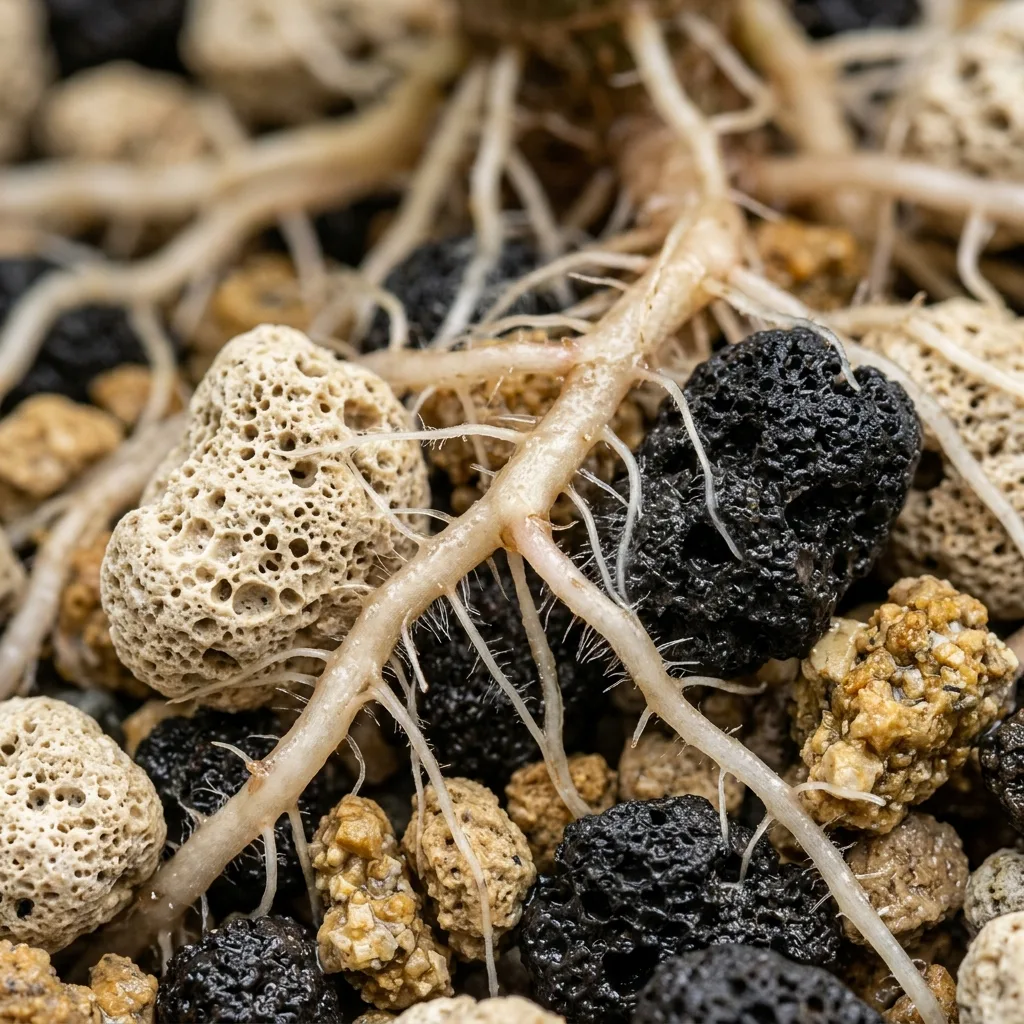
Pumice (Horticultural Grade): Pumice is an uncompromised life-insurance policy for Crassula ovata. Its cellular morphology features a honeycomb network of both open and closed vesicles. These microscopic cavities trap modest moisture reserves strictly through surface tension while instantly rejecting gravitational water. Furthermore, pumice introduces indispensable structural lightness to the container, permitting fibrous feeder roots to navigate unobstructed.
Lava Rock (Volcanic Scoria): Loaded with bioavailable iron, magnesium, and essential trace minerals, red or black volcanic scoria provides jagged, angular, structurally permanent geometry. Scoria does not crush or degrade under wet-dry cycles, preserving enduring structural air corridors deep in the root ball where compaction risks run highest.
Zeolite (Clinoptilolite): Thanks to its negative crystalline framework, horticultural zeolite exhibits an extraordinary Cation Exchange Capacity (CEC), latching onto vital nutrient ions including calcium, potassium, and magnesium. It acts as an active chemical buffer, soaking up excess fertilizer salts, releasing them slowly upon biochemical demand, and maintaining the substrate pH in the slightly acidic-to-neutral comfort sweet spot (6.0 to 6.8) preferred by Crassulaceae.
Quartz Grit and Perlite: While perlite offers undeniable initial pore space, its floatability and featherweight density mean it inevitably migrates to the soil surface during bottom-watering or top-drenching. Because mature jade plants become notoriously top-heavy with thick, water-laden foliage, perlite should be superseded by washed, coarse quartz gravel or crushed granite grit (1-3 mm). The added ballast grounds the pot securely, counterbalancing heavy arborized canopies.
2. Calibrating the Organic Fraction: Peat, Coco Coir, and Bio-Inoculants
While porous gravels establish the physical skeleton of the substrate, the organic fraction serves as the localized nutrient bank and moisture cushion where delicate microscopic root hairs anchor. Nonetheless, the single most lethal blunder in succulent horticulture is inflating this organic ratio. Species with succulent, swollen branches like Crassula ovata cannot withstand organic fibers that stay swampy for weeks on end.
Coarse Sphagnum Peat: Traditional horticultural peat is nutrient-rich, but possesses two major drawbacks: severe hydrophobicity once parched bone-dry, and catastrophic air pore collapse when saturated. Consequently, fine, pulverized peat must never be used alone. If incorporated, opt exclusively for coarse, fibrous, long-strand blonde Baltic peat, carefully blended with excessive mineral aggregates.
Coco Coir and Coco Chips: Coco coir represents a far more renewable, eco-conscious alternative to peat moss. It demonstrates vastly superior re-wetting properties without exhibiting harsh hydrophobic tendencies. However, lower-grade coir can harbor elevated electrical conductivity (EC) due to residual sodium and potassium chlorides; only use triple-washed, buffered products with certified low salinity.
Aged Earthworm Castings: Introducing a modest 5% to 10% volume of premium, aged vermicompost gently inoculates the root medium with beneficial microbial consortia and endomycorrhizal fungi without burning delicate roots. These microscopic allies form a living sheath around jade feeder roots, producing a biological frontline that physically outcompetes soil-borne fungal pathogens.
3. Precision Substrate Recipes Across Microclimates and Genera
Every living space maintains distinct ambient relative humidity levels, seasonal insolation, and air circulation dynamics. Likewise, differing succulent genera display distinct morphological water-storage tissue adaptations. The volumetric substrate recipes in the reference table below have been empirically calibrated and verified in greenhouse cultivation:
| Succulent Category | Inorganic Mineral Ratio (Pumice, Scoria, Zeolite) | Organic Fraction (Coarse Peat / Washed Coir) | Targeted Amendments (Castings / Biochar) | Post-Irrigation Dry-Down Window |
|---|---|---|---|---|
| Jade Plant (Crassula ovata) | 65% (3-5 mm calibrated grit) | 25% (Sifted coarse coir/peat) | 10% Worm Castings + Crushed Biochar | 3 to 5 Days |
| Haworthia & Gasteria | 70% (Accommodates thick, fleshy roots) | 25% (High-aeration fibers) | 5% Zeolite-dominant mineral charge | 4 to 6 Days |
| Echeveria & Graptopetalum | 75% (Sun-demanding rosettes) | 20% (Lightweight peat/coir) | 5% Horticultural activated charcoal | 2 to 4 Days |
| Desert Cacti & Lithops | 85% - 90% (Pure mineral aggregate) | 10% (Minimal organic dust) | Graded pumice, scoria, and decomposed granite | 1 to 2 Days |
For your prized jade plant, a bulletproof universal blend is: 3 parts horticultural pumice, 2 parts volcanic scoria or zeolite, 2 parts coarse coco coir/fibrous peat, and a half-part crushed horticultural charcoal. Activated charcoal acts as a natural porous bio-filter, adsorbing volatile organic acids and preventing the accumulation of stagnant, anaerobic gases within the core root zone.
4. Pot Material Dynamics: Terracotta, Glazed Ceramic, and Plastic
Even an impeccably formulated, free-draining substrate mix can be entirely negated if paired with a physiologically incompatible vessel. Container composition directly governs the physics of dry-down velocity and sidewall gas exchange.
Unglazed Terracotta (Fired Clay): Unquestionably the platinum standard for Crassula ovata. Owing to its open microscopic porosity, unglazed terracotta breathes continuously through its entire sidewall profile, not just its bottom aperture. Surplus capillary water diffuses outward and evaporates laterally, ensuring that the interior core never languishes in a cold, soggy state. Furthermore, terracotta's inherent mass grounds the vessel, preventing mature, arborized jade specimens from toppling under their own weight.
Plastic and Glazed Ceramic Vessels: Impermeable plastic and non-porous glazed ceramics completely prevent sidewall evaporation; moisture can exit only through the drainage hole or via the top air interface. If you choose to display a jade plant in glazed ceramic or plastic, you must proactively elevate the inorganic mineral fraction to 75%–80% and strictly dial back irrigation frequency to avoid persistent perched saturation.
The Fatal Fallacy of Closed Pots: Planting a jade plant inside a glass terrarium, decorative vessel, or mug devoid of drainage holes is horticultural suicide. Depositing a bottom layer of gravel does not generate drainage; rather, it creates an elevated 'perched water table,' concentrating stagnant saturation squarely within the deepest roots and expediting fatal hypoxic collapse.
5. Step-by-Step Repotting and Root Remediation
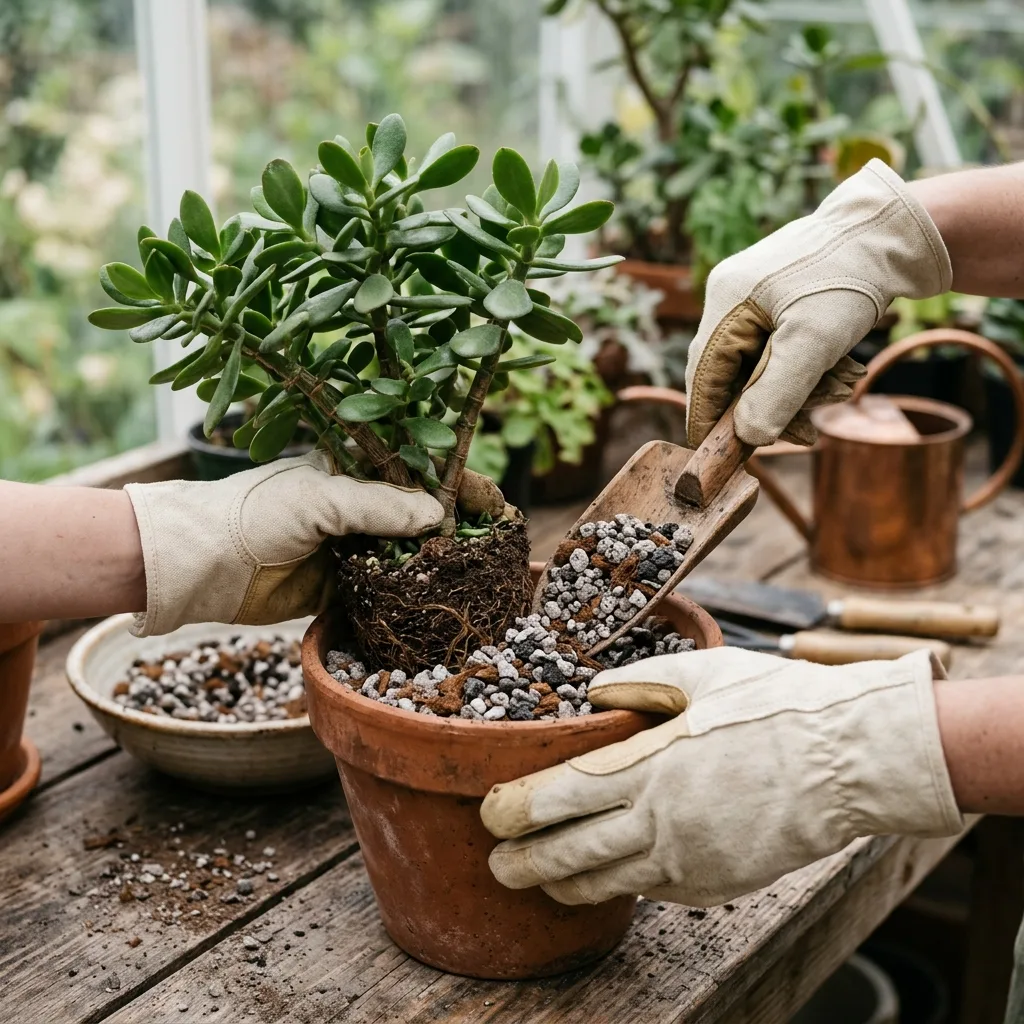
The jade plant is a steady, moderate grower that generally warrants repotting every 2 to 3 years. The golden window for this procedure is early spring (March to May), when winter dormancy breaks and endogenous growth hormones (auxins) surge to drive vigorous root initiation.
- Dry Extraction: Withhold all irrigation for at least 5 to 7 days before repotting; the root ball must be bone dry. Gently roll the pot onto its side, tap the rim against a firm surface to loosen adhesion, cradle the jade’s primary trunk firmly near the soil line, and coax the root mass free.
- Substrate Teasing: Using a wooden chopstick or root rake, delicately disentangle the compacted, hardened nursery soil. Strip away at least 80% of the old, depleted medium from the interior root ball to restore lateral root breathability.
- Pathological Root Inspection and Pruning: Closely inspect the root architecture under bright light. Healthy jade roots are firm, flexible, and pale tan to creamy white. Any dark brown, black, mushy, or stringy roots must be cleanly excised back to clean, living tissue using razor-sharp, alcohol-sterilized pruning shears. Circling, bound taproots can be safely shortened by one-third; this strategic pruning signals the plant to produce a lush burst of new juvenile feeder roots.
- Potting and Settling: Select a replacement pot only 2 to 3 cm (roughly 1 inch) wider in diameter than the root perimeter—oversized pots retain excess water volume that roots cannot transpire quickly. Cover the drainage hole with an inert mesh screen. Fill the bottom with a layer of your dry mineral mix, center the specimen, and backfill incrementally, tapping the pot gently against the potting bench to settle the aggregates between the root interstices without manually compacting the mix. Never bury the trunk deeper than its original soil collar; stems buried below the surface rot effortlessly.
6. Post-Repotting Protocol: The Inviolable 'Dry Rest' Rule
Traditional indoor foliage houseplants are routinely drenched immediately after transplanting to 'settle the roots'—however, in the realm of succulent cultivation, this practice is catastrophic. Never irrigate your jade plant immediately following a repot.
During soil extraction and root trimming, countless microscopic root hairs and major vessels suffer micro-fractures. If these open vascular lesions are instantly exposed to saturated soil, they function as open doorways for ambient fungal and bacterial pathogens. Keep the repotted jade entirely dry for 7 to 10 days. This dry interval allows root tissues to produce suberin and form a protective, callused scar over all wounds.
Throughout this recovery window, place your specimen in a brightly lit, well-ventilated location shielded from scorching, direct midday solar radiation. When you execute the first post-repot irrigation, drench the pot thoroughly until water cascades cleanly through the bottom drainage hole, and promptly discard all runoff pooled in the saucer after 10 to 15 minutes. Secure in its oxygen-saturated, mineral-rich home, your jade plant will reward you with dense, jade-like leaves, thick sculptural branches, and a lifespan that easily spans generations.


Reader Reviews & Comments 3 Reviews
Eleanor Vance
Marcus Thorne
Chloe Bennett
Leave a Review & Rating
Share your plant care tips, experiences, or questions with our succulent community.