






In the limestone fissures flanking the mighty Orange (Gariep) River valley that delineates the border between South Africa and Namibia—a land where geological time appears suspended—thrives an extraordinary desert relic: Ceraria pygmaea (reclassified in modern phylogenetics as Portulacaria pygmaea), affectionately known by collectors as the Pygmy Porkbush or Dwarf Ceraria. Braving some of our planet's most unforgiving droughts, this compact geophyte mesmerizes observers with its swollen, fissured caudex resembling an ancient living bonsai, crowned by clusters of miniature, translucent jade-green bead leaves. For passionate succulent growers, nurturing this species on a sunny windowsill is an intimate encounter with millions of years of evolutionary survival mastery.
Many plant enthusiasts mistranslate their first glimpse of this dwarf specimen as an artisan stone sculpture. Its rugged, fissured, ash-gray stem mimics exposed desert rock, while the fleshy globes emerging from terminal shoots evoke clusters of marine green coral. Beneath this deceptively fragile architecture, however, resides a botanical powerhouse engineered for extraordinary cellular moisture conservation. When understood with scientific clarity and treated with horticultural patience, Ceraria pygmaea flourishes into a prized generational heirloom that graces collections for decades.
1. Botanical Identity and Morphological Adaptations
Ceraria pygmaea is a slow-growing, dioecious (bearing separate male and female flowers on distinct individual plants) dwarf pachycaul shrub belonging to the family Didiereaceae (historically placed within Portulacaceae). Within its native terrain across the rocky outcrops of Namaqualand and the Richtersveld, mature specimens rarely exceed 15 to 20 cm in vertical height; however, the succulent basilar caudex can slowly expand to an impressive 10 to 15 cm in diameter over several decades.
Its most striking morphological signature is the cushion-like, water-storing bark coupled with tight clusters of spherical to slightly flattened cylindrical succulent leaves. These foliage beads are shielded by a dense cuticular wax layer engineered to reduce transpirational water loss to near zero. To flourish under hyper-arid conditions, the plant utilizes Crassulacean Acid Metabolism (CAM) photosynthesis: it seals its stomata tightly during hot daytime hours to prevent desiccation, opening them exclusively during cooler desert nights to assimilate and store carbon dioxide as malic acid for daytime photo-assimilation.
2. Light Requirements and Indoor Positioning
The Richtersveld desert receives some of the highest solar irradiance indices on Earth, meaning Ceraria pygmaea is an obligate sun lover. In low-light environments, the plant exhibits immediate etiolation: internodes stretch, the spherical bead-like leaves flatten and lose their turgidity, and the compact, sculptural bonsai silhouette degrades.
When cultivated indoors, an unobstructed south- or southwest-facing windowsill providing a minimum of 5 to 6 hours of direct, unfiltered sunlight daily is essential. For growers in overcast winter regions or higher latitudes, supplementing natural exposure with high-output, full-spectrum LED horticultural lights (delivering 3000–4000 lumens at close canopy range) prevents structural elongation. Unhindered ambient airflow is equally vital; stagnant, humid domestic microclimates swiftly trigger fungal stress in this arid specialist.

3. Watering Discipline: The 'Soak and Dry' Protocol
Routine, frequent watering is not an act of horticultural care; it is an active suffocation of root hair tissues. For Ceraria pygmaea, this warning holds double weight. Its swollen caudex and mucilaginous cellular matrices store adequate hydration reserves to survive months of prolonged drought, whereas its fibrous feeder roots will collapse from opportunistic fungal decay (such as Fusarium or Pythium) within 48 hours in a persistently damp substrate.
Follow this non-negotiable rule: never apply water unless the entire root ball and substrate column have dried out completely to the base of the container. When watering, saturate thoroughly until water streams freely through the bottom drainage holes ('soak and dry'). Promptly discard any run-off collected in drip saucers; letting the container sit in pooled water is a death sentence. When the bead-like leaves lose their firm luster and show delicate surface wrinkles, the plant is signaling thirst and can be safely watered; if the leaves remain firm and hard to the touch, hold off completely.
4. Ideal Substrate Formulation and Pot Selection
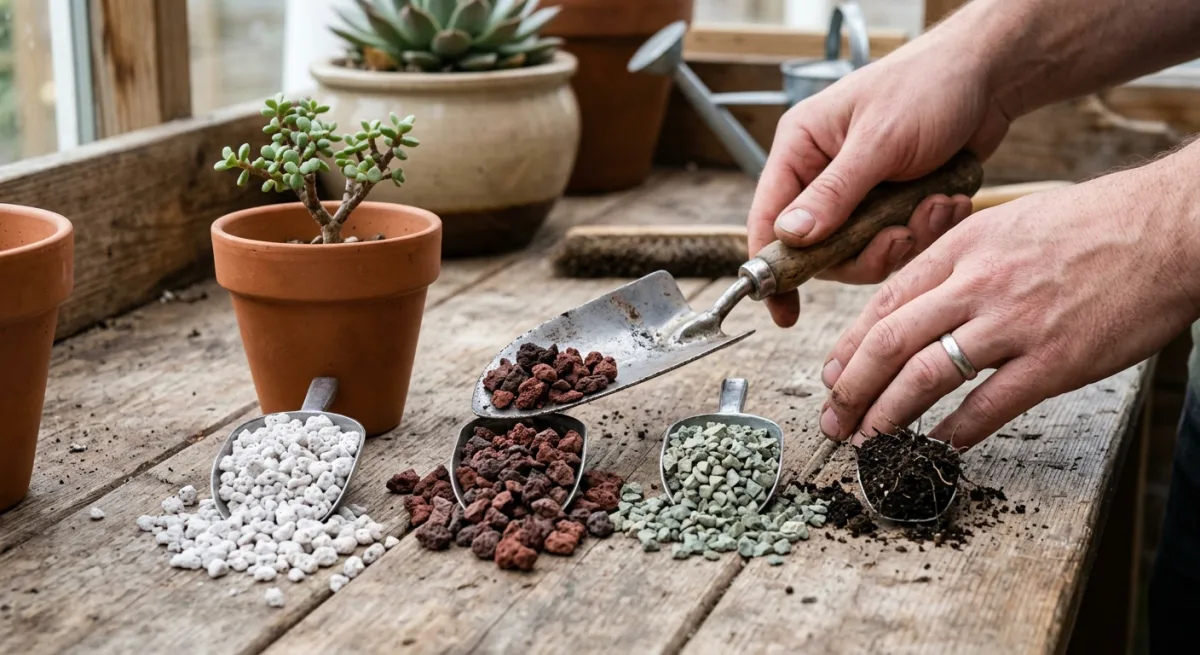
The root system of this dwarf caudiciform demands constant oxygen exchange. Standard peat-based potting soils are lethal to Ceraria pygmaea, as dense organic matter retains moisture like a sponge and deprives root xylem tissue of aeration. You must engineer a fast-draining, predominantly inorganic, gritty mineral mix to ensure peak root vigor.
| Component | Proportion (%) | Botanical Function & Root Benefits |
|---|---|---|
| Pumice (3–5 mm) | 40% | Porous structure delivers continuous rhizosphere aeration and rapid drainage. |
| Lava Grit / Scoria (Red or Black) | 25% | Anchors top-heavy caudexes, releases trace minerals, and prevents compaction. |
| Zeolite or Hard Akadama | 20% | Provides excellent Cation Exchange Capacity (CEC) and manages micro-moisture. |
| Screened Coir or Aged Cactus Peat | 15% | Supplies minimal organic matrix required for root hair colonization without holding excess water. |
Regarding containers, choose porous, unglazed terracotta pots or shallow ceramic bonsai containers featuring generous drainage openings. Glazed porcelain, plastic, or glass containers impede lateral substrate breathing and create hazardous moisture reservoirs. A broad, shallow pan mimics natural rock crevice conditions and keeps the root crown perfectly dry.
5. Step-by-Step Propagation Techniques
Propagating Ceraria pygmaea is an exercise in botanical precision. Unlike many Crassulaceae, single-leaf propagation has an exceptionally low success rate; the primary methods are semi-lignified stem cuttings and controlled seed germination.
- Cutting Selection and Harvesting: In early spring as metabolic activity initiates, select a healthy, semi-woody side branch possessing at least 3 to 4 nodes. Using a sterile scalpel, execute a clean incision flush with the branch juncture without gouging the primary caudex.
- Callus Formation: Never insert fresh cuttings into damp soil. Place the severed cutting in a dry, shaded, well-ventilated space for 5 to 7 days, allowing the cut surface to produce a firm, protective suberized callus tissue.
- Planting in Gritty Substrate: Insert the callused cutting 1 to 2 cm deep into an ultra-gritty medium composed of 85% pumice and coarse grit.
- Rooting Environment: Withhold water completely for the first week. By week two, introduce gentle bottom hydration by setting the container briefly in a shallow saucer of water. Position in bright indirect light shielded from harsh afternoon sun; adventitious rooting generally establishes within 4 to 6 weeks.
6. Common Diseases, Pest Management, and Remedies
While inherently sturdy in an arid setup, domestic indoor conditions can expose Ceraria pygmaea to distinct physiological and biological pressures:
- Caudex and Root Rot: The direct outcome of dense potting soils and excessive irrigation. If the caudex turns squishy or discolored, immediately unpot the specimen, excise all necrotic root tissue with a sterile knife, dust the clean cuts with elemental sulfur or cinnamon powder, dry in open air for 5 days, and replant in fresh, completely dry mineral aggregate.
- Mealybugs (Pseudococcidae): Cryptic invaders that nestle within the tight axils of the bead foliage, producing white cottony deposits. Manually dab colonies with a fine artist brush dipped in 70% isopropyl alcohol. For stubborn infestations, apply an insecticidal horticultural soap or systemic neem drench.
- Spider Mites (Tetranychidae): Thriving in dry, stagnant indoor rooms, these micro-arachnids spin fine webbing between branches, causing leaves to develop bronze stippling and shed prematurely. Boost surrounding ventilation and apply a targeted organic miticide or sulfur spray.
7. Seasonal Horticultural Calendar and Expert Milestones
Aligning cultural practices with seasonal phenology ensures prolonged vigor and sculptural form:
- Spring (March – May): The main flush of vegetative activity. Gradually step up watering intervals as temperatures warm and the grit dries out. Apply a low-nitrogen, high-potassium liquid cactus fertilizer diluted to one-quarter strength once monthly.
- Summer (June – August): During periods of intense ambient heat, the specimen rests. Regulate hydration carefully, protect from greenhouse heat traps, and maximize lateral airflow.
- Autumn (September – November): Secondary growth phase as nights cool down. Provide full, unshaded sunlight to harden seasonal branch growth before the onset of winter.
- Winter (December – February): Maintain the plant in a cool, bright area between 8°C and 12°C (46°F–54°F). Shield rigorously from freezing temperatures. Water sparingly—just once every 4 to 6 weeks—to prevent total caudex desiccation while avoiding wet dormant roots.


Reader Reviews & Comments 3 Reviews
Julian Vance
Clara Higgins
Marcus Sterling
Leave a Review & Rating
Share your plant care tips, experiences, or questions with our succulent community.