






Tucked between crumbling quartz outcrops beneath the scorching sun of the semi-arid Karoo basin of South Africa and Namibia lies a true botanical gem: Adromischus. Affectionately likened to 'potato chips', 'plover eggs', or 'toad skin', this distinctive member of the Crassulaceae family displays one of nature’s most refined water-storage architectures ever evolved to conquer extreme drought. Yet, when welcomed into our homes, many growers face the same heartbreak: plump, fleshy leaves dropping at the gentlest brush, accompanied by softening at the stem base. Dousing succulents with water on a fixed calendar is never an act of affection; it suffocates the root system, starving it of oxygen. In this master guide, we translate the survival code of wild Adromischus to your windowsill, providing the scientifically verified horticultural steps needed to banish root rot and cultivate vigorous, living sculptures.
1. Botanical Biology and Physiological Foundations
The genus Adromischus is defined by the extraordinary expansion capacity of its water-storing leaf parenchyma (hydrenchyma). In most species (such as Adromischus cooperi or Adromischus marianiae), each leaf joins the stem through an exceptionally narrow, fragile base—an abscission layer supported by minimal vascular bundles. Far from an anatomical flaw, this is an evolutionary survival strategy: when foraging animals disturb the foliage in habitat, the leaves detach cleanly upon impact, fall onto the rocky ground, and strike adventitious roots to propagate clonally while preserving the parent crown.
Photosynthetically, Adromischus relies strictly on Crassulacean Acid Metabolism (CAM). The stomata remain sealed during the heat of the day to eliminate transpirational water loss, opening exclusively during the cooler night hours to sequester atmospheric carbon dioxide as malic acid. Come daybreak, this acid is decarboxylated to fuel sugar production under sunlight. This reveals a non-negotiable horticultural rule: water applied during midday heat cannot be actively processed or transpired by the cells. Stagnant moisture lingering in the substrate collapses mitochondrial respiration within root cells, triggering rapid hypoxia. Furthermore, the powdery farina coating and speckled pigments function as an endogenous biological sunscreen; preserving this epicuticular wax layer from oily fingerprints is vital for cellular UV defense.
2. Accurate Diagnosis and Plant Signals
The cornerstone of cultivating Adromischus lies in accurately deciphering its micro-signals. Most plant lovers conflate the early signs of water stress with overwatering, executing fatal interventions when patience was required.
- Healthy Equilibrium: Leaves feel rock-hard to the touch, marbling patterns are vivid, the epicuticular farina is pristine, and foliage remains firmly attached under gentle physical contact.
- Dehydration (Under-watering): Subtle longitudinal wrinkles emerge on basal leaves; the leaf blade loses its rigid turgor and gains flexibility. Foliage often deepens to bronze or violet stress tones. This state is fully reversible, benign, and safe.
- Overwatering and Hypoxia: Leaves become translucent, taking on a pale, yellowish jelly-like consistency and dropping at the slightest breeze or tap. Blackened discoloration (xylem necrosis) develops right at the soil-stem interface.
- Etiolation (Insufficient Light): Speckled patterns fade to a washed-out green, internodes stretch abnormally, and the compact, architectural form collapses into weak, leggy growth.

3. Step-by-Step Care Protocol
Follow this rigorous protocol to raise resilient, rot-free Adromischus specimens that mature into wood-stemmed living heirlooms:
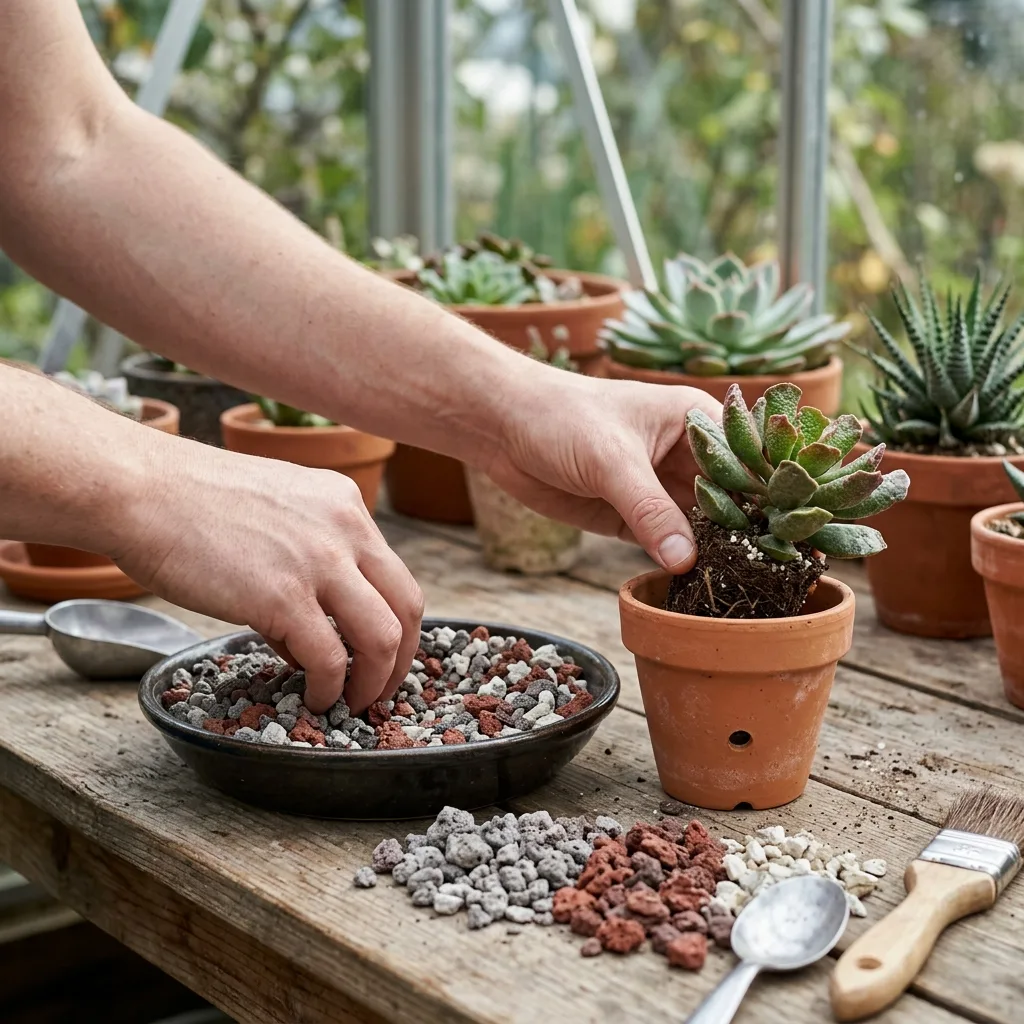
- Inorganic-Dominated Substrate Formulation: Commercial cactus soils retain excessive moisture and contain too much organic matter for Adromischus. Your potting medium should consist of at least 75–80% porous volcanic aggregates (pumice, crushed lava, zeolite). The remaining organic fraction must be limited to screened coco coir or sterilized, perlite-free leaf mold.
- Pot Selection and Drainage Dynamics: Unglazed terracotta pots provide natural breathability, allowing moisture to evaporate through the porous clay walls. Because Adromischus develops a shallow, fibrous root system rather than a deep taproot, choose wide, shallow bowls with generous drainage holes over deep containers.
- Soak-and-Dry Irrigation Dynamics: In harmony with nocturnal CAM uptake, irrigate exclusively in the late afternoon or near dusk. Water thoroughly around the base without wetting the foliage until water flows freely from the drainage hole. Discard all run-off sitting in the saucer within 10 minutes.
- Gradual Light Acclimation: Adromischus thrives on 5 to 6 hours of bright, filtered morning sunlight daily. The synthesis of defensive anthocyanin pigments—which give the leaves their dramatic mottling—is directly light-dependent. Never transfer a shade-grown plant directly into blazing midday sun; step up the light intensity gradually over a 10-day period.
- Active Air Circulation: The Karoo plateau is a wind-swept environment. Sealed terrariums, stagnant glass enclosures, or humid, unventilated room corners are fatal for Adromischus. Ensure a constant, gentle air exchange around the plant canopy.
4. Required Materials, Substrate Ratios, and Parameters
Precise aggregate particle sizes and substrate ratios determine long-term success. Use the following horticultural formulation as your benchmark:
| Component / Parameter | Recommended Ratio / Metric | Physiological Function |
|---|---|---|
| Pumice (3–5 mm) | 40% | Creates continuous capillary air pockets and prevents root-zone hypoxia. |
| Crushed Lava Rock (Red/Black) | 25% | Adds structural ballast, stability, and slow-release trace minerals (iron). |
| Clinoptilolite Zeolite | 15% | Enhances cation-exchange capacity (CEC), buffering against excess nitrogen. |
| Sterile Coco Peat / Succulent Soil | 20% | Provides an anchoring bed for fine feeder roots with minimal moisture retention. |
| Pot Material | Unglazed Terracotta | Facilitates rapid side-wall evaporation and root-zone thermal regulation. |
| Irrigation Cadence | 5–7 days after complete medium dryness | Accommodates natural CAM cycles and ensures safe cellular moisture draw-down. |
| Light Requirement | 3,000–5,000 Lux (Filtered Sun) | Maintains tight internodes and stimulates rich, speckled anthocyanin coloration. |
5. Five Common Mistakes and Emergency Solutions
- Mistake 1: Misting the Foliage: Spraying water to raise humidity destroys the protective farina and invites fatal fungal spores (Fusarium and Botrytis) into the leaf abscission scars. Solution: Keep the foliage completely dry; deliver water exclusively to the soil line surrounding the root crown.
- Mistake 2: Discarding Dropped Leaves: Plump, healthy leaves dislodged by accident are prime propagation material. Solution: Lay fallen leaves on a dry tray of pure pumice or perlite. Within 1 to 2 weeks, callus tissue will form, followed by delicate pink feeder roots and a brand-new miniature rosette.
- Mistake 3: Feeding with High-Nitrogen Fertilizers: Standard houseplant feeds cause cellular walls to over-inflate with water, producing watery, brittle, split-prone tissue. Solution: Apply a low-nitrogen, high-potassium succulent fertilizer (e.g., NPK 5-10-10) diluted to quarter strength no more than 2 or 3 times a year during active spring and autumn growth.
- Mistake 4: Regular Winter Watering in Heated Rooms: Warm indoor heating without intense winter lighting denies the plant its needed rest period, resulting in pale, weak growth. Solution: Move the specimen to a cool (8–12°C / 46–54°F), brightly lit spot, reducing irrigation to once a month or suspending it until leaf margins show visible crinkling.
- Mistake 5: Planting Too Deeply: Burying the delicate junctions where leaves meet the main stem invites localized moisture traps and collar rot. Solution: Plant only the root system in the substrate; top-dress with a 5 mm layer of dry, coarse volcanic gravel to lift the lower leaves entirely off damp soil.
6. Seasonal Calendar and Long-Term Results
Adromischus follows a biological cycle reminiscent of Mediterranean climates. Its primary growth flushes occur during the temperate weeks of spring and autumn, while extreme summer heat (above 35°C / 95°F) and winter cold induce semi-dormancy.
- Spring (March – May): The peak vegetative period. Leaf primordia emerge rapidly. Provide quarter-strength nutrients and resume regular watering monitored by leaf turgor tests.
- Summer (June – August): High daytime temperatures suppress CAM gas exchange, prompting the plant to conserve moisture. Space out waterings, maintain superb ventilation, and shield from harsh midday glass magnification.
- Autumn (September – November): The secondary active cycle commences. Widening day-night temperature swings deepen leaf mottling and red-violet speckles. Slender flower scapes often arise during this window.
- Winter (December – February): Minimal maintenance phase. Plants must never be kept wet below 5°C (41°F), though bone-dry specimens tolerate brief drops down to 2–3°C (36°F). A sun-drenched south-facing windowsill is essential.
By honoring these physiological adaptations, your Adromischus will slowly develop a thick, corky, architectural caudex crowned by chunky, speckled leaves—becoming one of the most durable and prized living sculptures in your botanical collection.


Reader Reviews & Comments 3 Reviews
Marcus Vance
Julian Thorne
Clara Higgins
Leave a Review & Rating
Share your plant care tips, experiences, or questions with our succulent community.